Building Reddit apps with React or Next.js tutorials
Struggling to find real Reddit app tutorials? Learn how to handle OAuth, tokens, and architecture with React or Next.js, so you can build production-ready apps instead of fragile demo projects.
If you have ever tried to build something on top of Reddit’s API, you probably noticed a gap. There are plenty of snippets, demos, and partial examples, but very few end-to-end learning resources that show how to design a real application.
That is why the question Are there any tutorials on building Reddit apps with React or Next.js? keeps coming up among developers. The difficulty is not React, and it is not Next.js. The difficulty is that Reddit’s API forces you to think about authentication, security, and architecture much earlier than most frontend tutorials expect.
In this blog, you will not be handed a shortcut. Instead, you will learn how to reason about Reddit’s API, how that reasoning affects your framework choice, and how to turn shallow tutorials into something you can actually build on.
Learn React 19: The Complete Guide to Modern Web Apps

React remains one of the most widely used libraries for building modern web applications. This course focuses on modern React (React 18+ and emerging React 19 capabilities), covering improvements in rendering, concurrency, and application architecture that help developers build faster and more scalable user interfaces. This course takes you beyond the fundamentals and focuses on building production-ready React applications. You'll learn how to structure large React codebases using feature-based architecture, state ownership principles, context segmentation, reducer patterns, and headless or compound components. You'll also explore React’s rendering internals, including the Fiber architecture, render and commit phases, and modern concurrent rendering patterns using transitions and Suspense, along with performance optimization strategies such as memoization and component profiling. The course then moves into modern async UI patterns, teaching you how to build responsive interfaces using Suspense, server-side and streaming rendering concepts, lazy loading, and error boundaries, along with an introduction to React Server Components (RSC). You'll learn how to manage server data effectively using TanStack Query (formerly React Query), including caching, dependent queries, optimistic updates, and query invalidation. The course also introduces real-time-inspired and offline-first UI strategies, background synchronization, and performance techniques such as using Web Workers for off-main-thread computation. Beyond architecture and data management, you'll learn how to build complex forms, scalable workflows, and accessible user interfaces, along with practical testing strategies using React Testing Library. The course concludes with production-focused topics including accessibility architecture, internationalization (i18n), design systems, security considerations, and deployment practices. You'll be able to design, optimize, and deploy scalable React applications using modern architectural and performance patterns. Throughout the course, you'll apply what you learn through two hands-on projects: Task Manager Dashboard: Build a complete React dashboard that manages tasks, routing, state, and API interactions. Product Launch Readiness Board: Build a modern collaboration tool featuring optimistic updates, offline-capable editing, simulated real-time collaboration (UI-level), Suspense-based lazy loading, and a themeable, internationalized UI.
Why finding good Reddit app tutorials is hard#
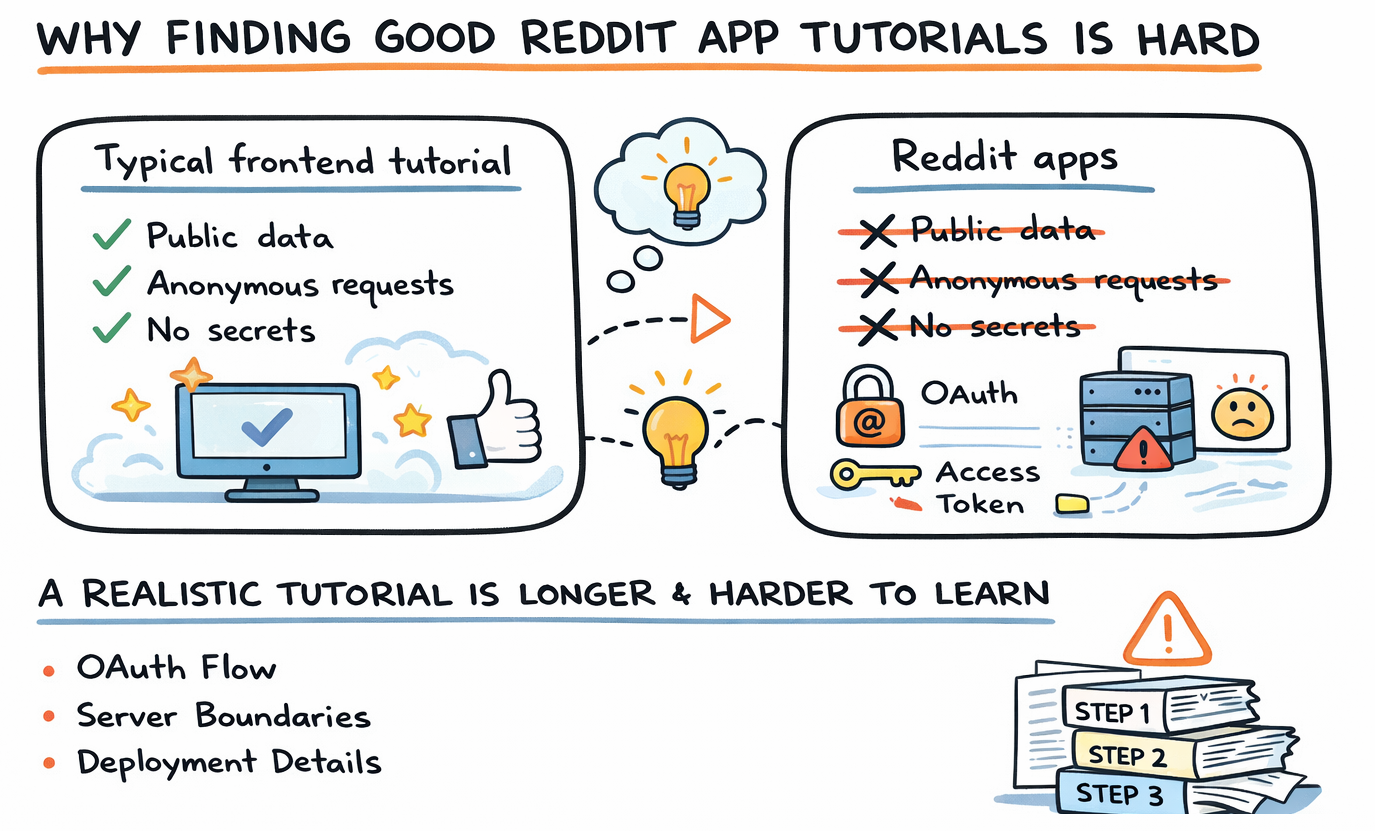
Most tutorials are optimized for fast wins. Reddit apps are optimized for controlled access.
A typical frontend tutorial assumes that data is public, requests are anonymous, and secrets do not exist. Reddit breaks all three assumptions. Even basic use cases quickly involve OAuth, access tokens, and rate limits.
This creates a teaching problem. A realistic tutorial must explain authentication flows, server boundaries, and deployment details. That makes the tutorial longer, harder, and less appealing to casual readers.
As a result, many tutorials quietly remove the hardest parts. They mock API calls, embed credentials, or treat tokens as static values. The result looks clean, but it teaches a mental model that fails as soon as you try to deploy.
Most tutorials skip production concerns, not because they are unimportant, but because they force architectural decisions that cannot be glossed over.
Once you recognize this pattern, the lack of deep tutorials becomes understandable rather than mysterious.
Understanding Reddit’s API model first#
Before you think about learning React or Next.js, you need to understand what Reddit expects from your application.
Reddit’s API is OAuth-based. Your app must authenticate itself, and often authenticate users. Tokens expire. Refresh tokens must be protected. Rate limits apply per client and per user context.
This immediately creates a split in responsibilities. Some logic must run on a server. Some logic can run in the browser. Mixing them leads to security issues.
It also means that “frontend app” is a misleading label. Even if your UI is entirely client-side, your system is not. There is always a backend component, even if it is small.
When tutorials ignore this reality, they train you to build something that only works in development. Understanding the API model first helps you judge which learning resources are worth your time.
Next.js - The ultimate way to build React apps

React is an amazing framework that allows you to build front-ends that are unmatched in speed, functionality, and ease of use. Where React falls short though is its ability to optimize for search engines. That’s where Next.js comes in. In this course, you will learn to build a giphy search app using the giphy.com API. To kick things off, you’ll learn how to statically optimize a Next.js page, creating an ultra fast loading experience for users. You’ll then dive into the inner workings of creating your giphy search app. In the back half of the course, you will learn how to optimize for SEO. By the end, you will have a great new framework to add to your resume and a new shiny application to add to your portfolio.
Using React for Reddit apps: strengths and limits#
React is excellent at rendering Reddit-style content. Lists, comments, voting controls, and filters map naturally to component-based UI design.
Where React alone falls short is security. A purely client-side React app has no safe place for secrets. OAuth client secrets and refresh tokens cannot live in the browser.
That means React must be paired with a backend. The backend handles authentication and API calls, while React focuses on presentation and interaction.
This separation is not a flaw. It is a design choice. React works best when you accept that it is a view layer, not an application boundary.
React is a good fit if you already understand client–server architecture and want explicit control. It becomes frustrating if you expect it to handle everything on its own.
Using Next.js for Reddit apps: when it makes sense#
Next.js changes the conversation by blending frontend and backend concerns into one framework.
When building apps with Next.js, you can handle OAuth callbacks, token storage, and API proxying in server routes while still using React for the UI. This removes the need for a separate backend service in many cases.
However, this convenience comes with responsibility. You must understand which code runs on the server and which runs in the browser. Treating Next.js as “React plus routing” leads to mistakes, especially with secrets.
Next.js makes sense when you want a single deployment unit and are willing to think in terms of request lifecycles, not just components.
The framework does not remove architectural complexity. It just places it in clearer locations.
Architectural comparison#
The table below summarizes how different Reddit app types interact with frontend and server responsibilities.
App type | Client-side vs server-side needs | React fit | Next.js fit | Common pitfalls |
Read-only viewer | Mostly server proxy, heavy caching | Good | Good | Rate-limit exhaustion |
User-authenticated app | OAuth and token refresh on server | Requires separate backend | Strong fit | Token leakage |
Moderation tools | Privileged scopes and auditability | Possible but complex | Better separation | Over-scoped access |
Data dashboards | Server-heavy aggregation | UI-focused role | Natural alignment | Slow builds |
This comparison highlights a key idea. Framework choice matters less than where you draw boundaries. If your boundaries are wrong, no framework will save you.
In the middle of evaluating resources, it helps to revisit Are there any tutorials on building Reddit apps with React or Next.js? and realize that most tutorials fail at explaining these boundaries.
A realistic way to learn by building#
Instead of searching endlessly for a perfect tutorial, use a conceptual build flow. This forces you to confront the real challenges in the right order.
OAuth: Understand how Reddit’s authorization flow works and where redirects terminate.
Token handling: Decide where access tokens and refresh tokens live and how they are rotated.
API access: Centralize Reddit API calls behind a server layer that enforces limits and handles errors.
UI rendering: Render data through React components that assume the server may fail or throttle.
Deployment considerations: Validate environment variables, callback URLs, and secret storage in production.
This approach works regardless of the framework. It also exposes weak tutorials quickly, because they tend to skip one or more of these steps.
Common mistakes beginners make#
Treating Reddit’s API as public data
Embedding OAuth secrets in frontend code
Ignoring token expiration until it breaks
Designing UI before authentication flows
Assuming demos scale to production
These mistakes usually come from copying code without understanding why it works.
What to focus on instead#
Understanding OAuth flows conceptually
Drawing request paths on paper
Separating authentication from UI logic
Testing rate limits early
Treating tutorials as references, not blueprints
These habits turn learning into architecture, not just syntax.
Conclusion#
When you ask Are there any tutorials on building Reddit apps with React or Next.js?, the honest answer is that very few tutorials teach the full problem. Most focus on UI and avoid the architectural decisions that actually determine success.
If you approach the problem concept-first, React and Next.js both become viable tools rather than constraints. The key is understanding Reddit’s API model and designing around it.
That mindset is what allows you to move from tutorial code to a real application that survives deployment.
Happy learning!
