Coding technical interview questions: Patterns and categories
Stop grinding random problems. Learn how to master coding technical interview questions using patterns, structured practice, and proven strategies to improve performance and confidently crack technical interviews.
Many candidates preparing for interviews fall into a familiar trap. They begin collecting coding technical interview questions from every platform they can find, bookmarking hundreds of prompts and tracking how many they have solved. The instinct is understandable because volume feels productive. However, mastery does not come from accumulation. It comes from recognizing the structural patterns that underpin those questions.
Most coding technical interview questions are variations of recurring ideas. Arrays are manipulated in predictable ways. Graph traversals follow familiar strategies. Dynamic programming problems rely on repeatable state transitions. When you focus on pattern recognition rather than sheer quantity, preparation becomes deliberate rather than frantic. Companies rarely test novelty. They test structured thinking under constraints.
Grokking the Coding Interview Patterns
I created Grokking the Coding Interview because I watched too many talented engineers fail interviews they should have passed. At Microsoft and Meta, I saw firsthand what separated the candidates who succeeded from the ones who didn't. It wasn't how many LeetCode problems they'd solved. It was whether they could look at an unfamiliar problem and know how to approach it the right way. That's what this course teaches. Rather than throwing hundreds of disconnected problems at you, we organize the entire coding interview around 28 fundamental patterns. Each pattern is a reusable strategy. Once you understand two pointers, for example, you can apply them to dozens of problems you've never seen before. The course walks you through each pattern step by step, starting with the intuition behind it, then building through increasingly complex applications. As with every course on Educative, you will practice in a hands-on way with 500+ challenges, 17 mock interviews, and detailed explanations for every solution. The course is available in Python, Java, JavaScript, Go, C++, and C#, so you can prep in the language you'll actually use in your interview. Whether you're preparing for your first FAANG loop or brushing up after a few years away from interviewing, this course will give you a repeatable framework for cracking the coding interview.
Core categories of coding questions#
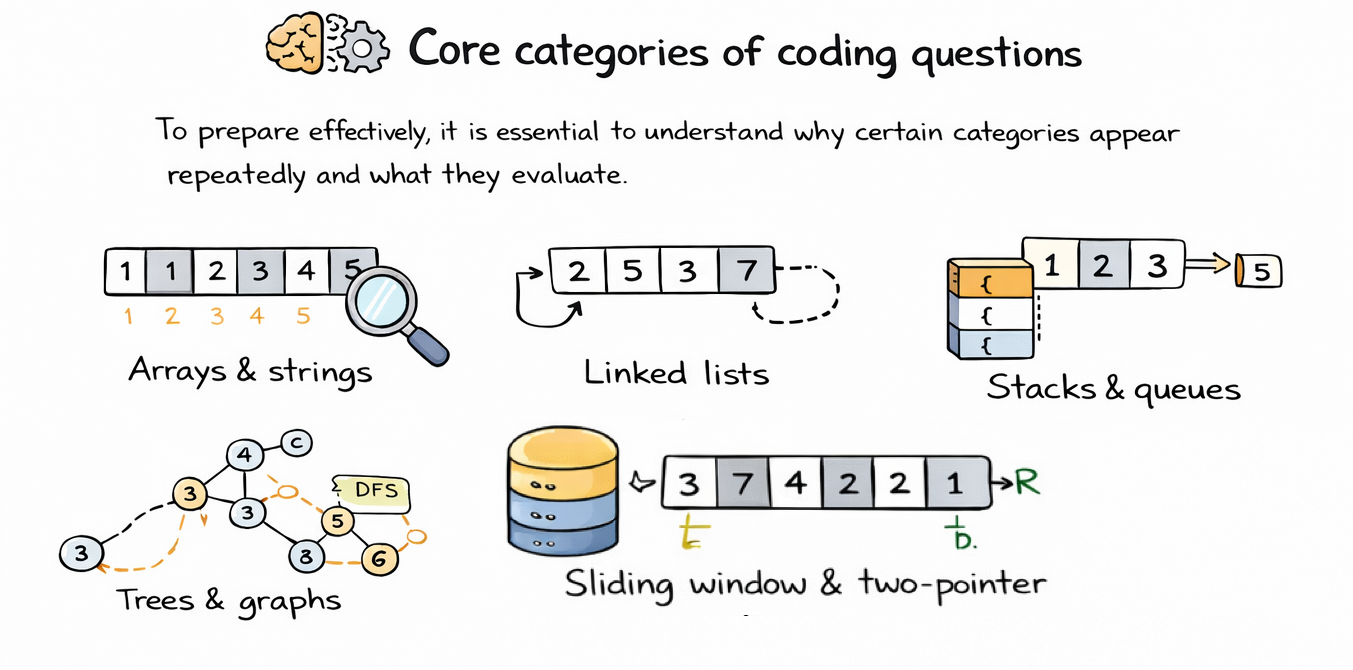
To prepare for coding interviews effectively, it is essential to understand why certain categories appear repeatedly and what they evaluate.
Arrays and strings#
Arrays and strings form the foundation of many interview problems because they test fundamental reasoning about indexing, iteration, and memory layout. These questions evaluate whether you can manage boundaries, handle edge cases, and reason about time complexity in linear structures.
Companies favor this category because it reveals clarity of thought early. Mistakes in array manipulation often expose weaknesses in basic logic or off-by-one errors that would surface in production code.
Linked lists#
Linked lists test pointer manipulation and spatial reasoning. Unlike arrays, linked lists do not provide constant-time random access, so candidates must think carefully about traversal and modification.
Interviewers use linked list problems to assess whether you understand references, node connections, and in-place transformations. Reversing a linked list or detecting a cycle may appear simple, but these tasks require precision.
Stacks and queues#
Stacks and queues evaluate your ability to manage order and state. Stack-based problems frequently appear in parsing, expression evaluation, and backtracking contexts.
Interviewers test whether you understand last-in, first-out versus first-in, first-out semantics and whether you can apply them appropriately. Many string and tree problems become simpler when reframed with stack logic.
Trees and graphs#
Trees and graphs test hierarchical and network reasoning. Traversals such as depth-first search and breadth-first search are foundational techniques.
Companies favor this category because it mirrors real-world system relationships. Whether modeling dependencies, routes, or hierarchies, understanding traversal strategies is critical. Candidates who struggle here often reveal gaps in abstraction and recursion.
Recursion and backtracking#
Recursion tests conceptual clarity about state and base conditions. Backtracking problems evaluate your ability to explore search spaces while managing constraints.
These questions often appear more intimidating than they are, yet they are structured around clear decision trees. Interviewers assess whether you can reason about branching complexity and pruning.
Dynamic programming#
Dynamic programming measures your ability to break problems into overlapping subproblems and store intermediate results efficiently. It is less about memorizing patterns and more about recognizing optimal substructure.
Companies use dynamic programming to differentiate surface-level problem solvers from deeper thinkers who understand trade-offs between brute force and optimization.
Grokking Dynamic Programming Interview
Some of the toughest questions in technical interviews require dynamic programming solutions. Dynamic programming (DP) is an advanced optimization technique applied to recursive solutions. However, DP is not a one-size-fits-all technique, and it requires practice to develop the ability to identify the underlying DP patterns. With a strategic approach, coding interview prep for DP problems shouldn’t take more than a few weeks. This course starts with an introduction to DP and thoroughly discusses five DP patterns. You’ll learn to apply each pattern to several related problems, with a visual representation of the working of the pattern, and learn to appreciate the advantages of DP solutions over naive solutions. After completing this course, you will have the skills you need to unlock even the most challenging questions, grok the coding interview, and level up your career with confidence. This course is also available in C++, JavaScript, and Python—with more coming soon!
Greedy algorithms#
Greedy approaches test whether you can identify locally optimal decisions that lead to globally optimal solutions. These problems often revolve around scheduling, interval management, or resource allocation.
Interviewers evaluate reasoning about constraints and the correctness of heuristics.
Sliding window and two-pointer techniques#
These techniques frequently appear in array and string problems. They assess your ability to manage boundaries efficiently without unnecessary nested loops.
The elegance of sliding window problems lies in transforming quadratic thinking into linear performance. Mastery here demonstrates maturity in complexity analysis.
Category versus skill evaluation#
Question category | Core concept tested | Common example pattern | What interviewers assess | Common candidate mistake |
Arrays and strings | Index management and iteration | Two-pointer traversal | Boundary handling and efficiency | Off-by-one errors |
Linked lists | Pointer manipulation | Reverse list, detect cycle | Reference clarity | Losing node references |
Stacks and queues | Order control | Valid parentheses | Data structure selection | Overcomplicating logic |
Trees and graphs | Traversal strategies | DFS and BFS | Abstraction and recursion | Confusing traversal states |
Recursion and backtracking | State branching | Generate permutations | Base case reasoning | Missing termination condition |
Dynamic programming | Optimal substructure | Memoization patterns | Complexity trade-offs | Memorizing without understanding |
Greedy algorithms | Local optimization | Interval scheduling | Proof of correctness | Assuming greediness always works |
Sliding window | Efficient boundary shifts | Longest substring problems | Linear optimization thinking | Using nested loops unnecessarily |
This table illustrates that coding technical interview questions are less about randomness and more about structured evaluation. Understanding this will help you ace your coding interview.
A pattern-based preparation model#
Learn the underlying data structure thoroughly: Before solving problems, understand how each structure works internally. Know how memory is allocated, how operations scale, and why certain operations are efficient. Conceptual depth prevents mechanical errors.
Solve curated pattern-based problems: Instead of choosing random questions, group them by pattern. Solve multiple variations of the same structure so recognition becomes automatic rather than forced.
Time-box practice sessions: Interviews impose time constraints. Practice solving problems within realistic limits to build pacing discipline and reduce hesitation.
Re-solve problems after one week: Revisiting previously solved questions strengthens retention. If you cannot reconstruct a solution after several days, your understanding was incomplete.
Practice verbal explanation of trade-offs: Technical interviews evaluate communication as much as correctness. Articulate why your solution works, discuss time and space complexity, and propose improvements.
This layered approach transforms coding technical interview questions into structured learning opportunities rather than isolated challenges.
How interviewers evaluate answers#
Interviewers do not assess solutions solely on correctness. They examine whether your code handles edge cases gracefully, whether you can justify time and space complexity, and whether you recognize optimization opportunities.
Communication clarity is critical. Explaining your thought process step by step demonstrates structured reasoning. Interviewers also observe how you respond to hints and feedback, which reflects collaboration skills.
Optimization thinking matters as well. Proposing a brute-force solution first and then refining it demonstrates analytical progression.
Common preparation errors#
Grinding random problems creates a false sense of competence because repetition without pattern grouping does not build transferable recognition.
Memorizing solutions undermines adaptability. Interviews often introduce slight variations that disrupt memorized approaches.
Ignoring complexity explanations weakens performance. Even correct code may be considered incomplete if you cannot analyze its efficiency.
These mistakes explain why some candidates solve many coding technical interview questions yet struggle in live interviews.
Frequently asked questions#
How many coding technical interview questions should I practice?#
The number matters less than mastery. Solving one hundred problems deeply with pattern recognition and review is often more effective than solving three hundred superficially.
Are easy problems enough?#
Easy problems build foundational fluency, but intermediate and harder problems develop adaptability and optimization skills. A balanced progression is advisable.
How important is dynamic programming?#
Dynamic programming frequently appears in interviews, especially for roles at larger companies. Understanding the concept and common patterns is valuable, even if you do not master every variation.
Should I focus on one language?#
Using one primary language during preparation is generally beneficial. Familiarity with syntax reduces cognitive overhead, allowing you to focus on logic and reasoning.
Closing reflection#
Coding technical interview questions are highly structured in nature. Their categories are predictable, their patterns repeat, and their evaluation criteria remain consistent. What makes them challenging is not randomness, but the demand for clarity, efficiency, and composure under time pressure.
With disciplined pattern-based preparation and deliberate review, these questions become manageable rather than mysterious. Without structure, however, even the most common patterns can feel overwhelming.