Effective ways to improve your Python coding skills
Want to level up your Python skills? Discover practical strategies, including mastering fundamentals, building real projects, solving algorithm challenges, and contributing to open source, to become a confident Python developer.
If you are asking this question, you are already on the right path. Most developers never pause to evaluate their growth. They write code to get things working and move on. But if you want to move from being functional to being truly proficient, you need deliberate improvement.
Improving your Python coding skills is not about memorizing more syntax. It is about refining how you think, how you structure programs, how you debug problems, and how you design systems. Python’s simplicity can sometimes mask deeper engineering principles. To grow meaningfully, you need structured practice, thoughtful reflection, and exposure to higher standards of code quality.
Learn Python
Python has become the foundation for everything from data science and automation to modern AI workflows. Yet many beginners struggle to learn Python because they spend too much time watching and not enough time building. This course is designed for a different kind of learner, one who wants to learn Python by doing, not just observing, and to build skills that remain relevant in an AI-driven development landscape. I built this course from my experience teaching and designing interactive learning systems at Educative. Across classrooms and platforms, I saw the same pattern: learners could follow tutorials, but struggled to apply concepts independently. The problem was the approach. This course is built on a simple principle: you learn Python best when you write, test, and refine code continuously. You’ll start with core fundamentals, variables, control flow, functions, and data structures, through hands-on exercises that reinforce real understanding. As you progress, you’ll build practical projects like a chatbot and an expense tracker. The course also introduces how to learn Python alongside AI tools, including prompting, debugging, and validating generated code in real workflows. If your goal is to learn Python in a way that prepares you to build real applications and work effectively with AI, this course gives you that foundation from day one.
This blog walks you through practical, effective, and realistic strategies to help you get started with Python, whether you are a beginner, intermediate developer, or working professional.
Shift from writing code to engineering solutions#
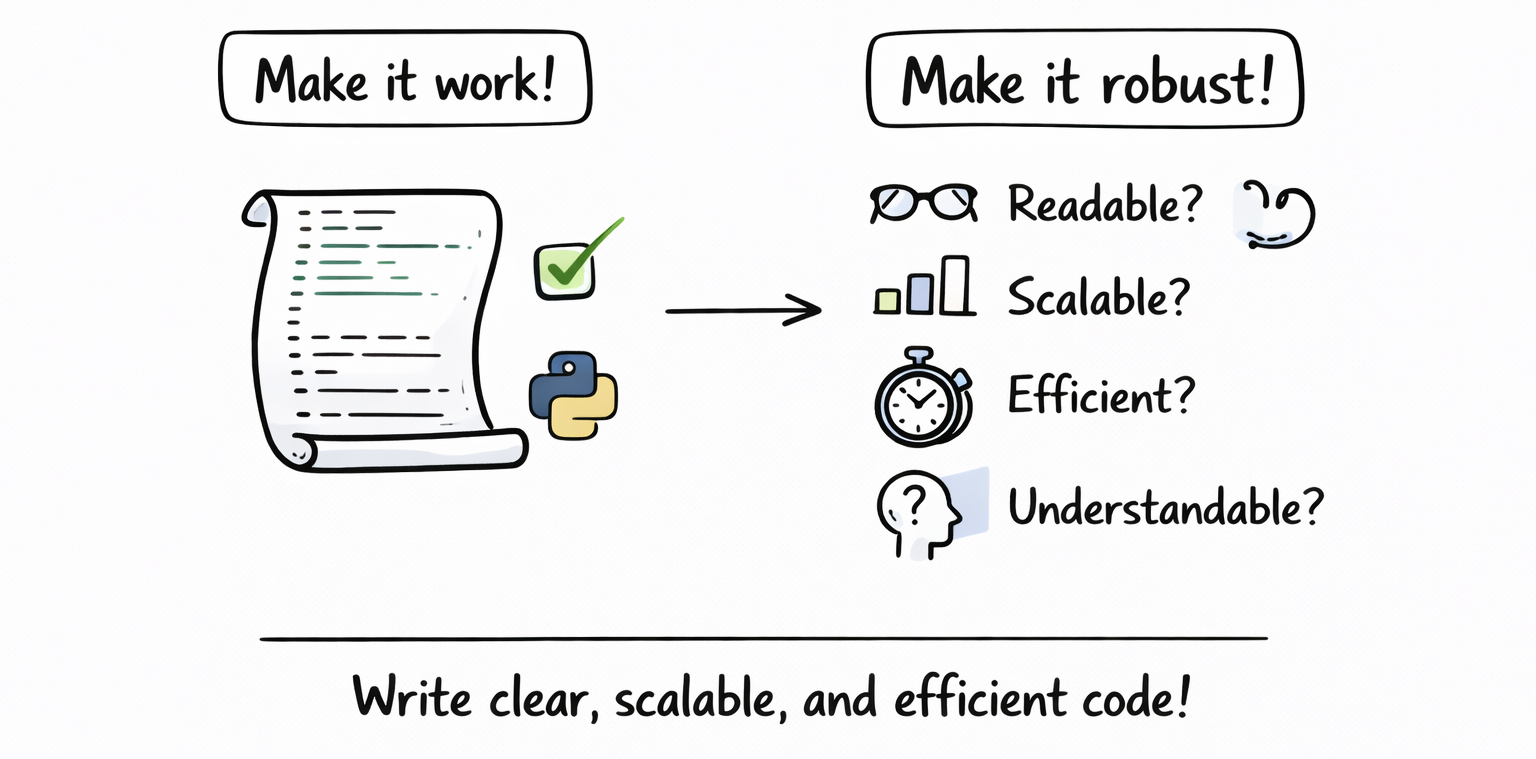
One of the first mindset changes that accelerates growth is moving from “making it work” to “making it robust.”
When you first learn Python, your focus is understandably on getting correct output. You write a script, it runs without errors, and you consider it complete. But as you improve, you start asking deeper questions.
Is this code readable?
Is it scalable?
Is it efficient?
Would another developer understand it immediately?
This shift transforms your learning approach. Instead of simply solving problems, you begin optimizing clarity, maintainability, and performance.
True skill growth happens when you care about how your code is structured, not just whether it runs.
Clean Code in Python
Writing high quality code is one of the highly desirable traits of software engineers in the industry. This course is useful for anyone interested in creating scalable and maintainable software design in Python. It is assumed that the learner is already familiar with the principles of object-oriented software design and has experience writing code in Python. In this course, you’ll go through the content in an increasing order of complexity, starting from the basics of Python. The course covers some advanced topics in Python as well, including decorators, descriptors, and an introduction to asynchronous programming. It'll help you discover more about Python because some of the cases are analyzed from the internals of the language itself. After taking this course, you are expected to be equipped with sound hands-on experience and working knowledge of advanced topics in Python. You will be able to demonstrate how to write highly readable and maintainable clean code using the software engineering principles.
Master the fundamentals deeply#
Many developers underestimate how powerful a deep understanding of fundamentals can be.
If you want to improve your Python coding skills, revisit core concepts such as data structures, list comprehensions, generators, decorators, context managers, and exception handling. Instead of simply knowing how they work, aim to understand when and why to use them.
For example, understanding the difference between lists and generators can dramatically improve performance in large data processing pipelines. Knowing how context managers manage resources can prevent subtle bugs in file handling and database connections.
Here is a conceptual breakdown of foundational areas that deserve mastery:
Core Area | Why It Matters |
Data structures | Determines algorithm efficiency |
Functions and closures | Enables modular design |
Object-oriented programming | Supports scalable architecture |
Error handling | Improves robustness |
Iterators and generators | Enhances performance |
Standard library usage | Reduces reinventing solutions |
Mastery of fundamentals reduces cognitive load when tackling advanced topics.
Python 3: From Beginner to Advanced
In this course, you will get a comprehensive overview of Python. You will start by laying the foundation and learning the introductory topics like operators, conditional statements, functions, loops, assignment statements, and more. You will then move onto more advanced topics such as classes and inheritance, iterators, list comprehensions, and dictionaries. Along with this, you will also get to explore the concept of testing and take a look at how GUI applications can be designed using Tkinter, Python's standard GUI library. By the time you're done, you'll be able to hit the ground running and be equipped with the tools that will allow you to be productive in Python.
Write code every day with intention#
Consistency beats intensity when it comes to skill improvement.
Writing Python occasionally will not push your boundaries. Writing Python regularly, even in small increments, builds fluency. However, repetition alone is not enough. You need intentional practice.
Instead of rewriting similar scripts repeatedly, choose problems that stretch your thinking. Work with unfamiliar libraries. Solve algorithmic challenges. Explore areas like asynchronous programming or file I/O.
Each coding session should introduce a new constraint or concept. Growth happens when you step outside your comfort zone.
Solve algorithmic challenges thoughtfully#
Algorithmic practice improves problem-solving skills and deepens your understanding of data structures.
Platforms that offer coding challenges force you to think about efficiency, edge cases, and optimization. While real-world development often relies on libraries, understanding algorithms strengthens your ability to reason through complexity.
The key is not to treat algorithm practice as rote memorization. Instead, analyze each solution carefully. Ask yourself why one approach is faster than another. Consider time complexity and space tradeoffs.
Over time, this disciplined thinking improves your everyday coding decisions.
Build real-world projects#
Nothing accelerates Python skill development like building real projects.
When you work on projects, you face architectural decisions, integration challenges, and debugging scenarios that tutorials rarely cover. You deal with configuration management, dependency resolution, and testing.
Projects force you to think holistically. Instead of writing isolated functions, you design systems. You create modular components. You think about how code will evolve.
Here is how projects compare to isolated exercises:
Practice Type | Skill Development Depth |
Syntax drills | Low |
Algorithm challenges | Moderate |
Guided tutorials | Moderate |
Real-world projects | High |
Projects transform knowledge into experience.
Read high-quality Python code#
One of the most underrated ways to improve your Python coding skills is by reading well-written code.
When you examine open-source repositories or well-maintained libraries, you see how experienced developers structure modules, name variables, and document logic. You observe idiomatic Python patterns that you might not encounter in beginner tutorials.
Reading code trains your eye for clarity. You begin recognizing elegant solutions. You also learn how professionals handle error cases, logging, and configuration.
Code reading is similar to reading literature in a language you are learning. It expands vocabulary and refines style.
Learn testing and debugging deeply#
Testing is often overlooked by beginners, but mastering it dramatically improves your coding maturity.
When you write unit tests, you learn to design functions that are modular and predictable. You start thinking about edge cases before they cause production bugs. You gain confidence when refactoring.
Similarly, improving debugging skills increases efficiency. Instead of randomly inserting print statements, you learn to use debuggers, logging frameworks, and stack trace analysis effectively.
Testing and debugging are multipliers. They make you faster and more reliable.
Explore advanced Python features#
Once your fundamentals are strong, exploring advanced features can elevate your skills significantly.
Topics such as asynchronous programming, concurrency with threading and multiprocessing, type hinting with mypy, and metaprogramming introduce new dimensions of complexity.
Learning these areas expands your mental model of what Python can do. It also prepares you for real-world systems that demand scalability and performance.
Advanced knowledge is not about showing off complexity. It is about having more tools available when problems demand them.
Contribute to open source#
Contributing to open-source projects pushes you beyond solo development.
When you submit pull requests, you expose your code to review. You receive feedback on structure, naming, and testing. You learn to follow style guides and collaborate with other developers.
Open-source contribution teaches professional discipline. It also builds confidence because you see your improvements integrated into larger systems.
Few activities accelerate growth as effectively as collaborative coding.
Measure progress intentionally#
Improvement is easier when you measure it.
Instead of coding aimlessly, set specific goals. For example, you might aim to master decorators this month or build a complete REST API with proper testing.
Track what you learn and revisit older code. Compare your current style to the code you wrote six months ago. The difference will often surprise you.
Intentional reflection prevents stagnation.
Avoid common growth traps#
Many developers plateau because they repeat comfortable tasks.
Writing similar scripts repeatedly may feel productive, but it rarely pushes your limits. Another trap is consuming too many tutorials without applying knowledge independently.
Real improvement requires discomfort. You need to face bugs you do not immediately understand. You need to design systems without step-by-step instructions.
Growth happens in those moments of challenge.
Build a structured improvement roadmap#
If you want consistent improvement, create a roadmap.
You can divide your growth into phases:
Phase | Focus |
Phase 1 | Strengthen fundamentals |
Phase 2 | Solve algorithmic challenges |
Phase 3 | Build mid-sized projects |
Phase 4 | Learn testing and debugging deeply |
Phase 5 | Explore advanced topics |
Phase 6 | Contribute to open source |
This progression ensures you cover both breadth and depth.
Final thoughts#
Improving your Python coding skills is not about finding a secret shortcut. It is about layering deliberate practice, conceptual mastery, and real-world experience.
Master fundamentals deeply. Write code consistently. Solve challenging problems thoughtfully. Build projects that stretch you. Read excellent code. Learn testing and debugging. Explore advanced features. Collaborate through open source.
When you combine these strategies, improvement becomes inevitable.
Python is a powerful language, but your growth depends on how intentionally you engage with it. If you treat coding as a craft rather than a task, you will steadily transform from a competent developer into a confident engineer.
