Frequently asked design patterns in Low-Level Design interviews
Master the most frequently asked design patterns in low-level design interviews. Learn when and how to apply Singleton, Factory, Strategy, Observer, and more with real examples. Build strong design intuition and walk into interviews prepared.

If you have ever walked into a low-level design interview and heard the phrase, “Can you apply a suitable design pattern here?”, you already know that understanding design patterns is not optional. It is expected.
Low-level design interviews are not about reciting textbook definitions of patterns. They are about recognizing structural problems and applying the right abstraction at the right time. Interviewers want to see whether you understand why a pattern exists, what problem it solves, and how it improves extensibility and maintainability.
If you are asking, “Can you explain some design patterns frequently asked in low-level design interviews?”, this guide will walk you through the patterns that come up most often. More importantly, you will learn how to think about them in interview scenarios so that they feel natural rather than forced.
Grokking the Low Level Design Interview Using OOD Principles
Low-level design interviews test something most engineers don't practice enough: taking a vague, open-ended prompt as "design a parking lot" or "design Stack Overflow" and turning it into a structured, implementable system with clearly defined classes, relationships, and behaviors. Knowing what inheritance is won't get you through. You need to demonstrate that you can use it to model a real system under time pressure. This course teaches that skill through repetition across 20+ real-world design problems. Each one follows the same structured approach: define requirements, identify key objects and relationships, model the system with UML diagrams (class, use case, sequence, activity), and then implement working code. By the time you've designed your fifth or sixth system, the process becomes second nature, which is exactly the point. We start with the foundations: OOP concepts, SOLID principles, and the most commonly tested design patterns. Then we move into the problems themselves: parking lots, elevator systems, Amazon's online shopping platform, chess, LinkedIn, and more. Each problem comes with a full walkthrough and a mock interview so you can test yourself under realistic conditions. Whether you're preparing for your first low-level design round or you've been avoiding this part of the loop, this course gives you a repeatable framework for breaking down any OOD problem systematically.
This article is not a glossary. It is a practical breakdown of how these patterns show up in real LLD problems such as parking lot systems, food delivery platforms, ATM machines, and notification systems.
Why Design Patterns Matter in Low-Level Design Interviews#
Before diving into specific patterns, you need to understand why interviewers care about them.
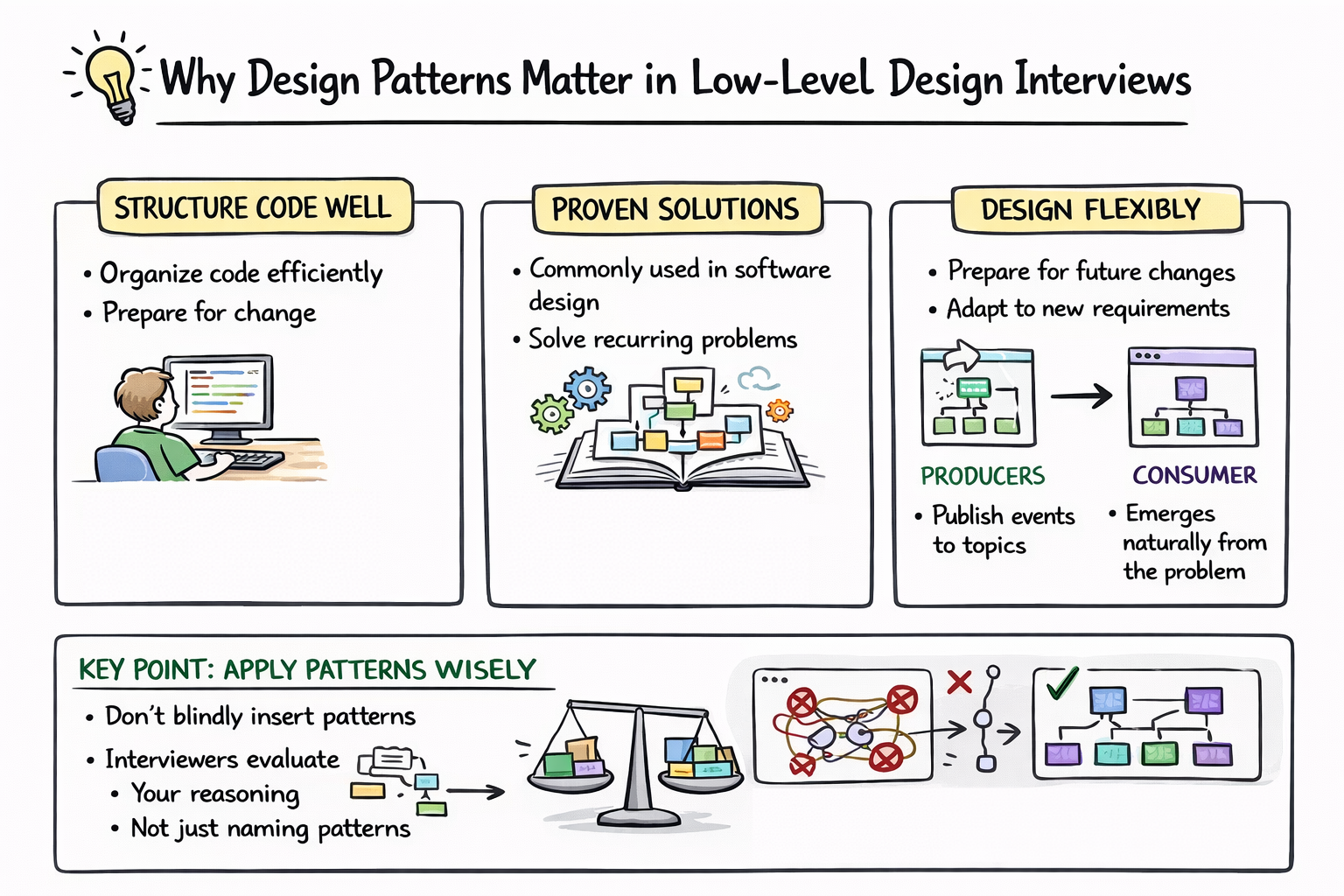
Low-level design interviews evaluate how you structure code, assign responsibilities, and prepare for change. Design patterns are proven solutions to recurring structural problems. When you use them correctly, you demonstrate that you think beyond immediate requirements and design for flexibility.
For example, if you design a payment module without anticipating new payment methods, your system becomes rigid. If you apply the right pattern, you can add new methods without modifying existing code. That difference is exactly what interviewers look for.
However, blindly inserting patterns into your design is worse than not using them at all. Patterns should emerge naturally from the problem. The interviewer is evaluating your reasoning, not your ability to name patterns.
Grokking Modern System Design Interview

For a decade, when developers talked about how to prepare for System Design Interviews, the answer was always Grokking System Design. This is that course — updated for the current tech landscape. As AI handles more of the routine work, engineers at every level are expected to operate with the architectural fluency that used to belong to Staff engineers. That's why System Design Interviews still determine starting level and compensation, and the bar keeps rising. I built this course from my experience building global-scale distributed systems at Microsoft and Meta — and from interviewing hundreds of candidates at both companies. The failure pattern I kept seeing wasn't a lack of technical knowledge. Even strong coders would hit a wall, because System Design Interviews don't test what you can build; they test whether you can reason through an ambiguous problem, communicate ideas clearly, and defend trade-offs in real time (all skills that matter more than ever now in the AI era). RESHADED is the framework I developed to fix that: a repeatable 45-minute roadmap through any open-ended System Design problem. The course covers the distributed systems fundamentals that appear in every interview – databases, caches, load balancers, CDNs, messaging queues, and more – then applies them across 13+ real-world case studies: YouTube, WhatsApp, Uber, Twitter, Google Maps, and modern systems like ChatGPT and AI/ML infrastructure. Then put your knowledge to the test with AI Mock Interviews designed to simulate the real interview experience. Hundreds of thousands of candidates have already used this course to land SWE, TPM, and EM roles at top companies. If you're serious about acing your next System Design Interview, this is the best place to start.
A Quick Classification of Frequently Asked Design Patterns#
Design patterns used in low-level design interviews usually fall into three broad categories: creational, structural, and behavioral. Understanding this classification helps you mentally organize them.
Category | Purpose | Common Patterns in LLD Interviews |
Creational | Object creation mechanisms | Singleton, Factory, Abstract Factory |
Structural | Class and object composition | Decorator, Adapter |
Behavioral | Communication and responsibility flow | Strategy, Observer, State |
Low-level design interviews most frequently emphasize behavioral and creational patterns because they directly impact extensibility and runtime flexibility.
Now, let us explore the patterns you are most likely to encounter.
Singleton Pattern#
The Singleton pattern ensures that a class has only one instance and provides a global access point to that instance.
In low-level design interviews, Singleton is commonly discussed when you need a shared resource, such as configuration management, logging services, or connection pools.
How It Appears in Interviews#
Imagine you are designing a parking lot system and need a central ParkingLot manager. You may decide that there should only be one instance controlling slot allocation. This is a natural scenario for Singleton.
However, interviewers often probe deeper. They might ask how you would handle thread safety or lazy initialization. That is where your understanding must go beyond the basic concept.
Key Considerations#
While Singleton seems simple, misuse can introduce tight coupling and testing difficulties. In interviews, explain not only how to implement it but also when it may not be appropriate.
Demonstrating awareness of tradeoffs elevates your answer.
Factory Pattern#
The Factory pattern encapsulates object creation logic. Instead of directly instantiating objects, you delegate creation to a factory class or method.
This pattern becomes powerful when your system needs to create objects based on dynamic conditions.
How It Appears in Interviews#
Suppose you are designing a food delivery system where users can pay via credit card, debit card, or wallet. Instead of directly creating payment objects everywhere, you can use a Factory to generate the appropriate payment strategy.
This centralizes creation logic and keeps your code open for extension but closed for modification.
Interview Insight#
When you explain the Factory pattern in an interview, focus on reducing coupling and improving extensibility. Show how adding a new payment method does not require changes in existing client code.
That clarity demonstrates design maturity.
Abstract Factory Pattern#
The Abstract Factory pattern creates families of related objects without specifying their concrete classes.
This pattern becomes relevant when multiple objects must be created together and follow a consistent theme.
How It Appears in Interviews#
Imagine you are designing a cross-platform UI framework where different operating systems require different button, window, and checkbox implementations.
An Abstract Factory allows you to create consistent families of UI components without tightly coupling your code to specific implementations.
Why It Matters in LLD#
Although slightly more advanced than the simple Factory, this pattern demonstrates that you understand scalable object creation strategies.
If used appropriately, it shows that you can handle systems with multiple variations cleanly.
Strategy Pattern#
The Strategy pattern allows you to define a family of algorithms and make them interchangeable at runtime.
It is one of the most frequently asked behavioral patterns in low-level design interviews.
How It Appears in Interviews#
Consider a payment system that supports multiple payment methods. Instead of writing conditional logic everywhere, you define a PaymentStrategy interface and implement concrete strategies for each payment type.
At runtime, the appropriate strategy is selected.
Why Interviewers Love It#
The Strategy pattern demonstrates separation of concerns and open-closed principle adherence. It eliminates long conditional chains and makes the system easier to extend.
In interviews, clearly explain how this pattern avoids modifying existing code when new strategies are introduced.
Observer Pattern#
The Observer pattern defines a one-to-many dependency between objects. When one object changes state, its dependents are notified automatically.
How It Appears in Interviews#
In a stock trading system, multiple clients may subscribe to price updates. When the stock price changes, all subscribers must be notified.
Similarly, in a notification system, different services may listen for events.
Why It Is Important#
Observer demonstrates event-driven design and decoupled communication. Interviewers appreciate candidates who understand how to implement pub-sub systems without tight coupling.
Be prepared to explain how to manage subscription and unsubscription cleanly.
Decorator Pattern#
The Decorator pattern allows you to dynamically add responsibilities to objects without modifying their structure.
How It Appears in Interviews#
Imagine a coffee ordering system where customers can add milk, sugar, or whipped cream to a base coffee.
Instead of creating subclasses for every combination, you wrap the base object with decorators.
Interview Value#
A decorator shows that you understand composition over inheritance. It demonstrates flexible behavior extension without exploding class hierarchies.
State Pattern#
The State pattern allows an object to change its behavior when its internal state changes.
How It Appears in Interviews#
Consider an ATM machine that has different states such as Idle, CardInserted, and Processing.
Each state defines different behavior for user actions.
Why It Is Frequently Asked#
State pattern demonstrates clean handling of complex state transitions without large conditional blocks.
Interviewers often test this in problems involving workflows or life cycles.
Comparing Frequently Asked Patterns#
The table below summarizes the core idea and typical interview scenario for each pattern.
Pattern | Core Idea | Common LLD Scenario |
Singleton | Single global instance | Logger, configuration manager |
Factory | Centralized object creation | Payment processors |
Abstract Factory | Family of related objects | Cross-platform UI systems |
Strategy | Interchangeable algorithms | Payment methods, sorting logic |
Observer | Event notification | Stock updates, notifications |
Decorator | Dynamic behavior extension | Add-ons in ordering systems |
State | Behavior changes with state | ATM workflow, order lifecycle |
Understanding these patterns comparatively helps you decide which one fits a given problem.
How to Apply Patterns Naturally in Interviews#
Recognizing when to apply a pattern is more important than memorizing its structure.
When you see conditional logic that keeps growing, consider Strategy or State. When object creation becomes scattered, consider Factory. When behavior needs runtime extension, think about Decorator.
Always explain why you are applying a pattern. Do not just name it. Connect it to the problem’s requirements.
Interviewers evaluate reasoning more than vocabulary.
Common Mistakes Candidates Make#
One common mistake is forcing a pattern into a design unnecessarily. Over-engineering makes the solution harder to understand.
Another mistake is reciting textbook definitions without applying them to the specific problem.
Finally, some candidates forget to discuss tradeoffs. Every pattern introduces complexity. Showing awareness of that complexity strengthens your answer.
How to Practice Design Patterns for LLD Interviews#
The best way to internalize these patterns is through implementation.
Choose classic low-level design problems and intentionally refactor them using appropriate patterns. Implement a payment system with a Strategy. Refactor a notification system using Observer.
When you practice in code, patterns become intuitive rather than theoretical.
Final Thoughts#
If you are preparing for low-level design interviews, mastering frequently asked design patterns is essential. Patterns like Singleton, Factory, Strategy, Observer, Decorator, and State appear repeatedly because they solve real structural problems.
However, interviews are not about naming patterns. They are about applying them thoughtfully. When you understand why a pattern exists and how it improves extensibility, you can integrate it naturally into your design.
Focus on reasoning, practice implementation, and learn to articulate tradeoffs clearly. When you do that, design patterns stop being intimidating buzzwords and become powerful tools in your engineering toolkit.
