How agentic AI and AGI are connected
This blog shows how agentic AI and AGI are connected by explaining that agentic systems are early building blocks of general intelligence, but AGI is still a future, more flexible form of AI.
Over the past few years, you’ve probably noticed a shift in how AI systems are being built. We are moving from static models that generate responses to systems that can plan, act, and iterate. These systems can write code, call APIs, retrieve data, and refine their outputs across multiple steps. In short, they behave less like tools and more like autonomous problem-solvers.
At the same time, conversations around Artificial General Intelligence, or AGI, have become more prominent. You hear claims about machines that can think, reason, and learn across domains the way humans do. This often creates confusion. If today’s systems already feel intelligent, are we already close to AGI, or are we just seeing better automation?
This is where the question of how agentic AI and AGI are connected becomes important. Understanding this relationship helps you separate what is happening today from what might happen in the future. More importantly, it gives you a clearer mental model for designing modern AI systems and thinking about where the field is heading.
Agentic AI represents the next evolution of artificial intelligence, creating autonomous systems that can reason, plan, and execute complex tasks. As businesses seek to automate sophisticated workflows and solve dynamic problems, the demand for experts who can design, build, and manage these intelligent agents is skyrocketing. This “Agentic AI” Skill Path provides a comprehensive journey to becoming an agentic AI expert. We’ll begin with the foundations of AI agents, then dive into hands-on development by building multi-agent systems with CrewAI. You’ll advance to mastering architectural design patterns for robust solutions and learn to build scalable applications with the Model Context Protocol (MCP), concluding with high-level system design. By the end of this Skill Path, you’ll possess the end-to-end expertise to architect and deploy sophisticated agentic systems.
What is agentic AI?#
Agentic AI refers to systems that can act autonomously to achieve a goal. Instead of responding to a single input, these systems operate in loops where they plan, execute actions, observe outcomes, and adjust their behavior.
In practical terms, an agentic system usually includes a few core capabilities. It can interpret a task, break it into smaller steps, decide which tools to use, and iterate until it reaches a satisfactory result. This behavior is what makes it feel “agent-like.”
Some common characteristics include:
Autonomy: The system can operate without step-by-step human instructions.
Goal-directed behavior: It works toward a defined objective rather than producing isolated outputs.
Planning: It can decompose tasks into sequences of actions.
Tool usage: It interacts with external systems such as APIs, databases, or code environments.
You can already see agentic AI in action today. Coding copilots that generate, test, and refine code are a good example. Research assistants that search the web, summarize findings, and iterate on answers are another. Even workflow automation tools that integrate LLMs with APIs are moving in this direction.
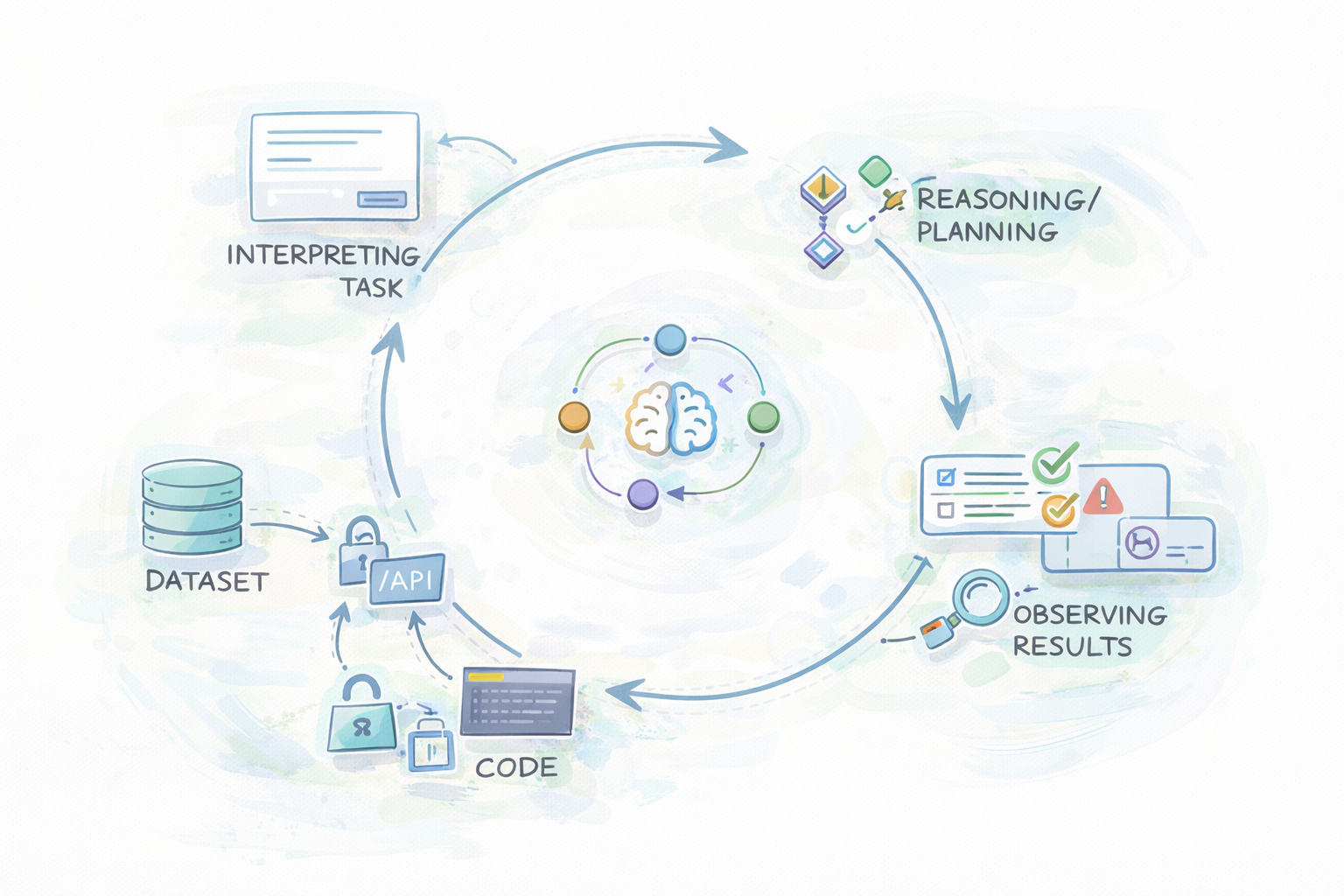
From a System Design perspective, agentic AI systems look like a loop-based architecture:
Input → reasoning → action → feedback → repeat
This resembles event-driven systems or feedback loops in distributed systems. Instead of a fixed pipeline, you now have dynamic orchestration where decisions are made at runtime.
Agentic system design is rapidly redefining how modern AI systems are built, moving from single-model interactions to autonomous, multi-step systems that can reason, plan, and act. As large language models evolve, the real challenge is no longer just using them, but orchestrating them into reliable, goal-driven agents that operate safely and effectively in real-world environments. I built this course from my work in adaptive AI and intelligent systems, where designing autonomous behavior requires more than model accuracy. It demands structured reasoning, control, and safety. A recurring pattern I observed was that teams could experiment with LLMs, but struggled to design cohesive agentic systems that could handle ambiguity, coordinate tasks, and remain aligned with user intent. This course is designed to bring that structure. You will study real-world examples, including the Multi-Agent Conversational Recommender System (MACRS), NVIDIA’s Eureka for reward generation, and advanced agents navigating live websites and creating complex images. Drawing on insights from industry deployments and cutting-edge research, you will gain the foundational knowledge to confidently start designing your agent-based systems. Engineers and researchers are already using these patterns to build next-generation AI systems. If you want to design agents that go beyond prompts and into action, this is where to begin.
What is AGI?#
Artificial General Intelligence, or AGI, refers to a system that can perform any intellectual task that a human can do. Unlike narrow AI systems, which are designed for specific tasks, AGI is expected to generalize across domains.
A true AGI system would be able to:
Learn new tasks without retraining from scratch
Transfer knowledge from one domain to another
Reason abstractly and adapt to unfamiliar situations
Continuously improve through interaction with its environment
It is equally important to clarify what AGI is not. It is not simply a larger language model, nor is it just a system that can perform multiple tasks. AGI implies a level of flexibility and generalization that current systems do not yet achieve.
Today’s AI systems, even the most advanced ones, are still specialized. They may appear general because they can handle a wide range of inputs, but they rely heavily on patterns learned during training and structured prompts during execution.
You should think of AGI as a long-term goal rather than a current reality. It represents a direction the field is exploring, not a milestone that has already been reached.
The conceptual bridge: how agentic AI and AGI are connected#
To understand how agentic AI and AGI are connected, it helps to think of agentic systems as building blocks rather than endpoints. They introduce many of the behaviors we expect from more general intelligence, but within constrained environments.
At a high level, both agentic AI and AGI share a common structure:
They perceive inputs from an environment
They reason about those inputs
They take actions to achieve goals
They adapt based on feedback
The difference lies in the scope and flexibility of these capabilities.

Agentic systems today operate within defined boundaries. They rely on specific tools, predefined workflows, and limited context windows. However, they introduce key ideas that are essential for general intelligence:
Autonomy: The system can operate independently, which is a prerequisite for any form of general intelligence.
Memory: Even basic memory systems allow agents to maintain context across steps, hinting at longer-term learning.
Planning: Breaking down tasks into sequences is a fundamental aspect of reasoning.
Environment interaction: Agents do not just generate outputs; they interact with external systems.
You can think of this progression as moving from scripted behavior to adaptive behavior. Traditional systems execute predefined logic. Agentic systems generate and adapt logic at runtime. AGI would extend this further by enabling systems to generalize across entirely new domains.
A useful analogy is the difference between a specialized robot and a general-purpose worker. An agentic system is like a robot that can perform multiple related tasks with some flexibility. AGI would be more like a human who can learn any task given enough time and context.
Architecturally, the bridge is also clear. Modern agent systems are built around loops:
Observe → plan → act → evaluate
This loop is a simplified version of what general intelligence would require at scale. As these loops become more robust, incorporate richer memory, and handle more diverse environments, they begin to approximate broader forms of intelligence.
This is the essence of how agentic AI and AGI are connected. One represents the current implementation of autonomous behavior, while the other represents the theoretical extension of that behavior across all domains.
Key differences between agentic AI and AGI#
While the connection is strong, the differences are equally important. Understanding these differences prevents overestimating what current systems can do.
Aspect | Agentic AI | AGI |
Scope | Task-specific or domain-limited | General across domains |
Adaptability | Limited to defined tools and context | Highly adaptable to new tasks |
Autonomy level | Autonomous within constraints | Fully autonomous across environments |
Learning | Mostly static after training | Continuous learning and improvement |
Maturity | Available today | Still theoretical |
Agentic systems are powerful because they extend narrow AI into multi-step workflows. However, they still depend on predefined tools, prompts, and boundaries. AGI would remove many of these constraints, enabling systems to operate in open-ended environments.
This distinction reinforces how agentic AI and AGI are connected but not equivalent. One is a practical implementation, while the other is an aspirational goal.
System design perspective: why this connection matters#
From a System Design perspective, this topic is not just theoretical. It directly influences how modern AI systems are built.
When you design agentic systems, you are essentially designing distributed decision-making systems. You need to think about:
How components communicate
How decisions are made at runtime
How feedback is incorporated
How failures are handled
These are classic System Design problems, now applied to AI.
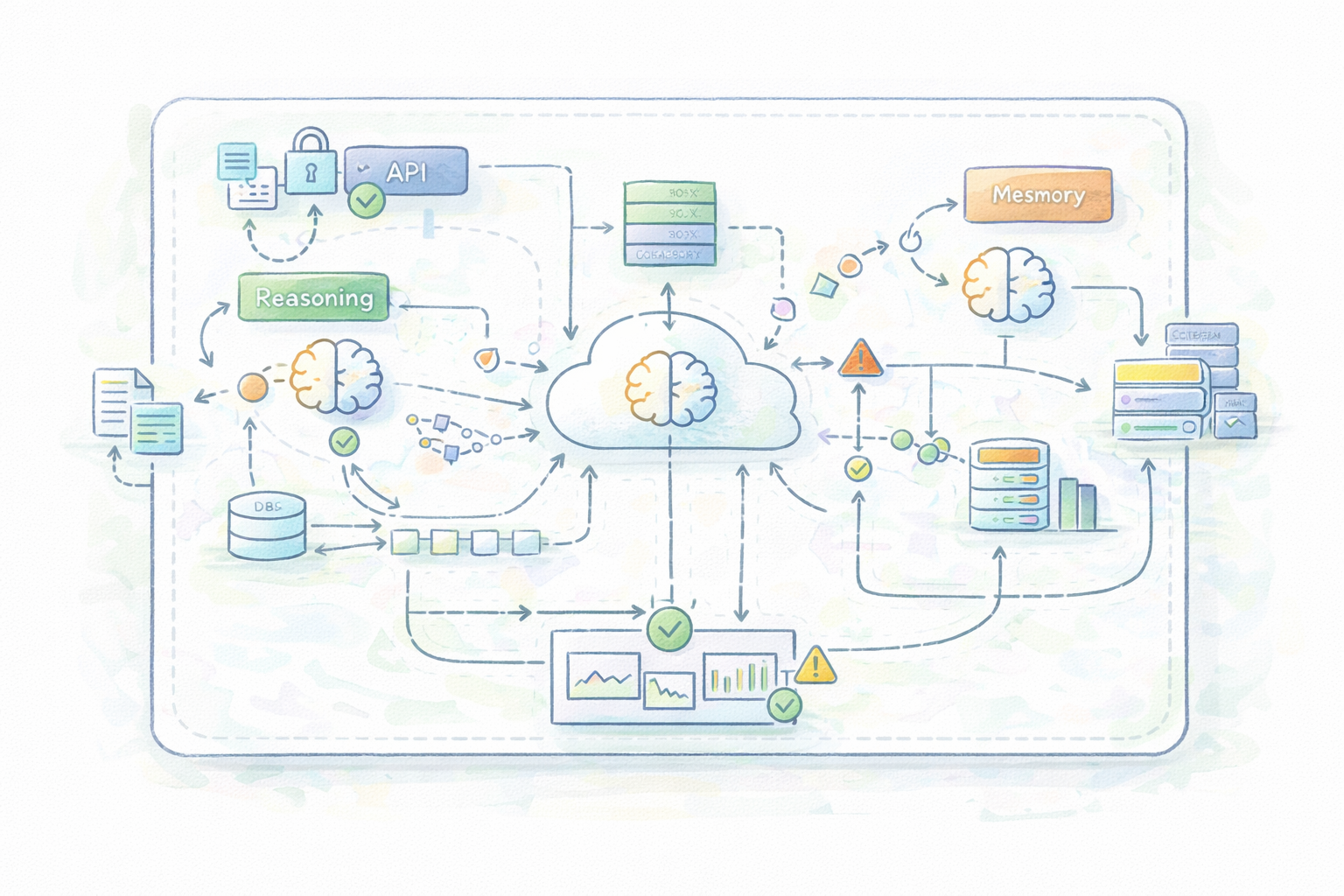
Agentic architectures introduce new challenges:
Scalability: How do you manage multiple agents or long-running workflows?
Reliability: What happens when a tool fails or returns incorrect data?
Control: How do you ensure the system behaves within safe and predictable boundaries?
Understanding how agentic AI and AGI are connected helps you think beyond individual models. It shifts your focus to systems that combine reasoning, memory, and action.
This is particularly valuable in interviews and real-world projects. Instead of treating AI as a black box, you start thinking in terms of system architecture, orchestration, and feedback loops.
Real-world trajectory: where the industry is heading#
The industry is clearly moving toward more agent-like systems. You can see this in several trends:
Multi-agent systems where different agents collaborate
Tool-using language models that interact with external APIs
Orchestration frameworks that manage complex workflows
Persistent memory systems that maintain context over time
These developments are pushing AI systems closer to more flexible and adaptive behavior. However, it is important to remain grounded.
These systems are not AGI. They are still constrained by their design, data, and environment. What they represent is an evolution of narrow AI into more capable and autonomous systems.
Whether this trajectory leads to AGI is still an open question. What is clear is that agentic patterns are becoming a dominant paradigm in AI system design.
Common misconceptions developers should avoid#
As these concepts become more popular, several misconceptions tend to emerge.
One common belief is that agentic AI is already AGI. This is not accurate. Agentic systems can perform complex tasks, but they lack true generalization and adaptability across domains.
Another misconception is that adding more tools automatically leads to general intelligence. While tools expand capabilities, they do not fundamentally change how the system reasons or learns.
Some developers also assume that better prompting or larger models will eventually result in AGI. While these improvements help, they do not address deeper challenges such as continuous learning and cross-domain reasoning.
Clarifying these misunderstandings helps you maintain a realistic perspective on what current systems can and cannot do.
Practical takeaways for developers#
If you are a developer, the key question is not whether AGI will arrive soon, but how you can build systems that align with current trends.
You should focus on skills that are already relevant today:
Designing agent loops and orchestration logic
Integrating tools and external systems
Managing state and memory across workflows
Evaluating and monitoring agent behavior
Instead of trying to build “AGI-like” systems, focus on building reliable, scalable agentic systems. These are the systems that are being deployed in production today.
By doing this, you are indirectly preparing for future developments. The principles you learn from building agentic systems will remain relevant even as the field evolves.
Final words#
The relationship between agentic AI and AGI is best understood as a progression rather than a binary distinction. Agentic systems introduce autonomy, planning, and interaction, which are essential components of more general intelligence.
Understanding how agentic AI and AGI are connected helps you see where current systems fit and where the field might go next. It allows you to think in terms of systems, not just models, and to design architectures that are flexible, adaptive, and scalable.
As a developer, this perspective is far more valuable than chasing hype. It grounds your understanding in real-world systems while keeping you prepared for future advancements.
Happy learning!