What are Consistency Models in Distributed Key-Value Systems?
Master consistency models in distributed key-value systems by understanding strong, causal, eventual, and session consistency trade-offs across scalability, latency, availability, replication, and failure handling.
When you’re working with distributed systems, especially distributed key-value systems, one of the biggest decisions you’ll face is choosing the right consistency guarantee.
In this blog, you’ll dive deep into consistency models in distributed key-value systems: what they are, why they matter, how they differ, and how you pick the right model for your needs. This isn’t just theory – you’ll see real scenarios, trade-offs, and actionable advice.
Grokking Modern System Design Interview

For a decade, when developers talked about how to prepare for System Design Interviews, the answer was always Grokking System Design. This is that course — updated for the current tech landscape. As AI handles more of the routine work, engineers at every level are expected to operate with the architectural fluency that used to belong to Staff engineers. That's why System Design Interviews still determine starting level and compensation, and the bar keeps rising. I built this course from my experience building global-scale distributed systems at Microsoft and Meta — and from interviewing hundreds of candidates at both companies. The failure pattern I kept seeing wasn't a lack of technical knowledge. Even strong coders would hit a wall, because System Design Interviews don't test what you can build; they test whether you can reason through an ambiguous problem, communicate ideas clearly, and defend trade-offs in real time (all skills that matter more than ever now in the AI era). RESHADED is the framework I developed to fix that: a repeatable 45-minute roadmap through any open-ended System Design problem. The course covers the distributed systems fundamentals that appear in every interview – databases, caches, load balancers, CDNs, messaging queues, and more – then applies them across 13+ real-world case studies: YouTube, WhatsApp, Uber, Twitter, Google Maps, and modern systems like ChatGPT and AI/ML infrastructure. Then put your knowledge to the test with AI Mock Interviews designed to simulate the real interview experience. Hundreds of thousands of candidates have already used this course to land SWE, TPM, and EM roles at top companies. If you're serious about acing your next System Design Interview, this is the best place to start.
What do we mean by “consistency models in distributed key-value systems”?#
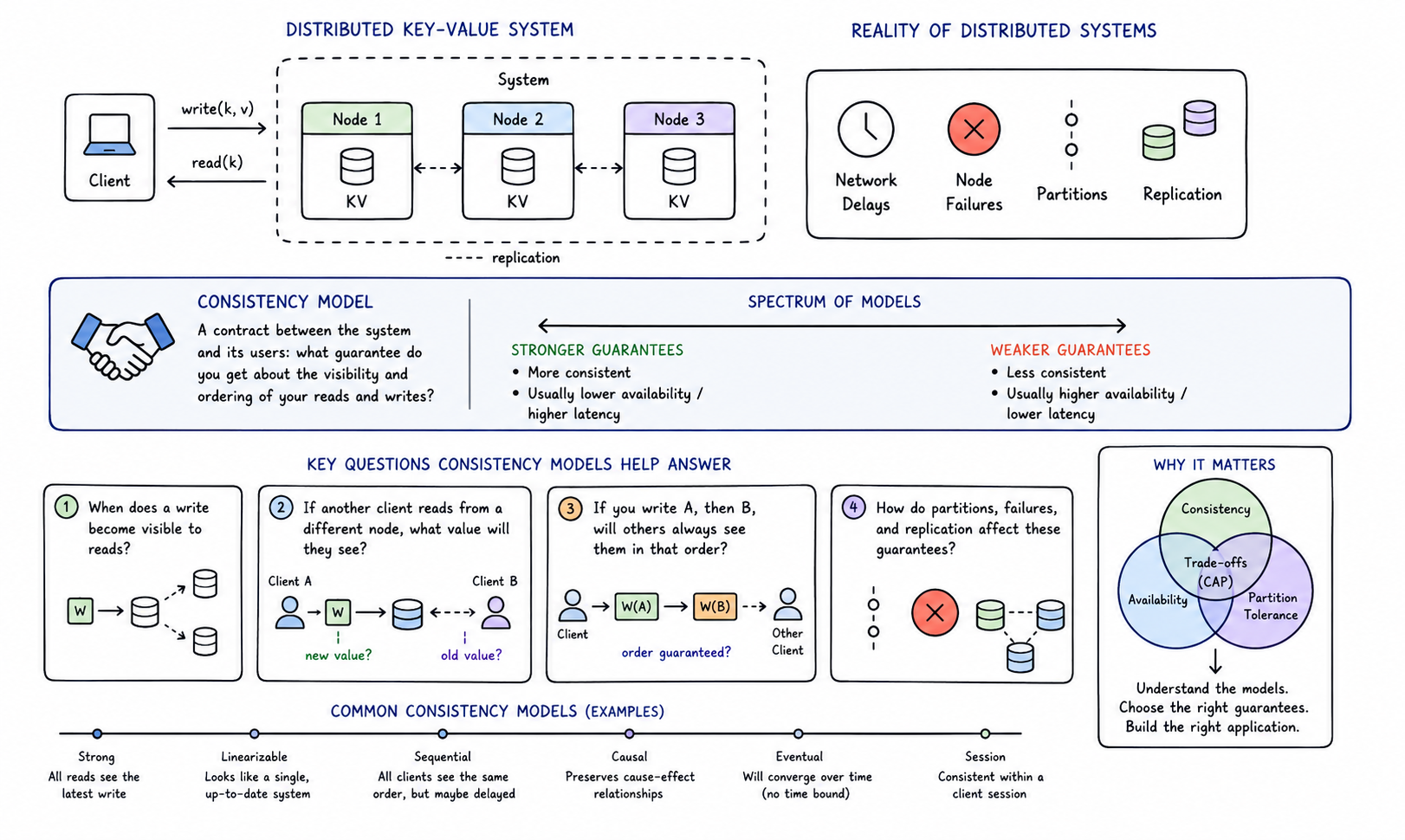
In a distributed key-value system, you have multiple nodes, replicas, partitions, and clients reading and writing keys and values. A consistency model is essentially a contract between the system and its users: what guarantee do you get about the visibility and ordering of your reads and writes? With distributed state, network delays, node failures, and replication, you can’t always guarantee “everyone always sees the latest write instantly.” So there’s a spectrum of models.
Key things you’re trying to reason about when you consider consistency models in distributed key-value systems:
When you issue a write to a key, at what point and where does it become visible to reads?
If another client reads that key from a different node, will they see the new value or an older one?
If you write key A, then key B, will other clients always see the writes in that order?
How do partitions, failures, and replication affect those guarantees?
This is critical for distributed key-value systems because you’re often trading off consistency, availability, and performance (the old CAP theorem territory). Understanding the models helps you choose what your system actually offers and what your applications can depend on.
Why consistency models matter in distributed key-value systems#
Given your system has many replicas, perhaps across geographies, you’ll face questions like:
Should reads clone the most recent write, or is stale data okay?
Is it acceptable for clients to see different orderings of operations?
What happens during network partitions?
What latency and throughput trade-offs are you comfortable with?
If you choose a too weak consistency model, you might surprise developers or end-users with bugs like “I just wrote this value, yet I read the old one”. If you choose a model that is too strong, you may pay a heavy price in terms of latency or availability. So when you’re building or choosing a distributed key-value system, thinking through consistency models in distributed key-value systems is non-optional.
Grokking the Fundamentals of System Design

System Design is central to building applications that scale reliably and operate securely. This is why I built this course to help you explore the foundational concepts behind modern system architecture and why these principles matter when creating real-world software systems or preparing for System Design interviews. You’ll begin by examining the basics of system architecture, then move on to distributed system concepts, including consistency, availability, coordination, and fault tolerance. Next, you’ll explore communication patterns, concurrency handling, and strategies like retries, backoff policies, and idempotency. You’ll also compare SQL, NoSQL, and NewSQL databases and dive into data partitioning, replication, and indexing techniques. The course concludes with security and observability, rounding out the pillars you need for System Design interviews. You’ll be able to analyze complex design problems, reason about trade-offs, and structure systems that are scalable, maintainable, and ready for real-world demands.
The spectrum of consistency models#
One of the hardest parts of distributed systems design is accepting that there is no single “perfect” consistency model. Every distributed key-value system operates under trade-offs involving latency, availability, coordination overhead, replication behavior, and failure handling.
That is why understanding consistency models in distributed key-value systems is so important.
When data is replicated across multiple nodes, regions, or data centers, different replicas may temporarily disagree about the latest value of a key. The consistency model defines what guarantees the system provides about those reads and writes.
This becomes one of the most important architectural decisions in distributed systems because it directly affects user experience, system behavior during failures, infrastructure cost, and application complexity.
At one end of the spectrum, you have strong consistency models that prioritize correctness and predictable reads. At the other end, you have weaker models that prioritize availability and scalability while tolerating temporary inconsistencies.
Most modern distributed systems exist somewhere between those extremes.
Understanding this spectrum helps you reason about trade-offs much more effectively during System Design interviews and real-world architecture discussions.
Strong/linearizable consistency#
Strong consistency, often called linearizable consistency, provides the simplest mental model for developers. Once a write operation completes successfully, every subsequent read from any node in the system must return that latest value or something newer.
From the application perspective, the system behaves almost as if there is only a single copy of the data.
This guarantee dramatically simplifies reasoning because clients never worry about stale reads, replication lag, or conflicting versions. Operations appear to execute in real-time order across the entire distributed system.
That predictability makes strong consistency extremely valuable for correctness-sensitive workloads.
For example, financial systems often require strong consistency because stale reads can create severe correctness problems. Inventory systems also frequently depend on stronger guarantees to avoid overselling products or creating inconsistent stock counts.
However, these guarantees come with substantial operational costs.
Strong consistency requires coordination between replicas, often involving consensus protocols, leader election, quorum acknowledgments, or distributed locking mechanisms. That coordination increases write latency and can reduce availability during network partitions or node failures.
The farther apart replicas become geographically, the more expensive strong consistency becomes operationally because every coordinated write must traverse network boundaries before completion.
Strong consistency characteristics#
Property | Impact |
Latest-read guarantee | No stale reads |
Real-time ordering | Predictable behavior |
Coordination required | Higher latency |
Partition sensitivity | Lower availability |
Easier application logic | Simpler reasoning |
Strong consistency is often the easiest model for developers to reason about, but it can become difficult to scale globally.
Sequential consistency#
Sequential consistency relaxes some of the strict real-time guarantees of linearizability while still preserving ordering guarantees from each client’s perspective.
Under sequential consistency, all operations appear in a globally consistent order, but that order does not necessarily match real-world timing.
For example, if one client writes A followed by B, every node in the system must observe A before B. However, operations from other clients may interleave differently as long as each client’s program order remains preserved.
This subtle distinction reduces some coordination requirements while still providing relatively intuitive behavior.
Sequential consistency becomes useful in systems where maintaining client-side operation ordering matters more than enforcing strict real-time synchronization.
Compared to strong consistency, sequential consistency can improve flexibility slightly, but it still requires meaningful coordination across replicas.
Sequential consistency behavior#
Guarantee | Description |
Client ordering preserved | Writes appear in issued order |
Global order exists | Operations remain consistent system-wide |
Real-time ordering relaxed | Timing may differ from wall-clock order |
Coordination still required | Moderate operational overhead |
This model occupies an important middle ground between strict correctness and operational flexibility.
Causal consistency#
Causal consistency introduces the concept of causally related operations.
The idea is simple: If operation B depends on operation A, then every client must observe A before B.
For example, imagine a collaborative editing system where one user posts a comment and another user replies to it. The reply logically depends on the original comment. Under causal consistency, all clients must see the original comment before seeing the reply.
However, unrelated operations may appear in different orders across replicas.
This approach provides significantly more flexibility than strong consistency because the system only coordinates causally connected operations rather than enforcing total global ordering.
Causal consistency becomes especially useful for collaborative systems, messaging applications, social feeds, and user-interaction platforms where preserving “happens-before” relationships matters more than enforcing strict synchronization globally.
Compared to eventual consistency, causal consistency improves user experience significantly because related actions appear logically ordered.
However, it also introduces additional tracking complexity because the system must maintain causal metadata across operations.
Causal consistency trade-offs#
Benefit | Drawback |
Preserves logical ordering | More metadata complexity |
Better UX consistency | Harder implementation |
Higher availability than strong consistency | Still weaker than linearizability |
Reduced coordination overhead | Causal tracking required |
Causal consistency often provides an excellent balance for globally distributed interactive systems.
Eventual consistency#
Eventual consistency is one of the most widely used models in large-scale distributed systems because it prioritizes availability, scalability, and low latency.
Under eventual consistency, replicas are allowed to diverge temporarily. If no new updates occur, all replicas will eventually converge to the same value over time.
This means clients may temporarily read stale data.
At first, this sounds dangerous, but for many workloads, it is completely acceptable.
Global caching systems, analytics pipelines, recommendation engines, social media feeds, and telemetry platforms often tolerate temporary inconsistencies because responsiveness and availability matter more than immediate synchronization.
The operational advantages are enormous.
Because replicas do not require immediate coordination before serving requests, the system remains highly available during partitions and can continue operating efficiently across geographically distributed regions.
However, eventual consistency shifts complexity toward the application layer.
Developers must now think about:
Stale reads
Conflict resolution
Version reconciliation
Out-of-order updates
Replication lag
This makes reasoning about application behavior significantly harder.
Eventual consistency behavior#
Property | Operational effect |
High availability | System remains responsive |
Lower latency | Faster reads/writes |
Replica divergence allowed | Temporary stale data |
Minimal coordination | Better scalability |
Conflict handling required | More application complexity |
Many modern internet-scale systems adopt eventual consistency because operational scalability becomes more important than strict synchronization.
Session consistency and monotonic guarantees#
Some systems provide weaker but highly practical guarantees focused on individual user experience rather than global synchronization.
Session consistency guarantees that within a client session, users will at least observe their own writes. For example, after updating a profile picture, the user immediately sees the new version even if other replicas have not fully synchronized yet.
Monotonic reads ensure that once a client reads a newer value, future reads will never return older versions.
Monotonic writes preserve ordering for a single client’s writes, even if the broader system remains eventually consistent globally.
These guarantees improve user experience significantly without requiring full global coordination.
They are especially useful for user-centric systems such as:
User sessions
Social feeds
Messaging interfaces
Preference management
Personal dashboards
Session-level guarantees#
Guarantee | User-facing benefit |
Read-your-writes | Immediate visibility of updates |
Monotonic reads | No backward version jumps |
Monotonic writes | Preserved user ordering |
Session consistency | Improved UX continuity |
These lightweight guarantees often provide excellent usability improvements with relatively low infrastructure overhead.
Trade-offs and how to think about them#
The most important thing to understand about consistency models in distributed key-value systems is that every guarantee introduces operational trade-offs.
There is no universally “best” consistency model.
Strong consistency simplifies application reasoning because developers always read the latest value. However, it increases latency, coordination overhead, and partition sensitivity.
Eventual consistency improves scalability and availability dramatically, but developers must now handle stale reads, conflicts, and asynchronous convergence.
Middle-ground models such as causal consistency attempt to balance these competing pressures.
This is why the CAP theorem appears so frequently in distributed systems discussions.
In distributed environments, systems cannot simultaneously maximize:
Consistency
Availability
Partition tolerance
When partitions occur, the system must prioritize either consistency or availability.
Understanding which trade-off matters most for the business becomes critical.
Consistency trade-off overview#
Model | Strength | Weakness |
Strong consistency | Simplest reasoning | Higher latency |
Sequential consistency | Ordered operations | Coordination overhead |
Causal consistency | Preserves causality | More complexity |
Eventual consistency | Maximum availability | Stale reads |
Strong System Design interviews often revolve around explaining these trade-offs clearly rather than memorizing terminology.
How to choose the right consistency model for your distributed key-value system#
Choosing the right consistency model always depends on workload requirements, user expectations, operational constraints, and business priorities.
The first question to ask is:
“How harmful are stale reads?”
If stale reads create severe correctness problems, stronger consistency may be necessary.
For example:
Banking systems
Financial ledgers
Inventory management
Critical counters
Often, they require stronger guarantees.
In contrast, systems such as analytics dashboards, recommendation feeds, and global caches often tolerate temporary inconsistency without harming user experience significantly.
Geographic distribution also matters heavily.
If replicas span multiple continents, strong consistency can introduce large latency penalties because writes require global coordination before acknowledgment.
In some cases, weaker consistency delivers a much better user experience because responsiveness matters more than perfect synchronization.
Developer complexity becomes another major consideration. Strong consistency simplifies application logic dramatically because developers do not need to reason about stale data or conflicting versions.
Eventual consistency improves operational scalability but pushes more complexity into the application layer.
Choosing a consistency model#
Scenario | Recommended model |
Financial transactions | Strong consistency |
Global cache layer | Eventual consistency |
Collaborative editing | Causal consistency |
User session state | Session consistency |
Social feeds | Eventual or causal consistency |
The right model depends entirely on which trade-offs the system is willing to accept.
Real-world considerations in distributed key-value systems#
Real-world distributed systems introduce additional operational realities beyond theoretical consistency guarantees.
Replication lag becomes a major issue in weaker consistency models because replicas may synchronize slowly during heavy traffic or network instability.
Conflict resolution also becomes increasingly important. Eventual consistency systems often require mechanisms such as:
Last-writer-wins
Vector clocks
CRDTs
Version reconciliation
These mechanisms add substantial application complexity.
Hot keys create additional pressure because frequently updated data may overwhelm coordination paths under stronger consistency models.
Cross-key dependencies also complicate design significantly. If writes involving multiple keys must remain synchronized, weaker consistency models may create correctness issues unless additional coordination exists.
Monitoring becomes extremely important because stale reads and replication anomalies can be difficult to debug operationally.
Real-world operational challenges#
Challenge | Why it matters |
Replication lag | Causes stale reads |
Conflict resolution | Determines final state correctness |
Hot keys | Increase coordination pressure |
Cross-key dependencies | Risk inconsistent views |
Geo-replication latency | Slows strong consistency |
Operational realities often influence architecture decisions more heavily than theoretical guarantees alone.
Why being clear about consistency models helps you win#
When you discuss consistency models clearly during System Design interviews, you demonstrate significantly deeper distributed systems understanding.
You show interviewers that you understand systems are not just collections of components. They are coordinated infrastructures operating under unavoidable trade-offs.
Strong consistency reasoning demonstrates awareness of correctness and coordination challenges. Eventual consistency discussions reveal understanding of scalability and availability pressures. Hybrid approaches show architectural maturity.
Most importantly, consistency discussions naturally lead into broader distributed systems conversations involving replication, partition tolerance, failover behavior, and operational resilience.
That is exactly the type of reasoning senior-level interviewers are trying to evaluate.
Pulling it all together: the decision path#
When designing a distributed key-value system, the best approach is usually to think systematically about consistency requirements rather than defaulting automatically to either “strong consistency everywhere” or “eventual consistency everywhere.”
Start by identifying which data absolutely requires strict correctness and which workloads tolerate temporary inconsistency safely.
Then evaluate:
Latency expectations
Availability requirements
Geographic distribution
Failure behavior
Developer complexity
Operational overhead
From there, choose the consistency guarantees that align most naturally with business priorities and user expectations.
Many modern systems even adopt hybrid strategies where different operations use different consistency levels depending on workload sensitivity.
This flexibility often provides the best balance between scalability, correctness, and operational efficiency.
Final thoughts#
Consistency is not just a buzzword; when you’re working on distributed key-value systems, consistency models in distributed key-value systems become one of the central decisions you’ll make. Pick the wrong model, and you’ll end up with user-confusing stale data, unbounded latency, or excessive complexity. Pick the right model, and you’ll meet your performance, availability, and correctness goals in harmony.
Throughout this blog, you’ve seen the major models, why they matter, how the trade-offs work, and how you can pick the right one. Whether you’re building your own key‐value store, selecting a managed database, or designing a feature on top of one, get clarity on your consistency guarantee, make it explicit, and engineers will thank you.
So, the next time you find yourself specifying a distributed key-value system or interviewing for one, ask: What consistency model are we offering, and is that the right one for our use case? Because consistency models in distributed key-value systems aren’t optional–they’re foundational.
