How does agentic AI differ from traditional automation?
This blog shows how agentic AI differs from traditional automation by explaining that traditional systems follow fixed rules, while agentic AI can plan, adapt, and act autonomously.
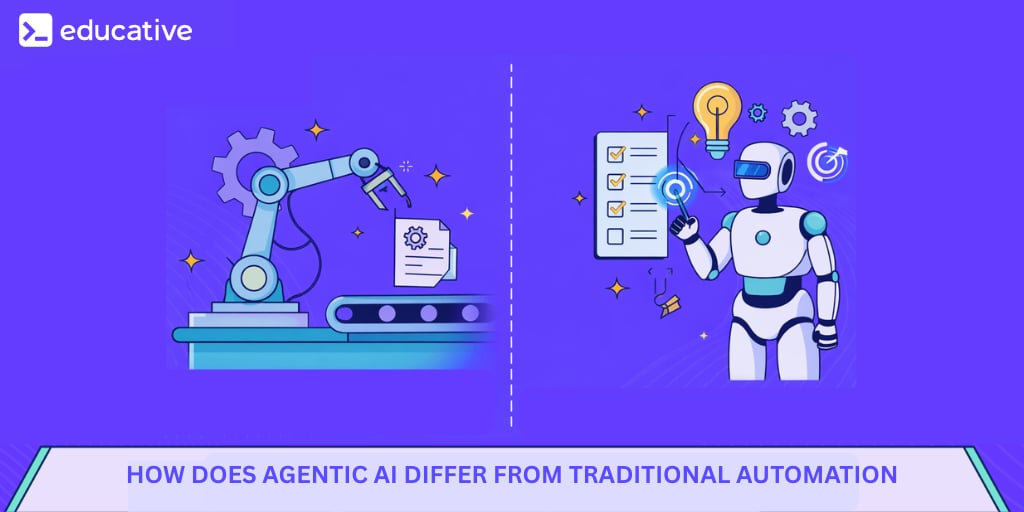
Automation has long been a central goal in software engineering and enterprise computing. For decades, organizations have relied on automated systems to execute repetitive workflows, reduce operational costs, and improve efficiency across business processes. Traditional automation tools were designed to follow explicit instructions defined by developers, allowing systems to perform tasks automatically whenever specific conditions were met.
These systems operate using rule-based logic, where a particular input triggers a predetermined output. For example, a scheduled task might run every night to process transactions, or a workflow engine might route support tickets based on predefined categories. In these environments, the behavior of the system is entirely defined by the rules and workflows created by engineers.
However, the rapid rise of large language models and AI-driven systems has introduced a new paradigm known as agentic AI. Instead of executing only fixed instructions, agentic systems can plan tasks, reason through problems, adapt to changing information, and dynamically decide how to complete complex objectives.
As developers explore these emerging architectures, many begin asking how does agentic ai differ from traditional automation and why this shift represents a fundamental change in how intelligent software systems are designed.
While traditional automation follows predefined rules and static workflows, agentic AI systems are designed to interpret goals, plan actions, and dynamically adjust their behavior during execution. This evolution represents a significant step toward more autonomous and adaptable AI systems.
Agentic system design is rapidly redefining how modern AI systems are built, moving from single-model interactions to autonomous, multi-step systems that can reason, plan, and act. As large language models evolve, the real challenge is no longer just using them, but orchestrating them into reliable, goal-driven agents that operate safely and effectively in real-world environments. I built this course from my work in adaptive AI and intelligent systems, where designing autonomous behavior requires more than model accuracy. It demands structured reasoning, control, and safety. A recurring pattern I observed was that teams could experiment with LLMs, but struggled to design cohesive agentic systems that could handle ambiguity, coordinate tasks, and remain aligned with user intent. This course is designed to bring that structure. You will study real-world examples, including the Multi-Agent Conversational Recommender System (MACRS), NVIDIA’s Eureka for reward generation, and advanced agents navigating live websites and creating complex images. Drawing on insights from industry deployments and cutting-edge research, you will gain the foundational knowledge to confidently start designing your agent-based systems. Engineers and researchers are already using these patterns to build next-generation AI systems. If you want to design agents that go beyond prompts and into action, this is where to begin.
Understanding traditional automation systems#
Traditional automation systems rely on deterministic workflows that execute predefined sequences of actions. In these systems, developers explicitly define rules that determine how tasks should be performed. Each step in the workflow is predictable because it follows instructions written by engineers or administrators.
A typical automation pipeline involves triggers, conditions, and actions. When a trigger occurs, the system evaluates a set of rules and executes the appropriate action. Because the workflow logic is explicitly defined, the behavior of the system remains stable and predictable across different runs.
Many widely used technologies rely on traditional automation principles. Common examples include:
Scheduled batch jobs that run data processing tasks at fixed intervals
Robotic Process Automation (RPA) tools that replicate repetitive human interactions with software interfaces
Continuous integration and deployment (CI/CD) pipelines that automatically build, test, and deploy applications
Rule-based customer support systems that route requests based on predefined keywords
These systems are highly effective when workflows are predictable and operating conditions are well understood. Because the rules governing the system are explicit, engineers can easily reason about how the system will behave.
However, traditional automation becomes difficult to manage when tasks require interpretation, decision-making, or adaptation to new circumstances. If a workflow encounters an unexpected situation that was not anticipated by the rules, the system typically fails or requires human intervention.
These limitations motivate the development of more flexible AI-driven architectures capable of reasoning about tasks rather than simply executing instructions.
What is agentic AI?#
Agentic AI refers to systems composed of autonomous agents capable of making decisions and executing tasks independently in pursuit of a defined objective. Instead of following a fixed sequence of instructions, these agents analyze the context of a task, determine what actions are required, and adapt their strategy as new information becomes available.
In many modern AI architectures, an agent is responsible for interpreting goals, generating a plan, and interacting with external tools or systems to accomplish the task. These agents are often powered by large language models that provide reasoning capabilities and natural language understanding.

Agentic systems typically include several key capabilities that distinguish them from traditional automation:
Task planning: Agents break down high-level objectives into smaller actionable steps.
Tool usage: Agents interact with APIs, databases, search engines, or external services to gather information or perform operations.
Iterative reasoning: Agents evaluate intermediate results and adjust their approach if the task is not progressing as expected.
Self-correction mechanisms: Agents can detect errors and revise their actions to improve outcomes.
In practice, agentic systems are often built using orchestration frameworks that coordinate interactions between large language models, memory systems, external tools, and workflow managers. These components allow agents to operate within complex environments where tasks require multiple stages of reasoning and interaction.
This architectural shift provides the foundation for understanding how does agentic AI differ from traditional automation. Instead of executing predetermined workflows, agentic systems dynamically generate workflows in response to the goals and context of the task.
Key architectural differences#
The fundamental differences between traditional automation and agentic AI become clearer when examining their underlying architectures and system capabilities.
Feature | Traditional Automation | Agentic AI |
Workflow design | Predefined rules | Dynamic planning |
Decision making | Fixed logic | Context-aware reasoning |
Adaptability | Limited | High |
Error handling | Manual intervention | Autonomous correction |
Task complexity | Predictable workflows | Complex multi-step tasks |
Traditional automation systems rely on workflows designed entirely by engineers. Every branch of logic must be anticipated during development, and the system executes these instructions exactly as defined.
Agentic AI systems, in contrast, treat workflows as dynamic processes that can be generated and modified during execution. Instead of following a static script, the system reasons about what actions are necessary and determines the sequence of steps required to complete a task.
These differences highlight why agentic systems are particularly effective for tasks involving uncertainty, interpretation, and complex problem solving.
Example workflow comparison#
A practical comparison between these two approaches can illustrate their differences more clearly.
Traditional automation example#
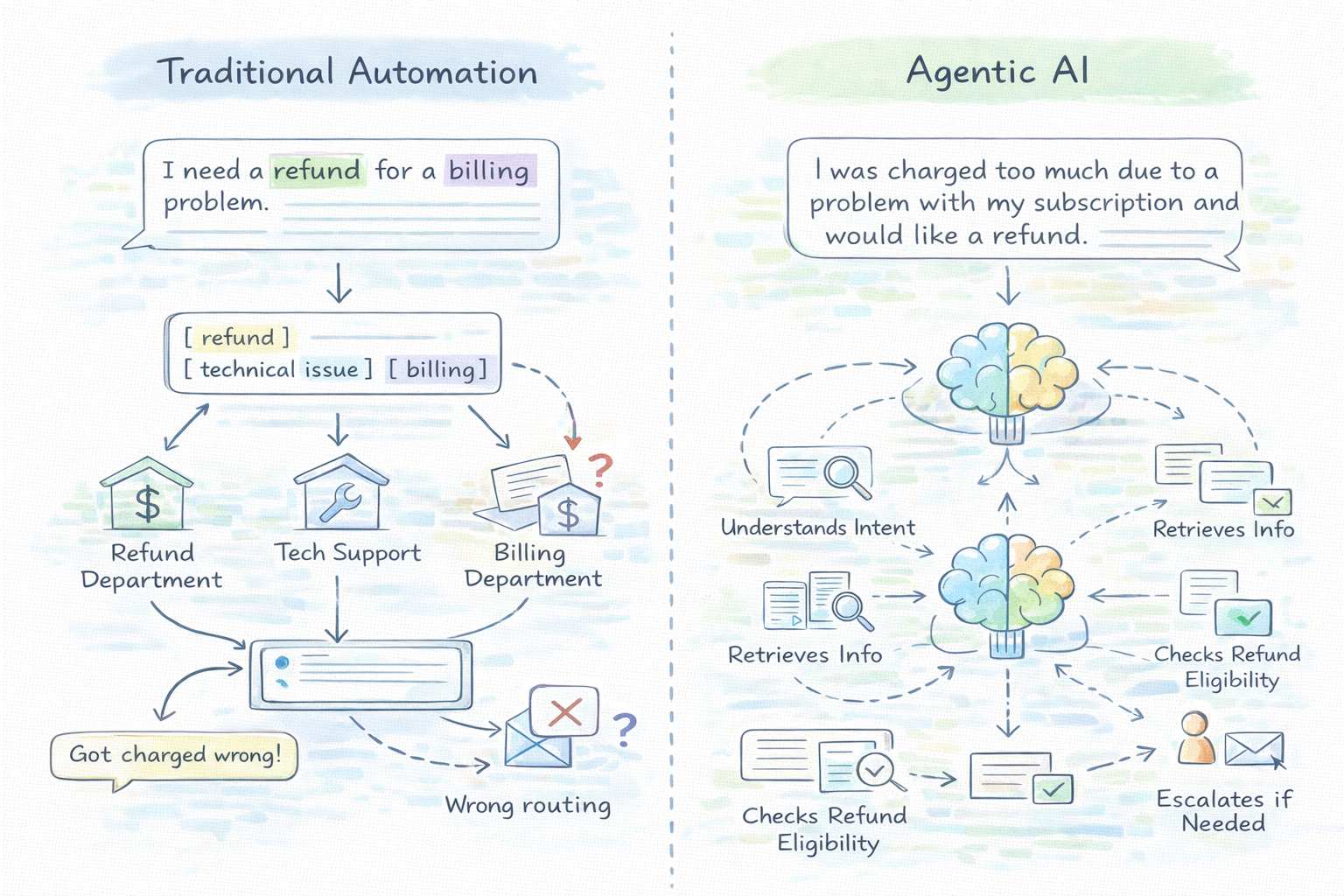
Imagine a customer support platform that uses rule-based automation to route incoming support tickets. The system scans each message for predefined keywords such as “refund,” “technical issue,” or “billing problem.” Based on the detected keywords, the system assigns the ticket to the appropriate department.
This workflow is reliable when customer requests follow predictable patterns. However, if a user describes a complex problem without using expected keywords, the system may misclassify the request or route it incorrectly.
Agentic AI example#
An agentic AI system approaches the same scenario differently. Instead of relying solely on keywords, the agent analyzes the entire message to understand the user’s intent. It may identify that the user is requesting a refund due to a technical issue with a purchased service.
The system could then retrieve relevant documentation, generate a draft response, determine whether the issue qualifies for a refund, and escalate the case if additional information is required.
This dynamic behavior illustrates how does agentic AI differ from traditional automation in real-world applications. Rather than executing a rigid set of rules, the agent evaluates context, plans actions, and adapts its strategy to complete the task.
Engineering considerations when building agentic systems#
While agentic AI systems provide greater flexibility and autonomy, they also introduce new engineering challenges that developers must address when designing production systems.
One important challenge is maintaining system reliability. Because agents dynamically generate plans and actions, their behavior may vary across different runs of the same task. Engineers must implement safeguards to ensure that agent decisions remain within acceptable boundaries.
Another challenge involves coordinating multiple agents within a system. Complex workflows may involve several specialized agents performing different roles, such as information retrieval, reasoning, execution, and verification. Effective orchestration mechanisms are required to manage communication and task delegation between agents.
Developers must also consider the risk of cascading reasoning errors. If an agent makes an incorrect assumption early in a workflow, subsequent decisions may propagate that error through the system. Monitoring and evaluation tools are essential for detecting and correcting such issues.
Finally, observability becomes a critical requirement. Engineers need visibility into the reasoning steps taken by agents, allowing them to audit decision processes and debug unexpected outcomes.
These considerations demonstrate that building robust agentic systems requires careful design, evaluation frameworks, and ongoing monitoring.
Real-world applications of agentic AI#
Agentic AI systems are increasingly being used in advanced applications that require adaptive reasoning and multi-step decision-making.
One example is AI research assistants capable of planning complex information retrieval workflows. These systems may search academic databases, evaluate relevant papers, summarize findings, and organize insights into structured reports.
Another rapidly growing application is autonomous coding assistants. These systems can generate code, execute tests, analyze failures, and iteratively refine their solutions. By combining reasoning with tool usage, agentic coding systems can perform tasks that previously required direct developer intervention.
Agentic AI is also being used in data analysis environments. Intelligent agents can explore datasets, identify patterns, generate visualizations, and produce analytical summaries that help organizations understand complex data.
In enterprise environments, agentic automation systems are beginning to manage complex operational workflows that span multiple software platforms. These systems coordinate data movement, decision-making processes, and task execution across large organizations.
These emerging applications demonstrate how agentic AI expands the capabilities of traditional automation by enabling systems that can reason about tasks rather than simply execute predefined workflows.
The future of automation systems#
Automation is evolving from deterministic workflow execution toward adaptive systems capable of reasoning and decision-making. This transition is being driven by advances in large language models, tool integration, and orchestration frameworks that support agent-based architectures.
As these technologies mature, developers are increasingly designing systems that combine traditional automation with agentic capabilities. Predictable tasks can still be handled by rule-based workflows, while complex or ambiguous tasks can be delegated to intelligent agents capable of reasoning through the problem.
Understanding how does agentic AI differ from traditional automation helps developers prepare for this new generation of intelligent software systems. Organizations that adopt these architectures will be better positioned to build systems that adapt to changing environments and solve problems that were previously difficult to automate.
Final words#
Automation has been a foundational principle of modern software systems, enabling organizations to streamline operations and reduce manual work through rule-based workflows. Traditional automation systems remain highly effective for predictable processes where tasks can be fully specified in advance.
Agentic AI introduces a new paradigm in which systems can interpret goals, plan actions, and dynamically adjust their behavior as conditions change. These capabilities allow agentic systems to handle complex tasks that require reasoning, adaptation, and multi-step decision-making.
By understanding how does agentic AI differ from traditional automation, developers can design systems that combine the reliability of deterministic workflows with the flexibility of intelligent agents. This hybrid approach will likely define the next generation of automation systems as organizations continue to build more autonomous and capable AI-driven applications.
Happy learning!