How to create an AI agent from scratch
Want to build your own AI agent? Learn the core architecture, key components, and step-by-step process to create intelligent systems with reasoning, memory, and tool integration. Start building powerful AI workflows today.
AI agents are rapidly becoming a central concept in modern artificial intelligence systems. Unlike traditional chatbots that respond to a single prompt and terminate execution, AI agents can reason about tasks, plan multi-step actions, interact with external tools, and iteratively refine their outputs. These systems are increasingly used in applications such as research assistants, coding copilots, and autonomous workflow engines.
As interest in autonomous AI systems grows, many developers begin exploring how to create an AI agent from scratch rather than relying entirely on pre-built frameworks. While frameworks can accelerate development, building an agent from first principles provides a deeper understanding of how reasoning engines, orchestration loops, memory systems, and tool integrations work together.
Build AI Agents and Multi-Agent Systems with CrewAI

Building AI agents and multi-agent systems with CrewAI is quickly becoming a core capability for developers working with modern LLM-powered applications. As workflows grow more complex, the shift is no longer about single prompts, but about orchestrating multiple agents that can collaborate, delegate tasks, and operate as coordinated systems. I built this course from my work in adaptive AI and intelligent orchestration, where designing agentic workflows requires structure, coordination, and control. A recurring pattern I observed was that developers could build individual agents, but struggled to scale them into reliable multi-agent systems. CrewAI provides a practical framework for this, and this course is designed to make it actionable. You’ll learn how to build AI agents and multi-agent systems with CrewAI through hands-on workflows, starting with core agent concepts, then progressing into task delegation, hierarchical orchestration, and human-in-the-loop systems. You’ll implement real automation pipelines and explore advanced features like conditional tasks, monitoring, and scalable agent operations. Developers are already using CrewAI to build coordinated AI systems at scale. If you want to move from single agents to fully orchestrated AI workflows, this is where you begin.
Understanding these core building blocks allows developers to build AI agent systems tailored to specific use cases.
What is an AI agent?#
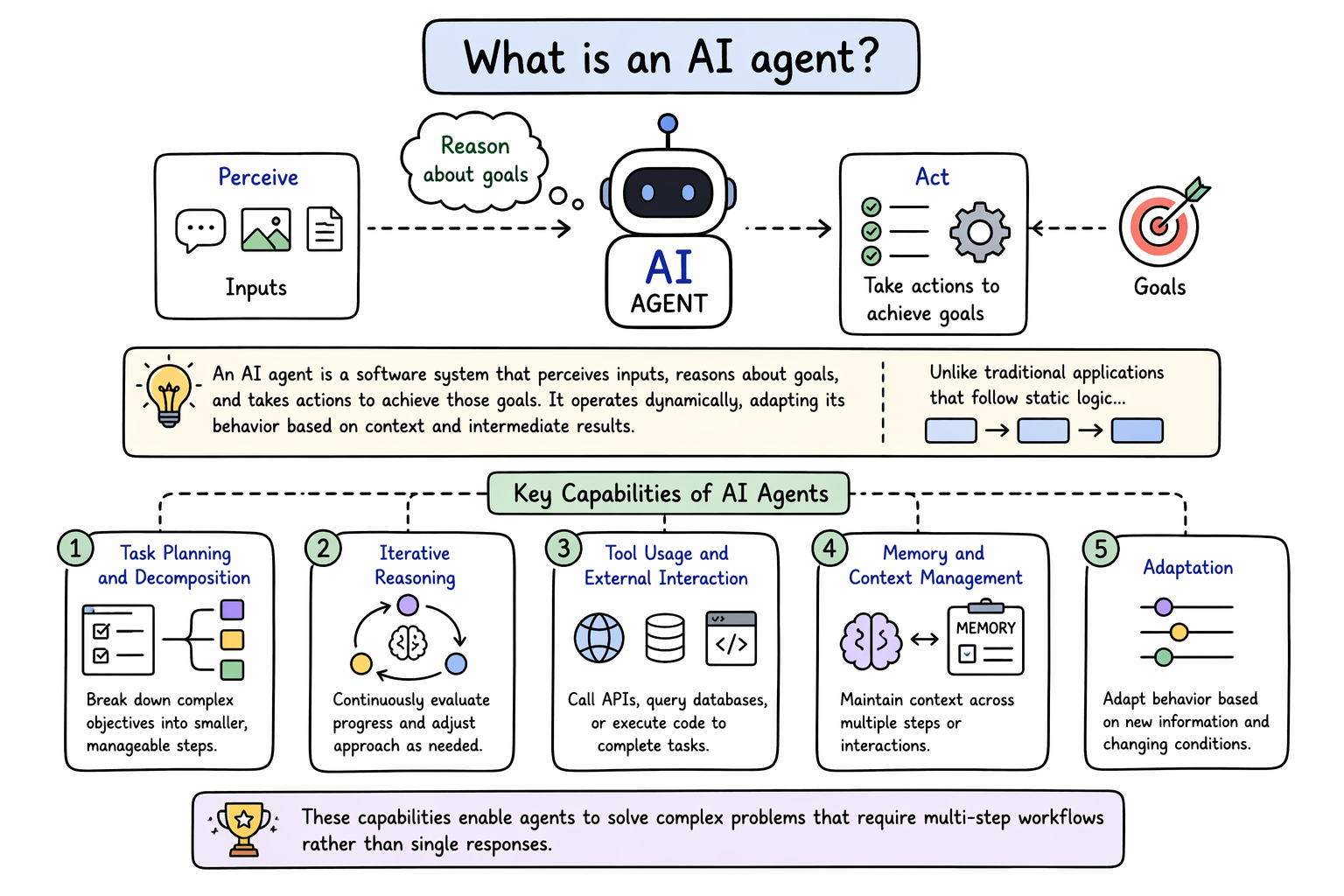
An AI agent is a software system capable of perceiving inputs, reasoning about goals, and taking actions to achieve those goals. Unlike traditional applications that follow static logic, agents operate dynamically, adapting their behavior based on context and intermediate results.
Several key capabilities distinguish AI agents from conventional AI systems:
Task planning and decomposition: Agents can break down complex objectives into smaller, manageable steps.
Iterative reasoning: Agents continuously evaluate progress and adjust their approach as needed.
Tool usage and external interaction: Agents can call APIs, query databases, or execute code to complete tasks.
Memory and context management: Agents maintain context across multiple steps or interactions.
These capabilities enable agents to solve complex problems that require multi-step workflows rather than single responses.
Agentic System Design
Agentic system design is rapidly redefining how modern AI systems are built, moving from single-model interactions to autonomous, multi-step systems that can reason, plan, and act. As large language models evolve, the real challenge is no longer just using them, but orchestrating them into reliable, goal-driven agents that operate safely and effectively in real-world environments. I built this course from my work in adaptive AI and intelligent systems, where designing autonomous behavior requires more than model accuracy. It demands structured reasoning, control, and safety. A recurring pattern I observed was that teams could experiment with LLMs, but struggled to design cohesive agentic systems that could handle ambiguity, coordinate tasks, and remain aligned with user intent. This course is designed to bring that structure. You will study real-world examples, including the Multi-Agent Conversational Recommender System (MACRS), NVIDIA’s Eureka for reward generation, and advanced agents navigating live websites and creating complex images. Drawing on insights from industry deployments and cutting-edge research, you will gain the foundational knowledge to confidently start designing your agent-based systems. Engineers and researchers are already using these patterns to build next-generation AI systems. If you want to design agents that go beyond prompts and into action, this is where to begin.
Core architecture of an AI agent#
Most AI agents follow a modular architecture composed of several interconnected layers. Each layer contributes to the agent’s ability to interpret tasks, make decisions, and execute actions.
At the center of the architecture is the reasoning engine, typically powered by a large language model or another decision-making system. This component interprets user input, generates plans, and decides which actions to take next.
Surrounding the reasoning engine is the tool integration layer, which enables the agent to interact with external systems such as APIs, databases, or search engines. This layer extends the agent’s capabilities beyond text generation.
The memory system stores relevant information, including past interactions, retrieved documents, or intermediate results. Memory allows the agent to maintain context and avoid repeating work.
The orchestration layer controls the agent’s execution loop. It determines how the agent moves from reasoning to action, evaluates results, and decides whether to continue or terminate.
Finally, the input and output interfaces handle communication between the user and the agent, ensuring that inputs are processed correctly and outputs are presented in a usable format.
Together, these layers form a cohesive system that enables intelligent, autonomous behavior.
MCP Fundamentals for Building AI Agents
MCP is one of those technologies where theoretical knowledge is widespread, yet production-grade implementation experience remains limited. The protocol itself is well-designed, but the documentation assumes a lot, the ecosystem is young, and most engineers I talk to have the same question: where do I actually start? That's why I built this course. As someone who has spent years researching and teaching AI systems (from neural networks and adaptive systems to the production-ready GenAI architectures we cover in other courses on Educative) I wanted to create the resource I wish existed when I first started working with MCP: a clear, structured, hands-on path from zero to a working MCP application. You'll start with the fundamentals: why agentic systems need a protocol like MCP in the first place, and how MCP's architecture (Host, Server, Client) solves the integration problems that have plagued AI tooling. From there, you'll build. You'll code an MCP server, wire up a client, add prompt and resource capabilities, and see your agent dynamically discover and use tools through the protocol. Everything runs in-browser. No local setup required. This course is designed for engineers who want to move beyond surface-level understanding and actually build with MCP. By the end, you’ll know how to implement the protocol, debug it, and understand where it fits in real GenAI architectures. If you’re serious about working with agentic systems and want a practical, grounded entry point into MCP, this course gives you a clear place to start and the confidence to go further.
Key components of an AI agent#
Component | Purpose | Example Implementation |
Reasoning engine | Interprets tasks and generates decisions | Large language model |
Tools | Provide external capabilities | APIs, databases |
Memory | Stores past interactions or retrieved data | Vector databases |
Orchestrator | Manages agent workflow | Control loops |
Each of these components plays a critical role in enabling agent functionality. The reasoning engine determines what to do, tools enable action, memory preserves context, and the orchestrator ensures that all components work together in a structured loop.
Understanding these components is essential when learning how to create an ai agent from scratch, because each piece must be carefully designed and integrated.
Step-by-step guide: building an AI agent from scratch#
Step 1: Define the agent’s goal and capabilities#
The first step in building an AI agent is defining its purpose. Developers must clearly identify what tasks the agent should perform, what inputs it will receive, and what outputs it should produce.
For example, an agent designed for research assistance may need to retrieve documents, summarize information, and validate sources. A coding agent, on the other hand, may need to generate code, execute tests, and debug errors.
Clearly defining the agent’s scope ensures that all subsequent design decisions align with the intended use case.
Step 2: Implement the reasoning engine#
The reasoning engine is the core of the agent. It processes input, interprets intent, and determines the next action. In modern implementations, this component is typically powered by a large language model capable of understanding natural language instructions and generating structured outputs.
The reasoning engine evaluates whether the task requires generating a direct response, invoking a tool, or performing additional reasoning. It may produce intermediate steps, often referred to as a plan, that guide the agent’s execution.
Designing this component carefully is crucial when learning how to create an ai agent from scratch, as it directly impacts the agent’s intelligence and flexibility.
Step 3: Integrate external tools#
AI agents become significantly more powerful when they can interact with external systems. Tool integration allows agents to access real-time data, perform computations, and execute actions beyond their internal capabilities.
Common tools include:
Web search systems for retrieving up-to-date information
Databases or document stores for structured queries
Code execution environments for running scripts
Data analysis APIs for processing datasets
The agent must be able to select the appropriate tool based on the task and interpret the results returned by that tool. This requires careful design of tool interfaces and response formats.
Step 4: Implement memory#
Memory is essential for maintaining context across multi-step workflows. Without memory, the agent would treat each step independently, limiting its ability to solve complex problems.
There are several types of memory systems used in agent architectures:
Short-term memory: Stores recent interactions within a session
Long-term memory: Retains information across sessions
Retrieval-based memory: Uses embeddings and vector databases to fetch relevant information
Memory enables the agent to build upon previous steps, reuse information, and maintain continuity in its reasoning process.
Step 5: Build the orchestration loop#
The orchestration loop defines how the agent operates over time. Most AI agents follow an iterative process that continues until the task is completed or a stopping condition is reached.
A typical agent loop includes:
Receive task input
Generate reasoning or plan
Execute tools or actions
Evaluate results
Produce output or continue the loop
This loop allows the agent to refine its approach dynamically, making it capable of handling complex, multi-step tasks.
Engineering challenges when building AI agents#
Building AI agents introduces several engineering challenges that developers must address to ensure reliability and scalability.
One major challenge is preventing hallucinated actions, where the agent attempts to use tools incorrectly or generates invalid outputs. This can be mitigated through validation layers and structured outputs.
Another challenge involves managing context across long workflows. As the number of steps increases, maintaining relevant context without exceeding system limits becomes more difficult.
Handling failures in external tools is also critical. If a tool returns an error or unexpected result, the agent must detect the issue and decide how to proceed, whether by retrying, selecting a different tool, or adjusting its plan.
Finally, maintaining predictable behavior is essential for production systems. Developers must ensure that agents operate within defined constraints and do not produce unintended or harmful outputs.
Example application of an AI agent#
Consider a scenario where developers build an AI research assistant.
The agent might perform the following workflow:
Accept a research question from the user
Retrieve relevant documents using a search tool
Summarize key findings from multiple sources
Validate information before generating a final response
In this example, the agent combines reasoning, tool usage, and memory to produce a comprehensive answer. This workflow demonstrates the practical application of how to create an ai agent from scratch in a real-world context.
Best practices for designing AI agents#
Designing effective AI agents requires thoughtful engineering and continuous evaluation. Several best practices can improve system performance and reliability.
Developers should define clear roles and capabilities for each agent, ensuring that the system remains focused and efficient. Limiting unnecessary reasoning loops helps prevent excessive computation and reduces the risk of errors.
Adding validation steps before producing final outputs can improve accuracy and prevent incorrect results from reaching users. Monitoring agent performance in production environments allows teams to identify issues and refine system behavior over time.
These practices contribute to building stable and trustworthy agent systems.
Conclusion#
AI agents represent a significant evolution in how software systems are designed and implemented. By combining reasoning engines, tool integrations, memory systems, and orchestration logic, developers can create systems capable of planning, adapting, and executing complex tasks autonomously.
Understanding how to create an ai agent from scratch provides developers with the foundational knowledge needed to design these systems effectively. From defining goals to implementing reasoning loops and integrating external tools, each step plays a critical role in building a functional agent.
As AI continues to evolve, mastering how to create an ai agent from scratch will become an increasingly valuable skill for developers building the next generation of intelligent applications.
Happy learning!