How to practice coding and improve programming skills
Want to become a better programmer faster? Learn how to practice coding with structured routines, real projects, and problem-solving techniques that actually build strong programming skills and help you grow into a confident developer.
Learning how to write code is one of the most rewarding skills you can develop in the modern technology industry. Many aspiring developers begin by completing tutorials and courses, but they quickly discover that understanding syntax and actually building strong programming ability are two very different things.
The real improvement happens when you learn how to practice coding consistently and intentionally. Effective coding practice involves structured exercises, problem solving, reviewing mistakes, and gradually building real software systems that challenge your thinking.
In this blog, you will learn how to practice coding in a way that builds great technical skills instead of temporary knowledge. Whether you are a beginner learning your first programming language or an experienced developer preparing for interviews, this article explains practical methods that lead to measurable progress.
Grokking the Coding Interview Patterns

I created Grokking the Coding Interview because I watched too many talented engineers fail interviews they should have passed. At Microsoft and Meta, I saw firsthand what separated the candidates who succeeded from the ones who didn't. It wasn't how many LeetCode problems they'd solved. It was whether they could look at an unfamiliar problem and know how to approach it the right way. That's what this course teaches. Rather than throwing hundreds of disconnected problems at you, we organize the entire coding interview around 28 fundamental patterns. Each pattern is a reusable strategy. Once you understand two pointers, for example, you can apply them to dozens of problems you've never seen before. The course walks you through each pattern step by step, starting with the intuition behind it, then building through increasingly complex applications. As with every course on Educative, you will practice in a hands-on way with 500+ challenges, 17 mock interviews, and detailed explanations for every solution. The course is available in Python, Java, JavaScript, Go, C++, and C#, so you can prep in the language you'll actually use in your interview. Whether you're preparing for your first FAANG loop or brushing up after a few years away from interviewing, this course will give you a repeatable framework for cracking the coding interview.
Why Learning How To Practice Coding Matters#
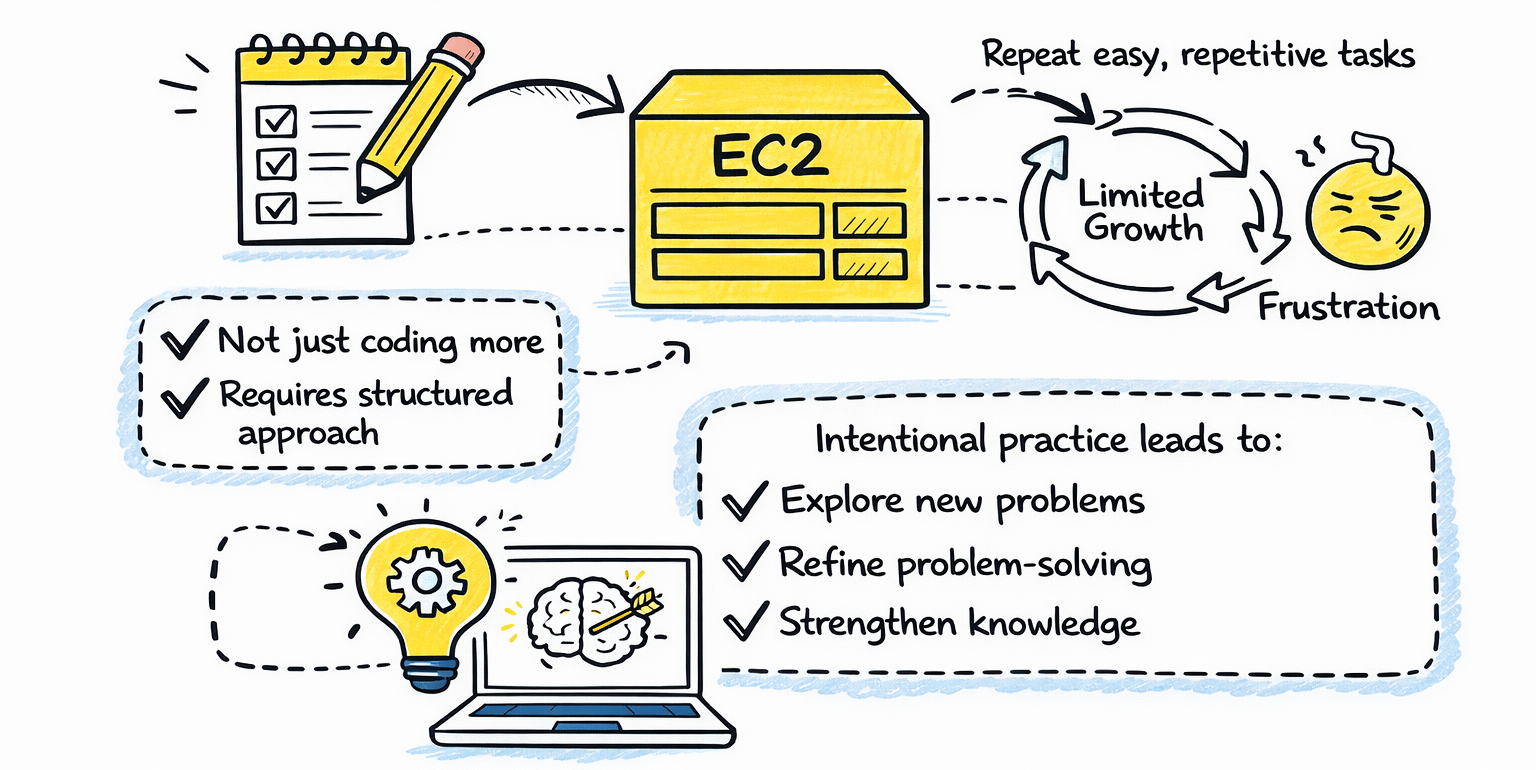
Many developers assume that writing code frequently will automatically make them better programmers when they learn to code. In reality, improvement depends less on quantity and more on how structured and intentional your practice process becomes.
When developers do not understand how to practice coding properly, they often repeat simple tasks that feel productive but do not challenge their understanding. This leads to slow improvement and frustration, particularly when trying to solve complex programming problems or prepare for technical interviews.
Intentional coding practice creates an environment where developers constantly confront new problems, refine problem-solving strategies, and strengthen their understanding of algorithms, data structures, and system architecture. Over time, this structured approach produces significantly stronger programming intuition.
The Different Ways Developers Practice Coding#
Developers improve their skills through several distinct types of coding practice, and each method develops different aspects of programming ability. Some approaches strengthen algorithmic thinking, while others build experience with real-world software development.
The following table illustrates the main practice styles programmers use to improve their skills and the types of abilities each method helps develop.
Practice Method | Focus Area | Skill Developed |
Coding Challenges | Algorithms and logic | Problem solving |
Building Projects | Real applications | Software architecture |
Code Review | Reading existing code | Code quality awareness |
Debugging Practice | Error resolution | Troubleshooting ability |
System Design Exercises | Scalable architecture | High-level design thinking |
Each of these approaches contributes to different parts of programming expertise. Developers who combine several practice styles often develop faster and more balanced technical growth.
Start With Clear Learning Goals#
One of the most overlooked parts of learning how to practice coding is defining clear goals before beginning a practice routine. Without specific goals, developers often drift between tutorials, projects, and exercises without building measurable progress.
A structured goal helps determine what type of practice is most beneficial at a given stage. For example, a beginner learning Python may focus on mastering loops and functions, while an experienced engineer preparing for interviews may concentrate on algorithm optimization and data structure problems.
Clear learning goals also help maintain motivation during challenging practice sessions. When developers understand what skill they are trying to improve, they can evaluate progress more objectively and remain committed to long-term learning.
Build A Consistent Coding Routine#
Consistency plays a much larger role in programming improvement than occasional long practice sessions. Developers who practice coding regularly tend to build stronger mental models of programming concepts because they interact with problems continuously.
A consistent coding schedule does not need to consume many hours each day. Even one focused hour of structured coding practice can produce meaningful improvement when repeated consistently over time.
The table below illustrates an example weekly coding practice routine that balances learning, problem-solving, and project work.
Day | Practice Activity | Goal |
Monday | Solve algorithm problems | Improve logic and patterns |
Tuesday | Work on personal project | Apply concepts in real systems |
Wednesday | Debug existing code | Strengthen troubleshooting |
Thursday | Study data structures | Build a theoretical foundation |
Friday | Implement a mini feature | Reinforce coding fluency |
Weekend | Review and refactor code | Improve readability and design |
This type of balanced routine allows developers to practice coding in multiple contexts while reinforcing both theoretical and practical knowledge.
Practice Problem Solving With Coding Challenges#
Coding challenges represent one of the most effective ways to strengthen logical thinking and algorithmic reasoning. These problems require developers to translate abstract problem statements into efficient code solutions.
When learning how to practice coding through problem solving, developers should focus on understanding patterns instead of memorizing solutions. Problems involving arrays, recursion, graphs, and dynamic programming often share structural similarities that become easier to recognize over time.
Another important habit involves reviewing multiple solutions after solving a challenge. Studying alternative approaches exposes developers to different problem-solving strategies and improves their ability to write more efficient algorithms.
Build Real Projects To Reinforce Learning#
While coding challenges strengthen algorithmic thinking, building projects teaches developers how software systems actually function. Projects require integrating multiple programming concepts into a cohesive system, which develops a deeper understanding.
A project forces developers to work with file structures, databases, APIs, and user interfaces. These elements mirror real development environments and prepare programmers for professional software engineering roles.
The following table shows common project types developers build while practicing coding and the technical concepts they reinforce.
Project Type | Skills Learned | Example Outcome |
Web Application | Frontend and backend integration | Blog platform |
Command Line Tool | Automation and scripting | File organizer |
API Service | Backend development | Task management API |
Mobile App | Cross-platform development | Habit tracking app |
Data Analysis Tool | Data processing | Visualization dashboard |
Projects help translate theoretical programming knowledge into practical development experience. Developers who consistently build projects gain a stronger intuition about system behavior and architecture.
Practice Reading And Understanding Code#
Many developers underestimate the importance of reading code written by other programmers. In professional environments, engineers often spend more time reading and understanding existing codebases than writing entirely new programs.
Learning how to practice coding effectively includes developing the ability to analyze unfamiliar code and quickly understand how different components interact. This skill becomes particularly valuable when working with large production systems.
Code reading exercises can involve exploring open-source repositories, studying library implementations, or reviewing the solutions of experienced developers. Over time, this process improves both coding style and architectural awareness.
Learn Debugging As A Core Programming Skill#
Debugging represents one of the most valuable abilities a developer can develop through coding practice. Many programming problems involve diagnosing errors, analyzing unexpected behavior, and identifying hidden logic mistakes.
When developers learn how to practice coding with debugging exercises, they strengthen analytical thinking and attention to detail. Instead of simply writing code that works initially, they learn how to identify deeper issues in complex programs.
Developers often improve debugging skills by intentionally reviewing broken programs and tracing execution step by step. Understanding why a program fails can be more educational than writing a working solution immediately.
Use Version Control During Coding Practice#
Version control systems such as Git provide valuable learning opportunities during coding practice. Using version control helps developers track changes, review previous implementations, and experiment safely with new ideas.
Practicing coding with version control encourages developers to think about code organization, commit structure, and collaborative workflows. These habits mirror professional engineering environments and help prepare developers for real software development teams.
Maintaining a personal repository of practice projects also creates a record of progress. Reviewing older code often reveals how much programming ability has improved over time.
Measure Progress In Coding Practice#
One challenge many developers face when learning how to practice coding is measuring improvement. Programming ability grows gradually, and progress can feel invisible during short time frames.
Tracking measurable metrics can help maintain motivation and provide evidence of improvement. These metrics might include the number of solved problems, project completion milestones, or reduced debugging time.
The following table shows examples of useful progress indicators developers can track while practicing coding.
Metric | What It Measures | Example Improvement |
Problems Solved | Algorithm familiarity | 10 → 150 problems |
Project Completion | System building experience | 1 → 5 projects |
Debugging Time | Troubleshooting efficiency | 60 min → 15 min |
Code Review Feedback | Code quality improvement | Fewer issues reported |
Tracking progress encourages developers to reflect on their learning journey and maintain long-term discipline.
Balance Learning With Implementation#
A common mistake in coding practice involves consuming too much educational material without writing enough code. Reading tutorials and watching lectures may feel productive, but programming ability only improves through active implementation.
Developers who truly learn how to practice coding maintain a balance between learning concepts and applying them immediately. After studying a new programming topic, writing a small implementation reinforces understanding and reveals gaps in knowledge.
This cycle of learning followed by implementation creates a powerful feedback loop. Developers quickly identify misunderstandings and correct them through hands-on coding experience.
Practice Explaining Code And Concepts#
Teaching others represents one of the most effective methods for reinforcing programming knowledge. When developers explain how a piece of code works, they clarify their own understanding and discover areas that need improvement.
Explaining coding concepts can happen through blog writing, study groups, or mentoring other developers. Each explanation requires organizing technical ideas into clear reasoning, which strengthens conceptual understanding.
Developers who practice explaining code also develop stronger communication skills. This ability becomes particularly valuable during technical interviews and collaborative engineering environments.
Avoid Common Coding Practice Mistakes#
Although learning how to practice coding can dramatically improve programming ability, many developers unintentionally adopt habits that slow their progress. Recognizing these mistakes early helps maintain efficient learning.
One frequent mistake involves repeatedly solving similar problems without expanding difficulty. Developers sometimes remain in comfortable learning zones instead of confronting challenging problems that stretch their skills.
Another mistake involves copying solutions too quickly without attempting independent reasoning. While reviewing solutions is valuable, developers should first struggle with a problem long enough to develop their own thinking process.
Long-Term Growth Through Structured Practice#
Programming mastery develops through years of continuous learning and deliberate practice. Developers who remain curious and disciplined gradually build strong intuition about algorithms, architecture, and software design.
Understanding how to practice coding provides a framework for sustained improvement rather than temporary progress. By combining problem solving, project development, debugging exercises, and code review, developers build a comprehensive programming skill set.
Over time, this structured approach transforms coding practice into professional engineering capability. The skills developed through intentional practice eventually enable developers to design complex systems, solve challenging problems, and contribute meaningfully to software development teams.
Conclusion#
Learning how to practice coding effectively is one of the most valuable steps in becoming a strong developer. Instead of relying on passive tutorials or occasional practice sessions, successful programmers build structured routines that challenge both their logic and creativity.
By combining coding challenges, real projects, debugging exercises, and code analysis, developers create a balanced learning system that develops deep technical ability. Consistency, curiosity, and reflection ultimately turn daily practice into long-term expertise.
Anyone willing to practice coding with discipline and purpose can gradually transform programming knowledge into professional software engineering skills.