How to reduce hallucinations in LLMs
Struggling with unreliable AI outputs? Learn how to reduce hallucinations in LLMs using proven techniques like RAG, prompt design, and validation systems. Build smarter, more trustworthy AI applications today.
Large language models have become powerful tools for generating text, writing code, answering questions, and assisting with research tasks. These systems can summarize documents, help developers debug code, and generate explanations for complex topics. As organizations integrate language models into real-world applications, they increasingly depend on these systems to produce reliable and accurate responses.
However, one of the most widely discussed limitations of language models is their tendency to generate incorrect or fabricated information. These outputs are commonly known as hallucinations, where a model produces responses that sound plausible but are factually inaccurate or unsupported by evidence.
When building AI applications and training LLMs, developers quickly discover that the question of how to reduce hallucinations in LLM systems becomes a central engineering challenge. Hallucinations can undermine trust in AI tools, introduce errors into automated workflows, and cause problems when AI-generated information is used in critical contexts.
Essentials of Large Language Models: A Beginner’s Journey

Large language models (LLMs) are at the core of today’s AI transformation, powering everything from conversational agents to code generation and enterprise automation. As adoption accelerates, understanding how LLMs actually work, and how to use them effectively in real systems, is no longer optional for developers and data professionals. I built this course from my work in neural networks and intelligent systems, where LLMs represent a shift from traditional modeling to probabilistic reasoning at scale. A recurring pattern I observed was that many practitioners could use APIs but lacked a clear mental model of how LLMs process language, make decisions, and fail in edge cases. This course is designed to bridge that gap with a systems-level perspective. You’ll learn LLM fundamentals from first principles, covering architecture, tokenization, embeddings, attention, and training dynamics, before moving into practical workflows like prompting, retrieval-augmented generation (RAG), and tool integration. Each concept is tied to how LLMs are actually deployed in production systems. Engineers and researchers are already building on these foundations to create real-world AI applications. If you want to go beyond surface-level usage of LLMs, this is where you begin.
Addressing hallucinations requires both an understanding of why they occur and the implementation of architectural strategies that improve reliability and factual grounding.
LLM hallucinations explained#
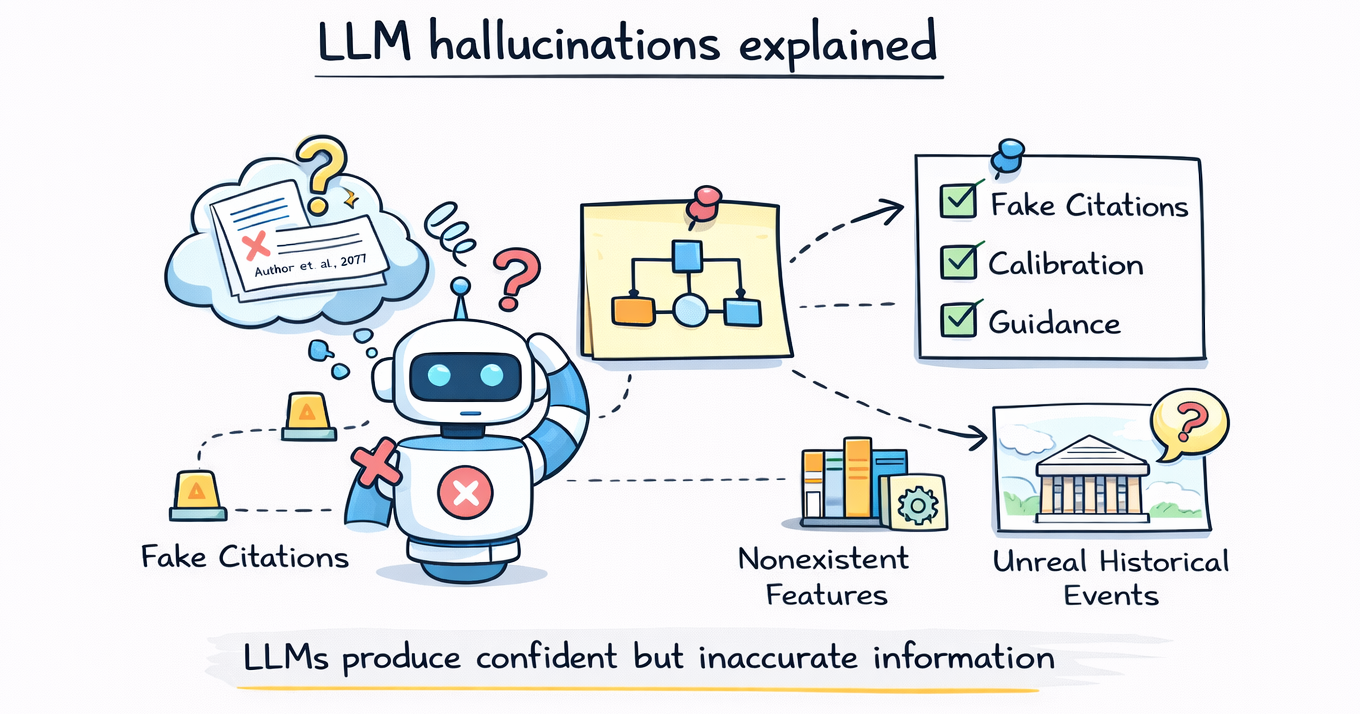
Hallucinations occur when a large language model generates information that is not grounded in the model’s training data or the context provided in the prompt. Because these models are trained to generate fluent language, they sometimes produce statements that appear credible even when they are incorrect.
This behavior can appear in several forms. A model may invent citations for academic papers that do not exist. It may describe technical features of a software library that were never implemented. It might even fabricate historical events or scientific explanations that have no factual basis.
What makes hallucinations particularly problematic is that the generated output often sounds confident and authoritative. Unlike traditional software systems that fail with clear error messages, language models typically attempt to produce an answer even when they lack sufficient knowledge.
For developers building AI-powered tools, understanding how to reduce hallucinations in LLM applications is therefore essential for maintaining accuracy and user trust.
Become an LLM Engineer

Generative AI is transforming industries, revolutionizing how we interact with technology, automate tasks, and build intelligent systems. With large language models (LLMs) at the core of this transformation, there is a growing demand for engineers who can harness their full potential. This Skill Path will equip you with the knowledge and hands-on experience needed to become an LLM engineer. You’ll start with the generative AI and prompt engineering to communicate with AI models. Then you’ll learn to interact with AI models, store and retrieve information using vector databases, and build AI-powered workflows with LangChain. Next, you’ll learn to enhance AI responses with retrieval-augmented generation (RAG), fine-tune models using LoRA and QLoRA, and develop AI agents with CrewAI to automate complex tasks. By the end, you’ll have the expertise to design, optimize, and deploy LLM-powered solutions, positioning yourself at the forefront of AI innovation.
Causes of hallucinations#
Hallucinations arise from the fundamental design of large language models and the way they generate text.
Language models generate responses using probabilistic token prediction. When given an input prompt, the model predicts the most likely next word based on patterns learned during training. While this process produces coherent language, it does not guarantee factual correctness.
Another contributing factor is the model’s limited access to external knowledge. Once training is complete, a language model cannot dynamically retrieve new information unless external systems provide it.
Ambiguous or incomplete prompts can also increase hallucination risk. If the model receives insufficient context, it may attempt to fill in missing information using patterns learned during training.
Overgeneralization from training patterns also contributes to hallucinations. Models may combine fragments of information from different contexts and produce outputs that appear plausible but do not correspond to real facts.
These factors collectively explain why developers must actively design systems that address hallucination risks rather than relying solely on the language model itself.
Common causes of hallucinations in LLM systems#
In practical deployments, several common scenarios increase the likelihood of hallucinated responses.
One common scenario occurs when users ask questions outside the model’s training knowledge. If the model lacks information about a particular topic, it may still attempt to produce a response by generating plausible language.
Another situation arises when prompts lack sufficient context. Without clear instructions or supporting information, the model may infer details incorrectly.
Hallucinations also appear when models are asked to provide precise factual information, such as statistics, dates, or citations. If the model does not recall the exact information, it may generate approximate or fabricated details.
Speculative prompts can also trigger hallucinations. When users ask the model to imagine possibilities or infer unknown facts, the model may produce answers that appear authoritative but are not grounded in evidence.
Recognizing these scenarios helps developers anticipate when hallucinations are most likely to occur.
Techniques to reduce hallucinations #
Developers have developed several techniques to reduce hallucinations and improve the reliability of language model outputs.
Retrieval-augmented generation (RAG)#
Retrieval-Augmented Generation connects language models to external knowledge sources. When a user submits a question, the system retrieves relevant documents from a knowledge base and includes them in the model’s prompt.
By grounding responses in retrieved documents, the model is less likely to invent information. Instead, it generates answers based on actual data retrieved from the knowledge source.
Improved prompt design#
Prompt design can significantly influence model behavior. Clear instructions that define the task, specify constraints, and request citations can reduce ambiguity.
For example, prompts that instruct the model to answer only using provided context often produce more reliable outputs.
Output verification systems#
Some architectures include secondary models or validation systems that evaluate generated responses. These systems may check whether the answer aligns with retrieved documents or detect contradictions within the response.
Verification layers provide an additional safeguard before presenting results to users.
Tool-assisted reasoning#
Integrating external tools allows language models to access reliable sources rather than guessing answers. Tools may include search engines, calculators, code interpreters, or structured databases.
By querying external systems, the model can verify information rather than relying solely on probabilistic generation.
These techniques collectively provide practical answers to the question of how to reduce hallucinations in LLM deployments.
Mitigation techniques comparison table#
Technique | Purpose | Benefit |
Retrieval-augmented generation | Adds external knowledge | Improves factual grounding |
Prompt engineering | Clarifies model instructions | Reduces ambiguity |
Output verification | Validates generated answers | Detects incorrect responses |
Tool integration | Allows models to query external systems | Improves reliability |
In many cases, the most effective systems combine several of these techniques rather than relying on a single approach.
Engineering best practices#
Reducing hallucinations requires careful engineering beyond simply choosing a language model.
One best practice involves designing prompts with explicit constraints. Instructions that require the model to cite sources or acknowledge uncertainty can reduce speculative responses.
Another strategy is limiting situations where the model must guess unknown information. If the system cannot retrieve supporting evidence, it should return an explanation indicating that the answer is unavailable.
Knowledge retrieval systems also play an important role. By providing relevant context to the model during inference, developers can significantly improve factual accuracy.
Monitoring and logging generated outputs is another important practice. Observability tools allow developers to detect hallucination patterns and improve system prompts or retrieval strategies.
These engineering strategies provide practical solutions for teams working to determine how to reduce hallucinations in LLM-based applications.
Real-world System Design examples#
Many real-world AI systems already implement hallucination mitigation techniques.
Enterprise knowledge assistants often rely on retrieval pipelines that connect language models to internal documentation. By retrieving relevant documents before generating responses, these systems ensure that answers are grounded in organizational knowledge.
AI coding assistants also implement safeguards to reduce hallucinations. These systems often reference official documentation or repository code when generating programming suggestions.
Research tools that summarize academic papers frequently include citations alongside generated summaries. Providing sources allows users to verify the information presented by the model.
These examples demonstrate that reliable AI systems typically combine multiple safeguards rather than relying solely on the language model itself.
Conclusion#
Large language models have transformed how developers build intelligent applications, but hallucinated responses remain one of the most significant challenges when deploying these systems in production environments.
Understanding how to reduce hallucinations in LLM systems requires both a conceptual understanding of why hallucinations occur and practical engineering strategies that improve reliability. Techniques such as retrieval-augmented generation, structured prompt design, verification systems, and tool integration help ground model outputs in real information.
By combining these approaches within thoughtfully designed system architectures, developers can significantly reduce hallucinated responses and build AI systems that produce more accurate, trustworthy, and useful results.
Happy learning!
