How to start learning bioinformatics programming with Python
Want to learn bioinformatics programming with Python? Discover a step-by-step roadmap covering Python basics, biology foundations, Biopython, data analysis, real-world projects, and research-ready skills.
If you are curious about bioinformatics programming with Python, you are standing at the intersection of biology and computation. That intersection is one of the most exciting and rapidly evolving spaces in science today. From genome sequencing to drug discovery, bioinformatics drives modern breakthroughs.
You might be coming from a biology background with limited coding experience. Or you may be a programmer who wants to work with biological data. In either case, the path can feel overwhelming at first. There are unfamiliar file formats, domain-specific terminology, and large datasets that do not resemble anything you have seen before.
The good news is that Python has become one of the most widely used languages in bioinformatics. Its readability, rich ecosystem, and scientific libraries make it an ideal starting point. The key is to approach learning in a structured and intentional way.
Bioinformatics Algorithms

Bioinformatics is an interdisciplinary field spanning diverse domains like biology, statistics, and computer science. It focuses on developing algorithms that extract useful information from biological data. These insights help address critical issues like waste cleanup, vaccine development, and climate change. This course focuses on algorithmic principles driving advances in bioinformatics. It starts by introducing the learner to important concepts in genomics, such as DNA replication, genome assembly, and comparing genetic sequences. It applies concepts from algorithm design to genomics, like Eulerian paths, de Bruijn graphs, and longest common subsequences. It includes coding challenges, as well as sections on additional insights and thought-provoking questions. By the end of this course, you’ll have a basic knowledge of genomics. You’ll be able to apply a diverse set of algorithms to biological data to get insights and also be introduced to various open problems in this field.
This blog will walk you through how to start learning bioinformatics programming with Python step by step, without drowning in jargon or skipping essential foundations.
Understanding what bioinformatics programming involves#
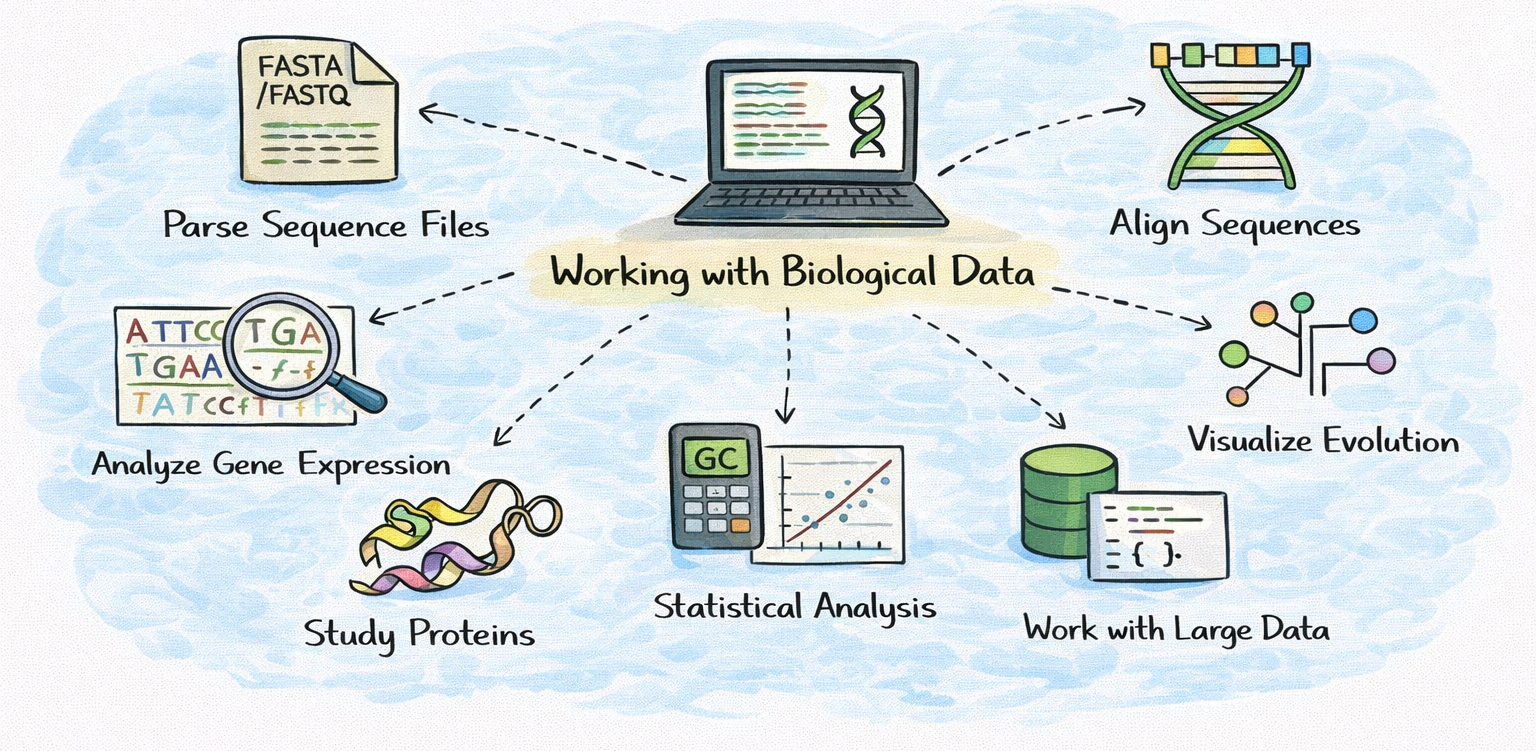
Before diving into tools and libraries, it is important to understand what bioinformatics programming actually looks like in practice.
Bioinformatics is not just writing scripts to analyze DNA sequences. It involves working with biological data at scale, including genomic sequences, protein structures, gene expression matrices, and evolutionary trees. These datasets are often large, messy, and stored in specialized formats.
When you program in bioinformatics, you might parse FASTA or FASTQ files, align sequences, compute GC content, analyze gene expression differences, or visualize phylogenetic trees. You will often combine programming skills with statistical reasoning and biological insight.
Understanding this broader picture helps you design your learning roadmap realistically.
Step 1. Build a solid Python foundation#
If you are completely new to Python, your first priority should be mastering the basics.
You need to understand variables, loops, functions, and conditionals. You should be comfortable with lists, dictionaries, and file handling. Bioinformatics frequently involves reading large files line by line and processing structured text.
You also need to become familiar with scientific libraries such as NumPy and pandas. These libraries allow you to manipulate arrays and tabular data efficiently, which is crucial when working with gene expression matrices or sequencing metadata.
Learn Python
Python has become the foundation for everything from data science and automation to modern AI workflows. Yet many beginners struggle to learn Python because they spend too much time watching and not enough time building. This course is designed for a different kind of learner, one who wants to learn Python by doing, not just observing, and to build skills that remain relevant in an AI-driven development landscape. I built this course from my experience teaching and designing interactive learning systems at Educative. Across classrooms and platforms, I saw the same pattern: learners could follow tutorials, but struggled to apply concepts independently. The problem was the approach. This course is built on a simple principle: you learn Python best when you write, test, and refine code continuously. You’ll start with core fundamentals, variables, control flow, functions, and data structures, through hands-on exercises that reinforce real understanding. As you progress, you’ll build practical projects like a chatbot and an expense tracker. The course also introduces how to learn Python alongside AI tools, including prompting, debugging, and validating generated code in real workflows. If your goal is to learn Python in a way that prepares you to build real applications and work effectively with AI, this course gives you that foundation from day one.
Here is a foundational comparison of Python skills and their bioinformatics relevance:
Python Skill | Why It Matters in Bioinformatics |
File I/O | Parsing FASTA, FASTQ, and annotation files |
Lists and dictionaries | Storing sequence data and metadata |
NumPy arrays | Handling numerical biological datasets |
Pandas DataFrames | Managing gene expression tables |
Functions | Writing reusable analysis pipelines |
Without this base, advanced topics will feel unnecessarily difficult.
Step 2. Learn core biological concepts#
If you come from a programming background, you need to invest time in biological fundamentals.
Understanding DNA, RNA, proteins, genes, transcription, translation, and mutation is essential. You should know what a genome is and how sequencing works at a high level. You should understand what alignment means and why it matters.
Bioinformatics programming is not just about manipulating strings of A, T, C, and G. It is about understanding the biological meaning behind those sequences.
When you learn biology alongside programming, your code becomes more informed. You start asking meaningful questions instead of just performing transformations mechanically.
Step 3. Explore Biopython#
Once you have Python fundamentals and basic biology knowledge, Biopython becomes your first major tool.
Biopython is a powerful library designed specifically for bioinformatics tasks. It provides tools for sequence parsing, alignment, phylogenetics, and accessing biological databases.
For example, you can use Biopython to read FASTA files, compute sequence statistics, and fetch data from online repositories such as NCBI. Instead of writing custom parsers for every file format, you rely on tested abstractions.
Learning Biopython introduces you to domain-specific programming patterns. You begin to see how Python integrates with biological workflows seamlessly.
Working with common bioinformatics file formats#
One of the early challenges in bioinformatics programming is understanding file formats.
You will encounter formats such as FASTA, FASTQ, SAM, BAM, GFF, and VCF. Each format serves a specific purpose in genomic workflows. Some store raw sequences, others store alignment results, and others represent genomic annotations.
Instead of memorizing all formats at once, start with FASTA and FASTQ. Learn how sequences are structured and how quality scores are represented.
Here is a simplified overview:
File Format | Purpose |
FASTA | Stores nucleotide or protein sequences |
FASTQ | Stores sequences with quality scores |
SAM/BAM | Stores alignment information |
GFF | Stores genomic feature annotations |
VCF | Stores genetic variation data |
Understanding these formats gives context to the scripts you write.
Step 4. Learn data analysis with pandas and NumPy#
Bioinformatics often involves statistical analysis of large datasets.
Gene expression studies, for example, produce matrices with thousands of genes and multiple samples. You need to filter, normalize, and transform these datasets before interpreting them.
Pandas allows you to manipulate tabular biological data efficiently. NumPy enables fast numerical operations. Together, they form the backbone of data-driven bioinformatics workflows.
You should practice loading datasets, filtering rows based on biological criteria, computing summary statistics, and visualizing trends.
This stage bridges the gap between raw sequence processing and analytical insight.
Step 5. Incorporate visualization#
Visualization is critical in bioinformatics.
Whether you are plotting gene expression levels, visualizing mutation frequencies, or mapping phylogenetic trees, graphical representation helps you interpret complex data.
Libraries such as Matplotlib and Seaborn integrate naturally with pandas. You can create publication-quality plots directly from your analysis pipeline.
Visualization transforms numbers into insight. It also strengthens your ability to communicate findings clearly.
Step 6. Build small projects#
Projects accelerate learning dramatically.
Instead of following tutorials passively, design small bioinformatics projects. For example, you might write a script that calculates GC content across multiple genomes and visualizes the distribution. You might build a pipeline that filters low-quality sequencing reads.
Projects force you to combine multiple concepts. You parse files, manipulate data structures, perform analysis, and generate output.
Here is how learning modes compare in depth:
Learning Mode | Skill Development Depth |
Watching tutorials | Low |
Solving isolated exercises | Moderate |
Building end-to-end projects | High |
Projects make your skills tangible and portfolio-ready.
Step 7. Explore real-world datasets#
At some point, you need to work with authentic datasets.
Public repositories such as NCBI and EMBL provide real sequencing data. Download a small dataset and attempt to process it independently. Expect confusion. That confusion is part of growth.
Real-world datasets introduce irregularities that no tutorial anticipates. You will debug parsing issues, handle missing annotations, and rethink assumptions.
This exposure builds resilience and confidence.
Step 8. Learn basic statistics and machine learning#
Bioinformatics increasingly overlaps with data science.
Understanding basic statistics such as hypothesis testing, p-values, and regression is essential. You may also encounter clustering algorithms, dimensionality reduction techniques, and classification models.
Python libraries such as SciPy and scikit-learn make these tasks accessible. Integrating statistical reasoning with biological context allows you to interpret results meaningfully.
Programming skills alone are not enough. Analytical thinking completes the picture.
Building a structured learning roadmap#
To avoid overwhelm, structure your journey into phases.
Phase | Focus |
Phase 1 | Python fundamentals |
Phase 2 | Basic molecular biology concepts |
Phase 3 | Biopython and file parsing |
Phase 4 | Data analysis with pandas and NumPy |
Phase 5 | Visualization and small projects |
Phase 6 | Real datasets and statistical analysis |
Following this progression ensures steady growth.
Common mistakes to avoid#
Many beginners try to learn everything at once. They jump into advanced genomic analysis without mastering file handling. Others focus solely on coding without understanding the biological meaning.
Another common mistake is avoiding real datasets because they feel intimidating. Real data teaches more than curated examples.
Patience and structure are your allies.
Final thoughts#
So, how can you start learning bioinformatics programming with Python?
Begin with solid Python fundamentals. Learn core biological concepts. Explore Biopython. Understand common file formats. Practice data analysis with pandas and NumPy. Visualize results. Build small projects. Work with real datasets. Incorporate statistics gradually.
Bioinformatics programming is not mastered overnight. It is built step by step, through curiosity and persistence.
If you stay consistent and approach learning intentionally, you will gradually move from writing simple sequence scripts to designing meaningful biological analysis pipelines.
And once you reach that point, you are not just coding. You are contributing to scientific discovery.