How to start learning Node.js from scratch
Ready to start learning Node.js? Discover the complete roadmap for beginners, including essential skills, tools, and projects that help you build real backend applications with JavaScript and Node.js.
Modern web development increasingly relies on technologies that can support scalable applications, real-time communication, and cloud-based services. As organizations continue to build complex digital platforms, developers need backend tools that allow applications to process large volumes of data and user requests efficiently.
Node.js has become one of the most widely used technologies for building server-side applications using JavaScript. Developers often search for guidance on how to start learning Node.js because it allows them to build both frontend and backend systems using the same programming language.
Learning Node.js opens the door to building APIs, web servers, and microservices that power modern web applications. However, beginners often feel uncertain about where to begin and which concepts to focus on first.
This guide explains how to start learning Node.js by exploring the foundational skills required, the tools developers need, the learning path for mastering Node.js, and the practical projects that help reinforce these concepts.
Learn Node.js
Modern applications rely on fast, scalable backend services, and Node.js has become one of the most widely used platforms for building them. From APIs and microservices to real-time applications, companies expect developers to understand asynchronous programming, networking, and production-ready server architecture. This course provides a structured path to developing the Node.js skills used in modern backend engineering. I built this course from my experience working on large-scale distributed systems for seven years at Microsoft, and later co-founding Educative. One challenge I consistently observed was that many developers could build simple Node.js applications but struggled to understand what happens behind the scenes. Rather than focusing only on frameworks, this course emphasizes the core runtime concepts that help you reason about performance, scalability, and maintainability. You'll begin by learning Node.js fundamentals, modules, and server-side JavaScript before diving into asynchronous programming with callbacks, Promises, async/await, and the event loop. From there, you'll explore event-driven programming, file systems, buffers, streams, HTTP servers, routing, REST APIs, PostgreSQL integration, JWT authentication, WebSockets, and automated testing with Jest. Throughout the course, interactive lessons and hands-on exercises reinforce each concept, culminating in a capstone project in which you'll build a production-style REST API capable of storing, filtering, and serving JSON data in multiple formats. Thousands of developers have used Educative's interactive learning platform to build practical software engineering skills and advance their careers. If you want to become a confident Node.js backend developer who understands not just how to write code but why it works, this course is the right place to start.
Understanding Node.js Before You Begin#
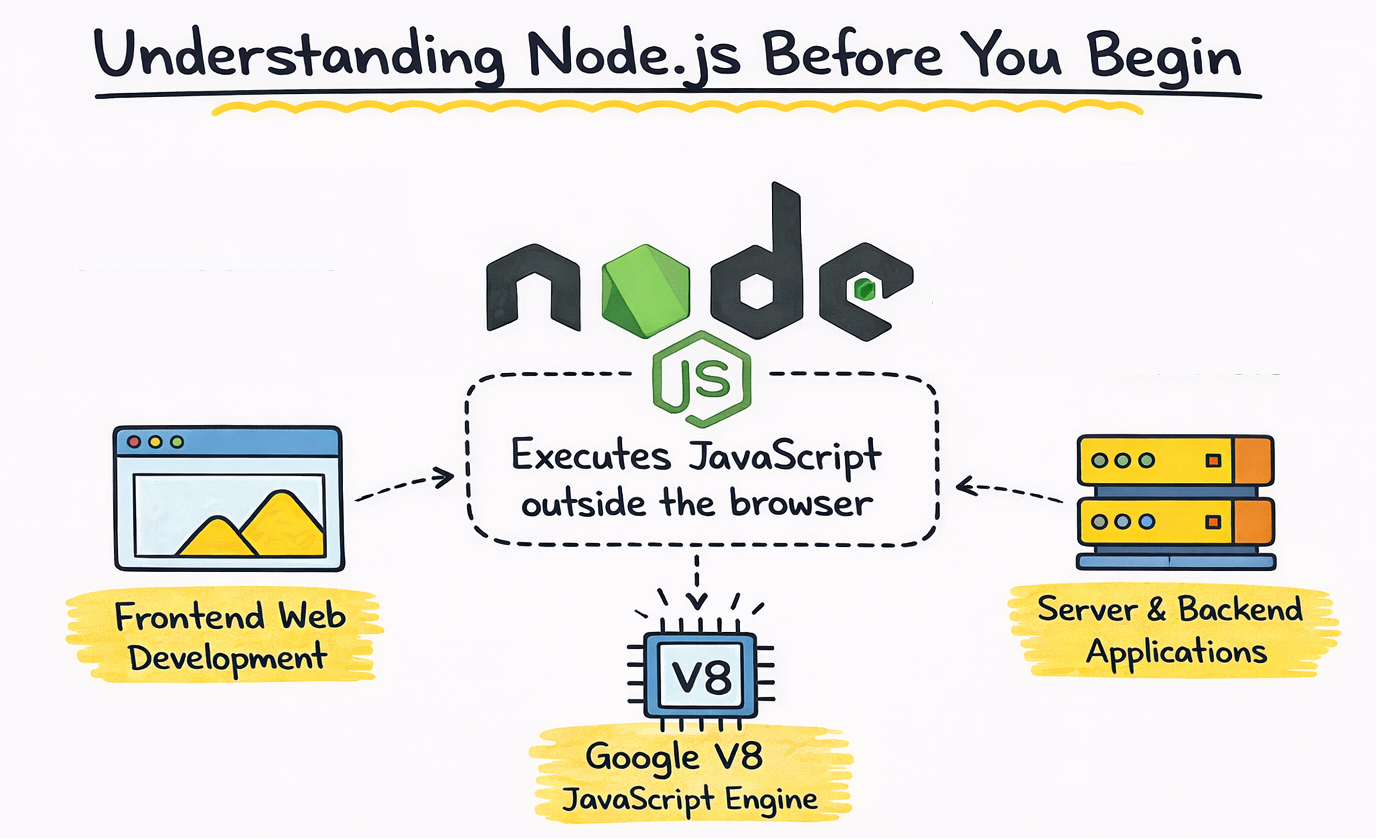
Before exploring how to start learning Node.js, it is important to understand what Node.js represents in the modern software development ecosystem. Node.js is a runtime environment that allows developers to execute JavaScript outside the browser.
Traditionally, JavaScript was limited to frontend web development, where it powered interactive user interfaces. Node.js expanded JavaScript’s capabilities by enabling developers to build server applications and backend systems.
The runtime environment is built on Google’s V8 JavaScript engine, which compiles JavaScript code into machine code for fast execution. This architecture allows Node.js to process large numbers of requests efficiently while maintaining strong performance.
Understanding these basic concepts helps beginners appreciate why Node.js has become such an important technology in modern web development.
Why Developers Choose Node.js#
Understanding how to start learning Node.js also involves recognizing why developers and organizations widely adopt this technology. Node.js allows developers to use JavaScript for both frontend and backend development, which simplifies the process of building complete applications.
Another important advantage involves performance. Node.js uses an event-driven architecture that processes requests asynchronously, allowing applications to handle many simultaneous operations.
The Node.js ecosystem also includes one of the largest collections of open-source libraries available through npm, the Node Package Manager. These libraries allow developers to integrate powerful features into applications without building everything from scratch.
Because of these advantages, Node.js has become a key technology used in modern web development and cloud infrastructure.
Become a Node.js Developer
Node.js is a powerful JavaScript runtime built for creating fast, scalable applications. This Skill Path gives you a comprehensive foundation, starting with core Node.js concepts like HTTP, databases, JWT, and WebSockets. Then, you’ll dive into Express.js to build RESTful APIs, implement authentication, validation, real-time communication, and structured logging. Next, you’ll build full stack applications with the MERN stack (MongoDB, Express, React, Node). Finally, you’ll learn Node.js design patterns to architect robust, maintainable back-end systems with confidence.
Skills You Should Learn Before Node.js#
When exploring how to start learning Node.js, beginners should first focus on mastering JavaScript fundamentals. Since Node.js uses JavaScript as its primary programming language, understanding the language is essential.
Developers should become comfortable with variables, functions, arrays, objects, and control structures before learning Node.js. These core programming concepts provide the foundation for building backend applications.
Another important concept involves asynchronous programming. Node.js relies heavily on asynchronous operations, so developers must understand callbacks, promises, and async functions.
The table below highlights key skills that help developers begin learning Node.js effectively.
Skill Area | Importance |
JavaScript Fundamentals | Essential |
Asynchronous Programming | Very Important |
Basic Web Development Concepts | Important |
Understanding APIs | Important |
Database Fundamentals | Helpful |
Developers who strengthen these skills before starting Node.js often progress more quickly through the learning process and ace their Node.js interviews.
Setting Up The Node.js Development Environment#
The next step in learning how to start learning Node.js involves setting up a development environment. Installing Node.js on a computer provides access to the runtime environment and the npm package manager.
Node.js installations typically include both the Node runtime and npm, which allows developers to install libraries and manage project dependencies. Once installed, developers can begin running JavaScript code outside the browser.
Many developers also install code editors that simplify the development process. Popular editors provide features such as syntax highlighting, debugging tools, and code suggestions.
The table below lists common tools used when working with Node.js.
Tool | Purpose |
Node.js Runtime | Executes JavaScript Code |
npm | Manages Packages And Dependencies |
Code Editor | Writing And Editing Code |
Terminal | Running Node Commands |
A properly configured development environment makes it easier to begin experimenting with Node.js applications.
Learning Core Node.js Concepts#
After setting up the development environment, developers learning how to start learning Node.js should focus on core concepts that define how Node.js applications work. One important concept involves modules.
Node.js applications use modules to organize code into reusable components. Modules allow developers to separate application functionality into independent files, which improves code organization and maintainability.
Another important concept involves the Node.js event loop. The event loop manages asynchronous operations and allows Node.js applications to process multiple requests without blocking execution.
Developers must also learn how Node.js interacts with the file system and network requests. These capabilities allow Node.js applications to read files, process data, and communicate with external services.
Understanding these concepts forms the foundation for building real Node.js applications.
Creating Your First Node.js Server#
A practical way to understand how to start learning Node.js involves building a simple server application. Node.js includes built-in modules that allow developers to create HTTP servers capable of responding to client requests.
Developers can use the built-in HTTP module to create servers that listen for incoming requests from web browsers or other applications. These servers process requests and return responses such as HTML pages or JSON data.
Building a basic server helps developers understand how backend systems interact with client applications. This knowledge is essential for developing APIs and web services.
After creating a simple server, developers can experiment with routing requests and returning different responses based on request parameters.
Understanding Node.js Frameworks#
As developers progress in learning how to start learning Node.js, they often begin using frameworks that simplify application development. Frameworks provide structured tools that help developers build scalable applications more efficiently.
One of the most popular frameworks used with Node.js is Express. Express simplifies the process of creating web servers, handling requests, and managing application routes.
Using frameworks allows developers to focus on application logic rather than low-level server configuration. Express also supports middleware functions that process requests before they reach the application logic.
Learning frameworks such as Express significantly accelerates the development process for Node.js applications.
Building APIs With Node.js#
Another important stage in learning how to start learning Node.js involves building APIs. APIs allow applications to communicate with each other by sending structured data through HTTP requests.
Node.js is widely used for creating REST APIs that power web and mobile applications. These APIs allow frontend applications to request data from backend servers.
Developers typically create API endpoints that respond to requests such as retrieving data, creating new records, or updating information in a database. Node.js frameworks simplify the process of building these endpoints.
Learning API development allows developers to build backend systems capable of supporting modern web applications.
Connecting Node.js Applications To Databases#
Most real-world applications require persistent data storage, which means developers must learn how to connect Node.js applications to databases. Databases allow applications to store user information, application content, and operational data.
Node.js supports many database technologies, including relational and non-relational systems. Developers often choose databases based on application requirements and data structure.
The table below shows several commonly used databases with Node.js.
Database | Type |
MongoDB | Document Database |
PostgreSQL | Relational Database |
MySQL | Relational Database |
Redis | In-Memory Database |
Learning database integration helps developers build full backend systems capable of managing large datasets.
Building Real Projects To Reinforce Learning#
Developers exploring how to start learning Node.js benefit greatly from building real projects. Practical projects reinforce theoretical concepts and expose developers to real-world challenges.
One common beginner project involves building a simple REST API that manages user data. This type of project introduces routing, database integration, and error handling.
More advanced projects may include authentication systems, real-time chat applications, or file upload services. These projects help developers understand how multiple backend components interact.
Hands-on development provides experience that reading documentation alone cannot deliver.
Learning Node.js Ecosystem Tools#
The Node.js ecosystem includes many tools that help developers build, test, and deploy applications. Understanding these tools is an important part of learning how to start learning Node.js effectively.
Package management tools allow developers to install libraries and manage dependencies. Testing tools help ensure application reliability by verifying that code behaves as expected.
Deployment tools allow developers to run Node.js applications in cloud environments where they can handle real user traffic. These tools support modern development workflows and continuous integration systems.
Learning these tools gradually improves productivity and application reliability.
How Long It Takes To Start Using Node.js Effectively#
Many developers who ask how to start learning Node.js also want to know how long it takes to become comfortable with the technology. Learning timelines vary depending on prior programming experience.
Developers who already understand JavaScript often learn basic Node.js concepts within a few weeks. Building more advanced applications may require several months of consistent practice.
Beginners with no programming experience may require additional time to master JavaScript fundamentals before moving into backend development.
With consistent study and hands-on practice, most developers can begin building functional Node.js applications within a relatively short period of time.
Career Opportunities After Learning Node.js#
Learning Node.js opens several career opportunities for developers interested in backend or full-stack development. Many organizations use Node.js to build APIs, web servers, and microservice architectures.
Node.js developers often work in roles such as backend engineer, full-stack developer, or API developer. These roles involve building scalable systems that support web applications and mobile platforms.
Because Node.js integrates well with modern frontend frameworks, developers who learn Node.js can build complete web applications from start to finish.
The growing demand for scalable web platforms ensures that Node.js remains a valuable skill for software developers.
Final Thoughts#
Understanding how to start learning Node.js allows developers to approach backend development with a clear learning path. By mastering JavaScript fundamentals, exploring Node.js architecture, and building real projects, developers can gradually develop the skills needed to create scalable applications.
Node.js offers a powerful platform for building APIs, web servers, and real-time systems that support modern digital services. Its event-driven architecture and large ecosystem of libraries make it one of the most widely adopted backend technologies today.
For developers interested in full-stack development, learning Node.js provides the tools necessary to build complete web applications using a single programming language. With consistent practice and real-world experimentation, mastering Node.js becomes an achievable goal.
