Popular Node.js projects to start building your backend skills
This blog shows how to choose Node.js projects by focusing on projects that build real backend skills, grow in complexity, and align with your goals.
You’ve learned the basics of Node.js. You understand how to create a server, handle routes, and maybe even connect to a database. On the surface, it feels like you’re ready to move forward. But when you try to figure out what to build next, things become unclear.
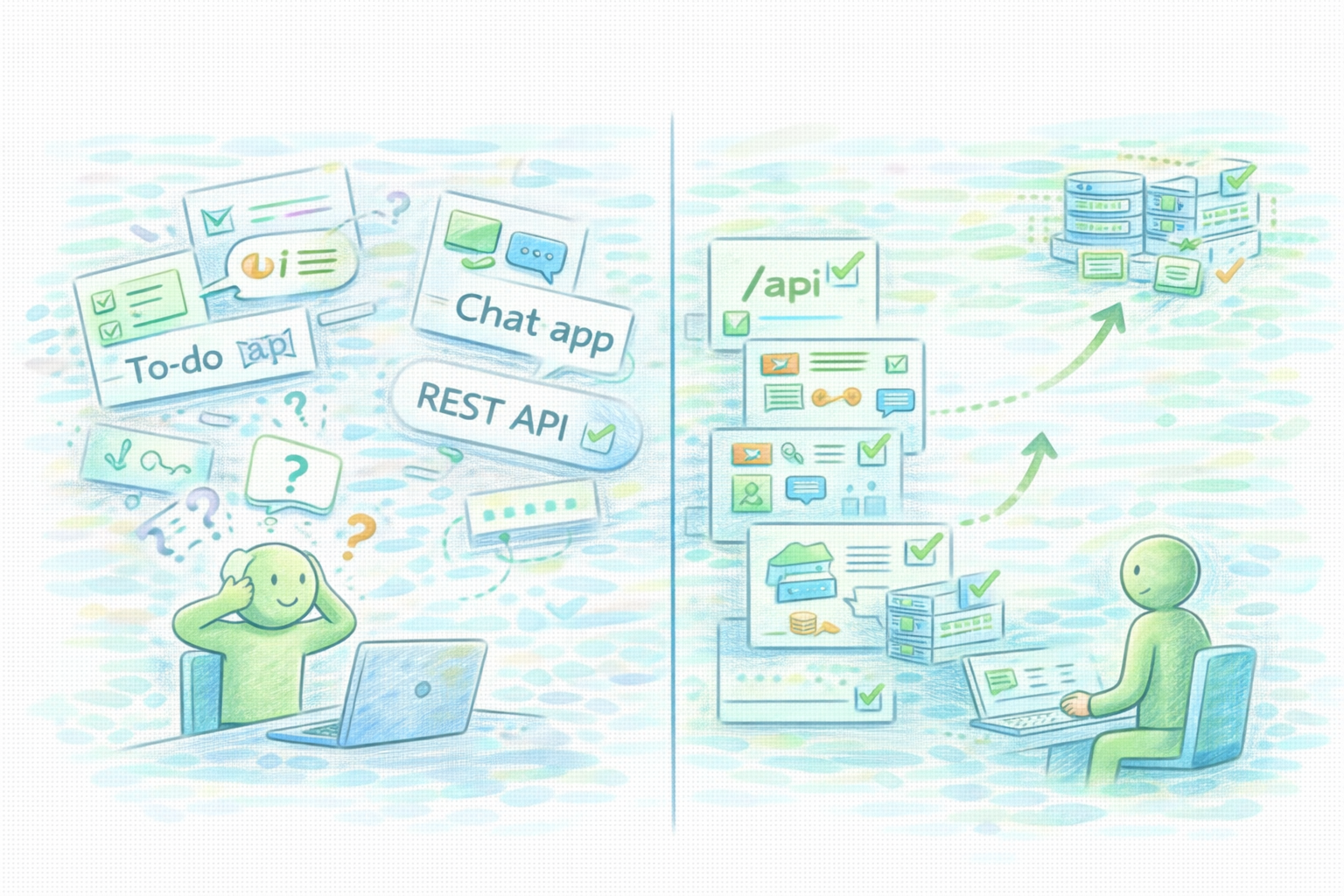
You search online and find countless suggestions—“build a to-do app,” “create a REST API,” “make a chat app.” At first, these sound helpful. But after a while, you realize that simply picking random projects doesn’t necessarily improve your skills in a meaningful way.
This is where the question becomes more important than it first appears: What are some popular Node.js projects to start with? The answer isn’t about listing project ideas. It’s about understanding how to choose projects that actually push your skills forward and prepare you for real backend development.
Modern applications rely on fast, scalable backend services, and Node.js has become one of the most widely used platforms for building them. From APIs and microservices to real-time applications, companies expect developers to understand asynchronous programming, networking, and production-ready server architecture. This course provides a structured path to developing the Node.js skills used in modern backend engineering. I built this course from my experience working on large-scale distributed systems for seven years at Microsoft, and later co-founding Educative. One challenge I consistently observed was that many developers could build simple Node.js applications but struggled to understand what happens behind the scenes. Rather than focusing only on frameworks, this course emphasizes the core runtime concepts that help you reason about performance, scalability, and maintainability. You'll begin by learning Node.js fundamentals, modules, and server-side JavaScript before diving into asynchronous programming with callbacks, Promises, async/await, and the event loop. From there, you'll explore event-driven programming, file systems, buffers, streams, HTTP servers, routing, REST APIs, PostgreSQL integration, JWT authentication, WebSockets, and automated testing with Jest. Throughout the course, interactive lessons and hands-on exercises reinforce each concept, culminating in a capstone project in which you'll build a production-style REST API capable of storing, filtering, and serving JSON data in multiple formats. Thousands of developers have used Educative's interactive learning platform to build practical software engineering skills and advance their careers. If you want to become a confident Node.js backend developer who understands not just how to write code but why it works, this course is the right place to start.
Why projects matter more than tutorials#
Tutorials are useful when you’re getting started. They show you how things work and help you build confidence with basic concepts. But they often guide you step by step, leaving little room for independent thinking. You follow instructions, write code, and reach a working result—but you don’t always understand why decisions were made.
Projects change that dynamic completely. When you build something on your own, you are responsible for every decision. You choose how to structure your code, how to handle errors, and how to connect different parts of the system. This forces you to think like an engineer rather than a learner.
Imagine building a simple API from scratch. There’s no predefined path. You need to decide how to organize routes, how to manage data, and how to handle edge cases. These decisions are where real learning happens. Over time, this process builds intuition that tutorials alone cannot provide.
Understanding what makes a good learning project#
Not all projects are equally valuable. A good learning project is not defined by how impressive it looks, but by how much it challenges your understanding. It should push you slightly beyond your current skill level without overwhelming you completely.
A strong project introduces real backend concerns. This includes handling data, designing APIs, managing state, and dealing with errors. These are the kinds of problems you’ll encounter in real-world applications, and they are what make a project meaningful from a learning perspective.
Another important aspect is progression. Your projects should evolve over time. You might start with something simple, then gradually add features, improve structure, and optimize performance. This iterative approach helps you build depth rather than just completing isolated tasks.
What are some popular Node.js projects to start with?#
Some projects focus on building APIs, which help you understand request handling, routing, and database integration. Others involve real-time communication, which introduces concepts like event-driven systems and WebSockets. There are also data-driven projects that require you to process and manage information efficiently.
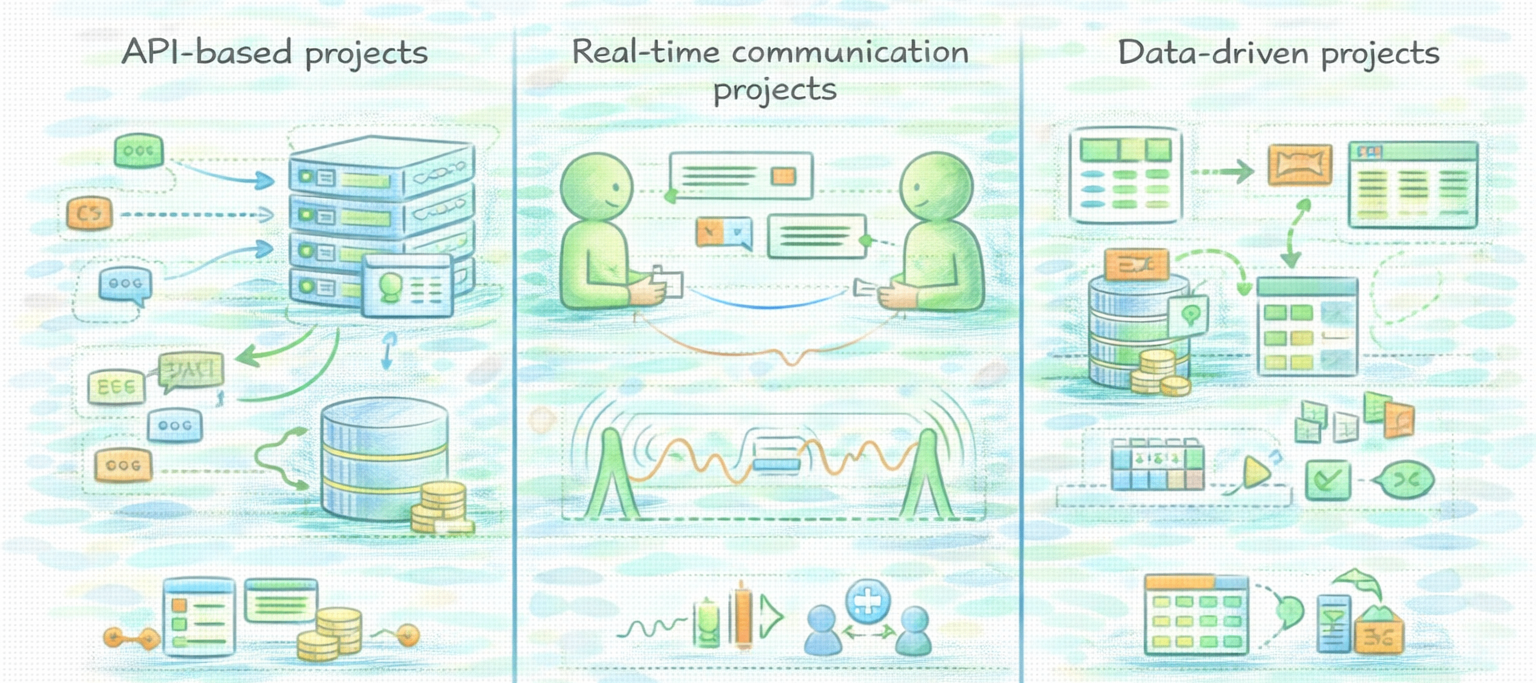
Each category teaches a different aspect of backend development. By understanding these categories, you can choose projects that align with your current level and your long-term goals. This approach is far more effective than randomly picking ideas from a list.
Node.js is a powerful JavaScript runtime built for creating fast, scalable applications. This Skill Path gives you a comprehensive foundation, starting with core Node.js concepts like HTTP, databases, JWT, and WebSockets. Then, you’ll dive into Express.js to build RESTful APIs, implement authentication, validation, real-time communication, and structured logging. Next, you’ll build full stack applications with the MERN stack (MongoDB, Express, React, Node). Finally, you’ll learn Node.js design patterns to architect robust, maintainable back-end systems with confidence.
Beginner-friendly project ideas and what they teach#
At the beginner level, your focus should be on building a solid foundation. This means working on projects that reinforce core concepts such as routing, middleware, and basic database operations.
For example, building a simple REST API for managing tasks or users teaches you how to handle HTTP requests, structure endpoints, and interact with a database. These are fundamental skills that form the backbone of most backend systems.
As you work on these projects, you begin to notice patterns. You learn how to organize your code, how to handle errors gracefully, and how to make your API predictable and consistent. These lessons may seem small, but they are essential for building more complex systems later on.
Intermediate projects and system thinking#
As you become more comfortable, your projects should introduce more complexity. This is where you move from writing code to thinking about systems. You start dealing with multiple users, authentication, and data relationships.
For instance, building a user authentication system forces you to think about security, session management, and data validation. These are not just coding tasks—they require you to understand how different parts of a system interact.
At this stage, your projects begin to resemble real-world applications. You are no longer just implementing features—you are designing systems. This shift is critical because it prepares you for the kinds of challenges you will face in professional environments.
Real-time and advanced project ideas#
Once you have a strong foundation, you can explore more advanced projects that involve real-time communication and event-driven architecture. These projects introduce concepts that are central to modern backend systems.
Building a chat application, for example, requires you to handle WebSockets, manage connections, and ensure that messages are delivered efficiently. This goes beyond traditional request-response models and introduces a new way of thinking about communication.
Similarly, projects involving streaming data or background processing expose you to distributed systems concepts. These are the kinds of systems used in large-scale applications, and working on them helps you understand how backend systems operate at scale.
Comparison of project types#
Project type | Skills developed | Complexity level | Real-world relevance |
API-based projects | Routing, request handling, database integration | Beginner to intermediate | High |
Multi-user systems | Authentication, data relationships, architecture | Intermediate | Very high |
Real-time applications | Event-driven systems, WebSockets | Advanced | High |
This comparison highlights how different types of projects contribute to your growth. API-based projects are a great starting point because they teach core backend concepts. Multi-user systems add complexity by introducing real-world concerns like authentication and data consistency.
Real-time applications push you further by requiring you to think about communication patterns and system performance. Choosing the right type of project depends on your current level and what you want to learn next.
How to choose the right project for your level#
Choosing the right project starts with an honest assessment of your current skills. If you are still struggling with basic concepts, jumping into a complex system will only lead to frustration. On the other hand, if your projects feel too easy, you are not challenging yourself enough.
The goal is to find a balance. Your project should feel slightly uncomfortable, but not overwhelming. This is where the most effective learning happens. You are forced to think, experiment, and solve problems without feeling completely lost.
It’s also important to align your projects with your goals. If you want to become a backend engineer, focus on projects that involve APIs, databases, and system design. This ensures that your learning is relevant and purposeful.
Common mistakes when building Node.js projects#
One of the most common mistakes is copying code without understanding it. This often happens when following tutorials or looking for quick solutions online. While it may help you complete a project, it does not build real skills.
Another mistake is overcomplicating projects too early. Adding too many features or using advanced tools before understanding the basics can create confusion. It’s better to start simple and gradually increase complexity.
Ignoring structure and error handling is another issue. Many beginners focus on making things work but neglect how the code is organized. In real-world systems, maintainability and reliability are just as important as functionality.
How to turn projects into real experience#
A project becomes truly valuable when you treat it as more than a one-time exercise. Instead of moving on after completion, you can improve it by adding new features, refactoring the code, and optimizing performance.
For example, you might take a simple API and add authentication, caching, or logging. Each addition introduces new challenges and helps you deepen your understanding. Over time, your project evolves into something that resembles a real application.
Deploying your project is another important step. Running your application in a real environment exposes you to issues that don’t appear during development. This experience is what prepares you for working on production systems.
Final words#
So, what are some popular Node.js projects to start with?
The answer is not about specific ideas, but about choosing projects that challenge you, align with your goals, and help you build real backend skills. The best projects are those that grow with you, introducing new concepts and pushing you to think more deeply.
Understanding what are some popular Node.js projects to start with means understanding how to learn effectively through building. When you focus on creating meaningful projects and improving them over time, you move beyond tutorials and start developing real-world expertise.
Happy learning!