Netflix Coding Interview Questions
Preparing for Netflix coding interviews? Learn what Netflix actually evaluates: code quality, ownership, debugging, judgment, and how to prepare beyond LeetCode to think and perform like a real Netflix engineer.
The Netflix coding interview prioritizes real-world engineering judgment over algorithm memorization, evaluating candidates on code quality, trade-off reasoning, and the ability to operate independently. Problems are often under-specified and evolve during the session to reflect how senior engineers actually work at the company.
Key takeaways
- Production-quality code matters: Interviewers assess readability, sensible abstractions, and explicit edge case handling rather than clever one-liners or condensed syntax.
- Scalability and trade-offs are part of the eval: Expect follow-up questions about concurrency, memory constraints, and why you chose one approach over another after your initial solution works.
- Debugging challenges are common: Many candidates receive broken or incomplete code and must diagnose root causes, fix bugs, and communicate their reasoning clearly.
- Behavioral interviews carry real weight: Netflix expects authentic examples of ownership, independent decision-making, and honest reflection on past mistakes rather than polished STAR scripts.
- The process is fast-moving: Most candidates complete recruiter screen, technical rounds, and on-site interviews covering coding, System Design, and behavioral evaluation within two to three weeks.
If there’s one company that consistently maintains one of the highest engineering bars in the industry, it’s Netflix. With a culture built around freedom, responsibility, and senior-level ownership, Netflix expects engineers to not only write strong code but also think like product builders and system architects.
That’s why preparing for Netflix coding interview questions requires more than memorizing LeetCode patterns. You’re expected to demonstrate practical engineering instincts, clear communication, and strong decision-making skills that reflect how Netflix teams operate in real life.
Grokking the Coding Interview Patterns

I created Grokking the Coding Interview because I watched too many talented engineers fail interviews they should have passed. At Microsoft and Meta, I saw firsthand what separated the candidates who succeeded from the ones who didn't. It wasn't how many LeetCode problems they'd solved. It was whether they could look at an unfamiliar problem and know how to approach it the right way. That's what this course teaches. Rather than throwing hundreds of disconnected problems at you, we organize the entire coding interview around 28 fundamental patterns. Each pattern is a reusable strategy. Once you understand two pointers, for example, you can apply them to dozens of problems you've never seen before. The course walks you through each pattern step by step, starting with the intuition behind it, then building through increasingly complex applications. As with every course on Educative, you will practice in a hands-on way with 500+ challenges, 17 mock interviews, and detailed explanations for every solution. The course is available in Python, Java, JavaScript, Go, C++, and C#, so you can prep in the language you'll actually use in your interview. Whether you're preparing for your first FAANG loop or brushing up after a few years away from interviewing, this course will give you a repeatable framework for cracking the coding interview.
In this guide, you’ll learn what Netflix actually looks for, how its interview process differs from other FAANG companies, and the common coding interview mistakes to avoid.
What the Netflix Coding Interview Actually Focuses On#
Before you learn the tips to ace your coding interview, it’s important to understand Netflix’s engineering philosophy. Unlike companies that evaluate you heavily on algorithm trivia, Netflix focuses on real-world engineering strength.
Area | What candidates expect | What Netflix actually evaluates |
Code quality | Working solution | Readable, maintainable, production-ready code |
Problem solving | Following hints | Driving the solution independently |
Algorithms | Clever tricks | Correctness + clarity + trade-offs |
Edge cases | Optional | Required and explicitly handled |
Communication | Minimal explanation | Clear reasoning and decision-making |
Practical code quality#
One of the most important things Netflix evaluates is practical code quality. Interviewers pay close attention to whether your code is readable, logically structured, and safe to maintain over time. Clear naming, sensible abstractions, and explicit handling of edge cases matter far more than clever tricks or condensed one-liners. Netflix interviewers want to see code that looks like it belongs in a real production repository.
Independent problem-solving#
Another major focus is independent problem-solving. Netflix teams operate with minimal micromanagement, so interviewers expect you to drive the conversation. You should be comfortable clarifying ambiguous requirements, proposing an approach, and iterating on it without waiting for constant validation. Candidates who hesitate to take ownership or rely heavily on hints often struggle.
Scalability mindset#
Netflix also evaluates whether you have a scalability mindset, even in coding interviews. After you produce a working solution, you’re often asked how it behaves at scale. Interviewers may probe how your solution handles millions of inputs, increased concurrency, or memory constraints. These follow-ups are not trick questions; they’re designed to assess engineering maturity.
Trade-off awareness#
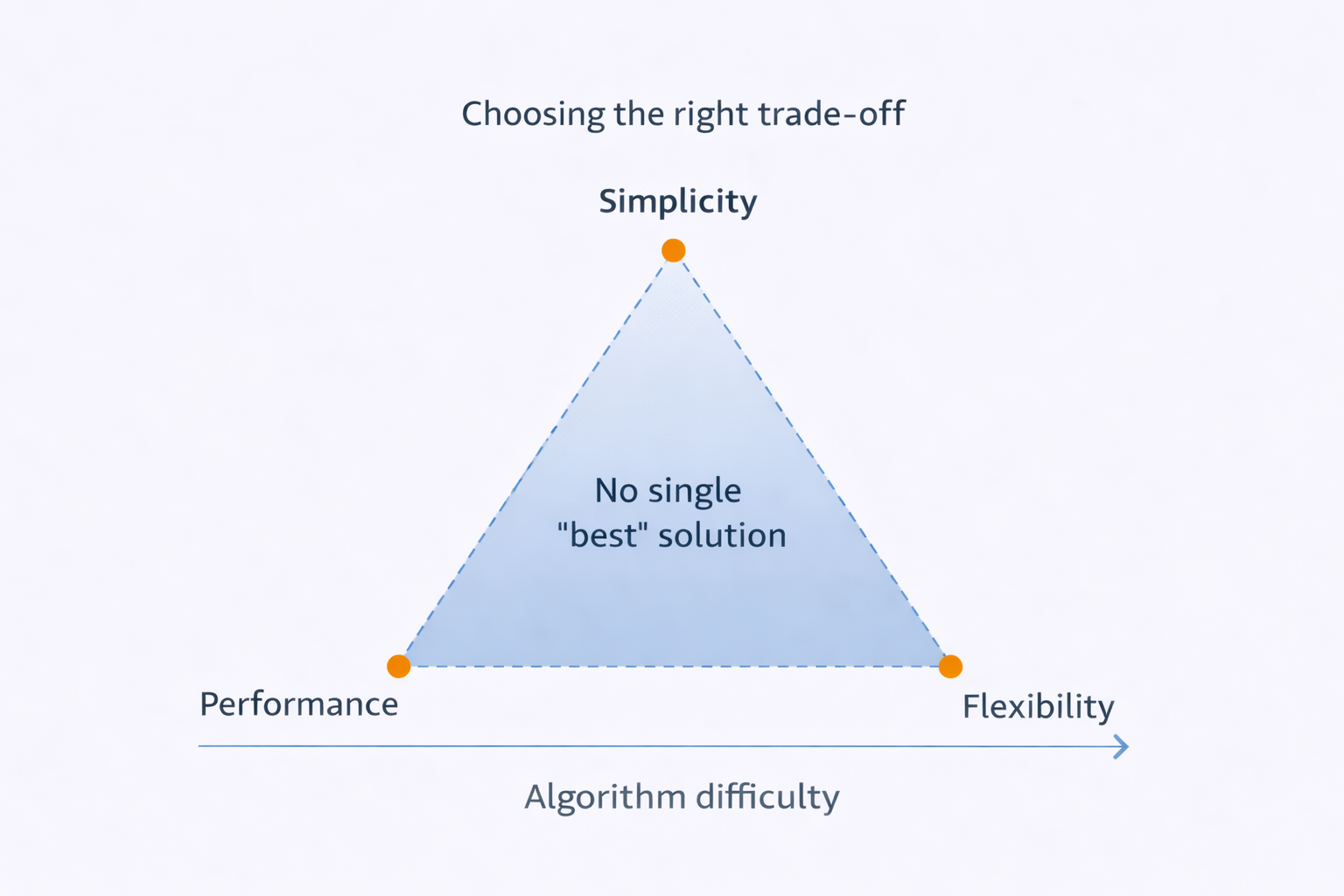
Finally, Netflix strongly values trade-off awareness. There is rarely a single “perfect” solution. Interviewers want to understand why you chose one approach over another, what you optimized for, and what you intentionally deprioritized. Being able to explain the “why” behind your decisions is often more important than the final code itself.
Netflix vs other FAANG coding interviews#
Dimension | Typical FAANG interview | Netflix interview |
Problem framing | Well-defined | Intentionally ambiguous |
Evaluation style | Speed + correctness | Judgment + reasoning |
Follow-ups | Limited | Deep, real-world extensions |
Use of LeetCode | Heavy | Foundational only |
Senior expectations | Role-dependent | Expected early |
Are Netflix Coding Interview Questions Harder Than Other FAANG Companies?#
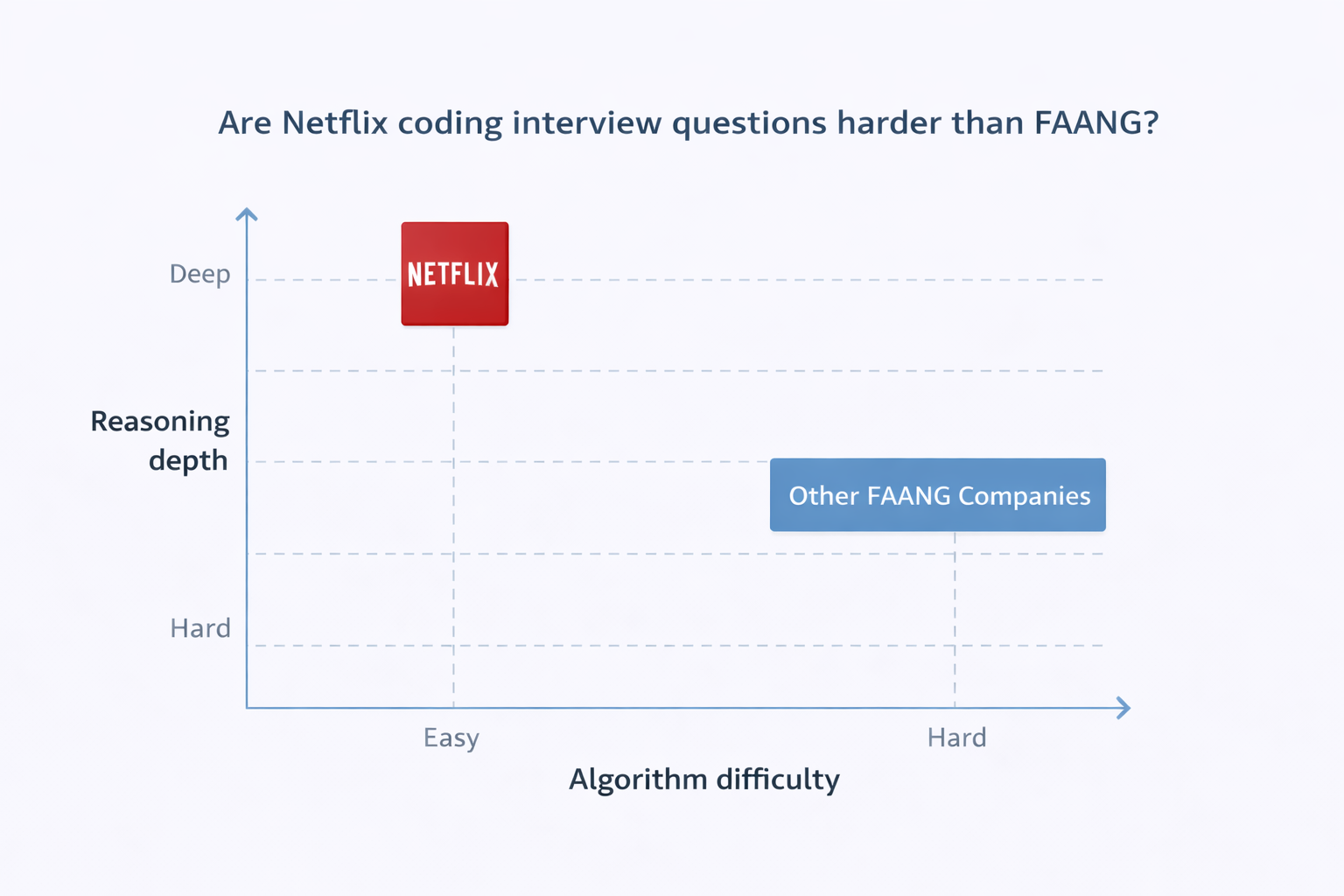
The short answer is that Netflix interviews are different, and that difference often makes them feel harder.
In terms of raw algorithmic content, Netflix does overlap with other FAANG companies. You’ll still encounter familiar problem domains such as arrays, strings, hash maps, trees, graphs, recursion, sliding windows, and breadth-first or depth-first search. These problems are typically medium difficulty rather than extreme, edge-case-heavy puzzles.
Where Netflix raises the bar is in depth and openness. Questions are often intentionally under-specified, with broader contexts and multiple valid solution paths. Instead of stopping once a solution works, interviewers push further. They may ask how you would parallelize the algorithm, what happens when the data grows by an order of magnitude, or how you would introduce caching or fault tolerance.
Netflix interviews also bring real-world constraints into the discussion much earlier than other companies. You may be asked to reason about latency, memory usage, operational safety, or long-term maintainability. This makes the interview feel less like an academic exercise and more like a design review with senior engineers.
Candidates who enjoy reasoning about systems, trade-offs, and evolving requirements often thrive in this environment. Candidates who rely heavily on memorized LeetCode templates without a deeper understanding often find Netflix interviews challenging.
Does Netflix Ask LeetCode-Style Questions?#
Yes, Netflix does use LeetCode-style questions—but not in the narrow sense many candidates expect.
Netflix typically starts with a problem that looks familiar on the surface. However, instead of treating it as a self-contained puzzle, interviewers use it as a foundation for deeper discussion. The question evolves as you progress.
After presenting a solution, you might be asked to optimize it, improve its readability, or adapt it to handle concurrency. You may be asked how it behaves under failure conditions, how you would test it, or how you would refactor it for maintainability. In some cases, the interviewer may deliberately change requirements midstream to see how you adapt.
More context-rich problems#
Instead of isolated algorithm puzzles, Netflix frequently frames problems around:
Streaming data
Logging pipelines
Distributed systems
API behavior
Real production constraints
Follow-up scenarios#
After you present a solution, you might be asked to:
Optimize it
Discuss concurrency considerations
Redesign the solution for efficiency
Handle failures or timeouts
Improve reliability or readability
Hands-on code quality evaluation#
Your interviewer will assess:
How safe your code is
How predictable your logic is
Whether you wrote production-like error handling
Whether your abstractions make sense
So yes, it helps to practice LeetCode. But focus on understanding why algorithms work, not just memorizing patterns.
What Makes Netflix Coding Interviews Unique#
While other FAANG companies follow structured, standardized interview systems, Netflix intentionally avoids rigid frameworks. They want engineers who think in terms of ownership, not just problem-solving speed.
Here’s what makes the process uniquely Netflix:
Netflix principle | How it shows up in interviews |
Freedom & responsibility | You lead the problem-solving |
High trust | Minimal hints, open-ended questions |
Strong judgment | Trade-offs matter more than perfection |
Low process | No rigid templates or frameworks |
Ownership | You’re expected to think end-to-end |
A culture-first approach#
One distinguishing factor is Netflix’s culture-first approach. Engineers are expected to operate with a high degree of autonomy, communicate directly, and take full ownership of decisions. The interview mirrors this environment by giving you space and responsibility to lead the discussion.
Less emphasis on trick questions#
Netflix isn’t trying to stump you with niche DP or obscure bit manipulation problems. The focus is on building real, understandable, maintainable solutions.
More emphasis on real engineering judgment#
Netflix also places less emphasis on trick questions. Interviewers are not trying to stump you with obscure algorithms or niche optimizations. Instead, they focus on whether you can build understandable, maintainable solutions that make sense in a real engineering context.
A senior-oriented hiring bar#
Another key differentiator is the emphasis on engineering judgment. Interviewers observe how you explain assumptions, choose between alternatives, and respond to new information. Candidates who naturally discuss trade-offs and avoid unnecessary complexity tend to perform well.
Even for mid-level roles, Netflix applies a senior-oriented hiring bar. The company prefers smaller teams of highly capable engineers, which means independence and clarity are expected early in your career.
Will You Get Debugging or Code-Fixing Challenges?#
Yes, and this is one of Netflix’s signature interview elements.
Many candidates report being given broken or incomplete code and asked to diagnose issues, fix bugs, or refactor the solution. These exercises often resemble real production scenarios rather than contrived puzzles.
You may encounter failing test cases, incorrect assumptions, subtle edge-case bugs, or performance issues. Sometimes the code compiles but behaves incorrectly under certain conditions. Other times, the task is to clean up messy logic or improve reliability.
What these tests#
You’ll be evaluated on your ability to:
Read unfamiliar code
Identify root causes
Reason about correctness
Improve reliability
Communicate your debugging strategy
This is a critical skill for a company that values engineers who can operate effectively without constant oversight.
How to Prepare for Netflix’s Behavioral Interviews#
At Netflix, behavioral interviews are not a formality; they are central to the hiring decision.
Behavioral signal | Strong response shows |
Ownership | You took responsibility for outcomes |
Judgment | You made trade-offs consciously |
Candor | You speak honestly about failures |
Growth | You learned and adapted |
Autonomy | You operated without heavy guidance |
Netflix operates according to a culture that prioritizes candor, transparency, high performance, and strong judgment. Interviewers are looking for evidence that you can operate effectively with freedom and responsibility.
Preparation requires more than rehearsed answers. Netflix prefers depth and authenticity over polished scripts. You should be ready to discuss real situations where you took ownership, made difficult decisions, or learned from failure.
Interviewers often probe how you reflect on past experiences. They want to see that you can analyze your own decisions, acknowledge mistakes, and articulate what you learned. Defensive or overly polished responses can be a red flag.
How to prepare effectively#
You’ll need to go beyond surface-level stories. Netflix expects:
Depth, not rehearsed answers: Interviewers prefer real examples that showcase your reasoning, not polished scripts.
Examples of ownership: Be ready to describe situations where you led initiatives, made hard calls, or took responsibility for failures.
Reflection and learning: Netflix values people who can analyze their decisions and grow from mistakes.
Authenticity and directness: Honesty is highly valued. Dodging difficult questions is viewed negatively.
Evidence of operating with freedom: Netflix gives engineers autonomy. They need confidence that you can make strong decisions independently.
If you’ve mainly prepared for behavioral questions using frameworks like STAR, that’s fine, but remember, Netflix prefers real stories with real substance.
How Long Is the Netflix Coding Interview Process?#
Compared to other FAANG companies, Netflix’s hiring process is relatively fast and streamlined. Many candidates complete the entire process in two to three weeks.
The process typically begins with a recruiter phone call to discuss your background, experience, and potential team alignment. This is followed by one or two technical screening rounds, which may include a coding interview, a debugging exercise, or a scenario-based discussion.
On-site interviews usually consist of four to five rounds covering coding, system design, behavioral evaluation, and a conversation with a hiring manager. Netflix often makes final decisions quickly after the on-site debrief.
Because the process moves fast, focused preparation is especially important.
Final Thoughts#
Preparing for Netflix coding interview questions isn’t just about algorithms; it’s about thinking like a full-stack, high-ownership engineer who knows how to reason through real-world challenges. Netflix values clarity, independence, engineering judgment, and the ability to navigate ambiguity thoughtfully.
By combining solid LeetCode practice with practical debugging, system design fundamentals, strong communication skills, and a deep understanding of Netflix’s culture, you’ll be well-equipped for success.
