20 Common OpenAI Interview Questions (With Sample Answers)
Master these 20 common OpenAI interview questions before your interview to improve your coding, System Design, behavioral, and AI engineering skills. Strong preparation helps you communicate clearly and perform confidently in every interview round.
Landing an interview at OpenAI is an exciting opportunity for software engineers, machine learning engineers, researchers, and infrastructure specialists. The company is known for building some of the world's most influential AI models, and its interview process reflects the complexity of the systems engineers work on every day.
Preparing for OpenAI interview questions requires much more than practicing coding challenges. Depending on the role, you may be asked to solve algorithms, design distributed systems, explain previous engineering projects, discuss AI infrastructure, and demonstrate how you approach difficult technical decisions.
This blog covers 20 common OpenAI interview questions, explains why interviewers ask them, and provides sample answers that illustrate the type of thinking interviewers typically look for.
What Does OpenAI Look for During Interviews?#
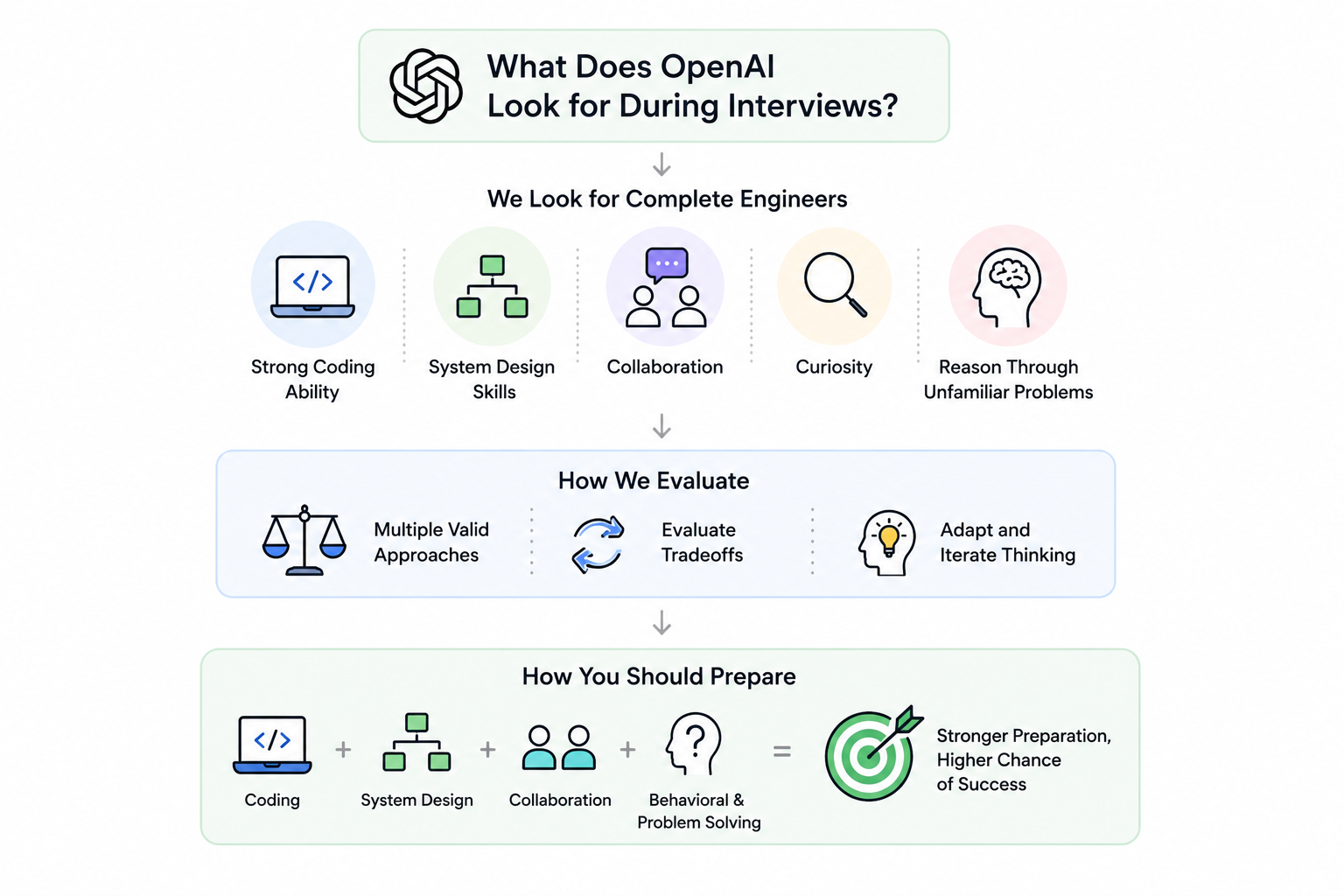
OpenAI hires engineers who can solve challenging technical problems while communicating clearly and making thoughtful engineering decisions. Although strong coding ability is important, interviewers also evaluate System Design skills, collaboration, curiosity, and your ability to reason through unfamiliar situations.
Many OpenAI interview questions intentionally have multiple valid approaches rather than a single correct answer. Interviewers are often more interested in how you evaluate tradeoffs and adapt your thinking than whether your first solution is perfect.
Preparing across multiple interview areas gives you a much stronger chance of success than focusing exclusively on algorithms.
Categories of OpenAI Interview Questions#
Most engineering candidates encounter several different types of interviews throughout the hiring process.
Interview Category | Typical Topics |
Coding | Algorithms and data structures |
System Design | Distributed systems and scalability |
Resume Deep Dive | Previous engineering projects |
Behavioral | Communication and collaboration |
AI Engineering | LLMs, inference, model deployment |
Engineering Judgment | Technical decision making |
Understanding these categories helps you prepare for the complete interview rather than only one stage.
Coding Interview Questions#
1. Solve this coding problem.#
Coding interviews remain one of the most important sources of OpenAI interview questions. Interviewers typically evaluate both the quality of your solution and your ability to explain your reasoning while solving the problem.
Sample Answer#
Begin by clarifying the problem and discussing edge cases before writing code. Explain a straightforward solution first, analyze its complexity, and then improve it while describing every major decision you make.
2. Can you improve the time or space complexity?#
Follow-up optimization questions are common because they reveal how well you understand algorithmic tradeoffs.
Sample Answer#
Discuss opportunities to reduce complexity using more appropriate data structures or algorithms. Explain why the optimization helps and mention any additional memory or implementation complexity it introduces.
3. How would you test your solution?#
Interviewers want to know whether you think beyond simply producing working code.
Sample Answer#
Describe unit tests, boundary conditions, invalid inputs, duplicate values, empty collections, and stress tests using large datasets. A structured testing strategy demonstrates production engineering habits rather than interview-only thinking.
4. How would your solution change if the requirements evolved?#
Real engineering problems rarely remain static.
Sample Answer#
Explain how changing constraints could influence your design and discuss how you would refactor the implementation while minimizing unnecessary complexity.
Grokking the Coding Interview Patterns

I created Grokking the Coding Interview because I watched too many talented engineers fail interviews they should have passed. At Microsoft and Meta, I saw firsthand what separated the candidates who succeeded from the ones who didn't. It wasn't how many LeetCode problems they'd solved. It was whether they could look at an unfamiliar problem and know how to approach it the right way. That's what this course teaches. Rather than throwing hundreds of disconnected problems at you, we organize the entire coding interview around 28 fundamental patterns. Each pattern is a reusable strategy. Once you understand two pointers, for example, you can apply them to dozens of problems you've never seen before. The course walks you through each pattern step by step, starting with the intuition behind it, then building through increasingly complex applications. As with every course on Educative, you will practice in a hands-on way with 500+ challenges, 17 mock interviews, and detailed explanations for every solution. The course is available in Python, Java, JavaScript, Go, C++, and C#, so you can prep in the language you'll actually use in your interview. Whether you're preparing for your first FAANG loop or brushing up after a few years away from interviewing, this course will give you a repeatable framework for cracking the coding interview.
System Design Interview Questions#
5. Design a scalable chat system.#
This remains one of the most common OpenAI interview questions for backend and infrastructure engineers.
Sample Answer#
Start by clarifying functional requirements before proposing an architecture that includes APIs, WebSockets, load balancers, message queues, databases, caching, and monitoring. Explain how each component supports scalability and reliability.
6. Design a system that serves AI model inference.#
Candidates interviewing for AI platform roles frequently discuss production inference systems.
Sample Answer#
Describe request routing, model serving infrastructure, GPU scheduling, batching, caching, autoscaling, monitoring, and fallback strategies. Consider both latency and operational cost throughout the discussion.
7. How would you design an API used by millions of users?#
Interviewers evaluate how you approach highly scalable production systems.
Sample Answer#
Discuss load balancing, horizontal scaling, database replication, caching, rate limiting, observability, and graceful failure handling. Explain why every architectural decision addresses a specific requirement.
8. How would you improve system reliability?#
Reliability is particularly important for production AI systems.
Sample Answer#
Discuss redundancy, retries, circuit breakers, health checks, monitoring, alerting, disaster recovery, and gradual rollouts. Emphasize preventing failures as well as recovering from them.
OpenAI System Design Interview Questions

This practice set dives into the System Design patterns favored by high-performance engineering teams. Expect exercises rooted in distributed architecture, real-time data systems, and AI-focused infrastructure design challenges. Challenges are designed to stretch your thinking, from handling inference traffic at scale to building globally consistent storage systems. You'll learn to reason about tradeoffs, simplify under constraints, and prioritize what matters in real-world tech environments. The goal is to train the instincts and judgment needed to design them under pressure.
Resume and Technical Deep Dive Questions#
9. Tell me about your most technically challenging project.#
Interviewers frequently spend significant time discussing projects you've listed on your resume.
Sample Answer#
Choose a project where you had meaningful ownership and explain the architecture, technical challenges, implementation decisions, measurable results, and lessons learned. Be prepared for detailed follow-up questions about individual components.
10. What tradeoffs did you make during that project?#
Engineering decisions always involve compromises.
Sample Answer#
Discuss the alternatives you considered, why you selected your final approach, and how business requirements, technical constraints, and operational complexity influenced the decision.
11. If you rebuilt this system today, what would you change?#
Interviewers often use this question to evaluate technical growth.
Sample Answer#
Identify architectural improvements, operational enhancements, or scalability optimizations you would implement today. Demonstrating reflection is generally more valuable than insisting your original design was perfect.
12. Describe a difficult production incident.#
Production experience often reveals engineering maturity.
Sample Answer#
Explain the root cause, investigation process, mitigation strategy, long-term fixes, and preventive improvements. Focus on systematic debugging rather than dramatic storytelling.
Grokking the Product Architecture Interview
I created Grokking Product Architecture after noticing a growing gap in how engineers prepare for the modern product architecture interview. While traditional System Design focuses heavily on backend scalability, many candidates struggle when asked to think from the client’s perspective, like how real users interact with products, how APIs are designed, and how those interactions translate into seamless experiences. Having worked on product-facing systems, I’ve seen that strong candidates understand the full lifecycle of a request. They can trace how a client call flows through APIs, interacts with services, and ultimately delivers a fast, reliable experience. That’s a very different skill set, and one that isn’t taught well in most System Design resources. That’s why I built this course. In Grokking Product Architecture, you’ll learn how to approach product architecture interview problems with a structured, practical mindset. Instead of treating APIs as an afterthought, we place them at the center of design. You’ll explore how to translate product requirements into clean, efficient APIs and how to design systems that minimize client-visible latency. We anchor these concepts in real-world scenarios. You’ll design products like YouTube, Stripe, and Zoom, breaking them down from the client’s perspective and understanding how each component works together. Along the way, you’ll use a reference backend implementation to see exactly how API calls flow through a system. By the end, you’ll be able to design it confidently, communicate it clearly, and stand out in your next product architecture interview.
Behavioral Interview Questions#
13. Tell me about a disagreement with a teammate.#
Collaboration plays a significant role in engineering organizations.
Sample Answer#
Describe the disagreement objectively, explain how different viewpoints were considered, discuss the final outcome, and highlight what you learned. Focus on collaboration rather than proving your position was correct.
14. Tell me about a mistake you made.#
Interviewers want to understand accountability and continuous learning.
Sample Answer#
Choose an example where you accepted responsibility, communicated transparently, resolved the issue, and implemented improvements that reduced the likelihood of similar problems occurring again.
15. How do you prioritize competing engineering work?#
Balancing multiple priorities is common on engineering teams.
Sample Answer#
Explain how you evaluate customer impact, business priorities, technical risk, dependencies, and deadlines before deciding what deserves immediate attention.
16. Why do you want to work at OpenAI?#
This is one of the first OpenAI interview questions many candidates encounter.
Sample Answer#
Explain your interest in advancing artificial intelligence, solving technically challenging problems, and building products that have meaningful real-world impact. Tailor your answer specifically to OpenAI rather than giving a generic response suitable for any technology company.
Grokking the Behavioral Interview

Behavioral interviews have become a decisive part of the hiring process across roles. Whether you’re a software engineer, product manager, or engineering leader, strong technical skills alone are no longer enough. Companies are evaluating how you think, communicate, and operate in real-world situations. That’s why preparing specifically for behavioral interviews is critical. This is why I built this course around a common gap: candidates often underestimate behavioral interviews or prepare for them too late. As a result, even strong candidates struggle to clearly articulate their experiences, decisions, and impact. The goal here is to give you a structured way to approach behavioral questions with clarity and confidence. You’ll learn how to break down common behavioral interview questions, structure your answers, and communicate your experiences effectively. The course also includes a video recording feature, allowing you to practice your responses, review them, and improve over time. By the end, you’ll have a repeatable approach to behavioral interviews, one that helps you present your experiences clearly and perform with confidence in any interview setting.
AI Engineering Questions#
17. What engineering challenges do large language models introduce?#
AI-focused candidates should expect questions that explore production machine learning systems.
Sample Answer#
Discuss inference latency, infrastructure cost, hallucinations, monitoring, evaluation, prompt engineering, retrieval systems, model deployment, and responsible AI considerations. Connect these topics to practical engineering challenges rather than research alone.
18. How would you evaluate the quality of an AI model?#
Evaluation is an important part of modern AI engineering.
Sample Answer#
Describe offline benchmarks, online experimentation, human evaluation, production monitoring, and application-specific metrics. Explain that model quality depends on the problem being solved rather than a single universal metric.
19. How would you reduce latency in an AI application?#
Performance optimization is essential for production AI systems.
Sample Answer#
Discuss batching, caching, model optimization, efficient hardware utilization, request routing, streaming responses, and infrastructure scaling. Explain how each optimization affects both performance and operational cost.
Ace the AI Engineer Interviews
This course prepares candidates to confidently tackle AI interviews by covering the most relevant and in-demand topics. You’ll explore neural network training (gradient descent, transfer learning, and model compression), language processing (tokenization, embeddings, and decoding), and transformer attention mechanisms (self-attention, cross-attention, and flash attention). You’ll gain a solid understanding of evaluation metrics like perplexity, BLEU, and ROUGE, and dive into modern AI challenges, including hallucinations, jailbreaks, and interpretability. You’ll also learn cutting-edge methods such as RAG, few-shot learning, and chain-of-thought prompting. You’ll explore efficiency, scalability, Mixture of Experts, vector databases, and agentic AI behaviors.
Engineering Judgment Question#
20. How do you make technical decisions when information is incomplete?#
Many engineering problems require decisions before every fact is available.
Sample Answer#
Explain that you gather available evidence, identify assumptions, evaluate tradeoffs, estimate risk, and choose the most practical solution given current information. You should also emphasize measuring outcomes and revisiting decisions as new information becomes available.
Tips for Answering OpenAI Interview Questions#
Preparing for OpenAI interview questions involves more than memorizing answers. Interviewers generally prefer candidates who communicate naturally, ask clarifying questions, and adapt their thinking as the discussion evolves.
When practicing technical interviews, explain your reasoning aloud instead of solving problems silently. This habit develops communication skills while helping interviewers understand your decision-making process during the interview.
Behavioral questions also deserve dedicated preparation. Reviewing several meaningful projects from your career and organizing them into structured stories makes it much easier to answer follow-up questions with confidence.
Common Mistakes Candidates Make#
Many candidates devote nearly all of their preparation time to algorithms while overlooking System Design, behavioral interviews, and resume discussions. Since OpenAI evaluates engineers across multiple dimensions, this narrow approach often leaves candidates underprepared.
Another common mistake is rushing into solutions without first clarifying requirements. Whether solving a coding problem or designing distributed infrastructure, interviewers generally appreciate candidates who slow down, ask thoughtful questions, and explain tradeoffs before proposing solutions.
Finally, some candidates underestimate the importance of communication. Even excellent technical ideas become less convincing when assumptions remain unstated or explanations lack structure.
Quick Review of the 20 Questions#
# | Question | Primary Focus |
1 | Solve a coding problem | Algorithms |
2 | Optimize your solution | Complexity analysis |
3 | Test your implementation | Code quality |
4 | Handle changing requirements | Adaptability |
5 | Design a chat system | System Design |
6 | Design AI inference serving | AI infrastructure |
7 | Design a scalable API | Scalability |
8 | Improve reliability | Distributed systems |
9 | Most challenging project | Resume discussion |
10 | Engineering tradeoffs | Technical judgment |
11 | What would you change today? | Reflection |
12 | Production incident | Ownership |
13 | Team disagreement | Collaboration |
14 | Mistake you made | Accountability |
15 | Prioritization | Decision making |
16 | Why OpenAI? | Motivation |
17 | LLM engineering challenges | AI systems |
18 | Evaluate an AI model | Model quality |
19 | Reduce AI latency | Performance engineering |
20 | Decisions with uncertainty | Engineering judgment |
Final Thoughts#
Preparing for OpenAI interview questions requires a balanced strategy that combines coding practice with System Design, behavioral preparation, AI engineering knowledge, and a thorough understanding of your previous projects. While technical ability remains essential, interviewers also evaluate how clearly you communicate, how thoughtfully you reason through tradeoffs, and how effectively you collaborate with others.
By practicing these common OpenAI interview questions, reviewing your engineering experience, and developing structured answers, you'll be well prepared to navigate every stage of the interview process with confidence.
