Top 5 NLP Applications in 2026
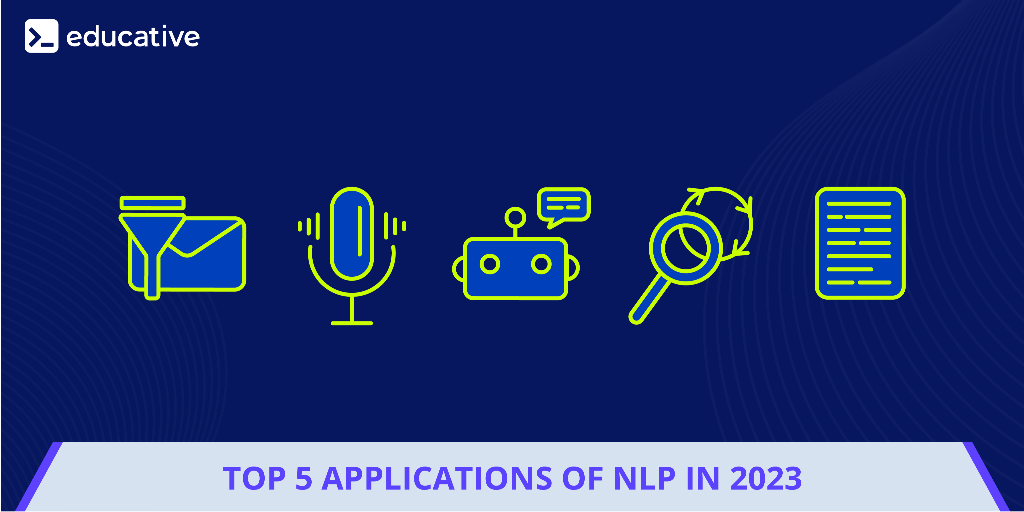
Natural Language Processing (NLP) is a branch of AI that enables machines to understand, analyze, and generate human language across applications ranging from email filtering and voice assistants to agentic workflows and multimodal real-time systems. In 2026, production NLP has expanded well beyond basic text processing to include retrieval-augmented generation (RAG), on-device small language models, long-context agent pipelines, and compliance-aware architectures shaped by regulations like the EU AI Act.
Key takeaways
- Everyday NLP applications: Email filtering, voice assistants, search autocomplete, chatbots, and text analytics automate routine tasks by extracting patterns, detecting intent, and performing sentiment analysis on unstructured data.
- Multimodal and agentic systems: Modern NLP models like GPT-4o accept mixed inputs of text, audio, image, and video while agent frameworks plan multi-step workflows, call external tools, and reason over million-token context windows.
- RAG as default architecture: Production systems now pair a vector-based retriever with a generative model to ground outputs in real data, improving factuality, freshness, and auditability through source citation.
- On-device and small language models: Privacy requirements, latency targets, and cost constraints drive tiered inference patterns where a distilled on-device model handles common tasks and falls back to cloud models for heavier reasoning.
- Safety, evaluation, and regulation: The EU AI Act and growing global scrutiny require NLP teams to implement model audits, bias checks, transparency logs, risk categorization, and governance workflows throughout the application lifecycle.
Natural Language Processing (NLP) is a subfield of Artificial Intelligence (AI). You come across NLP applications everywhere — from your phone’s voice assistant to the software programs that process unstructured data for business insights. As AI continues to advance, NLP machine learning is gaining momentum. If these NLP applications have piqued your interest, you must keep reading. Let's explore how well machines are learning to talk to humans!
What is NLP?#
Machines use NLP techniques to understand, analyze, and manipulate human language. As machines become more intuitive about human communication, data processing becomes more efficient. NLP coaching can help machines understand nuances of language such as the following:
Sentiments
Tone
Opinions
NLP utilizes computational linguistics to analyze and synthesize human language in real-time. The most significant advantage is that you can analyze complex and unstructured data quickly. Machines understand and analyze different dialects and languages in an unbiased manner. This has many applications in education, healthcare, business, etc.
Top 5 NLP Applications#
Here are some of the ways NLP is helping us automate and speed up everyday tasks:
1. Email Filtering#
You receive piles of emails every day. How do you start sorting? The email could be useless spam or an acceptance letter from your dream college. But email filtering has evolved beyond the spam filters. Email classification in Gmail divides messages into three categories: primary, social, and promotions. This is where Natural Language Processing steps in to help. NLP identifies incoming emails and sends them to their designated folders. How does NLP work in email classification? The email service uses natural processing to extract common patterns and phrases. So the NLP model searches the content of each email to put it in the right section. There you go! Now you can review and respond to emails much quicker. And delete redundant messages to manage inbox size.
2. Voice Assistants#
Are Alexa and Siri examples of NLP? Yes! You can talk to these smart assistants thanks to Natural Language Processing. The voice assistant breaks down what you say into the speech, root stem, and other linguistic features. Then it infers the meaning and naturally replies to you. Voice assistants will soon become the primary communication channel between humans and the internet. This will help users and businesses alike, because this conversational method of exploring products and services will bring customers to the right target.
3. Search Engine Autocomplete#
Predictive text and auto-correction are a blessing in the world of online searches. What do you do when you have many sources on the internet but don’t know exactly what you want? NLP models can help detect the intent behind your search. And voila! You now have the right keyword.
Moreover, there are suggested searches under your desired search that can help you explore interconnected subjects. When you start typing, the NLP model looks at the whole picture and similar search behaviors to give you these suggestions. For example, if you put in a flight number, it will show you the flight status.
4. Chatbots#
Chatbots are capable of understanding as well as learning from human conversations. This is the best part of an AI-powered Chatbot: it will learn over time. You can even have extensive discussions with chatbots. They work in three simple steps:
Comprehend the meaning of the question asked
Collect the required information from the user
Provide the appropriate response
Responses provided by chatbots are friendlier and more natural than those of search engines. This is because chatbots have emotional intelligence. As a result, they have eased the customer support process for businesses. Chatbots can handle most customer queries, speeding up response time and providing 24/7 availability for users. With no wait for the customer, they can get prompt solutions to their problems, and support agents no longer need to answer repetitive questions anymore.
Curious about OpenAI API for NLP in Python?
This course introduces OpenAI API and NLP in Python, teaching you how to use the OpenAI API for real-world natural language processing tasks. You’ll begin by exploring the OpenAI API with Python, setting up your account, and learning how to access key endpoints. The completions endpoint will be covered for generating, classifying and transforming text. The course then covers advanced NLP in Python techniques using other OpenAI endpoints like moderations and embeddings for in-depth text analysis. You’ll practice these methods to efficiently analyze and manipulate text data. Finally, you will integrate your OpenAI skills with Flask to build interactive, NLP-powered applications. The course emphasizes real-world projects, helping you use OpenAI’s capabilities to solve problems in content generation, text classification, and more. After completing this course, you can apply NLP in Python using OpenAI API to create scalable solutions.
5. Text Analytics#
Different linguistic, statistical, and machine-learning techniques are used to convert piles of unstructured data into meaningful data. This sounds complex to imagine, but NLP makes this process much easier. Businesses can examine customer behavior by going through the following sources:
Social media comments
Reviews
Brand name mentions
Monitoring these behaviors can help the brand plan their next marketing campaign. The text analysis leads to keyword extraction and pattern recognition. These kinds of intricate, tedious tasks can only be performed by automation. How does the system recognize emotions and nuances in opinion? The answer is sentiment analysis. This natural processing model goes beyond the literal meaning. Using sentiment analysis, you can enhance market research to identify trends and prospects for your business. It can also help you identify customer pain points and monitor competitors’ strategies. Beyond private business uses, government agencies can also use NLP text analytics to monitor threats to state security.
Multimodal & Real‑Time Assistants (Beyond Text & Voice)#
What is a multimodal assistant?#
Multimodal models accept and generate across multiple input/output types (text, audio, image, video). The recent GPT‑4o (“omni”) is a leading example: it can take as input audio, images, video + text, and respond in the same combined modalities, with latency around 232–320 ms.
Because of the unified architecture, a single request could mix image + voice + text, such as “Here’s a photo, tell me what’s wrong with the wiring while I speak instructions.” The model can respond with voice, overlaying visual pointers. This blurs the line between “voice assistants” and “vision agents.”
Why it matters for NLP apps in 2026#
NLP apps are no longer just about text processing; they must integrate visual perception, contextual awareness, and real-time voice exchange.
Apps in domains like AR/VR guidance, remote machinery repair, medical imaging consultation, and assistive tech depend on fused modalities.
Developers need to design prompts, pipelines, and interfaces that respect multimodal context (which part is audio, which is image, which is text).
Limitations & considerations#
Multimodal hallucination risk: the model may misinterpret or invent elements in images or video.
Temporal consistency: when processing video + speech sequences, ensuring alignment over time is nontrivial.
Computational cost: combining modalities increases resource needs, especially for large real‑time models.
Long‑Context, Agents & Tooling in NLP Workflows#
From single queries to agentic execution#
In 2026, many real world NLP systems adopt agent frameworks: the model not only responds to input, but plans steps, interacts with external tools (APIs, databases, search), and executes workflows over a long context.The newly launched GPT‑4.1 supports million‑token context windows, enabling agent pipelines to reason over entire documents (contracts, knowledge bases, logs) without chopped context.
What this enables differently (vs classic NLP)#
Autonomous workflows: e.g. “Analyze this 200-page contract, find risky clauses, propose edits, then search case law.”
Interactive tool usage: the agent can call search, spreadsheets, internal systems, and integrate responses.
Memory & context retention: The agent retains past interactions in long context, enabling smoother, context-aware conversations in multi-turn settings.
Best practices for developers#
Break tasks into subagents/substeps (e.g. chunk review, retrieval, summarization).
Use retrieval-augmented generation (RAG) patterns so agents ground themselves on external data to reduce hallucinations.
Monitor planner drift—the agent’s plan over time may deviate unless constrained or validated.
Retrieval‑Augmented Generation (RAG) as Default Architecture#
Why RAG is now baseline#
By 2026, RAG (retrieving vectors/knowledge + generative module) is ubiquitous in production NLP systems. It allows models to ground output in real data, improving factuality, freshness, and domain specificity.
Key components of a modern RAG stack#
Vector store / embedding index (e.g. FAISS, Pinecone)
Retriever / similarity search (dense + sparse hybrids)
Context builder / chunking (which docs to include)
Generator (LLM or multimodal)
Post‑filter / verification / citation module
Use cases & design patterns#
Enterprise search & QA: user ask, system retrieves relevant documents, then synthesizes with source attribution.
Document summarization / comparison: fetch sections/products, then generate summary or diff.
Compliance & reasoning: link reasoning to original regulation passages or data to ensure auditability.
Pitfalls & mitigations#
Hallucinations: guard via citation & consistency checks.
Context window overflow: limit total token budget; chunk smartly.
Retrieval bias: retriever may miss relevant documents—consider hybrid retrieval.
On‑Device & Small Language Models (SLMs)#
Why smaller / local models matter#
Privacy, latency, cost, and regulation push many NLP workloads to run on-device or in constrained environments. SLMs (small or distilled models) with efficient architectures allow:
Local text/speech summarization, translation, classification
Edge‑based interactive assistants (mobile, embedded devices)
Use in sensitive domains (health, finance) where data cannot leave the device
Hybrid deployment pattern#
A typical approach is tiered inference:
Use the on‑device SLM for common tasks and low latency
Fall back to cloud / full model for heavy analysis, multimodal reasoning, or long context jobs
Challenges & solutions#
Memory & compute constraints: use quantization, pruning, distillation
Model drift & updates: keep sync with server models
Seamless handoff: design prompt scaffolding so that state/context passes between device & cloud parts without losing coherence
Safety, Evaluation & Compliance (Regulation in 2026)#
Global regulatory landscape — spotlight on EU AI Act#
Regulation of AI matured: the EU AI Act came into force Aug 1, 2024, with a phased activation of obligations.
February 2, 2025: Bans on “unacceptable-risk” practices (e.g. social scoring, exploitative manipulation) became legally binding.
August 2, 2025: Key rules on general-purpose AI models (foundation models) become binding.
Organizations must begin conformity assessment, maintain documentation, transparency, risk management, human oversight, and safety measures.
Globally, regulators are increasing scrutiny on hallucination risk, bias, data provenance, and model explainability.
Responsibilities for NLP developers & product teams#
Model audits & evaluations: consistent bias / fairness checks, cross‑validation, red‑teaming.
Transparency & traceability: maintaining logs of inputs, prompt versions, reasoning traces, citations.
Risk categorization: identify modules with “high-risk” classification under law (e.g. decision support in finance/health).
User rights & appealability: allow users to query the basis of generated output, retract or correct.
Governance workflows: oversight boards, model change protocols, safety gates, and fallback safe policies.
Integrating compliance into NLP app lifecycle#
Incorporate regulatory review in design phases (not an afterthought)
Choose vendors that support transparency, audits, and compliance readiness
Monitor evolving regulation (other jurisdictions, e.g. U.S., China) and adapt model pipelines accordingly
Understand Natural Language Processing with Machine Learning#
As you have seen, NLP techniques can automate tedious daily tasks, saving time and helping to detect patterns in data that human beings cannot. In short, Natural Language Processing is revolutionizing how we analyze data and the way machines communicate with us.
All these exciting applications must have sparked your creativity. Do you want to learn the details of semantic analysis and machine translation? Our Natural Language Processing with Machine Learning course is an interactive way to learn how to solve day-to-day NLP problems. Try it out for yourself and learn how to make NLP work for you!
Happy learning!