How to translate user requirements into scalable architecture
Learn a proven 5-stage framework to turn user requirements into scalable System Design. From clarifying needs to handling growth and trade-offs, this guide helps you think like an architect and build systems that scale in the real world.
When you’re tasked with designing a system, one of the most critical skills is translating user requirements into a scalable architecture. This means going beyond “what the user wants” and building a system that can grow, adapt, and remain efficient as demand increases. In this blog, you’ll learn a clear, practical roadmap that takes you from user needs through to a scalable architecture. You’ll also learn how to think like an architect, so you’re prepared for real-world systems and interviews alike.
Grokking Modern System Design Interview

For a decade, when developers talked about how to prepare for System Design Interviews, the answer was always Grokking System Design. This is that course — updated for the current tech landscape. As AI handles more of the routine work, engineers at every level are expected to operate with the architectural fluency that used to belong to Staff engineers. That's why System Design Interviews still determine starting level and compensation, and the bar keeps rising. I built this course from my experience building global-scale distributed systems at Microsoft and Meta — and from interviewing hundreds of candidates at both companies. The failure pattern I kept seeing wasn't a lack of technical knowledge. Even strong coders would hit a wall, because System Design Interviews don't test what you can build; they test whether you can reason through an ambiguous problem, communicate ideas clearly, and defend trade-offs in real time (all skills that matter more than ever now in the AI era). RESHADED is the framework I developed to fix that: a repeatable 45-minute roadmap through any open-ended System Design problem. The course covers the distributed systems fundamentals that appear in every interview – databases, caches, load balancers, CDNs, messaging queues, and more – then applies them across 13+ real-world case studies: YouTube, WhatsApp, Uber, Twitter, Google Maps, and modern systems like ChatGPT and AI/ML infrastructure. Then put your knowledge to the test with AI Mock Interviews designed to simulate the real interview experience. Hundreds of thousands of candidates have already used this course to land SWE, TPM, and EM roles at top companies. If you're serious about acing your next System Design Interview, this is the best place to start.
Why translating user requirements into a scalable architecture matters#
You might have brilliant user requirements, such as lots of features, fantastic ideas, but if you don’t build the architecture to support growth, you’ll end up with a system that collapses under load, is difficult to maintain, or cannot evolve. When you focus on translating user requirements into scalable architecture, you do three vital things:
Align the System Design with what users and the business actually need.
Embed non-functional requirements (scale, performance, reliability) from the start rather than as an afterthought.
Build an architecture that grows with usage instead of breaking and requiring a costly redesign.
Succeeding here means you’re designing thoughtfully and responsibly, and that sets you apart.
A 5-Stage Framework to Go From Requirements to Scalable Architecture#
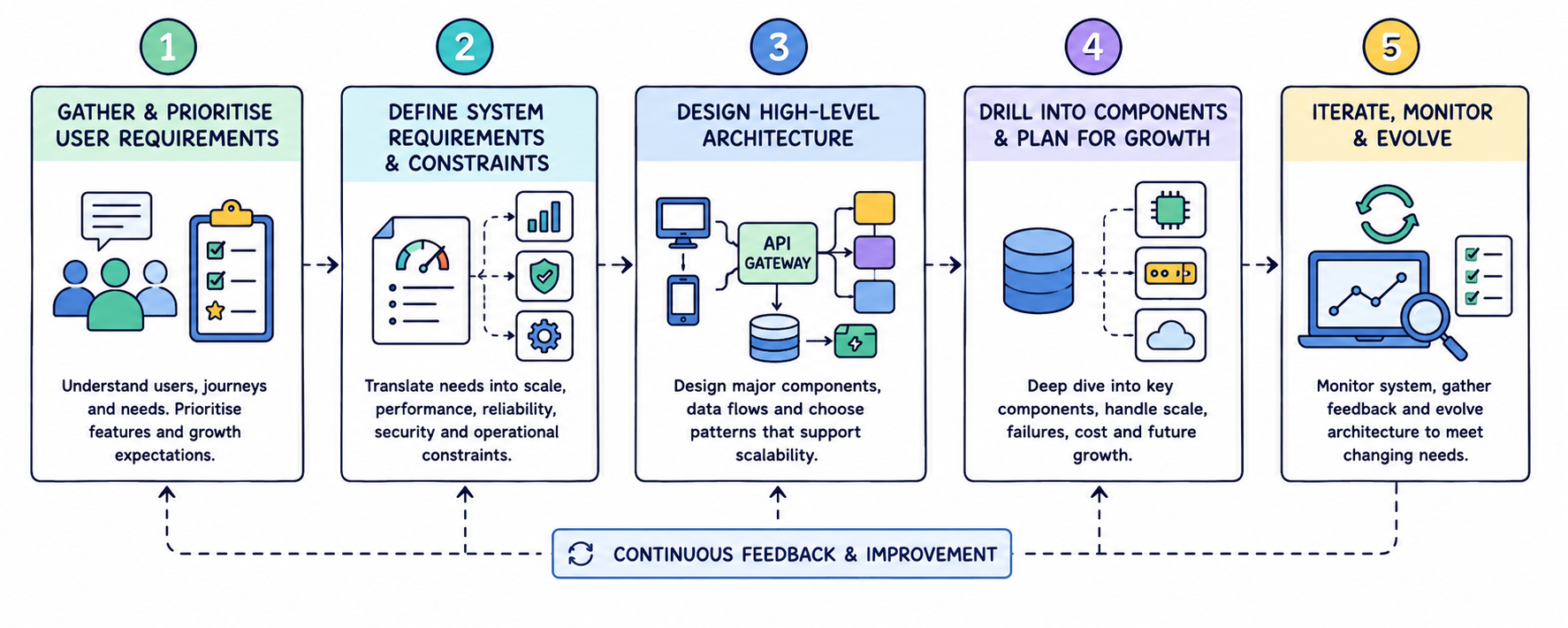
Here’s a tried-and-tested framework you can follow when translating user requirements into scalable System Design patterns and architecture. Think of this as your blueprint.
Stage 1: Gather & prioritise user requirements#
Before you even think about architecture, this stage is where strong System Designers quietly outperform everyone else.
Most candidates rush through requirements as if they’re just a formality. In reality, this is where the foundation of your entire system is set. If you misunderstand the user, you will design the wrong system, no matter how technically sound it is.
What experienced engineers do here is go beyond surface-level requirements. They try to understand intent. Why does the user need this feature? What problem are they really solving? That context often influences key design decisions later.
For example, a “photo upload feature” could mean very different things depending on whether users upload casually or at scale (e.g., influencers, businesses, or media companies). That difference impacts storage design, CDN usage, and even API design.
Another overlooked aspect is prioritisation. Not everything needs to be built at once. By clearly separating must-haves from future features, you avoid over-engineering early and keep your architecture focused.
Over time, this stage becomes less about gathering information and more about framing the problem correctly, and that’s a skill interviewers notice immediately.
Stage 2: Define system requirements & constraints#
This is where you transition from product thinking to engineering thinking.
User requirements describe what the system should do. System requirements define how well it needs to do it, and under what constraints. This is where architecture decisions start to become clearer.
A common mistake is treating numbers like “requests per second” or “latency targets” as abstract metrics. In reality, these numbers directly shape your design. A system handling 100 requests per second looks completely different from one handling 100,000.
This stage is also where trade-offs start emerging. For example:
Higher availability often increases cost
Lower latency may require more infrastructure
Strong consistency can impact performance
By explicitly defining constraints like budget, compliance, and infrastructure, you’re grounding your design in reality.
In real-world systems, constraints are often more important than features. Engineers don’t design in a vacuum; they design within limits. Showing that you understand this is a strong signal of maturity.
Stage 3: Design a high-level architecture aligned with requirements#
Now you’re finally translating understanding into structure.
At this stage, your goal isn’t to be detailed; it’s to be clear. A strong high-level architecture should feel intuitive. Anyone looking at it should understand how data flows through the system and how components interact.
Think of this as your “storyboard.” You’re telling the story of a request moving through your system.
Many engineers make the mistake of jumping into specific technologies too early. Instead, focus on roles first:
Where does the request enter?
Where is it processed?
Where is data stored?
Where is latency reduced?
Once those roles are clear, technology choices become much easier to justify.
Another important point is alignment. Every component you introduce should tie back to a requirement from Stage 2. If it doesn’t, it’s likely unnecessary.
This is where your system starts to feel intentional instead of generic.
Grokking the Fundamentals of System Design

System Design is central to building applications that scale reliably and operate securely. This is why I built this course to help you explore the foundational concepts behind modern system architecture and why these principles matter when creating real-world software systems or preparing for System Design interviews. You’ll begin by examining the basics of system architecture, then move on to distributed system concepts, including consistency, availability, coordination, and fault tolerance. Next, you’ll explore communication patterns, concurrency handling, and strategies like retries, backoff policies, and idempotency. You’ll also compare SQL, NoSQL, and NewSQL databases and dive into data partitioning, replication, and indexing techniques. The course concludes with security and observability, rounding out the pillars you need for System Design interviews. You’ll be able to analyze complex design problems, reason about trade-offs, and structure systems that are scalable, maintainable, and ready for real-world demands.
Stage 4: Drill into key components & handle scalability/growth#
This is where your design moves from “reasonable” to “convincing.”
High-level architecture shows that you can structure systems. Depth shows that you understand how they behave under real conditions.
The key here is focus. You don’t need to deep-dive into everything, only the parts that matter most.
For example:
If your system is read-heavy → focus on caching and data access
If it’s write-heavy → focus on database scaling and ingestion
If latency is critical → focus on edge delivery and optimization
What makes this stage powerful is that you’re anticipating the future. Instead of designing for the current scale, you’re asking:
“What breaks when this system grows 10x or 100x?”
This is also where failure handling becomes important. Systems don’t fail all at once; they fail in parts. Thinking through those failure modes shows that you understand real-world complexity.
Another layer here is cost. Scalable systems aren’t just about handling growth; they’re about doing so efficiently. Mentioning cost trade-offs adds a practical dimension that many candidates miss.
Stage 5: Iterate, monitor, evolve#
This is the stage that most interview answers skip, but in real systems, it’s the most important.
No system is perfect at launch. Requirements change, usage patterns evolve, and unexpected bottlenecks appear. Good architectures are not static, they are designed to adapt.
What sets strong engineers apart is their ability to think beyond the initial design. They consider:
How will we know when something is wrong?
How will we update the system without breaking it?
How will we support future features?
Monitoring and feedback loops are critical here. Metrics like latency, throughput, and error rates are not just operational, they inform future design decisions.
Another important concept is modularity. If your system is loosely coupled, you can evolve parts of it independently. If it’s tightly coupled, even small changes become risky.
By thinking about evolution upfront, you’re designing a system that can grow with the product, not fight against it.
Practical example: translating user requirements into scalable architecture#
Examples like this are where theory becomes tangible.
What makes this section strong is that it walks through the entire framework in action. To make it even more impactful, think of it as a simulation of real-world decision-making.
Each stage builds on the previous one:
Requirements define the problem
Constraints shape the design
Architecture provides structure
Deep dives ensure scalability
Iteration ensures longevity
What’s especially valuable here is how trade-offs naturally emerge. For example:
Using eventual consistency for search improves performance but sacrifices immediacy
Using a CDN reduces latency but increases infrastructure complexity
Sharding improves scalability but adds operational overhead
These are the kinds of decisions engineers make daily, and showcasing them makes your design feel real.
If you approach examples this way in interviews, you’re not just answering the question, you’re demonstrating how you think as an engineer.
Common Pitfalls to Avoid#
When you’re translating user requirements into scalable architecture, beware of these mistakes:
Designing only for current load, not future growth (will break under scale).
Ignoring non-functional requirements like latency, availability, and cost.
Choosing technologies without justifying them against requirements.
Over-engineering early: building complex architecture for features that aren’t needed yet.
Failing to document assumptions and changes over time.
Building a rigid system: tight coupling, no modularity, and difficult to evolve.
Neglecting the monitoring, feedback, and iteration stage, the architecture stays static while requirements shift.
Avoiding these ensures your design is resilient, efficient, and future-proof.
Final Thoughts#
Translating user requirements into scalable architecture is the foundational skill for any senior engineer or architect. It’s what separates systems that meet today’s needs from systems that will thrive tomorrow.
By following this five-stage framework, gathering user requirements, defining system requirements, designing high-level architecture, drilling into key components and scalability, and then iterating, you create a design that is grounded in user needs and equipped for growth.
Remember: it’s not enough to know what users want; you must translate that into architecture that scales, performs, costs less, and adapts. The phrase translating user requirements into scalable architecture isn’t just a buzz phrase, it’s your way of showing you can build systems that last.
If you’re preparing for interviews, System Design rounds, or real-world architecture work, make this approach your backbone. Practice it, refine it, and you’ll build systems right.
