Understanding the Six Degrees of Separation Theory
Six Degrees of Separation Theory#
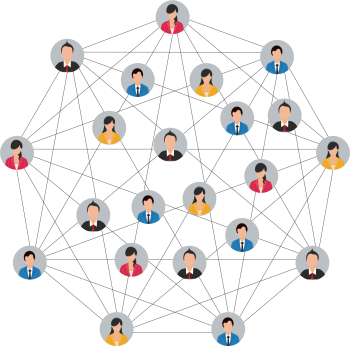
You might be surprised to find out that living in the globalized world today, we’re far closely connected to each other in ways that we might not expect. In fact, we are all at a maximum distance of six hops from any person in the world. This essentially means that there are six or fewer acquaintances between a person living in Nicobar islands and the famous actor Keanu Reeves.
Just imagine the link between a person in Dakota County to a person in Gobi desert in Mongolia. This person knows their councilor, who knows the congress representative, who knows the president and the president knows the president of Mongolia, who knows the local representative and through the local councilor, the particular person in the Gobi desert.
The concept of six degrees of separation becomes helpful in many applications of complex networks, social network analysis, branching process, news spread, epidemic spread, marketing psychology, internet search, and many other fields.

Milgram's small-world experiment#
Stanley Milgram, a social psychologist and Yale professor, conducted a series of experiments to find an average path length for social networks between people. In 1967, Milgram handed over parcels to 160 people to send to a particular target, a broker in Boston. The condition was that they should forward the parcel to someone they directly know, hoping that person should know the target person. The next person should follow the same procedure: if they know the target person, send the parcel to the broker; otherwise they should send it to someone they know, hoping they would know the target person.
Milgram kept track of the parcels' movements with the help of returning postcards. Despite many discrepancies in the experiment, at the end Milgram’s results determined that the chain varied between two hops to ten hops, with an average path length of five and a half or six.


The concept was also popularized by the film Six Degrees of Separation (released in 1993).
The following is a transcript of a conversation between two characters from the film:
Ouissa: I read somewhere that everybody on this planet is separated by only six other people.
Six degrees of separation between us and everyone else on this planet.
The president of the United States, a gondolier in Venice, just fill in the names.
I find that extremely comforting that we're so close, but...I also find it like Chinese water torture that we're so close, because you have to find the right six people to make the connection.
It's not just big names, it's anyone. A native in a rainforest, a Tierra del Fuegan, an Eskimo.
I am bound – you are bound – to everyone on this planet by a trail of six people. It's a profound thought.
How Paul found us. How to find the man whose son he claims to be, or perhaps is. Although I doubt it.
How everyone is a new door opening into other worlds.
Six degrees of separation between us and everyone else on this planet.
But...to find the right six people...
This is a small world, but how small is it?#
The experiment done by Stanley Milgram and other scientists is called the small-world experiment. It has become a mathematical model that is used to model networks in different scientific domains such as cosmology psychology, physics, computing and network science.
The small-world model suggests a web model where interconnections are closely knitted. To reach from one individual or element to another, there exist short links that show some kind of predefined relationship. There could be multiple such links which means a high level of connectivity.
Interestingly, according to the small-world model, the number of close neighbors to a node (strong ties) is low, while the number of distant acquaintances (weak ties) is high. The strong ties define clusters while the weak ties define bridges or connections among the clusters or communities in a network.
The small-world model helps us to understand many natural and practical phenomena such as friendship networks, epidemic spread, spread and reach of fake news, communication networks, social networks and more.


Mathematical models#
There are various mathematical models to represent the small-world network and analyze the degree of separation between individuals.
We represent a network with the help of a graph model. A graph consists of nodes and links. Nodes (also called vertices) represent the individual entities or elements in the network. Links (also called edges) represent the relationship between nodes. Structural properties of a graph define the behaviour and the dependencies of individuals on each other.
Graph theory and algorithms help us to study the properties of a network. Let's briefly look at some of the popular models to study how interconnected a network is.
Shortest path algorithms#
There are several algorithms in graphs that find the shortest path between two nodes. With the help of shortest paths, we can find out the degree of separation among the nodes.
Some popular shortest path algorithms are Dijkstra's algorithm, Floyd-Warshall algorithm, Bellman-Ford algorithm, Johnson algorithm, Prim's algorithm, A* algorithm, and their variants.
The degree distribution model#
The degree distribution model analyzes how densely a node is directly connected to the other nodes. The number of direct neighbors of a node is called the degree of the node. If, on average, the degree per node is high, that means the graph is densely connected. Therefore, the degree of separation among the nodes is low. This model helps to identify the most important node in the network.
Random walk model#
In the random walk model, we explore the graph, following a random process. Starting from a node, we may take any path with certain probability, and then keep on exploring the graph.
Many phenomena are modelled with the help of the random walk model. For example it is used to find the average path length, information diffusion across a network, epidemic spread, web crawling etc. The random walk model can be used to estimate the size of the web.
Clustering and centrality measures#
Clustering and centrality measures can be used to determine the density of a network, and the importance of certain nodes in the network. We measure the density of a network with a metric called the clustering coefficient. Similarly, a node connected to many nodes has a high centrality. These metrics help identify the degree of separation between nodes. There are various ways to measure these metrics.
Preferential attachment model#
The preferential attachment model is perhaps the best model to imitate the natural phenomenon. As the name suggests, any new node that joins the network prefers to attach itself with the highly-connected node with high chance. That's how the network grows.

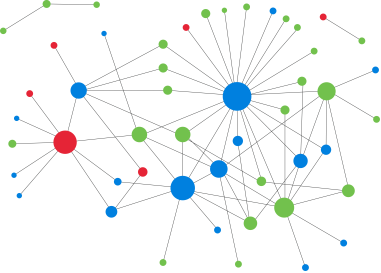
These are just a few models. There are several variations of these models to represent social and other kinds of networks.
Fun fact 1: In 2013, Hungarian physicist Albert-László Barabási discovered that, on average, there are 19 degrees of separation between any two web pages.
Fun fact 2: The Erdős number is widely used in the mathematics community. It shows the degree of closeness of someone's association with mathematician Paul Erdős. If someone directly worked with Erdős, they get the number Erdős-1. If someone worked with the Erdős-1, they get the number Erdős-2, and so on.
Fun fact 3: The Bacon number is similar to the Erdős number, but for the film industry. It measures the degree of separation of an actor from the actor Kevin Bacon. There is also a game called "six degrees of Kevin Bacon".
Fun fact 3.5: And then, there is the Erdős–Bacon number. Before you read the answer, try to guess what it is!
Six degrees of separation in action: Analyzing a social network#
The idea of six degrees of separation becomes much easier to understand when you see it in action. While the theory suggests that most people are connected through surprisingly short chains of relationships, modern network analysis helps explain why these short paths emerge and how platforms use them to connect people.
Graph theory provides the mathematical foundation for studying these relationships. In a social network, people are represented as nodes, relationships are represented as edges, and algorithms analyze how information, opportunities, and influence flow through the network.
Let's explore a simple professional networking platform and see how concepts such as shortest paths, centrality, clustering, and preferential attachment work together.
Our example social network#
Imagine a professional networking platform containing the following users:
Alice (Software Engineer)
Bob (Engineering Manager)
Carol (Product Manager)
David (Startup Founder)
Emma (Investor)
Frank (University Professor)
Grace (Research Scientist)
Henry (Data Engineer)
In graph theory:
Each person is a node
Each relationship is an edge
The collection of nodes and edges forms a network
Network relationships#
The network contains the following connections:
Alice ── Bob│Carol│David│Emma│GraceAlice ── HenryHenry ── FrankFrank ── Grace
Some relationships are direct:
Alice knows Bob
David knows Emma
Emma knows Grace
Others are indirect:
Alice does not know Grace directly
Alice can still reach Grace through a chain of connections
This is where degrees of separation become important.
Finding the shortest path#
One of the most common graph-analysis tasks is finding the shortest path between two nodes.
Question#
How is Alice connected to Grace?
One possible route is:
Alice↓Bob↓Carol↓David↓Emma↓Grace
This path contains five connections, meaning Alice and Grace are separated by five degrees.
However, notice another route:
Alice↓Henry↓Frank↓Grace
This path contains only three connections.
Because graph algorithms search for the shortest valid route, they would identify the second path as the most efficient connection between Alice and Grace.
This is exactly how professional networking platforms discover mutual connections and suggest introductions.
Identifying influential people#
Not all nodes in a network are equally important.
Some people act as bridges between groups, making them highly influential even if they aren't connected to everyone directly.
In our example, Bob serves as an important connector between engineering and product-related contacts.
Similarly, Frank connects academic and research communities.
These nodes have higher centrality, a measure that helps identify influential individuals within a network.
Social platforms use centrality measures to:
Recommend influential users to follow
Suggest valuable professional connections
Improve content discovery
Identify community leaders
For example, LinkedIn may prioritize connection suggestions involving users who frequently bridge otherwise disconnected groups.
Strong ties vs weak ties#
Not all relationships are equally strong.
Strong ties#
Strong ties represent close relationships, such as:
Close coworkers
Family members
Close friends
Long-term collaborators
These connections tend to form tightly connected communities.
Weak ties#
Weak ties represent looser relationships, such as:
Former coworkers
Conference contacts
Professional acquaintances
Alumni connections
Although weaker, these relationships often create the most valuable shortcuts in a network.
For example, Alice's connection to Henry may be relatively weak compared to her relationship with Bob. However, that weak tie dramatically reduces her separation from Grace.
This idea, known as the strength of weak ties, helps explain why networking events and professional communities can create unexpected opportunities.
How the network evolves#
Now imagine a new user joins the platform.
Isabella enters the network#
Isabella is a software engineer looking to expand her professional network.
She has several possible connection choices:
Alice
Bob
Carol
Frank
Research shows that new users are more likely to connect with already well-connected individuals.
This phenomenon is known as preferential attachment.
Because Bob and Frank already serve as important connectors, Isabella is more likely to connect with one of them than with a less connected user.
Over time, this process creates hubs—highly connected nodes that dramatically reduce average separation distances throughout the network.
Many real-world networks, including social media platforms and the web itself, naturally develop these hub structures.
What can we learn from this example?#
Concept | Example in the network |
Node | Individual person |
Edge | Relationship |
Degree | Number of direct connections |
Shortest path | Alice → Henry → Frank → Grace |
Centrality | Bob and Frank acting as connectors |
Weak tie | Alice's professional connection to Henry |
Together, these concepts explain why large social networks often remain surprisingly connected despite containing millions or even billions of users.
How real systems use these ideas#
The same graph-analysis techniques appear throughout modern technology.
LinkedIn connection recommendations#
LinkedIn identifies mutual connections and shortest paths to suggest people you may know.
Facebook friend suggestions#
Friend recommendations often rely on shared neighbors, network clustering, and relationship strength.
Instagram content discovery#
Recommendation systems analyze social and content graphs to surface relevant creators and posts.
Professional networking platforms#
Centrality measures help identify influential users, communities, and potential introductions.
Search engine ranking systems#
Search engines use graph concepts to evaluate how pages link to one another and determine authority.
Many technologies that seem unrelated on the surface are actually solving graph problems behind the scenes.
Many modern recommendation systems are fundamentally graph problems disguised as social features.
Six degrees of separation is much more than an interesting social theory. It emerges naturally from the structure of networks, where nodes, edges, hubs, and weak ties combine to create surprisingly short paths between people.
Modern platforms analyze these relationships continuously to recommend friends, discover content, rank information, and connect users more effectively. Understanding the underlying graph concepts helps explain not only how social networks work, but also how many of today's most influential technologies organize and navigate complex relationships.
Applications#
Six degrees of separation or the small-world phenomenon is a popular concept in network science. It is used in various scientific analyses. Let’s take a look at some of its computer science and general applications:
Web search: Search engines use web crawling and page rank algorithms to determine the importance of web pages. The pages which have the most connections from other web pages are ranked higher and are more important. A low degree of separation gives a page more importance.
Recommender systems: Recommender systems suggest an item based on its connectivity to other items/nodes in the network. An item referred to by more other items gets a higher recommendation.
Social networking: Social media such as Facebook, Twitter, LinkedIn, Instagram, etc. use the idea of degree of separation between users. They may suggest new friends, content, ads and communities based on relevant connections and social media usage.
Routing algorithms: Routing algorithms explore computer networks to find the shortest path between nodes, number of connections and the optimal cost of routes.
Distributed computing: Distributed computing is used to design peer-to-peer networks to share resources. It performs complex computation over distributed resources and parallel computation. To optimize cost and resources, it uses the concept of closeness and importance of the nodes.
The degree of separation concept is popular in social sciences and many other fields as well:
Social network analysis: The idea of six degrees of separation itself emerged from a social experiment. It is used to study the behaviour and relationships among individuals or groups and communities. The concept is used to study the spread of ideas, news, pandemic etc. It can be used to study how communities are structured and have evolved.
Marketing: It is interesting to identify influencers in various markets who can spread the word about a product or service. These influencers can help businesses reach larger audiences.
Psychology: It can be used to study the formation of social bonds and social behavior. It can be used to analyze the group polarization, spread of information, etc.
Navigation: Degrees of separation can be used to optimize navigation as well. It can be used to find the most efficient route between two points by considering the connections between different locations, potential blockages and time costs.
Conclusion#
Six degrees of separation, though not a mathematically proven idea, has earned quite a bit of popularity and acceptance among researchers. The idea has been used to characterise the well connectedness of individuals or elements in a network. This leads to the concept of a small-world model. The idea of six degrees of separation has many practical applications, ranging from social science to computer science to psychology and marketing.
Your next learning steps#
To understand the basics of complex networks and the properties of networks, the first step should be understanding graphs and the algorithms used to solve problems in graphs. That involves learning the structures of graphs, graph algorithms, data analysis, social network analysis and other related fields. If you want to start, no need to look further. Please have a look at the following courses offered here at Educative:
