Walmart System Design Interview
Ready to ace the Walmart System Design interview? Master real-time inventory, order fulfillment, pricing engines, and multi-region retail architecture. Learn to design scalable, reliable systems that power global commerce and stand out as a top engineer.
Preparing for the Walmart System Design interview means preparing to design systems that power one of the largest retail ecosystems in the world. Walmart operates at an enormous scale across e-commerce platforms, mobile apps, physical stores, warehouses, last-mile delivery networks, point-of-sale systems, and global supply chains.
Unlike purely digital companies, Walmart’s systems bridge the physical and digital worlds. A product viewed online must reflect real inventory sitting on a shelf in a store. A customer who orders online must trigger fulfillment logic that interacts with warehouses, delivery drivers, and store associates. Pricing must update across thousands of stores. Promotions must remain consistent across regions. Payments must be secure. Inventory must be accurate.
Grokking Modern System Design Interview

For a decade, when developers talked about how to prepare for System Design Interviews, the answer was always Grokking System Design. This is that course — updated for the current tech landscape. As AI handles more of the routine work, engineers at every level are expected to operate with the architectural fluency that used to belong to Staff engineers. That's why System Design Interviews still determine starting level and compensation, and the bar keeps rising. I built this course from my experience building global-scale distributed systems at Microsoft and Meta — and from interviewing hundreds of candidates at both companies. The failure pattern I kept seeing wasn't a lack of technical knowledge. Even strong coders would hit a wall, because System Design Interviews don't test what you can build; they test whether you can reason through an ambiguous problem, communicate ideas clearly, and defend trade-offs in real time (all skills that matter more than ever now in the AI era). RESHADED is the framework I developed to fix that: a repeatable 45-minute roadmap through any open-ended System Design problem. The course covers the distributed systems fundamentals that appear in every interview – databases, caches, load balancers, CDNs, messaging queues, and more – then applies them across 13+ real-world case studies: YouTube, WhatsApp, Uber, Twitter, Google Maps, and modern systems like ChatGPT and AI/ML infrastructure. Then put your knowledge to the test with AI Mock Interviews designed to simulate the real interview experience. Hundreds of thousands of candidates have already used this course to land SWE, TPM, and EM roles at top companies. If you're serious about acing your next System Design Interview, this is the best place to start.
The Walmart System Design interview questions evaluate your ability to build distributed systems that handle massive traffic, maintain strong inventory correctness, scale across thousands of locations, and remain resilient under peak retail load.
This blog explains what Walmart evaluates, common design prompts, and how to structure a high-scoring answer.
Why Walmart System Design is different#
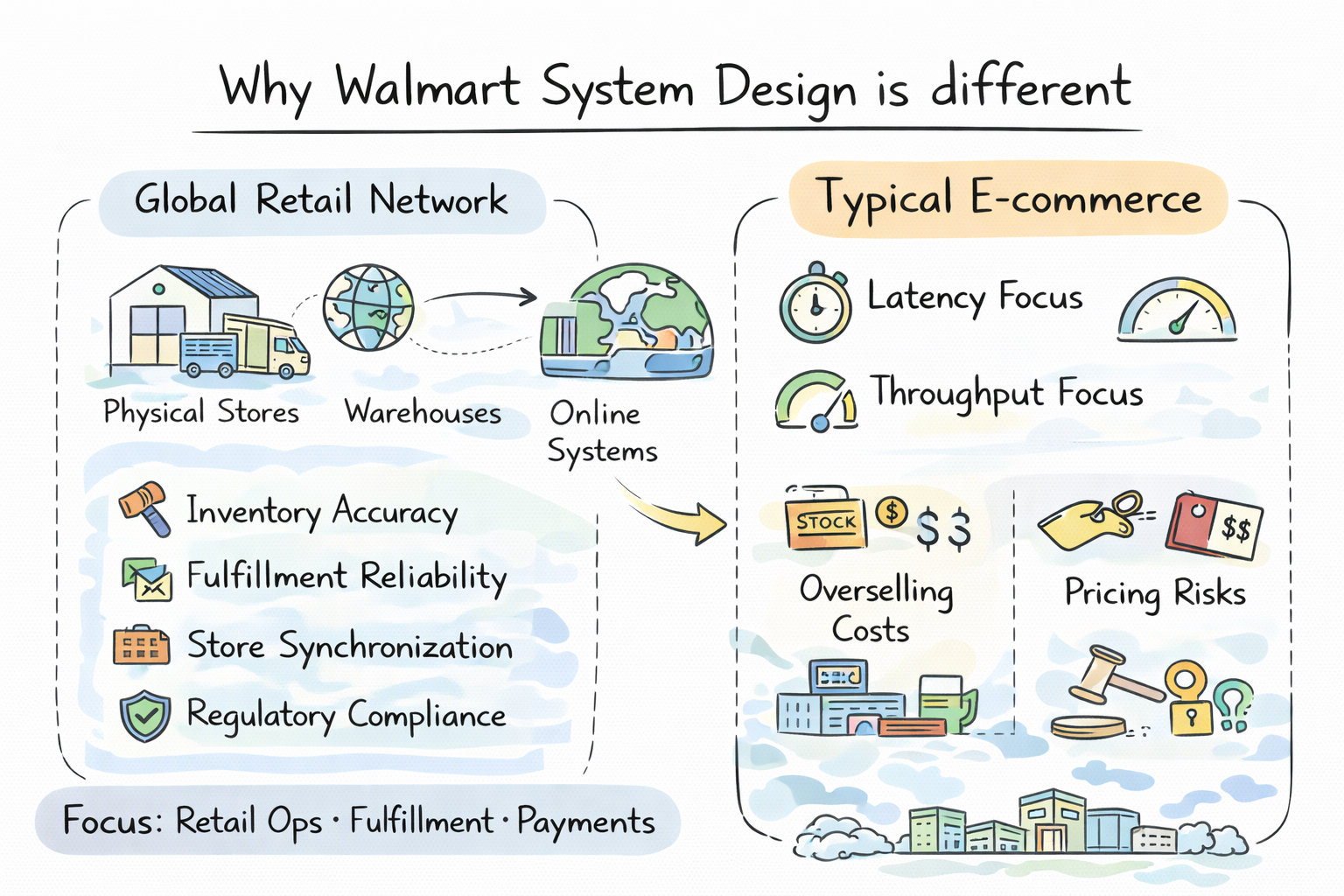
Walmart is not just an e-commerce company. It is a global retail network with tightly integrated online and offline systems. This means design decisions must account for physical stores, warehouse logistics, and real-world constraints such as shelf stock discrepancies and delayed updates from in-store systems.
While many web companies primarily optimize for latency and throughput, Walmart must also optimize for inventory accuracy, fulfillment reliability, store synchronization, and regulatory compliance. Overselling a product that is not actually in stock creates real operational costs. Inaccurate pricing can cause legal and financial issues.
The table below illustrates how Walmart differs from a typical digital-only platform.
Dimension | Typical E-commerce | Walmart Retail Ecosystem |
Inventory source | Central warehouse | Stores + warehouses |
Fulfillment | Warehouse shipping | Store pickup + shipping |
Pricing | Mostly centralized | Regional + store-level |
Consistency | Eventual often acceptable | Strong inventory consistency |
Traffic patterns | Seasonal spikes | Seasonal + daily store load |
Walmart System Design revolves around coordinating distributed physical and digital operations.
Scalability & System Design for Developers
As you progress in your career as a developer, you'll be increasingly expected to think about software architecture. Can you design systems and make trade-offs at scale? Developing that skill is a great way to set yourself apart from the pack. In this Skill Path, you'll cover everything you need to know to design scalable systems for enterprise-level software.
What the Walmart System Design interview evaluates#
Interviewers want to see whether you can design retail infrastructure that is reliable, scalable, and accurate across thousands of nodes.
The following table summarizes the primary areas of evaluation.
Evaluation Area | What You Must Demonstrate |
Inventory management | Strong consistency and multi-location tracking |
Order fulfillment | Reliable lifecycle orchestration |
Search & catalog | Scalable indexing and personalization |
Pricing & promotions | Dynamic updates and propagation |
Payments & fraud | Secure transactions and reconciliation |
Global resilience | Multi-region replication and failover |
Strong answers connect these components into an end-to-end retail architecture.
System Design Deep Dive: Real-World Distributed Systems

Modern software systems are expected to operate at a massive scale while meeting strict reliability and latency requirements. Whether it’s a feed refresh, a payment request, or a real-time analytics query, users expect systems to respond instantly and consistently. That expectation has raised the bar for engineers today, understanding that System Design isn’t optional. It’s a core skill for building and evaluating production-grade systems. I built this course from my experience working on large-scale distributed systems at Microsoft (Azure) and Meta (Scuba), and from interviewing hundreds of candidates across both companies. The pattern I kept seeing was this: candidates understood individual components, but struggled to combine them into a coherent system. They knew what a cache or load balancer was, but not when or why to use it. This course is designed to bridge that gap. We start with the foundational building blocks of System Design, including databases, caching layers, load balancing, and messaging systems, and focus on how they interact under real-world constraints. From there, we analyze systems built by companies like Google, Facebook, and Amazon, breaking them down to understand the trade-offs behind each design decision. The goal is not just to learn concepts, but to develop the ability to reason through them in practice. This approach has helped a large number of engineers build stronger intuition for System Design and perform better in interviews. If you want to understand how real systems are designed and be able to design them yourself, this course gives you a clear, practical path forward.
Real-time inventory management#
Inventory management is the most important theme in Walmart System Design. Inventory exists in stores, warehouses, fulfillment centers, and in-transit deliveries. The system must prevent overselling while handling millions of concurrent reads and writes.
Inventory updates occur through barcode scans, RFID systems, checkout systems, online reservations, and warehouse systems. Updates must propagate in near real time.
The table below outlines core inventory design concerns.
Inventory Concern | Architectural Strategy |
Overselling prevention | Reservation-based locking |
Multi-location stock | Per-location inventory records |
Real-time updates | Event-driven propagation |
Store sync delays | Reconciliation jobs |
Read-heavy traffic | Read replicas and caching |
A strong answer explains optimistic versus pessimistic locking, stock reservation windows, and reconciliation mechanisms.
Order management and fulfillment#
The order management system orchestrates the lifecycle of an order from placement to delivery or pickup. It must handle payment authorization, inventory reservation, routing to a store or warehouse, picking and packing, shipping, delivery tracking, and returns.
An order often transitions through multiple states, and each state may trigger additional events.
The following table summarizes order lifecycle phases.
Phase | Description |
Order placed | Stock reservation begins |
Payment authorized | Financial validation |
Routing | Store or warehouse selection |
Picking & packing | Physical preparation |
Shipment | Carrier handoff |
Delivery or pickup | Customer fulfillment |
Returns | Reverse logistics |
Reliability is critical. If the workflow fails at any stage, the system must recover gracefully.
Search and product discovery#
Walmart’s product catalog contains millions of SKUs. Customers expect real-time price accuracy and store-aware availability.
Search systems must index product metadata, availability signals, and pricing updates. Ranking systems combine relevance, popularity, personalization, and regional preferences.
The table below illustrates search design components.
Component | Purpose |
Indexing pipeline | Keep product data fresh |
Ranking model | Combine relevance signals |
Autocomplete | Improve query experience |
Geo-awareness | Show local availability |
Price sync | Reflect dynamic updates |
Search freshness and performance are tightly coupled with inventory and pricing systems.
Pricing and promotions#
Walmart operates complex pricing logic. Prices vary by region, store, season, and promotional window. Promotions may stack, expire, or override base prices.
The pricing engine must propagate changes quickly while avoiding inconsistencies across online and in-store systems.
The table below highlights pricing challenges.
Pricing Challenge | Architectural Response |
Regional overrides | Hierarchical rule engine |
Promotion windows | Time-based evaluation |
High traffic updates | Cache invalidation strategy |
Fraud prevention | Validation layer |
Online-store sync | Event-driven propagation |
Designing hierarchical pricing rules demonstrates deep retail understanding.
Payments and fraud detection#
Walmart processes millions of transactions daily. Payment systems must integrate with external gateways, maintain PCI compliance, and support refunds and reconciliation.
Fraud detection systems monitor suspicious patterns in transactions and return flows. Payment flows must be idempotent to prevent double-charging.
A mature answer discusses secure token storage, reconciliation pipelines, and monitoring dashboards.
Multi-region availability and resilience#
Walmart operates globally, meaning outages cannot halt operations. Multi-region active-active architectures ensure failover capability.
Data replication must balance consistency and latency. Inventory data may require stronger guarantees than search logs.
The following table summarizes resilience strategies.
Failure Scenario | Response Strategy |
Region outage | Traffic rerouting |
Store offline | Use the last-known inventory |
Warehouse failure | Alternate routing |
Payment timeout | Retry with rollback |
Search index lag | Serve slightly stale data |
Retail operations demand graceful degradation.
Structuring your answer effectively#
A high-scoring Walmart System Design answer follows a structured progression.
First, clarify requirements. Confirm whether the focus is on inventory, fulfillment, pricing, or search. Determine real-time constraints and consistency expectations.
Second, define non-functional requirements. These typically include high availability, strong inventory consistency, low latency for search, scalability across thousands of stores, and regulatory compliance.
Third, estimate scale. Provide realistic assumptions such as millions of daily orders, millions of SKUs, thousands of stores, and heavy holiday spikes.
Fourth, present a modular high-level architecture. A Walmart-scale architecture includes an API gateway, product catalog service, inventory service, order service, pricing service, payment service, search service, fulfillment engine, event streaming backbone, distributed caching layer, fraud detection system, and multi-region replication layer.
Deep dive into critical components#
Inventory service#
The inventory service maintains per-location stock counts. A reservation subsystem temporarily locks stock when an order is initiated. Updates from POS systems propagate through an event bus. Reconciliation jobs periodically correct discrepancies.
Order management system#
The order management system uses a state machine to manage transitions. Stock is reserved at order placement. Routing logic determines optimal fulfillment location based on proximity and availability. Cancellation flows release reserved stock.
Search and catalog service#
The catalog service manages product metadata. An indexing pipeline updates search clusters incrementally. Geo-aware filtering ensures accurate local results.
Pricing engine#
The pricing engine evaluates hierarchical rules. Cache layers ensure low-latency reads. Promotion logic supports stacking rules and expiration handling.
Fulfillment engine#
The fulfillment engine coordinates picking, batching, shipment creation, and delivery tracking. Real-time tracking integrates with logistics systems.
Handling failures#
Failure reasoning is critical in retail systems. If a store system goes offline, the platform may rely on last-known inventory data while marking confidence levels. If payment authorization fails, reservations must be rolled back. If a warehouse becomes unavailable, orders must reroute.
Graceful degradation preserves customer trust.
Trade-offs in Walmart System Design#
Trade-offs reveal engineering maturity.
Strong consistency prevents overselling but increases latency. Aggressive caching improves speed but risks stale availability. Centralized catalog systems simplify management but increase global latency. Asynchronous workflows improve scalability but complicate failure handling.
Explicitly articulating these trade-offs strengthens your response.
Example: Real-time inventory system#
Imagine designing an inventory system supporting both online and store sales.
A user queries availability. The API gateway routes the request to the inventory service. The service checks per-location stock counts using tenant-aware indexes. If the user places an order, a reservation subsystem locks the stock temporarily. The order service confirms payment and finalizes the deduction. Store and warehouse systems publish updates to an event bus. Caches invalidate accordingly. Reconciliation jobs correct discrepancies nightly.
This architecture balances accuracy, scalability, and resilience.
Final thoughts on the Walmart System Design interview#
The Walmart System Design interview tests your ability to build robust, scalable retail systems that power global commerce. You must think beyond simple web services and account for inventory accuracy, store synchronization, fulfillment complexity, dynamic pricing, payments, and multi-region resilience.
If you clarify requirements carefully, design modular retail services, emphasize strong inventory consistency, reason about fulfillment workflows, justify trade-offs thoughtfully, and plan for failure tolerance, you will stand out as a candidate ready to build systems that operate at retail scale.
