Walmart System Design Interview Questions
Preparing for the Walmart System Design interview? Learn how to design systems that never fail under extreme scale, peak traffic, and real-world retail constraints. This guide breaks down Walmart’s most common System Design questions.
Walmart System Design interviews test your ability to build high-throughput, globally distributed systems that support real retail operations across inventory, checkout, fulfillment, and fraud detection at massive scale. The questions are grounded in business-critical trade-offs like strong consistency versus availability, offline-first store behavior, and reliability under extreme peak loads such as Black Friday.
Core principles
- Inventory consistency boundaries: Checkout and reservation flows require strong consistency, while analytics and reporting can tolerate eventual consistency with idempotent, versioned writes to handle conflicts.
- Offline-first store design: Point-of-sale systems and IoT sensors must operate during network outages, buffering events locally and syncing back to central systems using deduplication and reconciliation logic.
- Real-time pipeline architecture: Fraud detection, order tracking, and dynamic pricing all rely on streaming pipelines that separate low-latency online inference from offline batch model training.
- Multichannel fulfillment coordination: Curbside pickup and order routing require geo-based store assignment, near-real-time inventory propagation, and fallback handling when local stock runs out unexpectedly.
- Audit and control layers: Pricing systems, fraud models, and checkout flows must include approval workflows, comprehensive audit logging, and graceful failure recovery to meet both technical and business compliance requirements.
If you’re preparing for a Walmart System Design interview, whether it’s for Walmart Global Tech, Walmart Labs, or a senior engineering role in their e-commerce division, there’s one big thing to understand upfront: Walmart is not just a retail company. It’s one of the largest distributed systems companies in the world.
With hundreds of millions of customers, tens of thousands of stores, and global supply chains that operate 24/7, Walmart’s systems must scale to match only Amazon, Alibaba, and a handful of other giants. That means Walmart System Design interview questions are built to test whether candidates can design high-throughput, globally synchronized, deeply reliable systems that support real retail operations, inventory, search, order fulfillment, logistics, fraud detection, pricing, curbside pickup, and more.
Grokking Modern System Design Interview

For a decade, when developers talked about how to prepare for System Design Interviews, the answer was always Grokking System Design. This is that course — updated for the current tech landscape. As AI handles more of the routine work, engineers at every level are expected to operate with the architectural fluency that used to belong to Staff engineers. That's why System Design Interviews still determine starting level and compensation, and the bar keeps rising. I built this course from my experience building global-scale distributed systems at Microsoft and Meta — and from interviewing hundreds of candidates at both companies. The failure pattern I kept seeing wasn't a lack of technical knowledge. Even strong coders would hit a wall, because System Design Interviews don't test what you can build; they test whether you can reason through an ambiguous problem, communicate ideas clearly, and defend trade-offs in real time (all skills that matter more than ever now in the AI era). RESHADED is the framework I developed to fix that: a repeatable 45-minute roadmap through any open-ended System Design problem. The course covers the distributed systems fundamentals that appear in every interview – databases, caches, load balancers, CDNs, messaging queues, and more – then applies them across 13+ real-world case studies: YouTube, WhatsApp, Uber, Twitter, Google Maps, and modern systems like ChatGPT and AI/ML infrastructure. Then put your knowledge to the test with AI Mock Interviews designed to simulate the real interview experience. Hundreds of thousands of candidates have already used this course to land SWE, TPM, and EM roles at top companies. If you're serious about acing your next System Design Interview, this is the best place to start.
In this guide, you’ll walk through the most important Walmart System Design interview questions, the hidden skills they test, and how to structure strong, senior-level answers. By the end, you'll know exactly how to approach Walmart’s interview expectations with confidence.
Why Walmart System Design interview questions are unique#
Dimension | Walmart | Typical Big Tech |
Focus | Retail + supply chain | Consumer apps |
Consistency | Very high | Often relaxed |
Peak traffic | Extreme seasonal spikes | More predictable |
Offline support | Required (stores) | Rare |
Priority | Reliability over elegance | Scalability over all |
You’ll notice quickly that Walmart doesn’t ask the same style of questions during their System Design interview as Meta, Google, or Netflix. That’s because the engineering problems they solve are different.
Walmart focuses heavily on:
Real-world commerce systems: Pricing engines, inventory tracking, checkout flows, supply-chain orchestration.
Store + online hybrid systems: Curbside pickup, online orders fulfilled from local stores, and in-store scanning apps.
High consistency requirements: Out-of-sync inventory numbers can cost millions.
Extreme peak load spikes: Especially during holidays, Black Friday, and seasonal events.
Reliability over raw complexity: Walmart’s priority is “never fail during peak hours.”
Because of this, Walmart System Design interview questions push you to think across end-to-end workflows, business constraints, and operational trade-offs, not just distributed architecture patterns.
System Design Interview: Fast-Track in 48 Hours

I created this System Design interview prep crash course after spending years interviewing engineers at companies like Meta and Microsoft. I kept seeing the same pattern: candidates who were strong in coding would struggle the moment the System Design interview began. It was because they didn’t have a clear way to approach System Design under pressure. That’s exactly why I built this course to help you master System Design in a hurry, without feeling overwhelmed. System Design interviews aren’t about memorizing architectures or listing technologies. They’re about how you think. Can you break down an ambiguous problem? Can you make the right trade-offs? Can you communicate your decisions clearly? The candidates who succeed are the ones with a structured approach they can rely on. In this course, I’ve distilled that approach into a simple, repeatable framework. Instead of scattered topics, you’ll learn System Design step by step, from understanding requirements to designing scalable systems and explaining your choices with confidence. Each lesson builds your intuition and prepares you for real interview scenarios. This is the same mindset I’ve seen successful candidates use to stand out. Whether you’re preparing for your first System Design interview or trying to level up quickly, this course gives you a practical path forward. By the end, you’ll know how to apply System Design concepts effectively, even when time is limited and the pressure is high.
How would you design a global inventory management system for Walmart?#
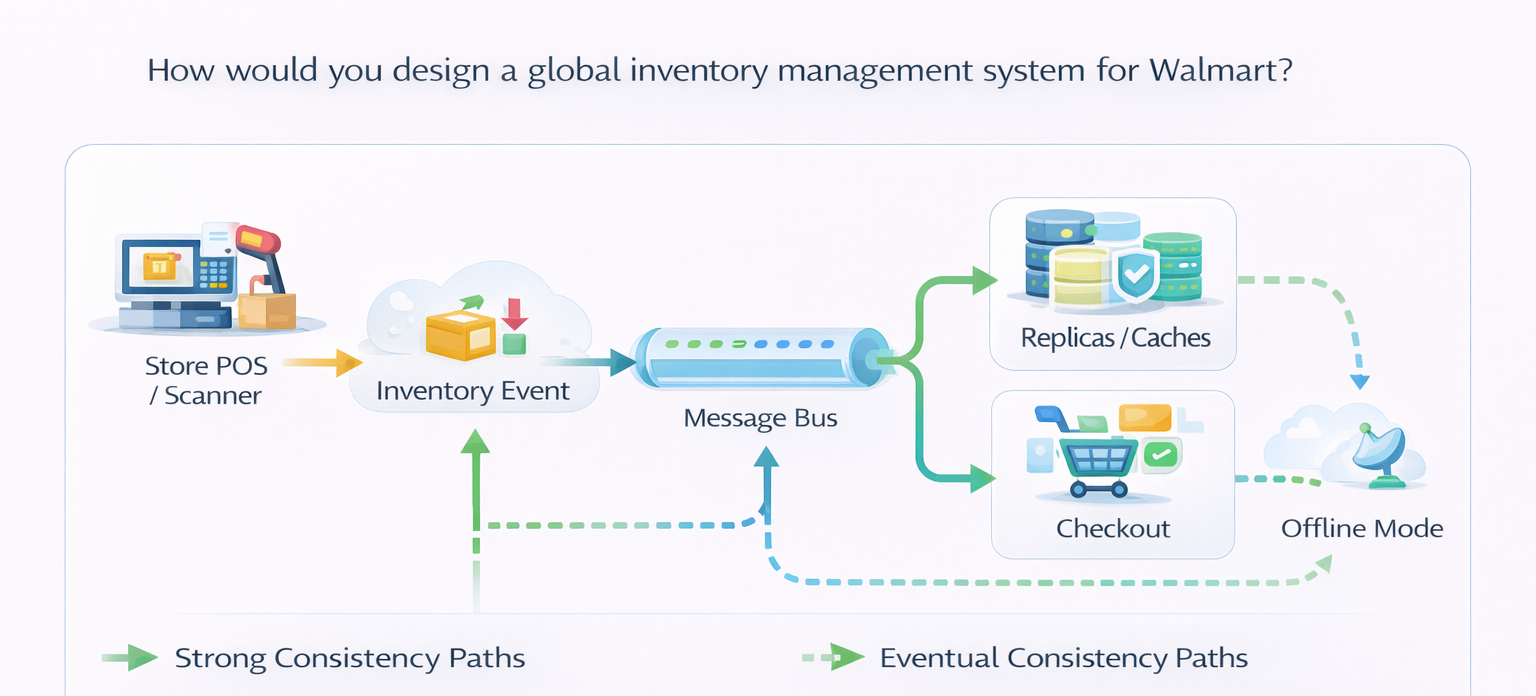
This is one of the most common Walmart System Design interview questions because inventory accuracy sits at the core of Walmart’s entire operation. Every checkout, curbside pickup, delivery promise, and pricing decision depends on having a reliable, up-to-date view of inventory across thousands of stores and warehouses.
When interviewers ask this question, they are not looking for a generic CRUD service. They want to see whether you can reason about distributed consistency, real-world stock movement, and failure recovery at a massive scale.
What Walmart is really testing#
First, Walmart wants to know whether you understand how to maintain strong consistency where it matters, especially during checkout and inventory reservation. A system that allows overselling or stale inventory during peak traffic can lead to significant financial and customer trust issues.
Second, interviewers evaluate whether you understand how inventory actually changes in the real world. Stock is affected by inbound shipments, customer purchases, returns, damaged goods, and shrinkage. A strong answer shows that you can model these events explicitly instead of treating inventory as a simple counter.
Finally, Walmart is testing your ability to balance regional replication and performance with correctness. You should be able to explain where strong consistency is required, where eventual consistency is acceptable, and how conflicts are resolved when updates arrive late or out of order.
Structuring your answer: data modeling#
A solid answer starts with the data model. At the core, inventory should be tracked at the SKU level, but scoped to physical locations such as stores and warehouses. Each SKU record typically maintains the current quantity on hand, the quantity already reserved for pending orders, and safety stock thresholds that prevent selling inventory too aggressively.
Separating store-level inventory from warehouse-level inventory is important because they have different usage patterns. Stores must support fast reads and offline operation, while warehouses often handle bulk updates and batch processing.
Structuring your answer: system architecture#
From an architectural standpoint, strong candidates usually describe an event-driven inventory pipeline. Every stock change, whether it’s a sale, return, or restock, is emitted as an immutable inventory event. These events are written to a durable message bus, such as Kafka, which becomes the source of truth for inventory movements.
An inventory service consumes these events and applies them using strict write semantics to ensure correctness. This service is responsible for enforcing constraints like preventing negative inventory or double-reserving stock. To support low-latency reads at scale, read replicas or materialized views are used, especially for search, availability checks, and browsing.
At the store level, local caches allow point-of-sale systems and scanners to continue operating during temporary network outages. When connectivity is restored, buffered events are synchronized back to the central system using versioning and idempotent updates to avoid duplication or conflicts.
What makes a strong answer stand out#
The strongest answers explicitly call out trade-offs. Checkout and reservation flows require strong consistency, while analytics and reporting can tolerate eventual consistency. You should also mention idempotency, versioned writes, and reconciliation processes for handling late or conflicting updates.
By grounding your design in real inventory movement, consistency boundaries, and offline behavior, you demonstrate the kind of practical, business-aware system design thinking Walmart looks for in senior engineers.
Key trade-offs#
Area | Strong consistency | Eventual consistency |
Checkout | Required | Not acceptable |
Analytics | Too expensive | Preferred |
Store sync | Versioned writes | Acceptable |
Conflict resolution | Mandatory | Reconciliation later |
Strong consistency for checkout flows
Eventual consistency for analytics
How to reconcile discrepancies
How to handle offline store scanners syncing later
A strong candidate explicitly discusses idempotent updates, versioning, and conflict handling for distributed writes.
System Design Deep Dive: Real-World Distributed Systems

Modern software systems are expected to operate at a massive scale while meeting strict reliability and latency requirements. Whether it’s a feed refresh, a payment request, or a real-time analytics query, users expect systems to respond instantly and consistently. That expectation has raised the bar for engineers today, understanding that System Design isn’t optional. It’s a core skill for building and evaluating production-grade systems. I built this course from my experience working on large-scale distributed systems at Microsoft (Azure) and Meta (Scuba), and from interviewing hundreds of candidates across both companies. The pattern I kept seeing was this: candidates understood individual components, but struggled to combine them into a coherent system. They knew what a cache or load balancer was, but not when or why to use it. This course is designed to bridge that gap. We start with the foundational building blocks of System Design, including databases, caching layers, load balancing, and messaging systems, and focus on how they interact under real-world constraints. From there, we analyze systems built by companies like Google, Facebook, and Amazon, breaking them down to understand the trade-offs behind each design decision. The goal is not just to learn concepts, but to develop the ability to reason through them in practice. This approach has helped a large number of engineers build stronger intuition for System Design and perform better in interviews. If you want to understand how real systems are designed and be able to design them yourself, this course gives you a clear, practical path forward.
How do you design a price recommendation and dynamic pricing system?#
Walmart adjusts prices continuously in response to changes in supply, demand, competitor behavior, and seasonal or event-driven signals. When interviewers ask this question, they are testing whether you understand how modern pricing engines balance data-driven intelligence with strict business controls.
A strong answer begins by explaining how pricing signals are collected. Historical data from point-of-sale systems, online orders, and external competitor feeds is ingested in batch pipelines to provide a broad view of demand patterns and price sensitivity. This data feeds machine learning models that estimate price elasticity, forecast demand, and optimize for margin while remaining competitive.
On top of these models sits a decision engine responsible for generating recommended prices. This engine scores potential price changes using model outputs and business constraints, ensuring recommendations stay within predefined guardrails. Because pricing decisions can have legal and brand implications, the system must also support approval and override workflows that allow human operators to review, adjust, or reject automated recommendations.
From an architectural perspective, a clear separation between offline analytics and online decision-making is essential. Batch data pipelines, built with tools like Spark or Flink, handle large-scale ingestion and model training. A feature store serves consistent inputs to both training and inference. The trained models are then deployed behind a low-latency pricing API that serves real-time price recommendations to downstream systems such as checkout and search.
Finally, every pricing decision must be auditable. Comprehensive audit logging ensures Walmart can trace how a price was generated, which inputs were used, and who approved it. Calling out this distinction between analytics pipelines and real-time decision services is critical, as Walmart interviewers want to see that you understand both the technical and business responsibilities of a dynamic pricing system.
How would you design a high-availability checkout system for Walmart’s e-commerce app?#
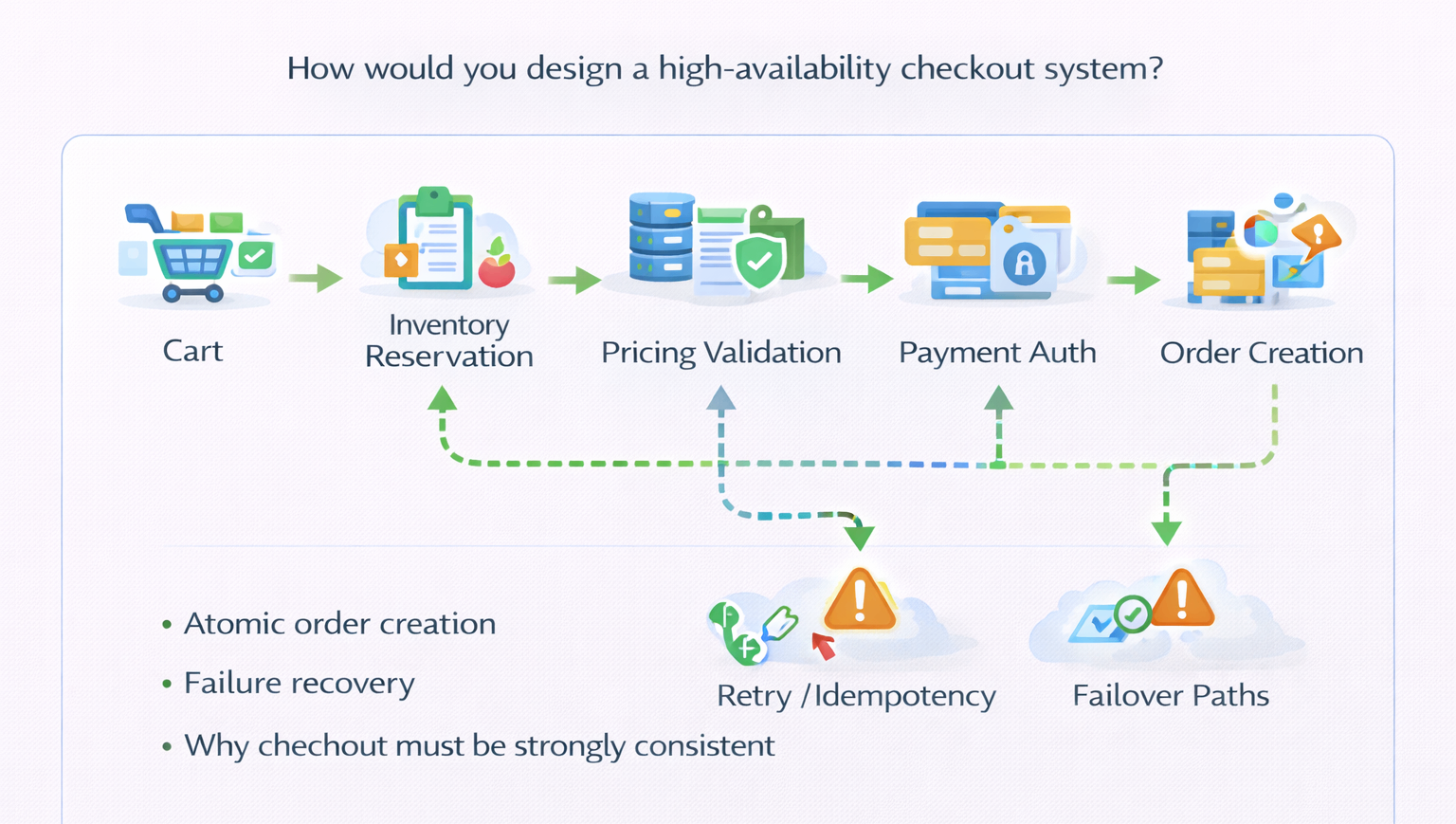
Checkout is one of the most sensitive systems in Walmart’s e-commerce platform because any failure immediately translates to lost revenue and broken customer trust. When designing a high-availability checkout system, interviewers expect you to think beyond a single service and reason about the entire transactional flow from cart to order confirmation.
A strong answer walks through the core services involved in that flow. The cart service initiates checkout, pricing validation ensures prices and promotions are still accurate, and the inventory reservation system temporarily locks stock to prevent overselling. Payment gateway orchestration handles authorization and capture, while the order creation service persists the final order state. Fraud checks run in parallel to flag suspicious transactions without adding unnecessary latency. Explaining how these components interact is more important than naming specific technologies.
Equally critical are the constraints under which the system must operate. Checkout must remain available during peak events like Black Friday, which means multi-region deployments and failover strategies are mandatory. Idempotent order creation is essential to prevent double-charging when retries occur, and strict PCI compliance governs how payment data is handled. Senior-level answers emphasize recovery paths, de-duplication of events, and graceful failure handling, showing that you understand checkout as a resilient, end-to-end system rather than just a cart feature.
How do you design Walmart’s curbside pickup or “order online, pick up in store” system?#
Designing Walmart’s curbside pickup system is a strong test of whether you understand how online systems integrate with physical store operations. Unlike purely digital workflows, this experience must coordinate customers, store inventory, staff actions, and real-time updates without breaking under load.
A solid answer starts with the key services involved. An order routing service determines which nearby store should fulfill the order based on inventory and proximity. A store availability database tracks local stock, while a slot scheduling system manages pickup windows. Geo-based assignment ensures customers are routed to the correct store, and an in-store staff app drives picking and staging.
You should then walk through the end-to-end flow. After a customer places an order, the system selects the fulfillment store and reserves inventory. Store staff receive a picking list and item status updates as each product is picked. Customers receive push notifications as the order progresses. When the customer arrives, geofencing detects their presence and alerts staff to bring the order curbside.
Interviewers also want to see operational awareness. High-turnover stores introduce concurrency challenges when multiple orders compete for the same items. Inventory updates must propagate in near real time, and store systems must stay in sync with cloud APIs. Strong answers also describe fallback behavior, such as rerouting orders or notifying customers when a store unexpectedly runs out of stock.
How would you design a real-time order tracking system?#
Walmart’s logistics network spans planes, trucks, micro-fulfillment centers, and local stores, which makes real-time order tracking a complex distributed systems problem. When designing a tracking system, interviewers expect you to think about accuracy across multiple carriers while maintaining a consistent customer experience.
A strong answer explains the core components involved. Shipment updates flow through an event ingestion pipeline, where tracking IDs are mapped to customer orders. GPS updates from delivery vehicles are stored in a time-series database to maintain location history, while a notification service pushes timely status updates to customers as orders move through the network.
The hardest challenges come from messy real-world data. Carriers often send updates in different formats, events can arrive out of order, and edge cases like lost or partially delivered packages must be handled gracefully. Senior-level answers explicitly mention schema normalization, deduplication of events, and late-event handling to ensure tracking remains accurate and trustworthy.
How do you design a fraud detection system for Walmart?#
Fraud detection is a critical system at Walmart because the platform processes massive volumes of payments across online and in-store channels. When discussing fraud detection, interviewers want to see that you understand how multiple detection layers work together to stop abuse without slowing down legitimate transactions.
A strong answer describes a real-time pipeline where transaction events flow through streaming systems and are scored within strict latency limits, typically under 100–150 milliseconds.
Feature extraction from user behavior feeds rule-based filters, machine-learning risk models, and graph-based anomaly detection. The architecture should include an ML inference service for online decisions, a feedback loop to learn from false positives, and alerting dashboards for analysts. Explicitly calling out the separation between online inference and offline batch training is a key signal of senior-level understanding.
How would you design a store-level IoT sensor monitoring platform?#
Many Walmart stores rely on IoT sensors for refrigeration, shelf tracking, camera analytics, and building management.
Components to discuss#
Edge gateways in each store
MQTT/WebSocket ingestion
Time-series storage
Rule engine for alerting
Long-term cold storage for analytics
Important considerations#
Offline-first design for stores with network outages
Batched data upload
Local anomaly detection
Secure device identity management
Walmart loves candidates who can articulate edge computing design patterns.
How do you design Walmart’s product search system?#
Search drives huge revenue for Walmart’s e-commerce platform.
Core system components#
Crawler + product feed ingestion
Search indexing pipelines
Distributed search service using inverted indexes + vector search
Query understanding layer
Re-ranking using ML models
What the interviewer wants to hear#
How you design for relevance, latency, and freshness
How you handle synonyms, typos, and stopwords
How you build autocomplete
How you scale index sharding
Mentioning A/B testing frameworks for search ranking wins bonus points.
Final thoughts#
If you master the eight question types above, you’ll be ready for 90% of Walmart System Design rounds. Walmart evaluates engineers based on their ability to design real-world, mission-critical systems, not just theoretical distributed components.
To stand out, focus on:
Strong consistency vs high availability
Global replication
Offline-first store systems
Real-time data pipelines
Multichannel inventory and fulfillment flows
Reliability under extreme peak loads
Business-aware trade-offs
Walk into your interview showing that you can design practical, scalable systems grounded in real retail operations, and you’ll perform like a top-tier Walmart Global Tech engineer.