What is chain-of-thought prompting?
Want more accurate AI responses? Learn how chain-of-thought prompting helps models reason step by step, boosting performance in math, logic, and complex tasks while making outputs easier to understand and debug.
Large language models have become powerful tools for generating text, answering questions, summarizing documents, and assisting with programming tasks. These models can often produce fluent responses quickly, but they sometimes struggle when solving problems that require multiple reasoning steps. Tasks involving arithmetic, logical analysis, or structured decision-making can expose these limitations.
As developers and researchers experiment with techniques to improve model reasoning, many encounter the question of what is chain of thought prompting and why it has become such an important concept in prompt engineering.
Chain-of-thought prompting is a strategy designed to guide large language models to reason through a problem step by step rather than producing an immediate answer. By encouraging models to generate intermediate reasoning steps, this technique often improves accuracy and makes the reasoning process more transparent.
All You Need to Know About Prompt Engineering

As generative AI becomes embedded in everyday workflows, the ability to guide models effectively is emerging as a core skill. Prompt engineering is foundational to how we build reliable, controllable AI systems. Yet most practitioners struggle to learn prompt engineering in a structured way, often relying on trial and error. This course focuses on turning prompt design into a disciplined, repeatable process. I built this course from my work in intelligent systems and adaptive AI, where controlling model behavior has always been as important as building the model itself. A pattern I observed across teams was that even strong engineers treated prompts as ad hoc inputs rather than system components. This led to instability, inconsistency, and hidden failure modes. This course addresses that gap by framing prompt engineering as a structured design problem. You’ll learn how to design prompts with clear objectives, defined roles, and controlled ambiguity to improve output quality. The course covers techniques such as few-shot prompting, schema-based outputs, reasoning strategies, and parameter tuning. You’ll also explore grounding, long-context handling, and defenses against prompt injection. Finally, you’ll integrate evaluation, monitoring, and safety practices to maintain prompt reliability in production systems. If you want to learn prompt engineering in a way that prepares you to build stable, trustworthy AI systems, this course provides a clear and practical foundation.
Understanding how chain-of-thought prompting works requires first exploring how prompts influence language model behavior and how structured reasoning emerges from carefully designed prompts.
Understanding prompting in large language models#
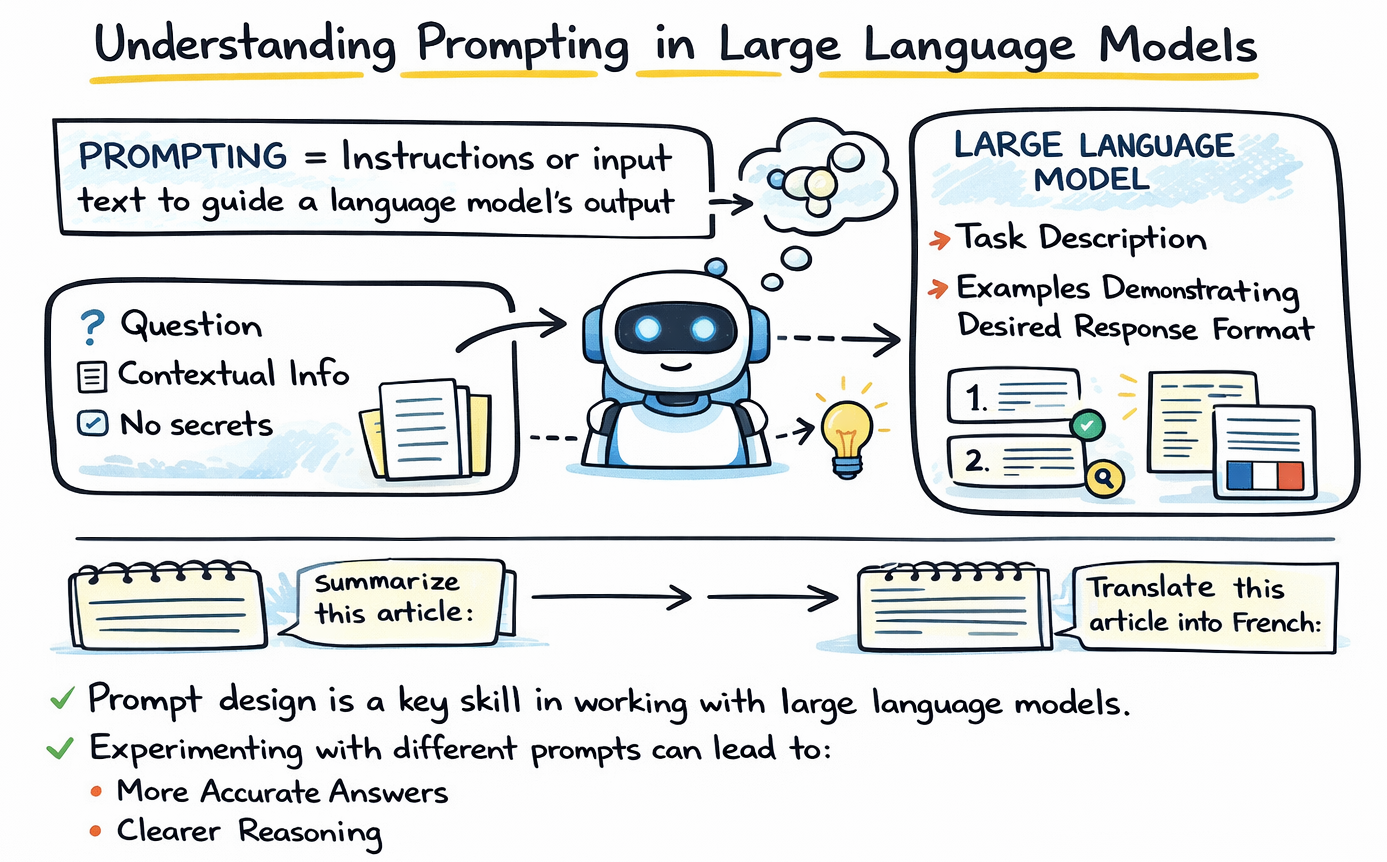
Prompting refers to the instructions or input text given to a language model in order to guide the output it generates. Because large language models produce text based on patterns learned during training, the phrasing and structure of a prompt can strongly influence how the model responds.
A prompt can contain several elements that shape the behavior of the model. It may include a question, a task description, contextual information, or examples demonstrating the desired response format. The model interprets these signals and generates output that follows similar patterns.
For example, a prompt asking a model to summarize an article produces a different response from one asking the model to translate the same text into another language. The difference arises not from the model architecture itself but from the instructions provided in the prompt.
Prompt design has therefore become an important skill when becoming a prompt engineer and building applications that rely on large language models. Developers often experiment with different prompt structures to encourage clearer reasoning, more accurate answers, or more consistent formatting.
Become a Prompt Engineer

Prompt engineering has emerged as one of the most in-demand skills in artificial intelligence, shaping how large language models think, reason, and generate outputs. As organizations adopt generative AI at scale, the demand for skilled AI prompt engineers and professionals pursuing prompt engineering jobs continues to grow. This “Become a Prompt Engineer” Skill Path provides a comprehensive, structured prompt engineering course that takes learners from fundamentals to production-ready systems. We begin by answering what prompt engineering is and mastering core prompt engineering techniques and best practices. We then explore prompt engineering examples for professional and developer workflows before advancing into grounding, multimodal prompting, tool integration, and production monitoring. By the end of this Skill Path, you will be equipped with the practical expertise and system-level understanding required to pursue modern AI prompt engineering roles with confidence.
Prompting techniques overview#
As developers have experimented with language models, several prompt engineering best practices have emerged that improve model performance on complex tasks.
Zero-shot prompting involves giving the model a task without providing examples. The model relies entirely on its training data to infer how the task should be completed.
Few-shot prompting provides several example input-output pairs in the prompt. These examples demonstrate the expected format and reasoning pattern before the model produces its own answer.
Instruction prompting provides clear directions about what the model should do, often specifying formatting rules, reasoning steps, or constraints on the output.
Chain-of-thought prompting extends these techniques by encouraging the model to produce intermediate reasoning steps. Instead of directly generating the final answer, the model first explains the logical process that leads to the solution.
This structured reasoning process often improves performance on tasks requiring multiple steps.
Chain-of-thought explanation section#
To understand what is chain of thought prompting, it is helpful to examine how the technique alters the way language models produce responses.
Chain-of-thought prompting encourages the model to generate intermediate reasoning steps before producing a final answer. Instead of immediately predicting a solution, the model walks through the logical process used to reach the conclusion.
This approach mirrors how humans often solve complex problems. When faced with a multi-step task, people rarely jump directly to the answer. Instead, they break the problem into smaller steps and work through each one sequentially.
Language models behave similarly when guided by structured prompts. By explicitly requesting step-by-step reasoning, the prompt encourages the model to generate a chain of intermediate tokens that represent logical reasoning.
These intermediate steps often help the model arrive at a more accurate final answer because the reasoning process becomes more structured and deliberate.
Why chain-of-thought prompting improves reasoning#
Large language models generate text by predicting the next token in a sequence based on the context of previous tokens. When a prompt encourages step-by-step reasoning, the model generates a longer sequence that includes intermediate logical explanations.
These additional tokens allow the model to explore relationships between concepts before committing to a final answer. Instead of compressing the entire reasoning process into a single prediction, the model distributes the reasoning across multiple steps.
Several benefits emerge from this approach.
First, it improves reasoning transparency. When the model explains its reasoning, users can inspect the intermediate steps and understand how the answer was derived.
Second, chain-of-thought prompting often improves performance on tasks involving mathematics, logic, and structured analysis. These tasks naturally benefit from sequential reasoning.
Third, guiding the model through explicit reasoning reduces the likelihood of shortcuts or superficial answers. By requiring intermediate steps, the prompt encourages deeper analysis.
These characteristics help explain why researchers frequently explore what is chain of thought prompting when developing reliable AI systems.
Standard prompting vs chain-of-thought prompting#
Prompting Method | Description | Behavior |
Standard prompting | Model generates direct answer | May skip reasoning steps |
Chain-of-thought prompting | Model explains reasoning step by step | Improves complex problem solving |
Standard prompting works well for simple tasks that require short responses. However, when tasks involve multiple reasoning steps, the model may produce incorrect answers because it skips intermediate reasoning.
Chain-of-thought prompting addresses this limitation by encouraging the model to generate reasoning steps explicitly.
Step-by-step reasoning example#
A simple example illustrates how prompting style influences model responses.
Standard prompt example#
Prompt:"If a store sells three notebooks for $5 each, what is the total cost?"
Model response:"$15"
The model produces the correct answer, but it does not explain the reasoning process.
Chain-of-thought prompt example#
Prompt:"Think through the problem step by step. If a store sells three notebooks for $5 each, what is the total cost?"
Model reasoning:
Each notebook costs $5.
The store sells three notebooks.
Multiply the price by the quantity.
The total cost is $15.
This structured reasoning demonstrates the logic behind the answer. For more complex problems, this reasoning chain often helps the model reach more reliable conclusions.
Applications of chain-of-thought prompting#
Chain-of-thought prompting is widely used in applications that require structured reasoning or analytical problem solving.
Mathematical problem solving represents one of the most common applications. Tasks involving arithmetic or algebra often benefit from step-by-step reasoning that mirrors human problem-solving approaches.
Logical reasoning tasks also benefit from structured prompts. When evaluating conditions, analyzing arguments, or solving puzzles, models perform better when encouraged to articulate intermediate reasoning steps.
Developers also use chain-of-thought prompting when explaining or debugging code. By describing the reasoning process behind a code snippet, the model can provide clearer explanations of program behavior.
Complex question-answering systems also benefit from structured reasoning prompts. When queries require combining multiple pieces of information, chain-of-thought reasoning helps organize the response logically.
Variations of chain-of-thought prompting#
Researchers have extended the idea of structured reasoning into several related techniques.
Few-shot chain-of-thought prompting includes examples of step-by-step reasoning within the prompt. These examples demonstrate the reasoning structure that the model should follow when generating its own answer.
Self-consistency prompting generates multiple reasoning chains and selects the most consistent final answer among them. This approach reduces the impact of incorrect reasoning paths.
Tree-of-thought reasoning extends the idea further by exploring multiple possible reasoning branches before selecting the best path. This approach resembles search algorithms used in traditional artificial intelligence systems.
These variations demonstrate how the concept of structured reasoning continues to evolve as researchers refine prompting strategies.
FAQ#
Do all large language models support chain-of-thought prompting?#
Most modern large language models can produce chain-of-thought reasoning when prompted appropriately. However, the effectiveness of this technique varies depending on the model size, training data, and alignment methods used during development.
Does chain-of-thought prompting always improve accuracy?#
Chain-of-thought prompting often improves performance on tasks that require multi-step reasoning. However, for simple tasks or factual queries, the additional reasoning steps may not significantly affect the outcome.
Can chain-of-thought reasoning increase response time?#
Because the model generates additional tokens to explain intermediate reasoning, chain-of-thought responses may take slightly longer to produce. The additional computation reflects the longer reasoning sequence generated by the model.
How do developers design effective prompts for reasoning tasks?#
Developers often experiment with prompts that explicitly request step-by-step reasoning or include example reasoning chains. Clear instructions and structured prompts help guide the model toward producing logical explanations.
Conclusion#
Chain-of-thought prompting represents an important technique for improving reasoning in large language models. By encouraging models to generate intermediate reasoning steps, developers can guide the model toward more structured and accurate solutions.
Understanding what is chain of thought prompting helps developers design prompts that better align with the reasoning patterns required for complex tasks. As AI systems continue to evolve, structured prompting strategies will remain an essential tool for building reliable and interpretable AI-powered applications.
Happy learning!