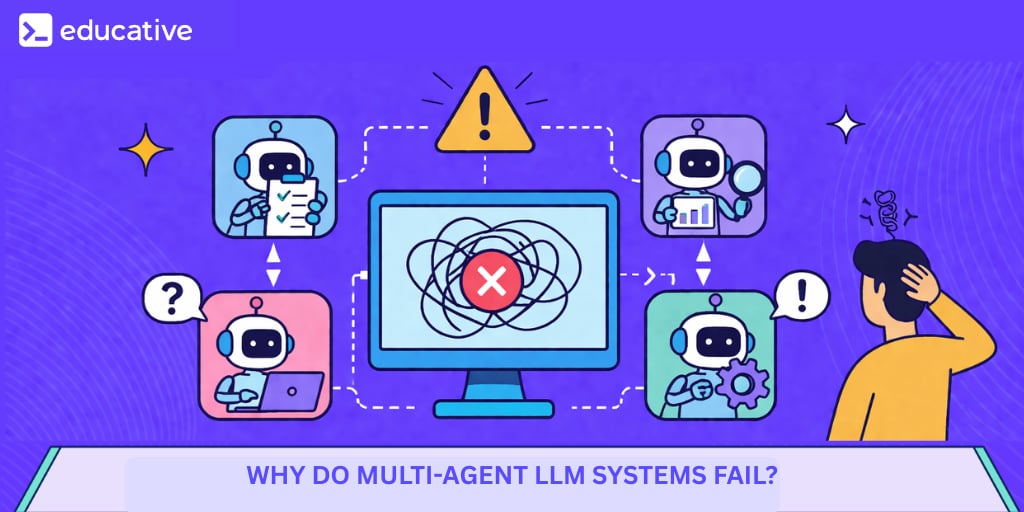
LLMs are increasingly used to build intelligent systems capable of performing complex workflows. Instead of relying on a single model instance to solve a task end to end, many modern AI applications attempt to combine multiple specialized agents that collaborate to complete a broader objective.
These architectures are commonly known as multi-agent LLM systems. In these systems, each agent is typically responsible for a specific role, such as planning a task, retrieving information, generating content, executing code, or verifying outputs. By distributing responsibilities across multiple agents, developers hope to create systems that resemble collaborative teams working toward a shared goal.
However, despite the impressive capabilities of individual language models, multi-agent systems frequently struggle with reliability. Developers who experiment with these architectures quickly encounter unpredictable behavior, cascading errors, and inconsistent outputs. This leads to a practical question many AI engineers now ask: why do multi-agent LLM systems fail even when each individual agent appears capable on its own.
The answer lies in the challenges of coordination, reasoning, communication, and system complexity that emerge when multiple autonomous agents interact within a shared workflow.
Agentic system design is rapidly redefining how modern AI systems are built, moving from single-model interactions to autonomous, multi-step systems that can reason, plan, and act. As large language models evolve, the real challenge is no longer just using them, but orchestrating them into reliable, goal-driven agents that operate safely and effectively in real-world environments. I built this course from my work in adaptive AI and intelligent systems, where designing autonomous behavior requires more than model accuracy. It demands structured reasoning, control, and safety. A recurring pattern I observed was that teams could experiment with LLMs, but struggled to design cohesive agentic systems that could handle ambiguity, coordinate tasks, and remain aligned with user intent. This course is designed to bring that structure. You will study real-world examples, including the Multi-Agent Conversational Recommender System (MACRS), NVIDIA’s Eureka for reward generation, and advanced agents navigating live websites and creating complex images. Drawing on insights from industry deployments and cutting-edge research, you will gain the foundational knowledge to confidently start designing your agent-based systems. Engineers and researchers are already using these patterns to build next-generation AI systems. If you want to design agents that go beyond prompts and into action, this is where to begin.
Overview of multi-agent LLM systems#
Multi-agent LLM systems consist of several language model instances working together as specialized components within a larger architecture. Rather than asking a single model to solve a complex problem directly, the system distributes the work across multiple agents, each designed for a specific function.
In many implementations, agents are assigned distinct roles that mirror collaborative human workflows.
Planner agents interpret the user’s request and divide it into smaller subtasks. These agents determine how the problem should be approached and which agents should perform each step.
Worker agents perform the individual operations defined by the plan. These operations might include generating text, writing code, analyzing data, or summarizing documents.
Retrieval agents gather external information from databases, search engines, or knowledge repositories. Their role is to supply relevant context for the rest of the system.
Evaluator agents review outputs and attempt to detect errors or inconsistencies before the system produces its final response.
The promise of these architectures lies in specialization. Instead of forcing a single model to manage every aspect of a complex workflow, multiple agents can focus on narrower responsibilities.
Agent workflow explanation#
Although implementations vary, most multi-agent systems follow a similar workflow architecture.
Step 1: Task decomposition#
The system begins when a planner agent receives the user’s request. The planner interprets the task and decomposes it into smaller subtasks that can be executed independently.
For example, a research assistant system might break a task into information retrieval, summarization, analysis, and report generation.
Step 2: Agent assignment#
After decomposing the task, the system assigns each subtask to a specialized agent. These agents are configured with prompts, tools, or instructions tailored to their specific roles.
For instance, a retrieval agent might query a database, while a writing agent generates explanatory text.
Step 3: Execution and communication#
Each agent performs its assigned task and produces intermediate outputs. These outputs are then passed to other agents in the workflow.
Agents may exchange information several times before the system progresses to the next stage.
Step 4: Aggregation of results#
Finally, a coordinating or synthesis agent combines the outputs from all agents and generates the final response for the user.
This architecture allows complex tasks to be divided into manageable components. However, it also introduces many potential points of failure.
Common failure modes table#
When developers investigate why do multi-agent LLM systems fail, they often encounter recurring failure patterns that arise from coordination and reasoning challenges.
Failure Mode | Description | Impact |
Coordination errors | Agents misunderstand task boundaries or responsibilities | Incorrect outputs |
Compounding hallucinations | Errors propagate between agents | Reduced reliability |
Communication breakdown | Agents misinterpret shared information | Workflow collapse |
Planning instability | Planner agent produces flawed task decomposition | Inefficient execution |
Coordination errors occur when agents interpret instructions differently or when the system assigns tasks in ways that overlap or conflict. Compounding hallucinations represent another serious problem. If one agent produces incorrect information, downstream agents may treat that information as valid input, amplifying the error.
Communication breakdowns also occur frequently. Because agents rely on textual communication, ambiguous messages or incomplete context can lead to misinterpretation.
Planning instability can be especially problematic. If the planner agent produces an incorrect task decomposition, the entire workflow may follow a flawed execution path. These patterns illustrate why the question why do multi-agent LLM systems fail arises so frequently in real-world deployments.
Step-by-step breakdown of a failing multi-agent workflow#
A hypothetical example can illustrate how failures propagate through a multi-agent architecture. Imagine a system designed to generate a research summary on renewable energy technologies.
First, the planner agent receives the user’s request and attempts to divide the task into subtasks. However, it incorrectly prioritizes outdated sources and neglects newer research areas.
Next, the retrieval agent gathers documents based on the planner’s instructions. Because the task was poorly defined, the retrieved documents contain incomplete or irrelevant information.
The writing agent then generates a summary using the retrieved documents. Since the information is incomplete, the summary includes misleading conclusions. Finally, the evaluation agent attempts to verify the output but fails to detect the problem because it relies on the same flawed context provided earlier.
In this scenario, a small planning error cascades through multiple agents, ultimately producing a response that appears coherent but contains significant inaccuracies. This cascading effect is a key reason developers frequently investigate why do multi-agent LLM systems fail when deployed in complex workflows.
Why complexity increases failure risk#
Multi-agent architectures introduce additional layers of complexity compared to single-agent systems.
One major factor is communication overhead. Each agent must interpret outputs from other agents, which introduces opportunities for misunderstanding. Another challenge involves maintaining consistent context across agents. If agents operate with slightly different context windows or assumptions, their outputs may diverge.
Compounded reasoning errors also become more likely. Each agent may introduce small inaccuracies that accumulate across multiple stages of the workflow.
Finally, many multi-agent systems lack centralized verification mechanisms capable of evaluating the entire reasoning chain. Without such mechanisms, errors may go undetected until the final output is produced. These factors contribute significantly to the difficulties developers encounter when attempting to scale multi-agent architectures.
Engineering strategies to reduce failures#
Despite these challenges, several engineering strategies can improve the reliability of multi-agent systems.
Improved task planning algorithms can help ensure that the initial task decomposition is accurate and logically structured. Strong planning reduces the likelihood of cascading errors.
Agent role constraints can also help stabilize workflows. By limiting each agent’s responsibilities and defining strict interfaces between agents, developers can reduce ambiguity.
Tool-assisted reasoning can further improve reliability. External tools such as calculators, code interpreters, and search systems can validate intermediate results.
Monitoring and debugging frameworks are also essential. Observability tools allow developers to inspect agent interactions and identify where failures occur within the workflow.
These engineering practices do not eliminate all challenges, but they help mitigate the problems that explain why do multi-agent LLM systems fail in many real-world systems.
Future outlook section#
Research into multi-agent AI systems continues to evolve rapidly. Many researchers believe that collaborative agent architectures will play an important role in future AI systems capable of solving complex tasks. Several emerging approaches aim to improve coordination between agents.
Hierarchical agent coordination frameworks attempt to organize agents in structured decision-making hierarchies.
Structured reasoning frameworks encourage agents to produce explicit reasoning steps that can be verified by other agents.
Improved memory systems allow agents to maintain shared context across longer workflows.
These innovations aim to make multi-agent systems more reliable, scalable, and capable of handling increasingly complex tasks.
Final words#
Multi-agent architectures represent an ambitious attempt to extend the capabilities of large language models by distributing complex tasks across multiple specialized agents. In theory, this collaborative structure allows AI systems to perform sophisticated workflows that would be difficult for a single model instance to manage.
However, in practice, these systems often struggle with coordination challenges, communication errors, cascading hallucinations, and planning instability. Understanding why do multi-agent llm systems fail is therefore essential for developers building real-world AI systems.
By recognizing these limitations and applying thoughtful engineering strategies, developers can design more reliable agent-based architectures that harness the strengths of language models while mitigating the risks introduced by complex multi-agent collaboration.
Happy learning!
