What are the key responsibilities of an AWS Solutions Architect?
This blog shows that an AWS Solutions Architect is responsible for designing systems, making strategic decisions, and ensuring scalability, reliability, and alignment with business needs.

At some point in your career, you start looking beyond writing code. You might already be comfortable building backend services or deploying applications to the cloud, but now you’re curious about roles that operate at a higher level. You come across the title AWS Solutions Architect, and it sounds both exciting and vague at the same time.
Job descriptions often make it sound straightforward—design systems, choose services, ensure scalability. But when you dig deeper, the responsibilities feel abstract. You start wondering what this role actually looks like in practice. Are you still coding? Are you just drawing diagrams? Or are you making decisions that affect entire systems?
This is where the real question comes in: What are the key responsibilities of an AWS Solutions Architect? The answer isn’t found in certifications or bullet-point job listings. To truly understand the role, you need to look at how architects operate in real-world systems, where technical decisions intersect with business needs and long-term strategy.
Cloud architecture has become a core skill for modern engineers. Whether you're building backend systems, deploying microservices, or scaling global applications, understanding how to design on AWS is no longer optional. The challenge is that AWS is an ecosystem. Without a clear structure, it’s easy to get lost in services without understanding how to use them together to build secure, reliable systems. I built this course from my experience working on Azure’s Fabric Controller and Remote Desktop services for Windows Server. In those environments, we dealt with real-world problems around availability, fault tolerance, and large-scale system management. The pattern I’ve seen with learners is similar: they can learn individual services, but struggle to connect them into a complete architecture. This course is designed to help you think in systems, not just services. We focus on the core pillars of AWS architecture, security, reliability, performance, and cost optimization, and show how they come together in practical designs. You’ll learn how to secure accounts and resources, design for high availability using load balancing and replication, and choose the right storage and analytics services for performance. The course also includes hands-on Cloud Labs so you can deploy and interact with real AWS resources, along with practice exams aligned to the SAA-C03 certification. This approach has helped many learners build confidence in AWS and successfully prepare for certification. If you’re aiming to become an AWS Certified Solutions Architect Associate and design systems the right way, this course gives you a clear and structured path.
The role of an AWS Solutions Architect in modern systems#
An AWS Solutions Architect sits at the intersection of engineering, operations, and business strategy. Unlike a developer who focuses on implementing features, or an operations engineer who manages infrastructure, the architect is responsible for shaping how the entire system is built. This means thinking not just about how something works, but why it works that way and how it will behave under different conditions.
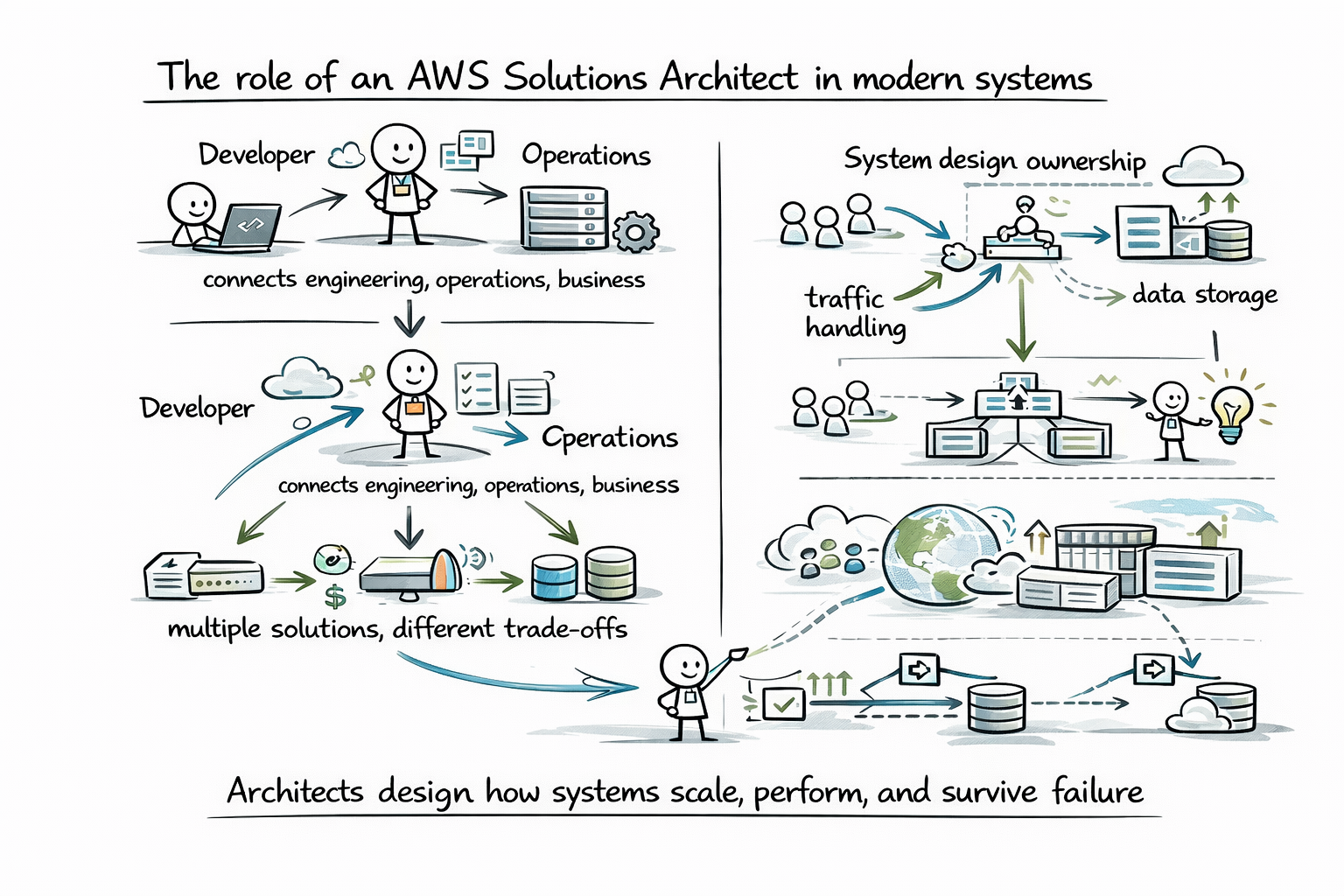
In modern cloud systems, this role becomes even more critical because of the flexibility AWS provides. There are multiple ways to solve the same problem, and each choice comes with trade-offs. The architect’s job is to evaluate these options and choose the one that aligns with both technical requirements and business goals. This requires a deep understanding of system design, cloud services, and operational constraints.
Imagine a company building a global e-commerce platform. The architect is not writing every line of code or configuring every server, but they are defining how the system handles traffic spikes, how data is stored and replicated, and how failures are managed. Their decisions influence the entire lifecycle of the application, from initial design to long-term scalability.
Translating business requirements into technical systems#
One of the most important aspects of this role is the ability to translate business requirements into technical solutions. Business stakeholders rarely describe problems in technical terms. They talk about user growth, revenue targets, and customer experience. It’s the architect’s responsibility to interpret these needs and convert them into system requirements.
For example, a business might say they expect rapid growth over the next year. To a developer, this might not immediately translate into action. But to an architect, it signals the need for scalable infrastructure, load balancing, and distributed systems. This translation process is where much of the value of the role comes from.
At the same time, architects must balance constraints. Budgets, timelines, and existing systems all influence the final design. You’re not just building the “best” system in theory—you’re building the most appropriate system given the circumstances. This requires constant trade-offs, where decisions are guided by both technical reasoning and practical limitations.
What are the key responsibilities of an AWS Solutions Architect?#
When you revisit the question What are the key responsibilities of an AWS Solutions Architect?, it becomes clear that the role cannot be reduced to a list of tasks. Responsibilities are interconnected and span the entire lifecycle of a system. You are not just designing architectures—you are guiding systems from concept to production and ensuring they remain effective over time.
An architect’s responsibility begins with understanding requirements and continues through design, implementation, and optimization. Each phase introduces new challenges, from selecting the right services to ensuring the system performs well under load. This continuous involvement is what differentiates the role from more narrowly defined positions.
Rather than thinking of responsibilities as isolated duties, it’s more accurate to think of them as areas of influence. You influence how systems are designed, how teams implement solutions, and how applications evolve as requirements change. This holistic perspective is what makes the role both challenging and impactful.
Designing scalable and reliable architectures#
Scalability and reliability are at the core of any cloud architecture. As an architect, you need to design systems that can handle growth without degrading performance. This involves understanding how traffic patterns change over time and how systems respond to increased demand.
Reliability is equally important. Systems will fail—it’s not a question of if, but when. Your job is to design architectures that can tolerate these failures without affecting the user experience. This includes implementing redundancy, failover mechanisms, and monitoring systems that detect issues early.
Consider a streaming platform that experiences sudden spikes in traffic during peak hours. An architect must design a system that automatically scales to handle these spikes while maintaining performance. At the same time, they must ensure that failures in one part of the system do not cascade into larger outages. These decisions require both technical knowledge and an understanding of system behavior under stress.
Choosing the right AWS services#
AWS offers a vast range of services, and choosing the right ones is a critical part of the architect’s role. This is not about memorizing services—it’s about understanding how they fit together and when to use each one. Every service comes with trade-offs in terms of cost, performance, and complexity.
For example, you might choose between a managed database service and a self-hosted solution. The managed service reduces operational overhead but may limit customization. The self-hosted option provides more control but requires more maintenance. The architect must evaluate these trade-offs in the context of the application’s needs.
These decisions are rarely obvious. They require a deep understanding of both the technical landscape and the specific requirements of the system. Over time, you develop intuition about which services work best for different scenarios, but that intuition is built on experience and careful reasoning.
Ensuring cost efficiency and performance#
In cloud environments, cost and performance are closely linked. As an architect, you need to ensure that your system performs well without incurring unnecessary costs. This requires continuous evaluation and optimization of resources.
For instance, over-provisioning resources may improve performance but increase costs significantly. Under-provisioning may save money but lead to poor user experience. Finding the right balance is an ongoing process that involves monitoring, analysis, and adjustment.
This responsibility extends beyond initial design. As usage patterns change, your system must adapt. You might need to optimize queries, adjust scaling policies, or redesign parts of the architecture. These decisions have long-term implications, making cost efficiency a key part of sustainable system design.
Comparison of responsibilities across roles#
Role | Primary focus | Scope of decisions | Key responsibility |
AWS Solutions Architect | System design and strategy | High-level, cross-system | Designing scalable, reliable architectures |
Software Engineer | Feature implementation | Code-level decisions | Building application logic |
Cloud Engineer | Infrastructure and deployment | Environment-level decisions | Managing cloud resources |
This comparison highlights how the AWS Solutions Architect differs from other roles. While software engineers focus on writing code and cloud engineers manage infrastructure, the architect operates at a higher level, connecting these layers into a cohesive system. Their decisions influence both development and operations, making their role central to the overall system.
Understanding this distinction helps clarify why the role requires a broader perspective. You’re not just solving individual problems—you’re shaping how different parts of the system work together. This requires both technical depth and the ability to think holistically.
Collaboration and communication#
An AWS Solutions Architect does not work in isolation. Collaboration is a core part of the role, as you need to align multiple teams around a shared vision. This includes working with developers, DevOps engineers, and business stakeholders to ensure that everyone is moving in the same direction.
Communication plays a critical role in this process. You need to explain complex technical concepts in a way that non-technical stakeholders can understand. At the same time, you must ensure that technical teams have clear guidance on how to implement the architecture.
Imagine a scenario where a new feature requires changes across multiple services. The architect must coordinate these changes, ensuring that each team understands their role and how their work fits into the larger system. This level of coordination is essential for building systems that function smoothly.
Common misconceptions about the role#
One common misconception is that the role is primarily about creating diagrams. While diagrams are an important tool, they are only a small part of the job. The real work lies in making decisions that affect how systems behave in production.
Another misconception is that the role is less technical than development. In reality, architects need a deep understanding of technology to make informed decisions. They must understand how systems work at a detailed level, even if they are not writing code every day.
There is also a belief that certification alone is enough to succeed in this role. While certifications provide a foundation, they do not replace real-world experience. The ability to design systems comes from working with complex applications and understanding how they behave under different conditions.
How the role evolves with experience#
As you gain experience, your responsibilities as an architect evolve. Early in your career, you may focus on specific technical decisions, such as choosing services or designing individual components. Over time, your role expands to include broader system-level and strategic decisions.
This evolution often involves moving from implementation details to influencing long-term architecture. You begin to think about how systems will scale over years, not just months. This requires a deeper understanding of both technology and business objectives.
Continuous learning is essential in this role. Cloud technologies evolve rapidly, and new patterns emerge regularly. Staying effective as an architect means constantly updating your knowledge and adapting to new challenges.
Final words#
So, what are the key responsibilities of an AWS Solutions Architect?
They go far beyond designing systems or selecting services. The role involves translating business needs into technical solutions, guiding system design, and ensuring that applications remain scalable, reliable, and cost-effective. It requires a combination of technical expertise, strategic thinking, and effective communication.
Understanding what are the key responsibilities of an AWS Solutions Architect? means looking beyond job titles and certifications. It means seeing how decisions impact real-world systems and how architects shape the way applications are built and maintained. Once you start thinking in these terms, the role becomes much clearer—and far more meaningful.
Happy learning!