What is Partitioning and Replication in Key-Value Databases?
Master partitioning and replication in key-value databases by learning how distributed systems scale horizontally, balance traffic, replicate safely, recover from failures, and manage consistency, latency, and availability trade-offs.
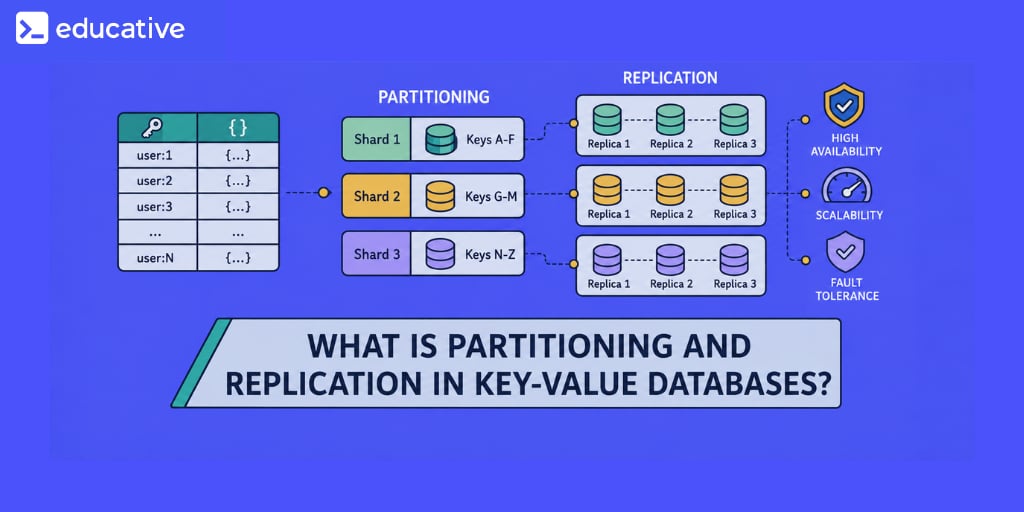
If you’re working on distributed systems or designing a storage layer, then understanding partitioning and replication in key-value databases is essential. Whether you’re building from scratch or evaluating a managed service, getting these two pillars right will determine your system’s scalability, availability, and performance.
In this blog, you’ll walk through both concepts, how they differ, how they work together, and the trade-offs you’ll face. Let’s get started.
Grokking Modern System Design Interview
For a decade, when developers talked about how to prepare for System Design Interviews, the answer was always Grokking System Design. This is that course — updated for the current tech landscape. As AI handles more of the routine work, engineers at every level are expected to operate with the architectural fluency that used to belong to Staff engineers. That's why System Design Interviews still determine starting level and compensation, and the bar keeps rising. I built this course from my experience building global-scale distributed systems at Microsoft and Meta — and from interviewing hundreds of candidates at both companies. The failure pattern I kept seeing wasn't a lack of technical knowledge. Even strong coders would hit a wall, because System Design Interviews don't test what you can build; they test whether you can reason through an ambiguous problem, communicate ideas clearly, and defend trade-offs in real time (all skills that matter more than ever now in the AI era). RESHADED is the framework I developed to fix that: a repeatable 45-minute roadmap through any open-ended System Design problem. The course covers the distributed systems fundamentals that appear in every interview – databases, caches, load balancers, CDNs, messaging queues, and more – then applies them across 13+ real-world case studies: YouTube, WhatsApp, Uber, Twitter, Google Maps, and modern systems like ChatGPT and AI/ML infrastructure. Then put your knowledge to the test with AI Mock Interviews designed to simulate the real interview experience. Hundreds of thousands of candidates have already used this course to land SWE, TPM, and EM roles at top companies. If you're serious about acing your next System Design Interview, this is the best place to start.
Why partitioning and replication matter#
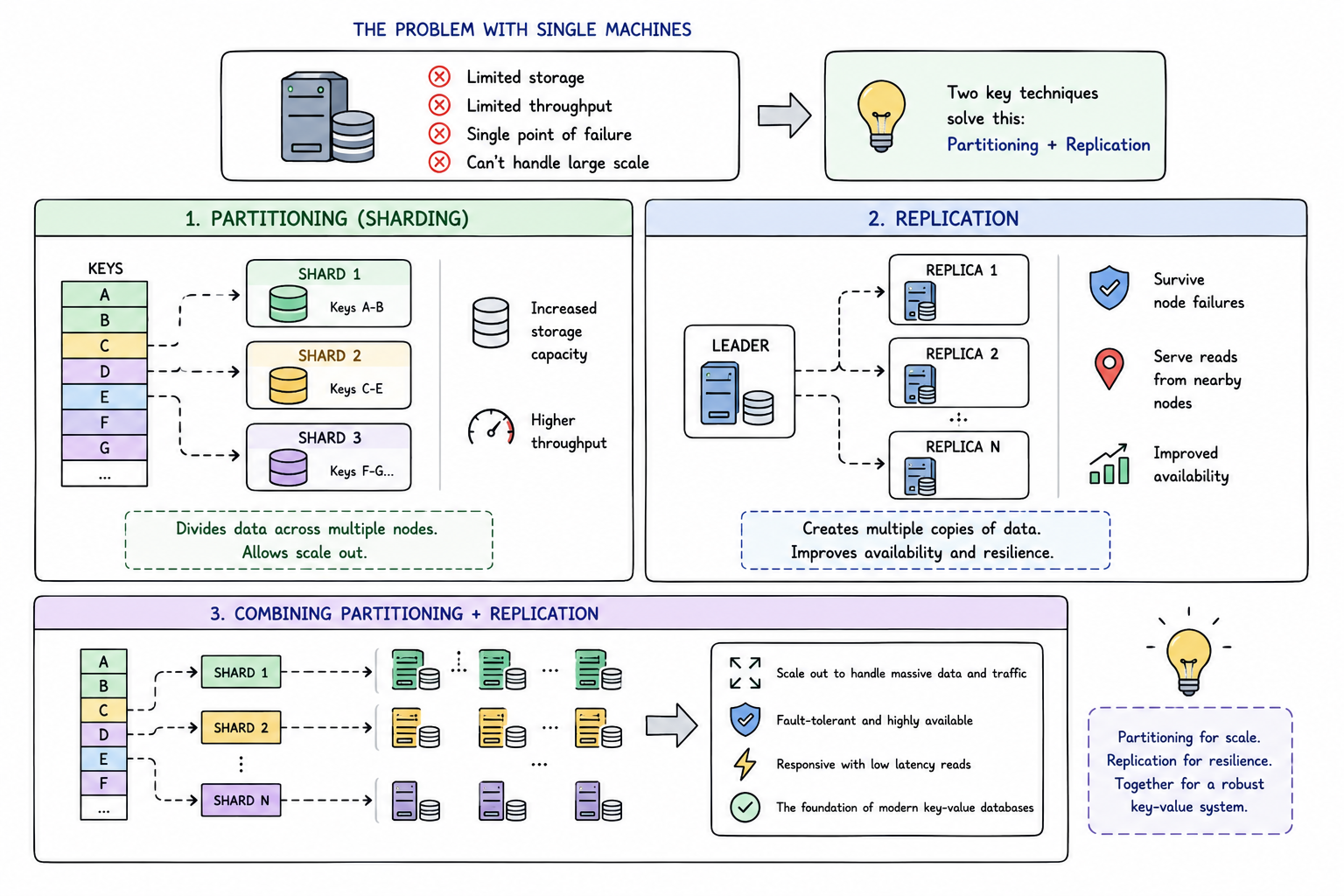
When you work with a key-value database that serves large traffic or stores massive data sets, you quickly hit the limits of single machines. Two techniques become your go-to:
Partitioning (sometimes referred to as sharding) divides data across multiple nodes, allowing for increased storage capacity and higher throughput.
Replication creates multiple copies of the data, allowing you to survive node failures, serve reads from nearby nodes, and improve overall availability.
By combining partitioning and replication, you get a system that can scale out (thanks to partitioning) and remain fault-tolerant and responsive (thanks to replication). These are foundational when you design or choose a key-value database, and hence the phrase partitioning and replication in key-value databases is more than a buzzword, but a design mantra.
Grokking the Fundamentals of System Design

System Design is central to building applications that scale reliably and operate securely. This is why I built this course to help you explore the foundational concepts behind modern system architecture and why these principles matter when creating real-world software systems or preparing for System Design interviews. You’ll begin by examining the basics of system architecture, then move on to distributed system concepts, including consistency, availability, coordination, and fault tolerance. Next, you’ll explore communication patterns, concurrency handling, and strategies like retries, backoff policies, and idempotency. You’ll also compare SQL, NoSQL, and NewSQL databases and dive into data partitioning, replication, and indexing techniques. The course concludes with security and observability, rounding out the pillars you need for System Design interviews. You’ll be able to analyze complex design problems, reason about trade-offs, and structure systems that are scalable, maintainable, and ready for real-world demands.
What is partitioning?#
As distributed systems grow, one of the first architectural challenges engineers encounter is scale. A single machine eventually becomes insufficient for storing all the data, processing all the traffic, or handling all the write throughput required by modern applications.
This is where partitioning becomes essential.
Partitioning in key-value databases refers to dividing the overall dataset into smaller subsets called partitions. Each partition is responsible for only a portion of the keys, and different partitions are distributed across different nodes in the cluster.
At a high level, partitioning solves a very important problem:
“How do we scale storage and traffic horizontally instead of continuously upgrading one machine?”
Instead of relying on vertical scaling, where one increasingly powerful server handles all requests, partitioning allows the workload to spread across many nodes simultaneously.
This approach improves several things immediately:
Storage capacity grows with cluster size
Read and write traffic distribute across machines
Throughput scales horizontally
Operational bottlenecks become easier to isolate
Modern distributed systems depend heavily on partitioning because internet-scale workloads simply cannot fit onto a single machine reliably.
However, partitioning also introduces new complexities. Once data spreads across many nodes, the system must determine:
Which partition owns a given key
How clients route requests correctly
How partitions rebalance during scaling
How failures affect ownership and recovery
This is why partitioning becomes one of the most foundational concepts in distributed systems engineering.
Why partitioning matters#
Problem without partitioning | Benefit after partitioning |
Single storage bottleneck | Horizontal scaling |
Limited throughput | Parallel request handling |
Single-node overload | Distributed traffic |
Difficult growth management | Elastic infrastructure |
Partitioning is often the first major architectural step toward building a truly distributed database.
Partitioning strategies#
When implementing partitioning in key-value databases, the partitioning strategy determines how keys are distributed across nodes. This decision influences scalability, load balancing, query efficiency, and operational complexity.
Different workloads benefit from different strategies, and each approach introduces trade-offs.
Key-hash partitioning#
Hash-based partitioning is one of the most common approaches because it distributes keys relatively evenly across nodes.
The system applies a hash function to the key and maps the result to a partition.
For example:
partition = hash(key) % N
This approach spreads traffic uniformly under most workloads, reducing the likelihood that one partition becomes overloaded while others remain underutilized.
Hash partitioning works especially well for workloads dominated by random lookups because requests distribute naturally across the cluster.
However, hash partitioning also introduces limitations. Since related keys become scattered across partitions randomly, range queries become extremely difficult. For example, retrieving all users between two alphabetical ranges may require querying many partitions simultaneously.
This trade-off makes hash partitioning excellent for high-throughput distributed systems focused on point lookups but less ideal for ordered query patterns.
Hash partitioning trade-offs#
Strength | Weakness |
Even load distribution | Difficult range queries |
Reduces hotspots | Random key placement |
Simple lookup logic | Harder ordered scans |
Good write scalability | Cross-partition aggregation complexity |
Many large-scale NoSQL databases adopt hash-based partitioning because scalability usually matters more than ordered querying.
Range partitioning#
Range partitioning organizes data based on key ranges rather than hash outputs.
For example:
Partition A stores keys from A–F
Partition B stores keys from G–M
Partition C stores keys from N–Z
This structure makes range queries significantly more efficient because related keys remain physically grouped together.
Range partitioning becomes especially useful for:
Time-series systems
Ordered indexing
Analytics workloads
Sequential scanning systems
However, it introduces an entirely different operational risk: hotspots.
If incoming writes concentrate heavily on one key range, one partition may receive dramatically more traffic than others. This commonly happens with timestamp-heavy workloads where all recent writes land in the same partition continuously.
Without careful balancing strategies, range partitioning can create severe scaling bottlenecks.
Range partitioning trade-offs#
Strength | Weakness |
Efficient range scans | Hotspot risk |
Better ordered retrieval | Uneven traffic distribution |
Useful for analytics | Harder balancing |
Natural grouping | Skewed write patterns |
This is why many production systems combine range partitioning with additional balancing mechanisms.
Hybrid partitioning approaches#
Many modern distributed databases avoid relying entirely on either pure hashing or pure ranges.
Instead, they combine multiple strategies.
Hybrid approaches may:
Pre-split partitions
Use virtual partitions
Combine hash and range routing
Dynamically rebalance based on traffic
Separate hot and cold storage patterns
These approaches improve flexibility significantly but increase operational complexity.
For example, systems may hash user IDs first and then maintain ordered ranges within each partition. Others may create virtual shards that can move independently across physical nodes during scaling operations.
The goal of hybrid schemes is usually to achieve:
Better scalability
Easier rebalancing
Reduced hotspots
Improved operational flexibility
These advanced techniques become increasingly important at the internet scale.
Challenges in partitioning#
While partitioning solves scalability problems, it introduces entirely new operational challenges.
This is one of the most important distributed systems lessons:
Solving one bottleneck often creates another.
Understanding these challenges helps distinguish senior-level distributed systems thinking from purely theoretical architecture knowledge.
Hotspots and skewed traffic#
One of the most common partitioning problems is skewed traffic distribution.
Even if data is distributed evenly initially, real workloads are rarely uniform. Certain keys may become extremely popular and generate disproportionate load.
For example:
A celebrity account on social media
A viral product listing
A globally shared configuration key
A trending livestream
If all traffic for a hot key routes to a single partition, that node can become overwhelmed despite the cluster being mostly idle elsewhere.
This creates latency spikes, throttling issues, and reduced availability.
Engineers often mitigate hotspots through:
Caching layers
Key salting
Dynamic splitting
Replication-based read distribution
Hotspot mitigation becomes critical for large-scale systems.
Rebalancing complexity#
Clusters evolve constantly. New nodes join. Old nodes fail. Traffic grows unevenly. Storage usage changes over time.
This means partitions must occasionally move between machines. That process is called rebalancing.
Rebalancing sounds simple conceptually, but operationally it becomes difficult because moving large partitions consumes:
Network bandwidth
Disk I/O
CPU resources
Replication coordination
Poorly designed rebalancing systems can create outages during scaling operations.
This is why distributed systems often use consistent hashing and virtual partitions to minimize movement during topology changes.
Common partitioning challenges#
Challenge | Operational impact |
Hot partitions | Overloaded nodes |
Data skew | Uneven storage growth |
Rebalancing | Expensive data movement |
Cross-partition queries | Increased latency |
Dynamic routing | Metadata complexity |
Partitioning is therefore not just a storage strategy. It becomes an operational coordination problem at scale.
How to think about partitioning in your design#
When designing partitioning in key-value databases, strong engineers think beyond simple key distribution formulas.
They ask architectural questions such as:
How large will the cluster become?
How many partitions should exist per node?
How will partitions rebalance safely?
How will clients locate partitions efficiently?
What happens during node failures?
How are hotspots detected and mitigated?
These questions matter because distributed systems rarely remain static.
A design that works well for 10 nodes may fail operationally at 1,000 nodes if metadata management, routing complexity, or balancing strategies are poorly designed.
Routing also becomes particularly important. Clients need efficient mechanisms to determine which partition owns a given key. Systems commonly use:
Routing tables
Metadata services
Partition maps
Consistent hashing rings
The more dynamic the cluster becomes, the more important routing coordination becomes.
Strong System Design interviews often focus heavily on these operational considerations rather than only the partitioning algorithm itself.
What is replication?#
Partitioning solves scalability. Replication solves reliability.
Without replication, partition failure means data loss and downtime.
Replication in key-value databases refers to storing multiple copies of the same partition across different nodes. This improves durability, availability, and read scalability simultaneously.
At a high level, replication ensures that if one node crashes or becomes unreachable, another replica can continue serving traffic safely.
This becomes absolutely critical in distributed systems because hardware failures are inevitable.
Replication also improves read performance because traffic can be distributed across multiple replicas instead of routing entirely through one machine.
However, replication introduces one of the most important challenges in distributed systems: consistency coordination.
Once multiple replicas exist, the system must decide:
How writes propagate
When acknowledgments occur
Which replicas serve reads
How conflicts resolve
What happens during partitions
These decisions shape the system’s consistency guarantees directly.
Replication strategies#
Different replication strategies optimize for different trade-offs involving consistency, availability, latency, and operational simplicity.
Single-leader replication#
Single-leader replication, often called leader-follower replication, designates one node as the write authority for a partition.
All writes route through the leader first, and followers replicate updates afterward.
This simplifies write ordering significantly because one node coordinates all modifications.
Single-leader systems are easier to reason about operationally, but they can become bottlenecks under extremely high write traffic.
Leader failover also becomes operationally important because downtime may occur during leadership transitions.
Single-leader replication#
Strength | Weakness |
Simpler ordering | Leader bottleneck |
Easier conflict handling | Failover coordination |
Predictable writes | Limited write scaling |
Many traditional distributed databases use this model.
Multi-leader and leaderless replication#
Some systems allow multiple nodes to accept writes simultaneously.
This improves availability and write scalability significantly, especially across geographically distributed regions.
However, it introduces much greater conflict-resolution complexity because concurrent updates may diverge.
Systems must now reconcile:
Concurrent writes
Version conflicts
Divergent replicas
Network partitions
These architectures often rely on:
Vector clocks
Last-writer-wins
CRDTs
Quorum coordination
The operational complexity increases dramatically, but so does flexibility.
Synchronous vs asynchronous replication#
Replication timing introduces another major trade-off.
With synchronous replication, writes complete only after replicas acknowledge the update. This improves durability and consistency guarantees, but increases latency.
With asynchronous replication, writes acknowledge immediately while replicas catch up later. This improves performance but risks temporary inconsistency and replication lag.
Replication timing trade-offs#
Strategy | Benefit | Drawback |
Synchronous replication | Stronger durability | Higher latency |
Asynchronous replication | Faster writes | Possible stale replicas |
This trade-off appears constantly in distributed systems interviews.
Integration: partitioning + replication in key-value databases#
Modern distributed key-value databases combine both partitioning and replication simultaneously.
This creates the full distributed architecture.
At a high level:
Data partitions distribute keys across nodes
Each partition replicates across multiple replicas
Routing logic directs traffic appropriately
Failover systems manage crashes
Rebalancing handles cluster growth
This layered structure allows systems to scale horizontally while remaining fault-tolerant.
For example:
The client sends a request
The routing layer hashes the key
The partition owner is located
The leader replica processes the write
Followers replicate updates
Reads may route to nearby replicas
This interaction between partitioning and replication forms the foundation of nearly every modern distributed database architecture.
Partitioning vs replication roles#
Concern | Solved by |
Scalability | Partitioning |
Durability | Replication |
Availability | Replication |
Load distribution | Partitioning |
Fault tolerance | Replication |
Horizontal growth | Partitioning |
Understanding how these layers interact is critical for distributed systems reasoning.
Trade-offs and considerations#
Partitioning and replication together introduce numerous operational trade-offs. More replicas improve durability but increase storage cost and coordination overhead. More partitions improve scalability but increase routing complexity and metadata management. Allowing reads from replicas improves availability but risks stale data. Synchronous replication improves consistency but increases latency.
Strong distributed systems engineers think continuously about balancing:
Consistency
Availability
Latency
Cost
Operational simplicity
Scalability
These trade-offs define distributed systems engineering fundamentally.
Key distributed systems trade-offs#
Trade-off | Operational impact |
More replicas | Better durability, higher cost |
More partitions | Better scalability, more routing complexity |
Async replication | Faster writes, stale reads possible |
Strong consistency | Safer coordination, higher latency |
There is no universally correct answer. The right architecture always depends on workload requirements.
Best practices for partitioning and replication in key-value databases#
One of the most important best practices is choosing partition keys carefully. Poor key selection can create hotspots, uneven storage growth, and severe operational bottlenecks.
Monitoring also becomes essential. Distributed systems require visibility into:
Partition imbalance
Replication lag
Hot keys
Rebalancing operations
Routing failures
Consistent hashing and virtual partitions are commonly used because they reduce operational disruption during scaling events.
Replication factors should align with durability and availability targets. Three replicas are common because they balance redundancy with operational cost reasonably well.
Failure handling should always be automated. Systems must recover from:
Node crashes
Network partitions
Replica lag
Leader failures
Rebalancing interruptions
The strongest distributed systems designs prioritize operational resilience from the beginning rather than treating it as an afterthought.
Why mastering partitioning and replication gives you a leg up#
When you truly understand partitioning and replication in key-value databases, you begin thinking like a distributed systems engineer instead of someone memorizing architecture diagrams.
You understand:
How systems scale horizontally
Why failures happen
How availability is maintained
Why consistency becomes difficult
How operational trade-offs shape architecture
This knowledge becomes extremely valuable during:
System Design interviews
Infrastructure discussions
Database optimization work
Backend architecture reviews
Scalability planning
Most importantly, it gives you a much deeper understanding of how modern internet-scale systems actually work underneath the abstraction layers developers interact with daily.
Wrapping up#
Partitioning and replication in key-value databases are the twin pillars of any scalable, high-availability data store. You split your data intelligently across nodes (partitioning) and maintain multiple copies of each piece of data (replication) to meet load and fault-tolerance demands.
You choose strategies for both that suit your workload, geometry, latency, traffic patterns, and correctness guarantees. When you do this well, your system can scale, survive faults, and serve users globally. When you do it poorly, you’ll hit hotspots, unexpected downtime, stale reads, or painful migrations.
With this walkthrough, you now have the mental model:
What partitioning is, how to do it, and what to watch out for.
What replication is, how to do it, and how it intersects with partitioning.
How both combine in key-value databases, and how you pick design choices and trade-offs.