Why do we use Dynamic Programming? Understanding its role
Struggling with slow algorithms? Learn why dynamic programming is essential for efficient problem solving. Discover how to eliminate redundant work, optimize performance, and master a must-know skill for coding interviews and real-world systems.
When developers and computer science students begin studying algorithm design, they quickly encounter problems that become inefficient when solved using straightforward methods. During this learning process, many learners naturally start asking why we use dynamic programming because it appears frequently in algorithm textbooks, technical interviews, and competitive programming challenges.
Many computational problems involve exploring a large number of possibilities or repeatedly calculating the same intermediate results. Simple strategies such as brute-force search or naive recursion may initially seem reasonable, but these approaches often become impractical as input sizes grow. The number of computations required can increase rapidly, making the algorithm too slow for real-world applications.
Dynamic programming provides a systematic approach to solving such problems more efficiently. Instead of recomputing the same values repeatedly, the algorithm stores results of smaller subproblems and reuses them whenever they are needed again. This technique significantly reduces redundant calculations and can transform exponential-time algorithms into much faster solutions.
Grokking Dynamic Programming Interview
Some of the toughest questions in technical interviews require dynamic programming solutions. Dynamic programming (DP) is an advanced optimization technique applied to recursive solutions. However, DP is not a one-size-fits-all technique, and it requires practice to develop the ability to identify the underlying DP patterns. With a strategic approach, coding interview prep for DP problems shouldn’t take more than a few weeks. This course starts with an introduction to DP and thoroughly discusses five DP patterns. You’ll learn to apply each pattern to several related problems, with a visual representation of the working of the pattern, and learn to appreciate the advantages of DP solutions over naive solutions. After completing this course, you will have the skills you need to unlock even the most challenging questions, grok the coding interview, and level up your career with confidence. This course is also available in C++, JavaScript, and Python—with more coming soon!
Because of its ability to optimize performance and manage complex problem structures, dynamic programming plays an important role in algorithm design, real-world optimization systems, and many areas of computer science.
The problem with naive solutions#
Many algorithmic problems can initially be solved using recursion or brute-force approaches. These methods typically break a problem into smaller pieces and attempt to compute the solution step by step. Although this strategy often leads to a correct solution, it may not be efficient.
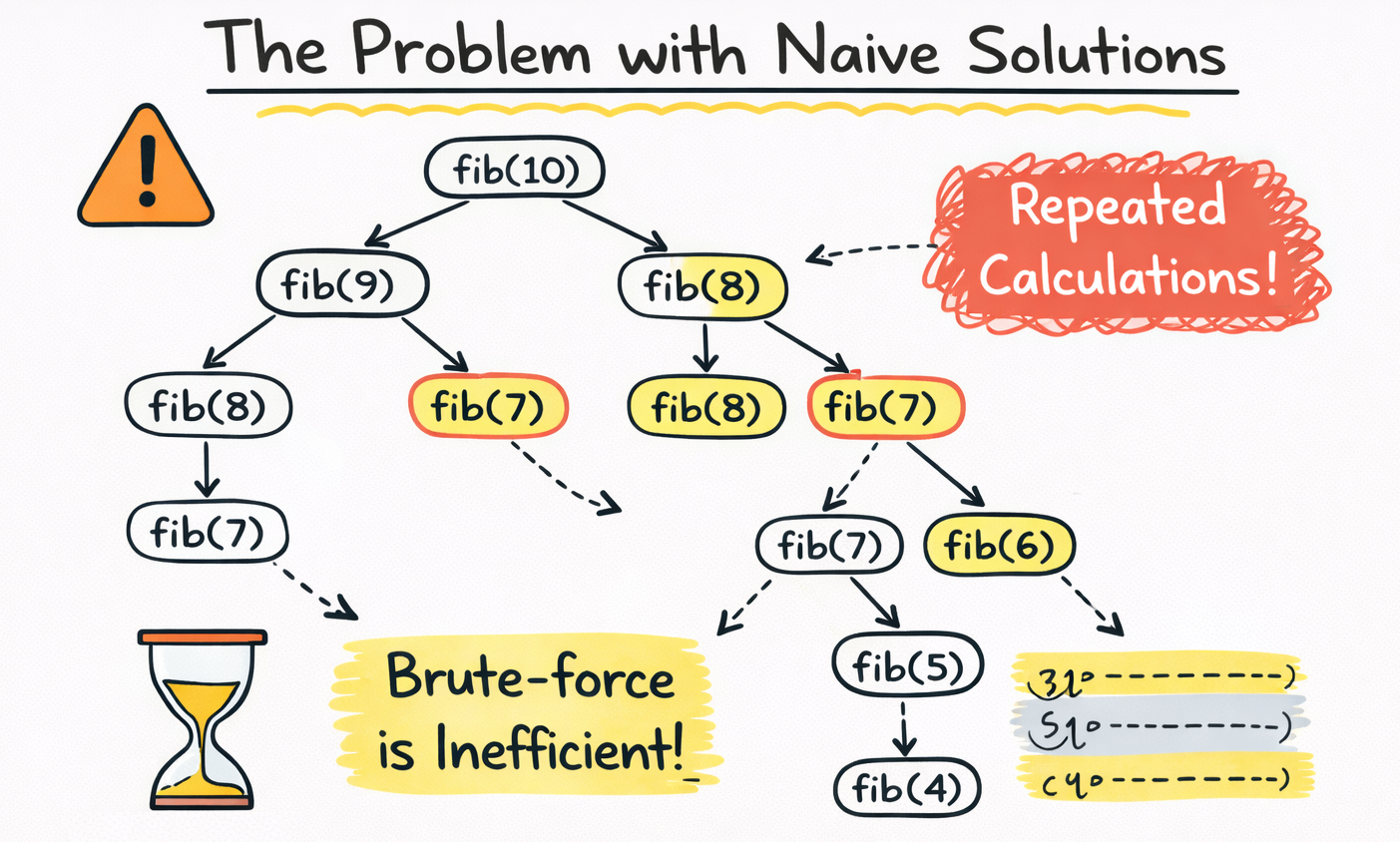
A classic example involves computing the Fibonacci sequence using recursion. The recursive definition of Fibonacci is simple: each value is the sum of the two preceding values. However, a naive recursive implementation repeatedly recalculates the same intermediate values many times.
For example, computing the tenth Fibonacci number requires calculating the ninth and eighth Fibonacci numbers. Each of those calculations again requires smaller Fibonacci values, which causes the algorithm to recompute the same results repeatedly. As the input value increases, the number of redundant computations grows exponentially.
This inefficiency demonstrates why many developers eventually explore why do we use dynamic programming when studying algorithm optimization.
What dynamic programming changes#
Dynamic programming changes the way recursive problems are solved by introducing a memory mechanism for storing intermediate results. When a subproblem is solved once, the result is saved so that the algorithm can reuse it later instead of recomputing it.
This strategy dramatically reduces the number of computations required to solve certain problems. Instead of repeatedly solving identical subproblems, the algorithm simply retrieves the stored results.
Dynamic programming works particularly well when a problem exhibits two important properties: overlapping subproblems and optimal substructure. Overlapping subproblems occur when the same smaller problem appears multiple times in the recursive solution. Optimal substructure means that the optimal solution to the overall problem depends on the optimal solutions of its smaller subproblems.
Recognizing these properties helps developers understand why do we use dynamic programming when designing efficient algorithms.
Dynamic Programming in Python: Optimizing Programs for Efficiency

Dynamic programming is something every developer should have in their toolkit. It allows you to optimize your algorithm with respect to time and space — a very important concept in real-world applications. In this course, you’ll start by learning the basics of recursion and work your way to more advanced DP concepts like Bottom-Up optimization. Throughout this course, you will learn various types of DP techniques for solving even the most complex problems. Each section is complete with coding challenges of varying difficulty so you can practice a wide range of problems. By the time you’ve completed this course, you will be able to utilize dynamic programming in your own projects.
Comparison of algorithm approaches#
Approach | Characteristics | Performance Impact |
Brute force | Tries all possible solutions | Often extremely slow |
Recursion | Breaks problems into smaller tasks | Can recompute the same subproblems |
Dynamic programming | Stores and reuses computed results | Significantly improves efficiency |
These approaches differ mainly in how they handle repeated work.
Brute-force algorithms examine every possible solution without optimizing the search process, which often results in extremely slow performance for large inputs. Recursive solutions improve the structure of the algorithm but may still repeat the same calculations many times.
Dynamic programming improves efficiency by remembering previously computed results. By eliminating redundant work, it often reduces time complexity dramatically.
Key benefits of dynamic programming#
Dynamic programming provides several important advantages when solving algorithmic problems.
Eliminating repeated calculationsMany recursive algorithms recompute the same subproblems multiple times, which wastes computational resources. Dynamic programming avoids this inefficiency by storing intermediate results and retrieving them when needed. This approach prevents the algorithm from performing the same calculations repeatedly.
Improving algorithm efficiencyBy removing redundant computations, dynamic programming often reduces the time complexity of algorithms. Problems that would otherwise require exponential time may become solvable in polynomial time when dynamic programming techniques are applied.
Breaking complex problems into manageable subproblemsDynamic programming encourages developers to think about problems in terms of smaller, simpler components. Each subproblem can be solved independently, and the final solution is constructed from these intermediate results.
Making large-scale optimization problems feasibleMany real-world optimization problems involve enormous search spaces that would be impossible to explore using brute-force techniques. Dynamic programming provides strategies for reducing these search spaces and identifying optimal solutions efficiently.
These advantages explain why do we use dynamic programming in many algorithmic and optimization contexts.
Example problem: Fibonacci optimization#
The Fibonacci sequence provides a simple illustration of how dynamic programming improves algorithm performance.
In a naive recursive solution, computing a Fibonacci number requires repeatedly recalculating the same smaller values. For example, computing the eighth Fibonacci number requires computing the seventh and sixth values, which again require earlier Fibonacci numbers that have already been calculated.
This repeated computation leads to exponential growth in the number of function calls. As the input increases, the recursive solution becomes increasingly inefficient.
Dynamic programming solves this problem by storing previously calculated Fibonacci values so that each value is computed only once.
Code example using dynamic programming#
The following Python example demonstrates how dynamic programming can be used to compute Fibonacci numbers efficiently.
def fibonacci(n):dp = [0] * (n + 1)dp[1] = 1for i in range(2, n + 1):dp[i] = dp[i-1] + dp[i-2]return dp[n]
In this implementation, the array dp stores the Fibonacci values that have already been computed. Each new value in the sequence is calculated using the two preceding values stored in the array.
Because every Fibonacci value is calculated only once, the algorithm runs much more efficiently than the naive recursive version. This example clearly illustrates why do we use dynamic programming when solving problems that involve repeated subcomputations.
Real-world applications of dynamic programming#
Dynamic programming techniques appear in many practical applications where optimization is required.
In route optimization and shortest path algorithms, dynamic programming helps determine the most efficient route between nodes in transportation networks or communication systems.
In financial decision-making systems, dynamic programming can help evaluate different investment strategies or pricing decisions by analyzing sequences of possible outcomes.
In resource allocation problems, organizations use dynamic programming to determine how to distribute limited resources across competing tasks while maximizing efficiency.
Dynamic programming also appears in bioinformatics sequence alignment, where algorithms compare DNA or protein sequences to identify similarities and evolutionary relationships.
These applications demonstrate how dynamic programming techniques extend beyond theoretical exercises into real-world problem solving.
When dynamic programming should be used#
Dynamic programming is most useful when certain characteristics appear in a computational problem.
One key indicator is the presence of overlapping subproblems, where the same smaller problem is solved multiple times during recursion. Another indicator is optimal substructure, where the optimal solution can be constructed from solutions to smaller subproblems.
Developers may also recognize dynamic programming opportunities when recursive solutions involve repeated computations or when a problem requires finding optimal decisions over a sequence of steps.
By identifying these patterns, developers can determine when dynamic programming is the most effective strategy.
FAQ#
Why is dynamic programming more efficient than recursion?#
Dynamic programming improves efficiency by storing intermediate results and reusing them instead of recomputing them. Recursive algorithms often perform the same calculations many times, while dynamic programming ensures that each subproblem is solved only once.
Is dynamic programming difficult for beginners to learn?#
Dynamic programming can initially seem challenging because it requires careful analysis of subproblem relationships and state definitions. However, with practice and exposure to common patterns, many developers find it easier to recognize when dynamic programming can be applied.
When should developers avoid dynamic programming?#
Dynamic programming should not be used when problems do not contain overlapping subproblems or optimal substructure. In such cases, the additional memory required to store intermediate results may not provide meaningful benefits.
How can developers practice dynamic programming problems?#
Developers can practice dynamic programming by solving classic algorithm challenges such as the Fibonacci sequence, the coin change problem, longest common subsequence problems, and the knapsack optimization problem. These exercises help build intuition for identifying suitable dynamic programming strategies.
Conclusion#
Dynamic programming is a powerful algorithmic technique that improves efficiency by storing and reusing previously computed results. By eliminating redundant calculations and structuring problems into manageable subproblems, dynamic programming allows developers to solve computational challenges that would otherwise be impractical.
Understanding why do we use dynamic programming helps developers recognize situations where algorithm optimization is necessary and apply strategies that significantly improve performance. With practice and experience, developers can use dynamic programming to design efficient solutions for complex problems in both academic and real-world computing environments.