Why is feature scaling needed in Machine Learning
Discover why feature scaling is needed in machine learning and how it improves model training, optimization, and accuracy. Learn the key preprocessing techniques that help algorithms perform better on real-world datasets.

Machine learning models depend heavily on numerical data to detect patterns, learn relationships, and make predictions. However, real-world datasets rarely contain features that share similar ranges or measurement units, which can create challenges during the model training process. Understanding why feature scaling is needed in machine learning is essential for anyone preparing to build reliable and efficient machine learning systems.
Feature scaling refers to the process of transforming numerical variables so that they share comparable ranges or statistical properties. This transformation allows machine learning algorithms to interpret each feature more fairly and prevents variables with large magnitudes from dominating the learning process.
Fundamentals of Machine Learning for Software Engineers
Machine learning is the future for the next generation of software professionals. This course serves as a guide to machine learning for software engineers. You’ll be introduced to three of the most relevant components of the AI/ML discipline; supervised learning, neural networks, and deep learning. You’ll grasp the differences between traditional programming and machine learning by hands-on development in supervised learning before building out complex distributed applications with neural networks. You’ll go even further by layering networks to create deep learning systems. You’ll work with complex real-world datasets to explore machine behavior from scratch at each phase. By the end of this course, you’ll have a working knowledge of modern machine learning techniques. Using software engineering, you’ll be prepared to build complex neural networks and wrangle real-world data challenges.
Many beginners underestimate the importance of preprocessing steps such as scaling, but these transformations often determine whether a machine learning model converges efficiently or struggles during training. This blog explains why is feature scaling needed in machine learning, how it affects different algorithms, and how practitioners apply scaling techniques to improve model performance.
Understanding The Problem Of Uneven Feature Scales#
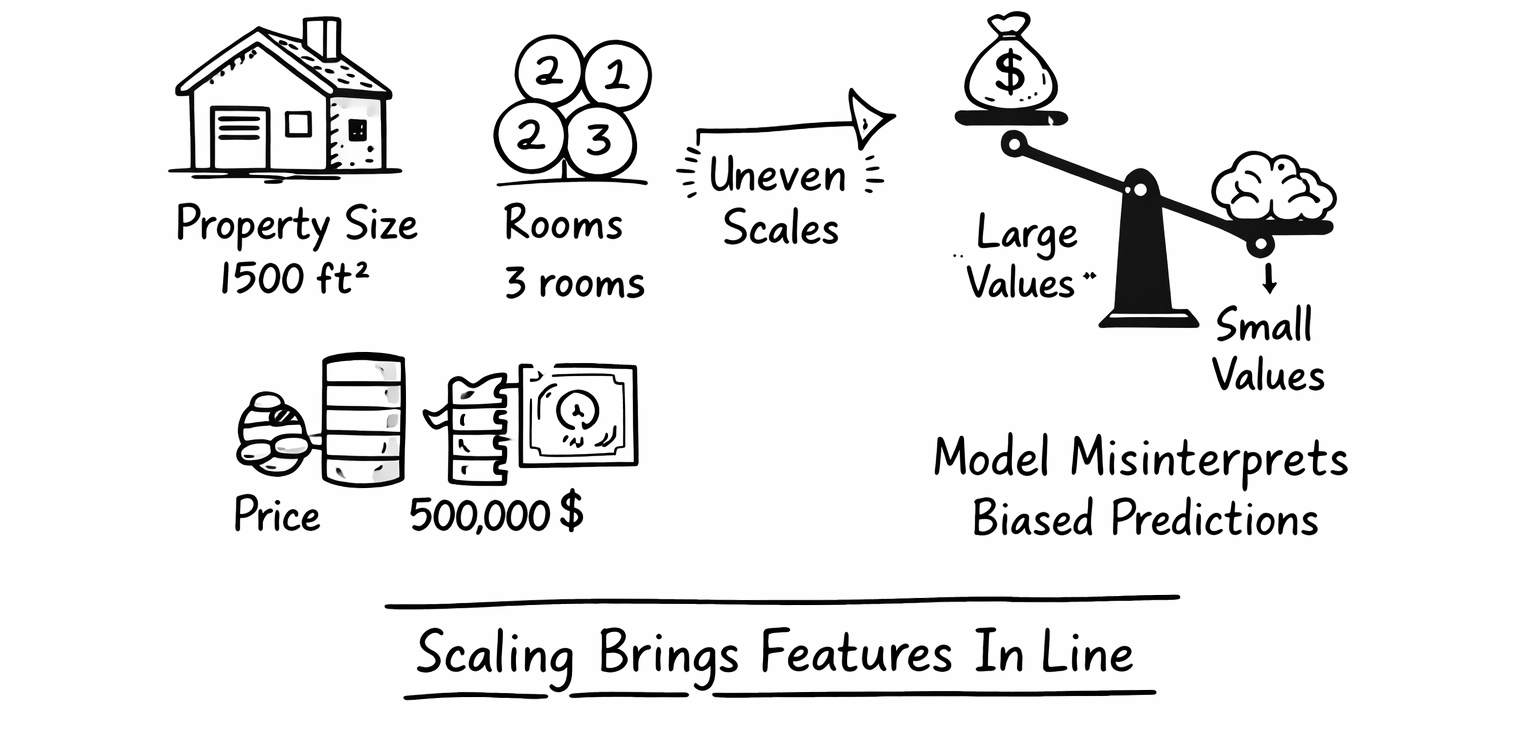
Machine learning datasets often contain features measured in different units and ranges. For example, a dataset used to predict housing prices may include variables such as property size measured in square feet, number of rooms represented as small integers, and property prices measured in hundreds of thousands of dollars.
When features vary significantly in magnitude, machine learning algorithms may interpret large numerical values as more influential than smaller ones. This imbalance can cause the model to prioritize certain features even if they are not the most meaningful predictors.
Understanding why is feature scaling needed in machine learning begins with recognizing how uneven feature ranges influence mathematical calculations used by algorithms. Many models rely on distance measurements, gradient optimization, or statistical assumptions that require features to share comparable scales.
Without scaling, the learning process may become inefficient, unstable, or biased toward specific features.
Building a Machine Learning Pipeline from Scratch

Machine learning (ML) has matured into a mainstream development activity, and data scientists are expected to be able to write production-grade training pipelines. This course will provide you with a foundation in ML pipeline development guided by best practices in software engineering. You’ll start by learning about code organization, style, and conceptual ideas, such as topological sorting of directed acyclic graphs. You’ll dive into the hands-on development of an ML pipeline. You’ll learn some advanced Python concepts and useful libraries. Finally, you’ll learn about testing methodologies and how to package your code into a distributable library. By the end of this course, you’ll understand what makes a great ML pipeline work, better appreciate software engineering processes, improve your Python knowledge, and learn how to build ML training pipelines. This knowledge will make you more attractive to potential employers and improve your chances of thriving as a new data scientist.
How Machine Learning Algorithms Interpret Numerical Features#
Machine learning algorithms rely on mathematical computations to analyze relationships between input variables and target outcomes. These computations often involve distance metrics, gradient updates, or statistical transformations.
When algorithms process datasets with inconsistent feature ranges, the calculations become skewed toward the largest values. For example, if one feature contains values in the thousands while another ranges between zero and ten, the algorithm may treat the larger feature as significantly more important.
The following table illustrates how feature magnitudes can differ within a dataset.
Feature | Typical Range | Example Dataset Variable |
Age | 18 – 70 | Customer demographics |
Salary | 30,000 – 150,000 | Financial data |
Years Of Experience | 0 – 40 | Employment records |
Credit Score | 300 – 850 | Lending analysis |
In such cases, salary values may dominate model calculations simply because they contain larger numbers. Understanding why feature scaling is needed in machine learning helps prevent this imbalance by transforming features into comparable ranges.
The Role Of Feature Scaling In Gradient Descent#
Gradient descent is a widely used optimization technique in machine learning. Many algorithms rely on gradient descent to minimize error functions by adjusting model parameters iteratively.
When features have drastically different magnitudes, the gradient descent algorithm may behave inefficiently. Features with larger numerical values generate larger gradients, which causes the optimization process to move unevenly through the parameter space.
This imbalance can slow down convergence and require more iterations for the model to reach an optimal solution. In some cases, the algorithm may oscillate or fail to converge entirely.
Understanding why is feature scaling needed in machine learning becomes particularly important when working with models that rely heavily on gradient-based optimization techniques.
Impact Of Feature Scaling On Distance-Based Algorithms#
Many machine learning algorithms rely on distance calculations to evaluate similarities between data points. These algorithms include techniques such as k-nearest neighbors, clustering algorithms, and support vector machines.
Distance-based models measure how far data points are from one another using mathematical distance metrics such as Euclidean distance. When features have different ranges, variables with larger magnitudes dominate the distance calculations.
This imbalance can lead to inaccurate predictions or poorly formed clusters because the algorithm effectively ignores smaller features.
The following table illustrates how scaling affects distance calculations.
Feature | Unscaled Value | Contribution To Distance |
Age | 25 | Small influence |
Annual Income | 100,000 | Large influence |
Number Of Purchases | 5 | Minimal influence |
Applying feature scaling ensures that each feature contributes proportionally to the distance calculation. This explains why feature scaling is needed in machine learning for algorithms that depend on similarity measurements.
Improving Model Training Efficiency#
Machine learning models often require extensive training to learn patterns within large datasets. When feature ranges vary significantly, the training process may become inefficient because the algorithm struggles to interpret the data consistently.
Feature scaling improves training efficiency by normalizing feature ranges so that algorithms can process information more uniformly. When variables share similar scales, optimization algorithms can navigate the parameter space more smoothly.
This improved efficiency allows models to converge faster and reduces computational costs associated with training large machine learning systems.
Understanding why feature scaling is needed in machine learning helps practitioners build models that train more quickly and perform more reliably.
Feature Scaling And Neural Network Performance#
Neural networks rely heavily on numerical optimization during the training process. These models update internal weights using gradient-based learning algorithms that depend on the scale of input features.
If features vary dramatically in magnitude, neural networks may experience unstable gradients or slow learning rates. Large input values can cause the activation functions within neural networks to saturate, which prevents the model from learning effectively.
Feature scaling helps neural networks maintain stable gradients and improves the overall learning process. Many neural network architectures perform best when input features are normalized between zero and one or standardized around a zero mean.
The following table summarizes how neural networks respond to scaled and unscaled features.
Data Condition | Neural Network Behavior | Result |
Unscaled Features | Uneven gradient updates | Slow training |
Moderately Scaled Data | Balanced gradient updates | Improved training |
Properly Scaled Data | Stable optimization | Faster convergence |
These improvements highlight why is feature scaling needed in machine learning when training deep learning models.
Handling Outliers And Feature Distributions#
Real-world datasets often contain outliers, which are extreme values that differ significantly from the majority of observations. These outliers can distort machine learning models if features are not scaled appropriately.
Outliers may influence statistical measures such as mean and variance, which affect how algorithms interpret feature distributions. When outliers dominate certain features, the model may produce inaccurate predictions.
Feature scaling techniques such as robust scaling address this problem by using median values and interquartile ranges instead of mean-based statistics.
Understanding why is feature scaling needed in machine learning includes recognizing how scaling techniques help manage irregular data distributions and improve model stability.
Algorithms That Require Feature Scaling#
Not every machine learning algorithm requires feature scaling, but many widely used algorithms benefit significantly from it. Algorithms that rely on distance metrics or gradient optimization are particularly sensitive to feature magnitude differences.
Algorithms such as k-nearest neighbors, logistic regression, support vector machines, and neural networks typically perform better when features are scaled appropriately.
Tree-based algorithms such as decision trees and random forests are generally less sensitive to feature scaling because they split data based on threshold values rather than numerical distances.
The following table summarizes which algorithms benefit most from feature scaling.
Algorithm | Sensitivity To Scaling | Explanation |
K-Nearest Neighbors | High | Uses distance calculations |
Support Vector Machines | High | Depends on margin optimization |
Logistic Regression | Moderate | Gradient-based learning |
Neural Networks | High | Gradient descent optimization |
Decision Trees | Low | Splits based on feature thresholds |
Understanding these relationships helps practitioners determine when scaling is necessary.
Feature Scaling Techniques Used In Machine Learning#
Several scaling techniques exist to transform features depending on the structure of the dataset and the requirements of the algorithm. Each method adjusts feature values using different mathematical transformations.
Normalization rescales values to a fixed range, typically between zero and one. Standardization transforms features so that they have a mean of zero and a standard deviation of one.
Robust scaling focuses on reducing the influence of outliers by using statistical measures such as medians and interquartile ranges.
Selecting the appropriate technique depends on the distribution of the dataset and the type of machine learning model being trained.
Practical Implementation Of Feature Scaling#
In real-world machine learning workflows, feature scaling is typically applied during the data preprocessing stage. Data scientists often rely on specialized libraries to perform scaling transformations efficiently.
A common approach involves fitting the scaling transformation using training data and applying the same transformation to validation and test datasets. This ensures that the model does not gain information from unseen data during training.
The following table shows common scaling implementations available in machine learning frameworks.
Scaling Technique | Implementation Tool | Typical Use Case |
Min-Max Scaling | MinMaxScaler | Neural networks |
Standard Scaling | StandardScaler | Regression models |
Robust Scaling | RobustScaler | Data with outliers |
Max Absolute Scaling | MaxAbsScaler | Sparse datasets |
These tools simplify the process of applying feature scaling consistently across machine learning pipelines.
Common Mistakes When Applying Feature Scaling#
Many beginners make mistakes when applying feature scaling in machine learning workflows. One common mistake involves scaling the entire dataset before splitting it into training and testing subsets.
This mistake introduces data leakage because information from the test dataset influences the scaling transformation. Proper preprocessing requires fitting the scaling parameters using only the training dataset.
Another mistake involves applying scaling to algorithms that do not require it. Tree-based models typically perform well without feature scaling because they rely on feature thresholds rather than numerical distances.
Understanding these pitfalls helps practitioners implement feature scaling correctly and avoid unintended biases.
The Future Of Data Preprocessing In Machine Learning#
As machine learning systems grow more complex, automated preprocessing tools are becoming increasingly common. Modern machine learning platforms often include automated pipelines that perform feature scaling and other transformations automatically.
Automated machine learning tools evaluate multiple preprocessing strategies and identify the transformations that produce the best model performance. These tools help reduce manual experimentation while improving model efficiency.
Despite these advancements, understanding why feature scaling is needed in machine learning remains an essential skill for data scientists and machine learning engineers.
Practitioners who understand data preprocessing techniques can interpret model behavior more effectively and build more reliable predictive systems.
Conclusion#
Understanding why is feature scaling needed in machine learning is essential for building accurate and efficient models. Differences in feature magnitudes can distort optimization processes, bias distance calculations, and slow down training algorithms.
Feature scaling techniques transform numerical features into comparable ranges, allowing machine learning algorithms to interpret each variable more fairly. These transformations improve convergence speed, increase model stability, and enhance predictive accuracy.
By applying appropriate scaling techniques during data preprocessing, practitioners can significantly improve the performance of machine learning models and ensure that algorithms learn meaningful patterns from the data.