Agile Teams---Scrum vs. Kanban
Discover how to determine whether Scrum or Kanban best fits your product team's workflow. Learn the strengths of each methodology in managing predictability, team maturity, delivery style, and workflow optimization to improve agile processes.
When to choose Scrum over Kanban
Deciding between Scrum and Kanban depends on the specific needs and goals of the product team, and both methodologies have their own advantages and disadvantages. Here are some factors that could influence the choice between Scrum and Kanban:
Predictability: If the team needs a higher level of predictability and wants to plan and estimate work more accurately, then Scrum may be a better choice. Scrum provides a fixed time frame (a sprint, through a practice known as timeboxing) during which a set of tasks are completed. The team can use this predictability to plan and adjust their work based on the velocity (amount of work completed per sprint) and the outcomes they are working to accomplish.
Team maturity: If the team is new to agile methodologies or if the team is still maturing, then Kanban may be a better choice. Kanban provides more flexibility in terms of the work process and can help the team to adapt to changing circumstances by being implemented over time. The team also works with a limited number of work items at any given time, and there is no timeboxing and pressure to deliver a potentially shippable product increment.
Work type: If the work is more routine or recurring in nature, then Kanban may be a better choice. Kanban allows the team to optimize the flow of work and continuously improve their processes.

Ultimately, the choice between Scrum and Kanban depends on the specific needs and goals of the product team. It's important to assess the team's current state, the work type, and the level of predictability required before choosing a methodology.
When to choose Kanban over Scrum
Choosing Kanban over Scrum may make sense for a product team under the following circumstances:
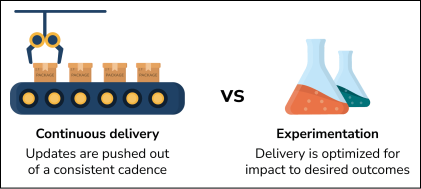
Continuous delivery: If the team values continuous delivery, where new features and improvements are released frequently, Kanban may be a better choice. Kanban emphasizes the flow of work and allows the team to continuously deliver outside of timeboxed iterations.
Workflow improvement: If a team's focus is workflow improvement and reducing lead times, Kanban may be a better choice. Kanban allows the team to visualize and optimize their workflow, and to identify and eliminate bottlenecks or other inefficiencies in the process.
Variable demand: If the demand for work is variable, with frequent changes in priorities or requirements, Kanban may be a better choice. Kanban is less prescriptive and can easily accommodate changes in priorities or requirements without disrupting the workflow.
Small teams: If the team is small and cross-functional, with all team members involved in development, testing, and deployment, Kanban may be a better choice. Kanban allows the team to work together to optimize the flow of work, without the need for strict roles or ceremonies.
No timeboxing: If the team doesn't want to be bound by a set timebox, but still wants to work in an agile manner, Kanban may be a better choice. Kanban doesn't timebox like Scrum, but instead allows work to be pulled from a backlog as capacity becomes available.

How Scrum differs from Kanban for a product team
The experience of working in a Scrum team and a Kanban team can be quite different, even though both methodologies are agile and share some similar values and principles. Here are some ways in which the experience can differ.
Iterative vs. continuous delivery: Scrum is based on iterative delivery, with work done in timeboxed sprints. Kanban, on the other hand, emphasizes continuous delivery, with work pulled from the backlog as capacity becomes available. This means that Scrum teams work in sprints and have a clear end date for each iteration, while Kanban teams can work on a task until it's completed, with no set timebox.
Roles and ceremonies: Scrum has well-defined roles and ceremonies, with the product owner responsible for defining and prioritizing the backlog, the scrum master responsible for facilitating the Scrum process, and the development team responsible for delivering the product increment at the end of each sprint. Kanban is more flexible and doesn't have specific roles or ceremonies, allowing the team to define its own process.
Predictability: Scrum provides more predictability, with the team committing to a fixed set of work for each sprint and delivering a potentially shippable product increment at the end of each iteration. Kanban, on the other hand, is more focused on flow and can be less predictable, with work being pulled from the backlog as capacity becomes available.
WIP limits: Kanban emphasizes the use of work-in-progress (WIP) limits to help the team focus on completing work before starting new tasks, which can help reduce lead times and increase throughput. Scrum doesn't have explicit WIP limits but instead relies on the sprint goal to provide a focus for the team.
Continuous improvement: Both methodologies emphasize continuous improvement, but the focus can be different. In Scrum, the team reflects on their process at the end of each sprint and makes changes to improve their performance in the next iteration. In Kanban, the team continuously analyzes their workflow and makes changes as needed to optimize their process.

Quiz
Quiz yourself on when to choose Scrum vs. when to choose Kanban.
When is Scrum a better choice than Kanban?
When the work is more routine or recurring in nature
When the demand for work is variable
When the team values continuous delivery
When outcomes are valued more than specific outputs or features