

SQL is a declarative language for asking questions of relational data, where you describe the result (rows, summaries, or joins) and the database determines the execution plan.
Content
SQL is how you have a clear conversation with data. Instead of telling a computer how to find an answer step-by-step, you simply describe what you want, and the database does all the heavy lifting. It’s the powerful, behind-the-scenes engine for most products you use every day, including shopping carts, analytics pages, finance reports, and more.
Think about it:
When you open a ride sharing app and check your trip history, that’s an SQL query filtering your data.
When a manager asks, “What were our total sales last week?” that’s a query summarizing data.
When a dashboard shows new user sign-ups by day, that’s a query joining user data with event data.
Whether you’re coding an app using programming languages such as Python or JavaScript, or using tools like Tableau, your data almost always comes from one place: a database. And to talk to that database, you’ll need to be fluent in SQL.
Why SQL is still important in 2026#
Tools like no-code apps and Python libraries (like pandas) are great for small tasks, but they need you to pull the data out of the database first. In contrast, SQL runs directly within the database, where the data is actually stored.
This gives SQL a big advantage:
Speed and scale: Databases are built for fast answers, using special tools like the ones mentioned below.
Indexes: This is like the index in a book that helps you jump to the right page.
Query planners: This is like the GPS that finds the fastest way to get your answer.
Portability: SQL works similarly across many databases (PostgreSQL, MySQL, SQL Server), so once you learn it, your skills apply almost anywhere.
Your first look of SQL#
SQL is simpler than it looks because it’s designed to be readable, almost like a sentence:
This query simply says: “Show me the product, quantity, price, and order date from the orders table, but only for the user with an ID of 1.”
If you change user_id = 1 to product = 'Mug', you’ve asked a completely different question using the exact same pattern. A great tip for beginners is to say your question out loud in plain English. If your sentence is clear, the SQL will be too.
Try it: Before you write a query, say the question out loud. If the sentence is clear, the SQL will be too.
Using AI as your co-pilot#
Yes, AI can absolutely help you write a query or explain an error, but you must remain in control. Think of it as a co-pilot, not the pilot.
Here’s a simple loop to stay safe and ensure that you’re learning.
Run it: Never trust code you haven’t executed yourself.
Add a tiny check: Verify the result with a simple mental check (e.g., “I expect this to return 3 rows for last week’s sales.”).
Explain it back: If you can’t explain what the query does in one sentence, it’s too complex. Ask the AI to simplify it.
A good prompt is specific. It gives the AI context (your table structure), a clear goal, and simple constraints, for example:
Prompt: Given the following schema and question, perform the tasks below.
Write one SQL query to answer the question.
Provide a brief 2-line explanation of the query logic.
Include a variant using
LEFT JOINto ensure products with zero revenue are included.Add a minimal test case showing the expected first row of output.
Schema: (Insert schema here). Question: Calculate revenue by product for the last 7 days, including products with zero revenue.
Steps on use this guide#
You’re in the right place to get started. You’ll set up a tiny database in minutes, learn the core SQL patterns in about 20 minutes, and follow a 30-day, two-project plan to make your new skills stick. The key is to build a small, consistent habit: ask one new question of your data each day, and aim for one small improvement each week.
1. Set up in five minutes #
The goal of this section is to get you running real SQL queries right now, without a complicated installation process.
What you’ll need: A web browser. That’s it.
What you’ll finish with: Two sample tables (
usersandorders) and three queries that prove your setup is working correctly.
Step 2: Choose your playground#
The point isn’t to master installations; it’s to get queries running fast. This guide includes interactive SQL playgrounds, so you don’t need to install anything. The fastest path is using a browser.
Browser sandbox (recommended): This is the zero-install option that we’ll use in this guide. Simply use the provided code editors in each section. To do a quick test, you can run the simplest query possible:SELECT 1;. If the output is 1, you’re ready to go.
Local SQLite (optional): If you’re comfortable with the command line and already have SQLite installed on your machine, you can use that instead. Open your terminal and type sqlite3 demo.db to create and open a new database file. You can check your version with sqlite3 --version. You’ll learn the same SQL either way.
Step 3: Create your demo database#
Copy the entire SQL block below, paste it into the editor, and run it once. This script will set up two tables, users and orders, and populate them with sample data for you to work with.
The DROP TABLE IF EXISTS commands ensure that you can safely run this block multiple times without causing errors.
If you get an error, try running one statement at a time, and make sure each line ends with “;”.
Step 3: Run your first query#
Now, you can prove that everything works by running a few queries. Run these one at a time to see the results.
A) Filter and sort#
This query answers the question: “Show me Amy’s orders, with the newest one first.”
You should see two rows returned: the notebook order first, and then the pen order.
Try it: Modify the query by swapping user_id = 1 for product = 'Pen' to ask a new question.
B) Summarize#
This query answers: “What is the total revenue for each product?”
Try it: Change SUM(qty * price) to COUNT(*) to see which item sells most often instead.
C) Combine tables#
To do this, we need to get data from both the orders and users tables at the same time. We connect, or JOIN, them where the user_id in the orders table matches the id in the users table.
Notice the AS o and AS u in the query below. This is us giving a short nickname (an alias) to each table. orders AS o means from now on in this query, we can just type o instead of orders. This is especially useful for telling the database exactly which id column we want (e.g., o.id for the order’s ID vs. u.id for the user’s ID).
Optional: Want to see all users, even those who have never placed an order? Simply change JOIN to LEFT JOIN. You’ll see Dan appear in the list with no order details.
Step 5: Save your tiny win#
This is a great time to practice documentation. Add this sentence to a personal notes file or a project README: “I set up an SQLite database, created users and orders tables, and successfully ran a filter, a summary, and a join query.” Paste the three queries from Step 3 under a “Health Check” heading.
Quick fixes#
If you run into issues, check these common fixes.
No such table: You likely didn’t run the full setup block from Step 2, or you missed a semicolon (
;) at the end of a command.Empty results: Your
WHEREclause might be too strict. For example,user_id = 5would return nothing, as no user has that ID. Try removing theWHEREclause to see all the data first.Numbers look wrong: Double-check your spelling (e.g.,
qty * price) and make sure you’re referencing the correct columns.
Want guided practice of the same patterns (SELECT, GROUP BY, JOIN, CTEs) in a sandbox? Open Learn SQL and match lessons to the queries that you just ran.
SQL in 20 minutes#
You now have two sample tables ready for use. The first step in learning SQL is not to memorize keywords, but to visualize the rows of data. Once you can form a clear mental model of the data, writing the queries will become more intuitive.
First see the data#
We will now work with our two sample tables. It is important to understand their structure before proceeding.
users
id | name | is_member |
1 | Amy | 1 |
2 | Bo | 0 |
3 | Cat | 1 |
4 | Dan | 0 |
orders
id | user_id | product | qty | price | order_date |
1 | 1 | Pen | 3 | 1.50 | 2025-08-20 |
2 | 1 | Notebook | 1 | 4.00 | 2025-08-21 |
3 | 3 | Mug | 2 | 8.00 | 2025-08-22 |
4 | 3 | Pen | 10 | 1.50 | 2025-08-23 |
Tip: Remember these two tables..
Every query you write is a process of answering three questions in order: Which rows? → Which columns? → In what order?
3.1 Filter and sort#
We will begin with a clear, simple question: “Show Amy’s orders, with the newest one first.”
By observing the tables, we know Amy’s id is 1. Therefore, we need to retrieve orders WHERE user_id = 1 and then sort those results by the order_date.
Why this works: The query first finds all rows that match the WHERE condition and then sorts only those resulting rows by date in descending order.
As an exercise: Change the condition to product = 'Pen'. What rows do you expect the query to return?
3.2 Summarize#
Next, consider a common business question: “Which product brings in the most revenue?”
To answer this, we know the revenue for each row in the orders table is qty * price. We must calculate this for all “Pen” orders, then sum them, and repeat the process for all other products. This technique is called grouping.
Why this works: The GROUP BY clause creates “buckets” for each unique product name. The SUM() function then performs the calculation within each bucket.
A key rule to understand is the difference between the WHERE and HAVING clauses:
WHEREfilters individual rows before the grouping operation occurs.HAVINGfilters entire groups after the aggregation has been performed.
For example, to display only the products that generated $10 or more in revenue:
As an exercise: Add a WHERE order_date >= '2025-08-21' clause to the query above. Predict which products will remain before you run it.
3.3 Join tables#
Now, we will ask a question that requires data from both tables: “List each order with the buyer’s name.”
The names are in the users table, while order details are in the orders table. We must link them using the ID that they share (orders.user_id and users.id). This is done with an INNER JOIN, which returns only the rows where a matching value is found in both tables.
Now consider a different question: “Show every user’s total revenue, even if they never placed an order.” This requires a LEFT JOIN, which will keep every row from the “left” table (users), regardless of whether a match is found in the right table.
As an exercise: Change the LEFT JOIN in the query above back to a JOIN. Which users disappear from the results and why?
3.4 Subqueries and CTEs#
Sometimes, a question is too complex to be answered in a single step. For example: “In the last 3 days, how much revenue did each user create?”
This question involves two logical steps: (1) Identifying the recent orders, and then (2) joining that data to users and calculating the total. A Common Table Expression (CTE) allows you to break the problem down into readable steps. You can think of a CTE as a temporary, named scratchpad.
Why this works: The CTE recent makes the logic clean and easy to follow. You first define the subset of recent orders, and then you use that named subset in the main part of the query.
Try it: Rename the CTE to members_recent and add a second CTE members AS (SELECT id FROM users WHERE is_member = 1), then join recent to members to see member-only revenue.
Read SQL like a story#
When you are unable to solve a problem, it is helpful to analyze the query in the logical order that the database processes it.
FROM / JOIN: Where do the rows come from?WHERE: Which individual rows should be kept?GROUP BY: How should these rows be bucketed?HAVING: Which of these buckets should be kept?SELECT: What columns or calculations should be shown?
ORDER BY / LIMIT: How should the final result be presented?
Do it now
Review the two data tables. Write one new question of your own in plain English.
Before writing any code, predict the answer by looking at the tables.
Translate your English sentence into an SQL query and run it.
Add a line to your
READMEfile documenting your work: “I answered the question of____by selecting____, filtering on____, and ordering by____.”
For a detailed hands-on for all these SQL patterns without the need for any extra installations, try Learn SQL.
Real Projects#
You’ll learn SQL faster by shipping two small, real projects than by reading twenty tutorials. The plan is to work in short, focused sessions; aim for 60–90 minutes, five times a week.
By the end of the month, you’ll have tangible proof of your new skills:
Runnable SQL scripts for both projects.
A clear
READMEfile that explains your work.A couple of screenshots showing your results.
Two 60-second video demos that you can share.
This isn’t about grinding through exercises; it’s about the confidence that comes from finishing something real.
Weekly Chart
Week | Focus | What You Finish |
1 | Starter schema and 3 core queries |
|
2 | +2 queries, tiny | 5 queries total, |
3 | Add table and analytics ( | 3 analytics queries, 1 screenshot |
4 | +3 analytics queries, polish, demo | 6 analytics queries, |
Practice loops in Learn SQL as you go; version with Learn Git; and then go deep afterward with Become a Database Professional with SQL.
Project 1: Book tracker store and query (weeks 1–2)#
Your first project is to create a single table for a personal book tracker and then answer five common questions with SQL. The goal is to keep it small so that you secure a quick win.
1. Your schema (run this once): This script creates your books table and adds some sample data.
Your five queries (Run these one by one):
Newest books:
Unfinished list:
Added this week (adjust dates):
Top authors:
Title search:
Package it: Create a README file that explains what the project is. Take a screenshot of one of your query results. Finally, record a 60-second demo where you narrate one query, like: “To find my top authors, I grouped my books by author and then counted the number of books in each group.”
Project 2: Reading analytics (weeks 3–4) #
Now, you’ll add a second table to track your reading sessions. This is where you’ll learn how to get powerful insights by connecting data with JOIN and CTE.
Your second table (run this once): This script creates a reading_log table that links to your books table.
Analytics queries (examples).
Total minutes per book:
Pages by day:
Last 3 days (CTE):
Update your README with a new “Growth Project” section. Add a screenshot of your JOIN query. Record a second 60-second demo, this time focusing on the CTE and explaining why naming the intermediate recent_logs result made the final query easier to read.
A quick note on using AI
Use AI as your pair programmer to speed up this process. Remember the loop: Spec → prompt → run → test → explain. Ask for one query or one refactor at a time, not the whole project. Always run the code and add a tiny test (like checking the expected row count).
A safe prompt that you can reuse:
When you’re ready, add two tiny, standard-library files. They make your work easier to share and see, with still no web stack.
A) Run any query, get JSON/CSV#
main.py: One file, no dependencies.
B) See it on desktop (Tkinter table and bar chart)#
desktop_dashboard.py: Single file, uses sqlite3, tkinter/ttk, csv. It opens a window, lets you pick a preset query (e.g., “Revenue by product”), shows a table, draws a simple bar chart, and lets you save CSV. (Can you use AI as your coding partner to pull this off?)
The end product looks like this:
Runnable
schema.sqland seed.8–9 queries total (5 Starter, 3–4 Growth).
READMEsays what/run/expect + screenshots.Two 60-sec demos (Starter, Growth).
Optional: CLI export and desktop dashboard.
You can explain each query in one sentence.
Keep practicing the same patterns in Learn SQL. When you want to save history and collaborate, take the click-first route with Learn Git. Ready to think like a database pro? Move on to Become a Database Professional with SQL.
Learn SQL with AI#
AI can feel a breakthrough the first time it writes a query for you. But here’s the catch: if you don’t stay in control, you can end up with 80 lines of SQL that you can’t explain or fix. The goal isn’t to avoid AI, but to pair with it. You set the direction, it drafts a small piece, and you verify the result.
Think of AI as the gas pedal; your loop of spec → run → test → explain is the steering and the brake that keeps you in control. The spec (short for specification) is your clear, simple plan.
A safer way to pair
When you’re stuck, don’t just say “build my whole report.” That’s how you get confusing code that you can’t debug. The key is to start with a great spec. A good spec is tiny and answers three questions before you even prompt an AI.
Inputs: What information does your query need to do its job? This is where you’ll provide the relevant table structures (your CREATE TABLE schema).
Outputs: What should the final result look like? What columns should it have?
Definition of done: What’s a concrete example of a successful result? (e.g., “The user ‘Dan’ should appear in the list with a revenue of 0.”)
Once you have that spec, you run the AI’s suggestion, add a quick sanity check (like checking the row count), and explain the query back to yourself in one sentence. If you can’t, your spec was too big.
Practice round 1: Generating a complex query#
Let’s put this into practice by writing a spec for a common business question.
Goal: I want to see the total revenue for each product from the last seven days.
Inputs: The orders table.
Outputs: A table with product and revenue columns.
Definition of done: Products that had zero sales in the last seven days must be included in the list with a revenue of 0.
With a clear spec like that, you can ask an AI for a single query and get back something useful and targeted, like this:
Now it’s your turn: run it, quick review the totals, and explain it out loud. A good explanation would be: “We list all unique products, join any recent orders to that list, and treat missing ones as zero revenue.” If that sentence feels natural, your spec was the right size.
Practice round 2: Making code readable#
AI is also excellent at refactoring code for clarity. Here’s a query that works, but is a bit messy:
You can ask an AI to “refactor this query into a CTE for readability.” You’ll likely get back a much cleaner version:
It’s much easier to see the logic now, right?
Your turn: Run the query, but first, predict which user will be at the top of the list. That prediction step is where you start to think like a data analyst, not just a code copier.
When to slow down and be cautious#
There are certain situations where you shouldn’t rely on AI shortcuts. Be especially careful with queries that involve:
Payments or financial data
Personal user information (PII)
Anything security-related
And most importantly, if an AI gives you a large wall of SQL that you can’t explain, don’t use it. Ask for a smaller, simpler piece that you can understand.
Why this matters for your projects#
When you get to the projects later in this guide, this is the loop that will ensure you’re actually learning and building reliable code:
Write a clear spec for one small slice of the problem.
Let the AI suggest a draft.
Run it yourself and add a sanity check.
Explain it back in your own words.
That’s the recipe for learning faster and building proof of your skills that you can confidently show to others.
Career options: Where SQL can take you#
If you can ask clear questions of data, you already have a valuable skill. The real fork in the road is what else excites you. This can range from telling stories with charts, making systems reliable and fast, to wiring together data pipelines, or shipping features that users can see and touch.
Here are four common paths where SQL is a core skill:
Data analyst#
You spend your days inside queries, charts, and “so what?” moments. A product manager asks if a new onboarding worked. You join events to users, compute weekly cohorts, and show results in a chart that makes sense to everyone in the room.
Everyday work: Write queries, build dashboards, explain trends.
Proof that counts: A KPI dashboard with clear SQL definitions and a short note on one decision that your analysis would change.
Next move: Polish your SQL style (window functions, CTEs) and learn a dashboard tool.
Why it pays: $71k–$120k starting, top earners reach ~$152k.
Database professional#
You’re the keeper of healthy databases and fast queries. You’re focused on the engine itself, you design schemas, add indexes to speed up lookups, enforce data quality rules, and tune slow queries until they’re instant. Engineers and analysts build on your work; their apps run faster because your foundation is solid.
Everyday work: Schema design, indexing, tuning, migrations.
Proof that counts: Normalize a messy dataset, add the right index, and show the “before/after” timing in an EXPLAIN plan.
Next move: Explore views, triggers, partitioning, and backups.
Why it pays: $83k–$137k starting, top earners reach ~$171k.
Data engineer#
Metaphorically, you build the highways that data travels on. You stitch systems together to get raw logs from one place, clean and transform them, and load them into clean, reliable tables. SQL is your primary modeling tool, but you’ll often use Python to orchestrate the entire process. Your work is the foundation for all data analysis and machine learning.
Everyday work: ELT/ETL, modeling (staging → marts), scheduling jobs, quality checks.
Proof that counts: Build a daily load from CSV → staging → gold table, and include a short
READMEon cost or latency trade-offs.Next move: Learn SQL modeling patterns, add testing, and pick up Python for orchestration.
Why it pays: $102k–$169k starting, top earners reach ~$211k.
Full stack/Web developer#
Your work shows up in the user interface: the buttons, feeds, and reports that people click every day. SQL is the skill that keeps your application’s features correct and its pages fast, even if you spend most of your time writing application code in a language like JavaScript or Python.
Everyday work: Parameterized queries, pagination, reporting endpoints.
Proof that counts: A small feature with a clean JOIN + GROUP, and a screenshot of the UI and SQL side by side.
Next move: Learn how to grow from one query into a simple backend with tests, and practice preventing SQL injection.
Why it pays: $95k–$155k starting, top earners reach ~$192k.
Career role with guidelines#
Role | What You Actually Do with SQL | Companion Skills to Add | Portfolio Proof (Starter Idea) | Next Step |
Data Analyst | Ad-hoc questions, cohorts, KPIs, dashboards | Visualization and storytelling, window functions, CTEs | KPI dashboard and written definitions, a 2-paragraph “insight memo” | Become a Data Analyst |
DBA/DB Developer | Schema design, indexing, tuning, data quality | EXPLAIN plans, constraints, migrations, backups | “Before/after” index demo with plan and timing, normalized schema write-up | Become a Database Professional with SQL |
Data Engineer | ELT/ETL, modeling layers, job schedules | Python scripting, data tests, cost/latency basics | CSV → staging → marts → metric table, | Become a Python Developer (pair with SQL) |
Full Stack/Web Developer | Feature queries, pagination, reports | Back-end basics, parameterized queries, testing | Feature page, endpoint and the SQL it runs; note on avoiding injection | Become a Web Developer / Full Stack Developer |
Which career to choose?#
Answer these questions to see which role might be a good fit for you:
Do you enjoy the process of finding an insight and explaining it in a chart? → Data Analyst
Do you have an urge to fix slow queries and organize messy data? → Database Professional
Do you enjoy wiring systems together and building clean, reliable processes? → Data Engineer
Do you want users to see and interact with something you built? → Full Stack/Web Developer
Whichever one you choose, keep your proof small and real: a query, a screenshot, and a short README explaining why it’s correct. Then, you can start building the specific skills for your chosen path.
Practice loops and portfolio projects → Learn SQL (daily reps).
Save history and collaborate → Learn Git.
Go deep on reliability and design → Become a Database Professional with SQL.
Head toward storytelling → Become a Data Analyst.
Build pipelines with a bit of Python → Become a Python Developer.
Turn features into shipped apps → Full-Stack Developer.
Reality check: Titles overlap and change across companies. What doesn’t change is the value of a clear query, a readable explanation, and a small artifact someone else can run. Keep shipping those, and your SQL will open whichever door you pick.
Your next 30–90 days#
You’ve got the core patterns down, and you have a plan for practice. Now, it’s time to turn that practice into evidence, the kind a hiring manager can review in under a minute and say, “Yes, this person can work with data.”
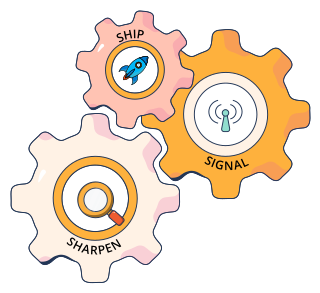
Think of the next three months as three gears meshing together: shipping, sharpening, and signaling. They’re small, individual steps, but they compound over time to build a strong professional profile.
Days 1–30#
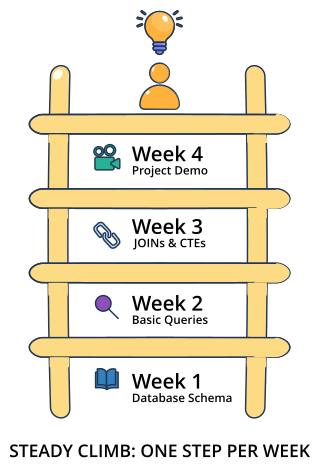
Your first month is about finishing the two-project ladder you started in this guide. The key is to keep your work loop tiny: Ask a question → write a query → check the result → explain it back to yourself.
Your deliverables at day 30:
Your Starter and Growth projects, fully completed as you scoped them.
A README file for each project, written in plain English, that explains what it does, how to run it, and what to expect.
Two short video demos where you narrate the question, run the query, point at the result, and explain the “so what.”
A daily rhythm matters more than the size of your effort. Twenty minutes a day is enough if you keep the scope of each task microscopic.
Days 31–60#
Now that you can ship a finished project, the focus shifts to readability and performance. These are the skills that make your work easier for others to trust and scale.
Your deliverables at day 60:
One query refactored into a tidy CTE: Take a long or complex query from one of your projects and rewrite it for clarity.
One “before and after” performance note: Pick a query, run EXPLAIN to see its query plan, add an index to improve it, and write a two-line note on what changed and why it helped.
One query using a window function: Stretch your skills by writing a query that calculates something like a 7-day rolling average revenue.
Days 61–90#
By month three, you’re not just practicing; you’re signaling which career lane you’re interested in. Pick the path that excites you most (from the previous “Career Snapshots” section) and tilt your portfolio in that direction.
Your deliverables at day 90:
One lane-specific portfolio piece: Add an artifact that speaks to your chosen role.
For the Data Analyst: Build a mini-dashboard with two or three KPIs and write a short “insight memo.”
For the Database Professional: Normalize a messy dataset and show the before/after timings.
For the Data Engineer: Build a tiny daily data pipeline (e.g., from a CSV to a final table) and include a simple runbook.
For the Full-Stack/Web Developer: Add a small feature backed by a parameterized query and mention how you avoided SQL injection.
A tuned-up résumé: List your SQL and Git basics and link them to your two projects.
Two mock interview run-throughs: Practice debugging a query out loud and do a short walkthrough of one of your projects.
One-glance plan#
Days 1–30: Finish the two-project ladder, practice daily, and record two demos.
Days 31–60: Refactor a query into a CTE, test an index’s performance, and write one window function.
Days 61–90: Pick a career lane, add one lane-specific artifact to your portfolio, tune your résumé, and do two mock interview runs.
Final word#
Add a “Next 90 Days” section to your main project README. Circle the career lane you plan to signal by day 90. Then, block two 30-minute sessions in your calendar for next week: one to refactor a query into a CTE, and one to run your first EXPLAIN on a query.
Momentum comes from small, repeatable wins. Always remember the core loop: run it yourself, add a test, and explain it in one line.
Keep the habits from earlier sections: run it yourself, add one tiny test, and explain it in one sentence. For daily practice, lean on Learn SQL. For depth and durability, go through Become a Database Professional with SQL. For collaboration hygiene, add Learn Git. When you’re ready to learn with an assistant without giving up ownership, fold in Learn to Code with AI.
Frequently Asked Questions
What is SQL?
What is SQL?
Which SQL dialect should I start with?
Which SQL dialect should I start with?
Do I need Python before SQL?
Do I need Python before SQL?
How long until I’m useful with SQL?
How long until I’m useful with SQL?
Can I skip SQL if I use no-code tools or pandas?
Can I skip SQL if I use no-code tools or pandas?
What’s the difference between WHERE and HAVING?
What’s the difference between WHERE and HAVING?
INNER JOIN vs. LEFT JOIN, When do I use each?
INNER JOIN vs. LEFT JOIN, When do I use each?
What’s a CTE and why should I care?
What’s a CTE and why should I care?
How should I practice each day?
How should I practice each day?
I don’t want to set up servers. How do I start quickly?
I don’t want to set up servers. How do I start quickly?
Can AI teach me SQL safely?
Can AI teach me SQL safely?
Do I need web development to visualize results?
Do I need web development to visualize results?
How do I make queries faster without guessing?
How do I make queries faster without guessing?
What first projects actually prove skill?
What first projects actually prove skill?
What careers use SQL the most?
What careers use SQL the most?
How do I avoid SQL injection?
How do I avoid SQL injection?
I keep getting errors. How do I debug them quickly?
I keep getting errors. How do I debug them quickly?
What should I learn after the basics?
What should I learn after the basics?
How should I present my work to get interviews?
How should I present my work to get interviews?
Written By:
Junaid Akhtar