Best practices for using scikit-learn in data analysis
Ready to improve your scikit-learn workflows? Learn the best practices for preprocessing, pipelines, cross-validation, and model evaluation to build reliable, reproducible data analysis projects with confidence.
If you are using scikit-learn for data analysis, you are already working with one of the most reliable and widely adopted machine learning libraries in Python. Scikit-learn is powerful, consistent, and flexible. It allows you to move from raw data to predictive models quickly. However, speed without structure can lead to fragile or misleading results.
Many analysts and aspiring machine learning practitioners learn how to call .fit() and .predict(), but overlook the deeper practices that make models reliable. Data analysis is not just about training algorithms. It is about building workflows that are reproducible, interpretable, and robust against real-world complexity.
If you want to move beyond experimentation and into disciplined data analysis, you need to adopt best practices intentionally. This guide will walk you through those best practices step by step, showing you how to use scikit-learn responsibly and effectively in real projects.
Scikit-Learn for Machine Learning

This comprehensive course is designed to develop the knowledge and skills to effectively utilize the scikit-learn library in Python for machine learning tasks. It is an excellent resource to help you develop practical machine learning applications using Python and scikit-learn. In this course, you’ll learn fundamental concepts such as supervised and unsupervised learning, data preprocessing, and model evaluation. You’ll also learn how to implement popular machine learning algorithms, including regression, classification, and clustering, using scikit-learn’s user-friendly API. The course also introduces advanced topics such as ensemble methods, model interpretation, and hyperparameter optimization. After taking this course, you’ll gain hands-on experience in applying machine learning techniques to solve diverse data-driven problems. You’ll also be equipped with the expertise to confidently leverage scikit-learn for a wide range of machine learning applications in industry as well as academia.
Start with clean and well-understood data#
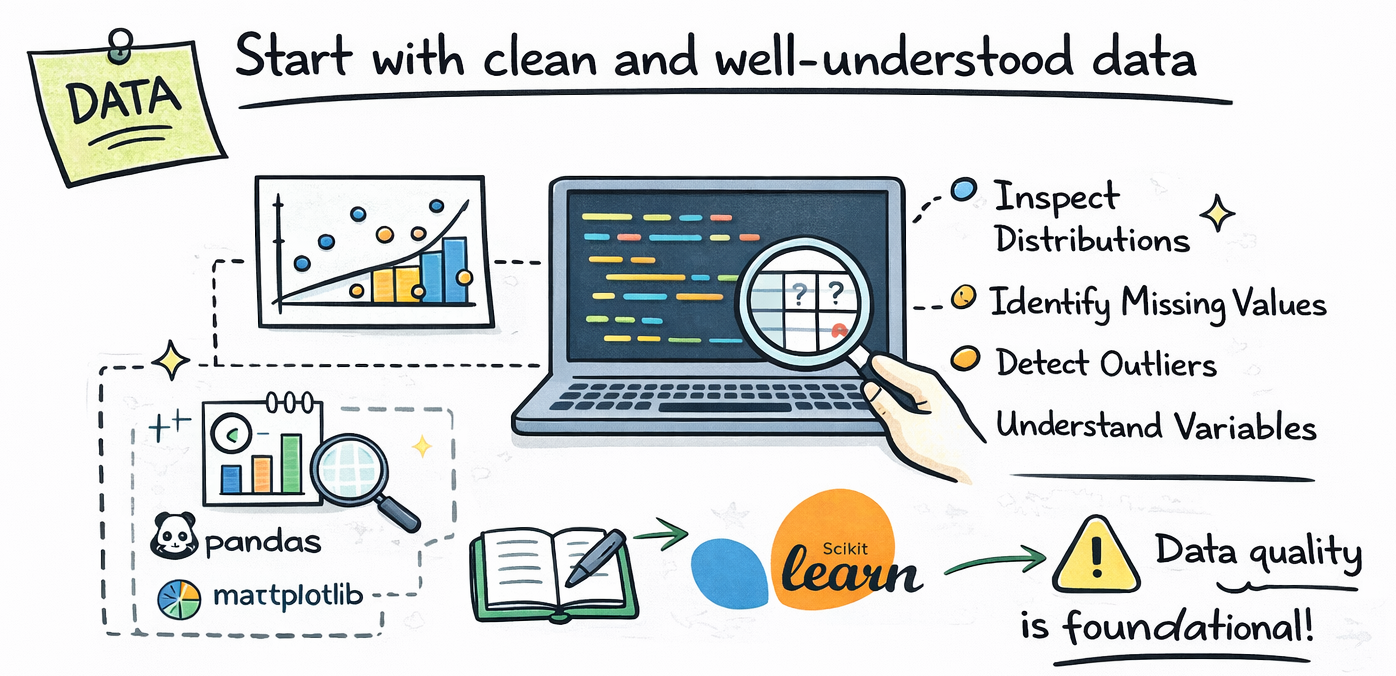
Before you touch a model, you must understand your data.
Scikit-learn is not responsible for cleaning messy datasets. It assumes that the data you provide is structured and meaningful. That means you must inspect distributions, identify missing values, detect outliers, and understand variable types before modeling.
Exploratory data analysis using pandas and visualization libraries should always precede scikit-learn modeling. When you understand your features, you make better modeling decisions. Without that understanding, even the most advanced algorithm may produce unreliable insights.
Data quality is not optional. It is foundational.
Hands-on Machine Learning with Scikit-Learn

Scikit-Learn is a powerful library that provides a handful of supervised and unsupervised learning algorithms. If you’re serious about having a career in machine learning, then scikit-learn is a must know. In this course, you will start by learning the various built-in datasets that scikit-learn offers, such as iris and mnist. You will then learn about feature engineering and more specifically, feature selection, feature extraction, and dimension reduction. In the latter half of the course, you will dive into linear and logistic regression where you’ll work through a few challenges to test your understanding. Lastly, you will focus on unsupervised learning and deep learning where you’ll get into k-means clustering and neural networks. By the end of this course, you will have a great new skill to add to your resume, and you’ll be ready to start working on your own projects that will utilize scikit-learn.
Separate training and testing data properly#
One of the most critical best practices in scikit-learn data analysis is maintaining a clear separation between training and testing data.
If you train and evaluate your model on the same data, you risk overfitting. The model may memorize patterns rather than generalize. Scikit-learn provides tools such as train_test_split to help you divide datasets appropriately.
You should always reserve a portion of your data for unbiased evaluation. Even better, use cross-validation to evaluate models across multiple splits. This reduces the chance that your results are influenced by a single random partition.
Proper evaluation practices prevent false confidence.
Use preprocessing pipelines instead of manual steps#
Many beginners preprocess data manually and then feed it into models separately. This approach often leads to data leakage and inconsistent workflows.
Scikit-learn’s Pipeline and ColumnTransformer allow you to chain preprocessing steps and models together into a single, reproducible unit. For example, you can scale numerical features, encode categorical variables, and train a classifier all within one pipeline.
Here is a conceptual comparison:
Approach | Risk Level | Reproducibility |
Manual preprocessing | High | Low |
Pipeline-based preprocessing | Low | High |
Using pipelines ensures that the same transformations applied during training are also applied during prediction. This consistency is essential in real-world deployments.
Avoid data leakage at all costs#
Data leakage occurs when information from the test set influences the training process. It is one of the most common mistakes in data analysis.
For example, scaling an entire dataset before splitting it introduces leakage. The scaling parameters should be learned only from the training data and then applied to the test data.
Using pipelines reduces this risk because preprocessing steps are fitted within the training process. Being vigilant about leakage ensures that your evaluation metrics reflect true model performance.
Reliable analysis depends on disciplined separation.
Choose evaluation metrics thoughtfully#
Not all metrics are appropriate for every problem.
For regression tasks, mean squared error or mean absolute error may be suitable. For classification tasks, accuracy alone may be misleading, especially with imbalanced datasets. Metrics such as precision, recall, and F1 score often provide better insight.
Scikit-learn offers a wide range of evaluation tools. You should choose metrics based on the business or research objective, not convenience.
Here is a simplified alignment:
Problem Type | Recommended Metrics |
Regression | MSE, MAE, R² |
Balanced classification | Accuracy, F1 score |
Imbalanced classification | Precision, Recall, ROC-AUC |
Thoughtful metric selection leads to meaningful conclusions.
Apply cross-validation consistently#
Single train-test splits can produce unstable results.
Cross-validation evaluates models across multiple data partitions. Scikit-learn’s cross_val_score and GridSearchCV make this process straightforward.
Cross-validation provides a more robust estimate of model performance. It reduces the risk of drawing conclusions from favorable random splits.
If you want dependable insights, cross-validation should be part of your default workflow.
Tune hyperparameters systematically#
Default model parameters rarely produce optimal results.
Hyperparameter tuning using GridSearchCV or RandomizedSearchCV allows you to explore different parameter combinations. This process improves model performance while maintaining evaluation discipline.
Tuning should always be performed within cross-validation. Performing it on the test set invalidates results.
Systematic tuning transforms average models into well-calibrated ones.
Document and version your experiments#
Reproducibility is a hallmark of good data analysis.
You should document model configurations, preprocessing steps, dataset versions, and evaluation metrics. Using version control systems and structured notebooks helps maintain clarity.
When experiments are documented clearly, you can revisit results and understand why certain decisions were made. This transparency builds credibility and facilitates collaboration.
Reproducibility is not optional in professional environments.
Understand model interpretability#
Data analysis often requires explaining results to stakeholders.
Scikit-learn models such as linear regression and decision trees are relatively interpretable. Coefficients and feature importances provide insight into how predictions are formed.
More complex models, such as ensemble methods, may require additional tools for interpretation. Understanding feature contributions strengthens trust in your analysis.
Interpretability enhances communication and accountability.
Manage class imbalance carefully#
In classification problems, class imbalance is common.
If one class dominates, accuracy may appear high even when the model performs poorly on minority classes. Techniques such as resampling, adjusting class weights, or using evaluation metrics like ROC-AUC can address this issue.
Scikit-learn supports class weighting in many models. Incorporating imbalance management into your workflow improves fairness and reliability.
Balanced evaluation ensures honest reporting.
Maintain clean code and a modular structure#
Even in exploratory notebooks, code quality matters.
You should organize preprocessing, modeling, and evaluation logically. Encapsulate repeated processes into functions where possible. Avoid hardcoded parameters that hinder experimentation.
Here is how structured workflows compare to ad hoc scripts:
Workflow Style | Maintainability | Scalability |
Ad hoc scripts | Low | Limited |
Modular pipeline structure | High | Strong |
Clean structure accelerates iteration and reduces errors.
Integrate scikit-learn with broader data tools#
Scikit-learn works best when integrated with pandas, NumPy, and visualization tools.
Data manipulation and feature engineering should occur before modeling. Visualizing predictions and residuals after modeling helps interpret results.
Data analysis is holistic. Models are one component of a larger workflow.
Integration ensures coherence.
Final thoughts#
So what are the best practices for using scikit-learn in data analysis?
Start with thorough data exploration. Separate training and testing data properly. Use pipelines to prevent leakage. Apply cross-validation consistently. Choose evaluation metrics thoughtfully. Tune hyperparameters systematically. Document experiments carefully. Maintain interpretability and clean code.
Scikit-learn is powerful, but its effectiveness depends on your discipline. If you approach data analysis with structure and intentionality, you will produce insights that are reliable, reproducible, and valuable.