ByteDance System Design Interview
Ready to ace the ByteDance system design interview? Master ML-driven ranking, real-time video pipelines, caching, and global scaling. Learn to design low-latency, data-intensive systems that power billions, and stand out as a true senior engineer.
Preparing for the ByteDance System Design interview means understanding how one of the most data-intensive companies in the world builds systems at a planetary scale. As the company behind TikTok, CapCut, Douyin, and several global-scale recommendation engines, ByteDance operates massive distributed systems that serve billions of users, process petabytes of multimedia content daily, and deliver hyper-personalized recommendations in milliseconds.
Unlike typical social platforms, ByteDance’s architecture is defined by machine learning–driven experiences, real-time content pipelines, high-throughput video ingestion, aggressive caching, region-aware distribution, and fast feedback loops connecting user behavior to ranking models. The ByteDance System Design interview reflects these realities. It tests your ability to build systems that are ML-centric, latency-aware, and capable of scaling reliably across multiple continents.
Grokking Modern System Design Interview
For a decade, when developers talked about how to prepare for System Design Interviews, the answer was always Grokking System Design. This is that course — updated for the current tech landscape. As AI handles more of the routine work, engineers at every level are expected to operate with the architectural fluency that used to belong to Staff engineers. That's why System Design Interviews still determine starting level and compensation, and the bar keeps rising. I built this course from my experience building global-scale distributed systems at Microsoft and Meta — and from interviewing hundreds of candidates at both companies. The failure pattern I kept seeing wasn't a lack of technical knowledge. Even strong coders would hit a wall, because System Design Interviews don't test what you can build; they test whether you can reason through an ambiguous problem, communicate ideas clearly, and defend trade-offs in real time (all skills that matter ore than never now in the AI era). RESHADED is the framework I developed to fix that: a repeatable 45-minute roadmap through any open-ended System Design problem. The course covers the distributed systems fundamentals that appear in every interview – databases, caches, load balancers, CDNs, messaging queues, and more – then applies them across 13+ real-world case studies: YouTube, WhatsApp, Uber, Twitter, Google Maps, and modern systems like ChatGPT and AI/ML infrastructure. Then put your knowledge to the test with AI Mock Interviews designed to simulate the real interview experience. Hundreds of thousands of candidates have already used this course to land SWE, TPM, and EM roles at top companies. If you're serious about acing your next System Design Interview, this is the best place to start.
This blog walks you through what the ByteDance System Design interview questions evaluate, the most common problems you’ll encounter, and the step-by-step structure you should use to deliver clear, senior-level answers.
Why the ByteDance System Design interview is different#
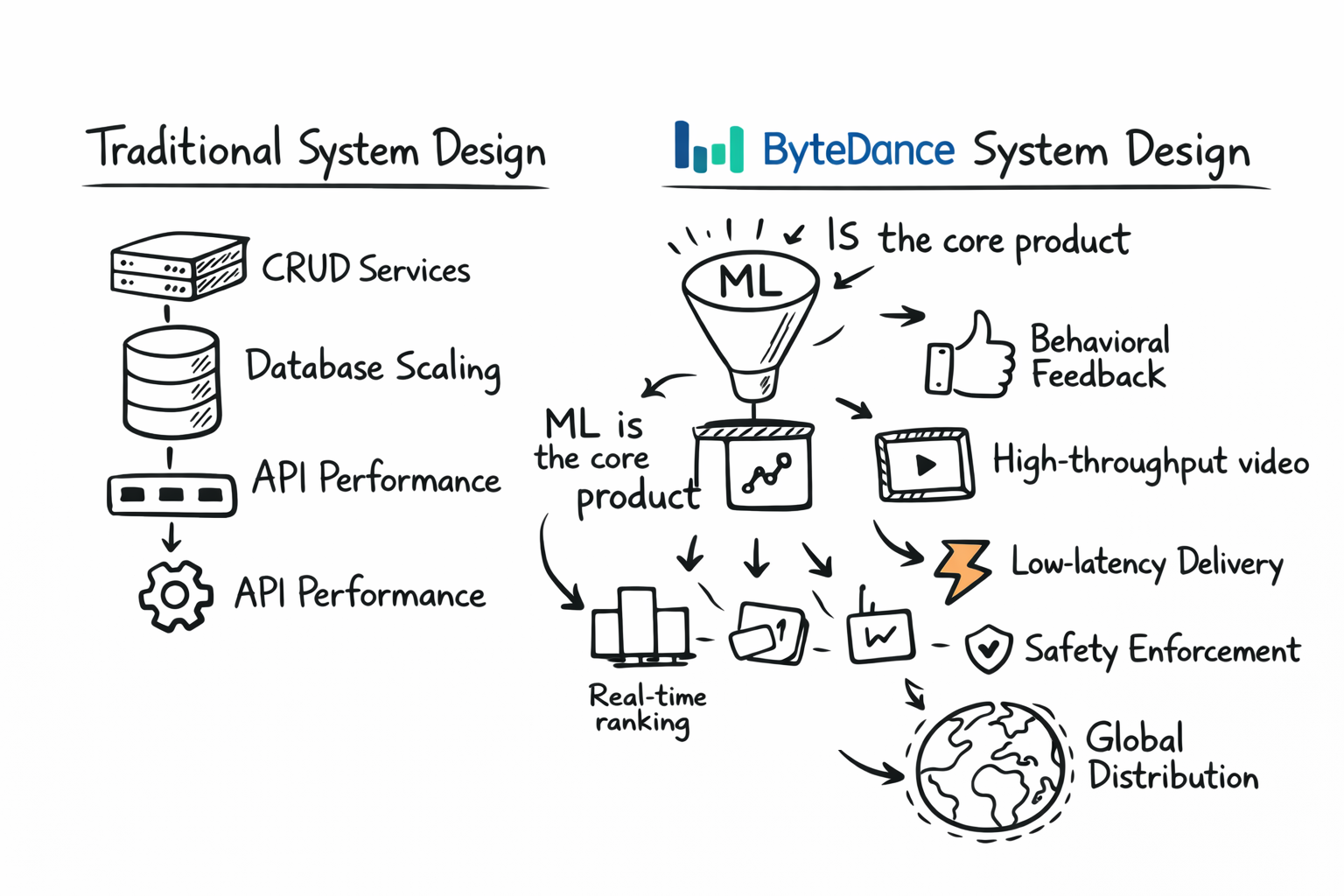
The biggest mental shift you must make when preparing for the ByteDance System Design interview is understanding that machine learning is not an add-on feature. It is the core of the product.
In many companies, ML is an optimization layer. At ByteDance, ML defines the user experience. The recommendation system is the product.
Traditional System Design interviews often focus on CRUD services, database scaling, and API performance. ByteDance System Design, by contrast, revolves around:
Real-time ranking inference
Continuous behavioral feedback ingestion
High-throughput video pipelines
Low-latency content delivery
Safety and compliance enforcement
Global distribution with region-specific boundaries
You are not simply designing a backend service. You are designing an adaptive, ML-powered ecosystem where ingestion, ranking, delivery, and feedback are tightly coupled.
If you treat the ByteDance System Design interview like a generic microservices problem, you will miss what matters most: how data flows into models, how models influence ranking, and how user behavior reshapes the system continuously.
System Design Deep Dive: Real-World Distributed Systems

Modern software systems are expected to operate at a massive scale while meeting strict reliability and latency requirements. Whether it’s a feed refresh, a payment request, or a real-time analytics query, users expect systems to respond instantly and consistently. That expectation has raised the bar for engineers today, understanding that System Design isn’t optional. It’s a core skill for building and evaluating production-grade systems. I built this course from my experience working on large-scale distributed systems at Microsoft (Azure) and Meta (Scuba), and from interviewing hundreds of candidates across both companies. The pattern I kept seeing was this: candidates understood individual components, but struggled to combine them into a coherent system. They knew what a cache or load balancer was, but not when or why to use it. This course is designed to bridge that gap. We start with the foundational building blocks of System Design, including databases, caching layers, load balancing, and messaging systems, and focus on how they interact under real-world constraints. From there, we analyze systems built by companies like Google, Facebook, and Amazon, breaking them down to understand the trade-offs behind each design decision. The goal is not just to learn concepts, but to develop the ability to reason through them in practice. This approach has helped a large number of engineers build stronger intuition for System Design and perform better in interviews. If you want to understand how real systems are designed and be able to design them yourself, this course gives you a clear, practical path forward.
What the ByteDance System Design interview evaluates#
ByteDance interviewers look for engineers who understand how distributed systems and ML pipelines intersect. The evaluation spans several core architectural competencies.
The table below summarizes the primary evaluation domains.
Domain | What You Must Demonstrate | Why It Matters at ByteDance |
ML-driven architecture | Model inference at scale, training pipelines, feature stores | Personalization defines the product |
Video ingestion | High-throughput uploads, transcoding, metadata extraction | User-generated video volume is massive |
Ranking systems | Multi-stage ranking, embeddings, vector retrieval | Feed quality determines engagement |
Read-heavy optimization | Caching, feed precomputation, CDN distribution | Consumption far outweighs creation |
Safety and compliance | Moderation pipelines, audit logs, and regional rules | Regulatory pressure is significant |
Each of these areas often appears in combination during a single interview question.
Scalability & System Design for Developers
As you progress in your career as a developer, you'll be increasingly expected to think about software architecture. Can you design systems and make trade-offs at scale? Developing that skill is a great way to set yourself apart from the pack. In this Skill Path, you'll cover everything you need to know to design scalable systems for enterprise-level software.
ML-driven System Design at ByteDance#
Almost every ByteDance product relies on machine learning for ranking, moderation, personalization, or recommendation. As a candidate, you do not need to implement neural networks, but you must understand how ML shapes architecture.
In a ByteDance system, user interactions generate events such as watch time, replay frequency, like signals, comments, and skip rates. These events are ingested into streaming systems. Features are extracted and stored in feature stores. Offline training pipelines update models periodically. Online inference services score content in real time.
The following table outlines the relationship between ML pipeline components and system architecture.
ML Component | System Impact |
Feature extraction | Requires scalable event processing |
Offline training | Requires batch compute clusters |
Online inference | Requires a low-latency model serving |
Model versioning | Requires safe rollout infrastructure |
A/B testing | Requires traffic segmentation |
The ByteDance System Design interview expects you to reason about both offline and online flows. Offline training improves models periodically, while online inference generates rankings in milliseconds.
A strong answer shows how model deployment integrates into the system without disrupting latency or reliability.
Machine Learning System Design
ML System Design interviews reward candidates who can walk through the full lifecycle of a production ML system, from problem framing and feature engineering through training, inference, and metrics evaluation. This course covers that lifecycle through five real-world systems that reflect the kinds of problems asked at companies like Meta, Snapchat, LinkedIn, and Airbnb. You'll start with a primer on core ML system design concepts: feature selection and engineering, training pipelines, inference architecture, and how to evaluate models with the right metrics. Then you'll apply those concepts to increasingly complex systems, including video recommendation, feed ranking, ad click prediction, rental search ranking, and food delivery time estimation. Each system follows a consistent structure: define the problem, choose metrics, design the architecture, and discuss tradeoffs. The course draws directly from hundreds of recent research and industry papers, so the techniques you'll learn reflect how ML systems are actually built at scale today. It is designed to be dense and efficient, ideal if you have an ML System Design interview approaching and want to go deep on production-level thinking quickly. Learners from this course have gone on to receive offers from companies including Snapchat, Meta, Coupang, StitchFix, and LinkedIn.
Real-time video ingestion and processing#
ByteDance platforms process enormous volumes of user-generated video. Designing this pipeline is one of the most common ByteDance System Design interview problems.
When a user uploads a video, the system must support chunked uploads to handle unstable networks. The upload service stores raw content in distributed object storage. A transcoding pipeline generates multiple resolution variants. Metadata extraction services analyze audio, text overlays, and visual frames. Moderation models scan for policy violations. Finally, the processed video is distributed via CDN.
The table below illustrates the stages in a video ingestion pipeline.
Stage | Responsibility |
Chunked upload service | Resumable video uploads |
Distributed storage | Durable storage of raw content |
Transcoding cluster | Generate multi-resolution formats |
Metadata extraction | Extract NLP and computer vision features |
Moderation models | Detect unsafe content |
CDN propagation | Distribute globally |
Interviewers evaluate whether you understand throughput constraints. Millions of videos per day require horizontally scalable transcoding clusters and distributed object storage. Latency matters for user experience, but reliability and scalability are equally critical.
Personalized ranking at scale#
The recommendation feed is the heart of the ByteDance architecture. The TikTok System Design is known for extreme personalization combined with speed.
A modern ByteDance-style ranking pipeline typically uses a multi-stage approach. First, candidate generation retrieves a large pool of potential videos using vector embeddings. Then a scoring model ranks candidates based on user embeddings and content features. Finally, a re-ranking stage optimizes for diversity, freshness, and safety.
The following table describes the ranking pipeline stages.
Ranking Stage | Purpose |
Candidate generation | Retrieve thousands of potential videos |
Scoring model | Assign relevance scores |
Re-ranking | Optimize diversity and freshness |
Filtering | Remove unsafe or restricted content |
Embedding-based retrieval and vector search are critical. Systems often rely on approximate nearest neighbor search to retrieve similar content quickly. Real-time feature updates ensure recommendations reflect recent behavior.
The ByteDance System Design interview expects you to explain how feedback loops feed into ranking models continuously.
Massive read-heavy workloads#
ByteDance systems are heavily read-dominant. Content consumption far exceeds content creation.
To support billions of feed refreshes daily, the system must aggressively cache results, precompute portions of feeds, and distribute content via CDNs. Storage must be optimized for read performance.
The table below compares write-heavy and read-heavy workloads.
Characteristic | Write-Heavy System | Read-Heavy System |
Primary load | Data creation | Data consumption |
Optimization | Write throughput | Read latency |
Storage focus | Write durability | Read efficiency |
Caching importance | Moderate | Critical |
In a ByteDance System Design interview, explain how caching layers such as Redis or Memcached reduce database load. Describe how precomputed feed candidates can reduce real-time ranking pressure.
Safety, moderation, and compliance#
ByteDance operates globally under intense regulatory scrutiny. Safety engineering is central to System Design.
When a user uploads content, automated ML models screen for inappropriate material. Frame sampling detects visual violations. NLP models detect harmful text. Suspicious content enters human review queues. Region-specific compliance rules may restrict certain categories of content.
The table below outlines a moderation flow.
Stage | Responsibility |
Automated screening | Initial ML-based filtering |
Frame sampling | Visual analysis |
Text processing | NLP-based detection |
Human review | Escalated evaluation |
Audit logging | Regulatory compliance |
The ByteDance System Design interview often includes moderation considerations even in recommendation questions. Strong answers include safety filters integrated into ranking pipelines.
Format of the ByteDance System Design interview#
A typical ByteDance System Design interview lasts 45 to 60 minutes. It begins with requirements clarification. You then propose a high-level architecture. The interviewer may guide you to a deep dive into ranking systems, video pipelines, or moderation infrastructure. You will discuss data modeling, latency considerations, failure scenarios, and trade-offs. The interview often concludes with scaling extensions or global deployment considerations.
ByteDance values candidates who can reason about both system-level architecture and ML-driven workflows simultaneously.
Common ByteDance System Design interview topics#
One of the most iconic questions is designing a TikTok-style short video recommendation feed. This tests your ability to integrate feature extraction, embedding-based retrieval, real-time ranking, caching, and feedback ingestion.
Another common problem involves designing a video upload and transcoding pipeline. Here, you must demonstrate knowledge of chunked uploads, distributed processing, and global CDN propagation.
Content moderation systems are also common. These require combining ML pre-screening with human review and regional compliance enforcement.
Real-time comment systems test your ability to design low-latency messaging infrastructure with moderation filters and multi-region replication.
Trending content detection questions focus on stream processing and sliding window aggregation to identify viral content quickly.
How to structure your answer in the ByteDance System Design interview#
Success depends on structured reasoning.
Begin by clarifying requirements. Confirm whether recommendations must be global or region-specific. Ask about expected latency targets. Clarify whether moderation happens before or after content goes live.
Next, explicitly define non-functional requirements. ByteDance systems require global scale, low-latency read paths, high throughput for ingestion, strict compliance boundaries, and seamless ML integration.
Then estimate the scale. Quantify concurrent viewers, ranking inferences per second, and video storage growth. Even approximate calculations show maturity.
After that, present a high-level architecture separating real-time and offline pipelines. Real-time services handle inference and feed delivery. Offline systems handle training and batch feature extraction.
Deep dive into the recommendation engine. Explain multi-stage ranking. Discuss embedding retrieval and feature stores. Show how behavioral feedback feeds into training pipelines.
Discuss failure handling. If the ranking service fails, fallback recommendations may use popular content. If moderation pipelines overload, content may enter temporary queues. If inference latency spikes, caching can mitigate the impact.
Finally, explain trade-offs such as inference cost versus ranking quality or personalization depth versus latency.
Example: High-level TikTok-style recommendation architecture#
Imagine designing a personalized short-video feed with sub-200 millisecond latency.
When a user opens the app, the feed service requests candidate videos from a candidate generation service powered by vector search. The ranking model scores candidates using user and video embeddings. A re-ranking stage optimizes for diversity and freshness. Results are cached and streamed via CDN. User interactions are sent to a feedback pipeline and stored in a feature store. Models are periodically retrained and redeployed via a model registry.
This architecture integrates personalization, ML inference, scaling, and global delivery.
Final thoughts on mastering the ByteDance System Design interview#
The ByteDance System Design interview challenges you to build ML-powered systems at a global scale. You must think beyond traditional distributed systems. Your architecture must integrate video ingestion, real-time ranking, safety pipelines, caching, and behavioral feedback loops seamlessly.
If you demonstrate understanding of ML-aware architecture, low-latency delivery, moderation pipelines, and global deployment trade-offs, you will stand out as a strong candidate capable of building data-intensive systems that power billions of users.
