Can you learn React without knowing HTML and CSS?
Thinking about learning React but unsure where to start? Understanding whether you can learn React without HTML and CSS helps you plan a smarter learning path and build the strong web development foundation every React developer needs.
Many beginners entering web development ask a common question before starting their front-end journey: Can I learn React without knowing HTML and CSS? React has become one of the most popular JavaScript libraries for building user interfaces, which leads many new developers to want to jump directly into learning it.
While React simplifies the process of building interactive web applications, it still depends heavily on fundamental web technologies. Understanding HTML and CSS plays a significant role in making React development easier and more effective.
Learn React 19: The Complete Guide to Modern Web Apps

React remains one of the most widely used libraries for building modern web applications. This course focuses on modern React (React 18+ and emerging React 19 capabilities), covering improvements in rendering, concurrency, and application architecture that help developers build faster and more scalable user interfaces. This course takes you beyond the fundamentals and focuses on building production-ready React applications. You'll learn how to structure large React codebases using feature-based architecture, state ownership principles, context segmentation, reducer patterns, and headless or compound components. You'll also explore React’s rendering internals, including the Fiber architecture, render and commit phases, and modern concurrent rendering patterns using transitions and Suspense, along with performance optimization strategies such as memoization and component profiling. The course then moves into modern async UI patterns, teaching you how to build responsive interfaces using Suspense, server-side and streaming rendering concepts, lazy loading, and error boundaries, along with an introduction to React Server Components (RSC). You'll learn how to manage server data effectively using TanStack Query (formerly React Query), including caching, dependent queries, optimistic updates, and query invalidation. The course also introduces real-time-inspired and offline-first UI strategies, background synchronization, and performance techniques such as using Web Workers for off-main-thread computation. Beyond architecture and data management, you'll learn how to build complex forms, scalable workflows, and accessible user interfaces, along with practical testing strategies using React Testing Library. The course concludes with production-focused topics including accessibility architecture, internationalization (i18n), design systems, security considerations, and deployment practices. You'll be able to design, optimize, and deploy scalable React applications using modern architectural and performance patterns. Throughout the course, you'll apply what you learn through two hands-on projects: Task Manager Dashboard: Build a complete React dashboard that manages tasks, routing, state, and API interactions. Product Launch Readiness Board: Build a modern collaboration tool featuring optimistic updates, offline-capable editing, simulated real-time collaboration (UI-level), Suspense-based lazy loading, and a themeable, internationalized UI.
The reality is that learning React without HTML and CSS is technically possible, but it is rarely practical. Developers who skip these foundations often struggle to understand how React components render content and how layouts are structured in modern web applications.
Understanding What React Actually Does#
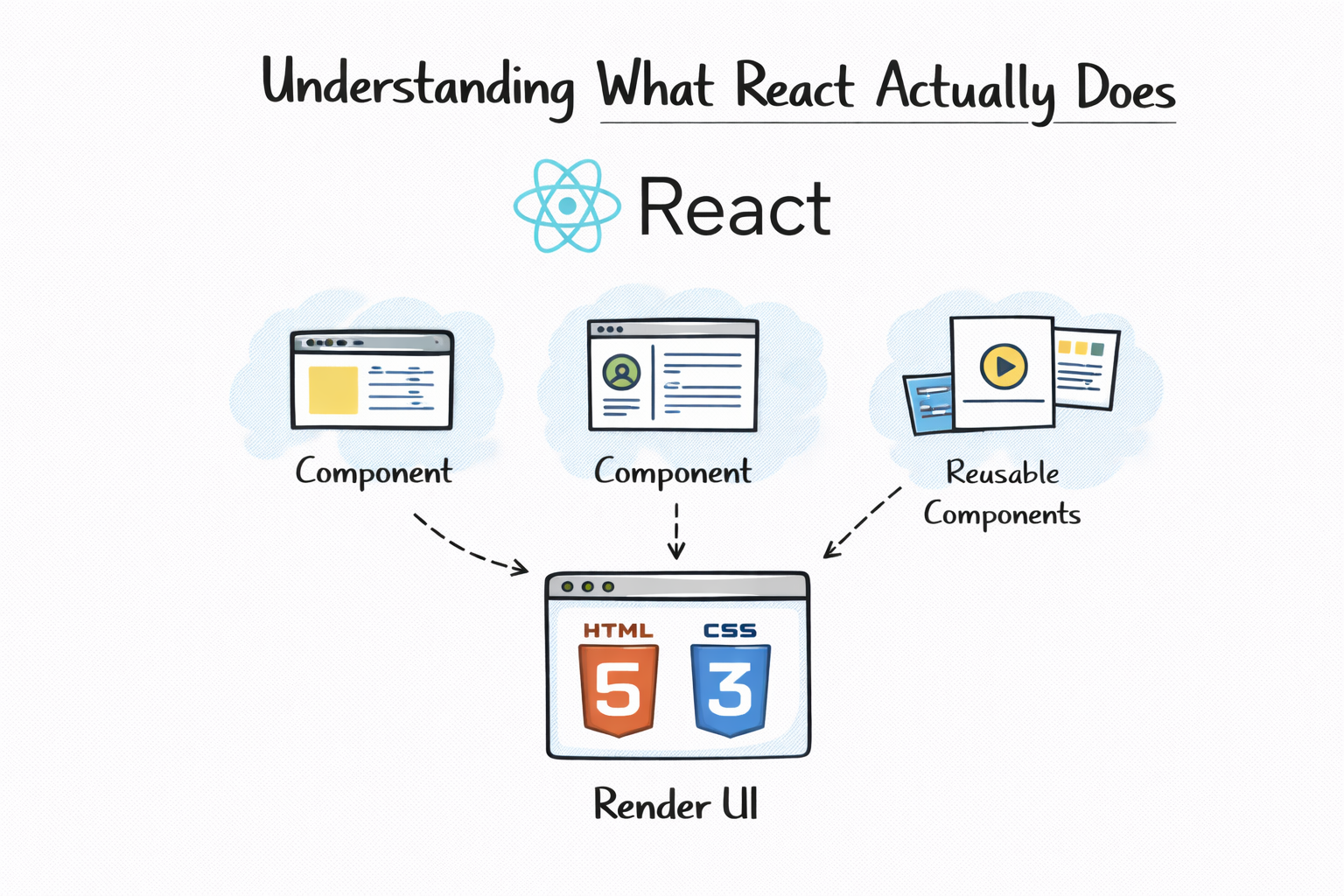
Before answering whether you can learn React without HTML and CSS, it is important to understand what React is designed to do. React is a JavaScript library that focuses on building user interfaces using reusable components.
These components ultimately render HTML elements in the browser, which means React applications still rely on HTML structure and CSS styling to display content properly. React simply provides a more efficient and organized way to manage dynamic interfaces.
React’s component-based architecture allows developers to break complex user interfaces into smaller pieces that can be reused across an application. Each component controls how a specific part of the interface behaves and appears.
Because of this design, React developers still work closely with HTML-like structures and CSS-based styling when building applications.
Zero to Hero in Front-end Development with React

Front-end development is a critical part of web applications. Many of the in-demand tech jobs today are for front-end developers. This Skill Path is designed for individuals who are interested in becoming front-end developers but don't have a background in programming. You’ll learn how to design and build efficient and scalable user interfaces using HTML, CSS, JavaScript, and the React framework. By the end of this Skill Path, you’ll have a strong understanding of front-end development concepts and the ability to build your own web applications.
The Relationship Between React, HTML, And CSS#
React sits on top of traditional web technologies rather than replacing them entirely. When developers write React code, they use a syntax called JSX that looks very similar to HTML.
JSX allows developers to describe the structure of user interfaces while still writing JavaScript logic inside the same file. Even though JSX may look different from traditional HTML files, it ultimately compiles into standard HTML elements in the browser.
The table below shows how these technologies interact when building React applications.
Technology | Role In React Development |
HTML | Defines the structure of the user interface |
CSS | Controls layout, colors, and visual design |
JavaScript | Handles logic and application behavior |
React | Manages components and dynamic rendering |
This relationship explains why developers who understand HTML and CSS usually learn React faster than those who skip these fundamentals.
Learn HTML, CSS, and JavaScript from Scratch
This course will teach you the fundamentals of creating web applications, from the basics of creating web pages with HTML, stylizing content with CSS, all the way to building interactivity into a page using JavaScript in the browser. Instead of watching tedious videos and wondering how to translate those videos into real code, you'll be practicing what you learn through interactive, test-based exercises within minutes. Along the way, you'll be able to produce functional modules, including an image carousel and a to-do list application. No prior knowledge is needed.
Why HTML Knowledge Is Important For React#
Understanding HTML plays a critical role in React development because React components ultimately render HTML elements. Developers who already understand how HTML structures pages can easily translate those concepts into React components.
For example, elements such as div, header, section, and form still appear in React applications through JSX syntax. Developers who know how these elements behave in HTML can design better layouts and structures when writing React components.
HTML knowledge also helps developers understand accessibility and semantic structure, which are essential for building modern web applications. React does not replace these concepts, so developers still need to understand how HTML organizes content for browsers and users.
Without HTML knowledge, developers may struggle to understand why certain components render incorrectly or how to structure user interfaces efficiently.
Why CSS Is Still Essential When Learning React#
CSS controls how web applications look and feel, which makes it an essential skill even when working with React. React manages how components behave and update, but CSS determines how those components appear visually.
Developers often style React applications using traditional CSS, CSS modules, or frameworks such as Tailwind CSS. Regardless of the styling approach, understanding CSS fundamentals remains necessary for designing responsive and visually appealing interfaces.
The table below highlights the responsibilities of CSS in React applications.
CSS Concept | Purpose In React Projects |
Layout | Controls positioning of components |
Flexbox | Builds responsive interface layouts |
Grid | Creates complex page structures |
Styling | Applies colors, fonts, and spacing |
Responsiveness | Ensures applications work on different devices |
Developers who skip CSS often struggle to build usable interfaces because React focuses primarily on functionality rather than design.
What Happens If You Try Learning React Without HTML And CSS#
Some beginners attempt to learn React directly because they believe frameworks automatically handle layout and styling. While React simplifies development in many ways, it still requires a clear understanding of how web pages are structured.
Developers who attempt to learn React without HTML and CSS often encounter confusion when writing JSX syntax or designing component layouts. Because JSX closely resembles HTML, a lack of HTML knowledge can make even simple React components difficult to understand.
Another challenge appears when developers try to style components. Without CSS knowledge, developers may rely entirely on external UI libraries without understanding how to customize or control layouts.
These difficulties often slow down learning and create frustration that could have been avoided by learning the core web technologies first.
Recommended Learning Path Before Starting React#
For most beginners, the most effective approach is to learn the foundational technologies before diving into React. Understanding how HTML, CSS, and JavaScript work together provides a strong base for learning modern frameworks.
The following table shows a typical learning progression for front-end development.
Learning Stage | Skills Developed |
HTML Fundamentals | Page structure and semantic markup |
CSS Basics | Styling and layout design |
JavaScript Essentials | Programming logic and interactivity |
React Fundamentals | Component-based interface development |
React Ecosystem | Routing, state management, and tools |
This progression ensures that developers understand the building blocks of web applications before working with higher-level frameworks.
How React Simplifies Front-End Development#
Although React still relies on HTML and CSS, it simplifies front-end development by organizing interfaces into reusable components. Instead of repeating the same HTML structures across multiple pages, developers create components that can be reused throughout the application.
This approach improves maintainability because updates to a component automatically affect every place where that component is used. Large applications benefit greatly from this structure because it reduces duplication and improves code organization.
React also introduces state management, which allows interfaces to update automatically when data changes. This capability eliminates the need for manual DOM manipulation that developers previously handled using traditional JavaScript.
These advantages explain why React remains one of the most popular front-end libraries in the developer ecosystem.
How Long It Takes To Learn React After Learning HTML And CSS#
Developers who already understand HTML, CSS, and JavaScript typically learn React significantly faster than beginners who skip these fundamentals. Once the basics of web development are clear, React mainly introduces a new way of organizing interface logic.
The following table provides a realistic timeline for learning React based on prior knowledge.
Developer Background | Time To Learn React Basics | Time To Build Real Projects |
Beginner Without HTML/CSS | 4–6 months | 6–8 months |
Beginner With HTML/CSS | 2–3 months | 4–5 months |
Developer With Strong JavaScript | 4–6 weeks | 2–3 months |
Experienced Front-End Developer | 2–3 weeks | 4–6 weeks |
This timeline shows why learning HTML and CSS first often accelerates the overall learning process.
Practical Advice For Beginners Interested In React#
Many beginners feel tempted to skip foundational skills because frameworks appear more exciting than basic technologies. However, experienced developers consistently recommend learning the core building blocks of the web before exploring advanced tools.
Developers who understand HTML structure and CSS layouts often find React easier to learn because they already understand how interfaces behave in the browser. Instead of struggling with layout problems, they can focus on learning React’s component-based architecture.
Another helpful strategy involves building small projects that combine HTML, CSS, and JavaScript before transitioning into React. These projects reinforce fundamental concepts and provide practical experience that makes learning React far smoother.
Consistent practice and real-world experimentation ultimately make the biggest difference when learning modern front-end technologies.
Final Thoughts#
The question "Can I learn React without knowing HTML and CSS?" often appears when beginners explore modern web development frameworks. While it is technically possible to start learning React without these skills, doing so usually makes the process more difficult and confusing.
React builds on top of traditional web technologies rather than replacing them completely. Developers who understand HTML, CSS, and JavaScript usually learn React faster and build more effective applications.
For anyone serious about becoming a front-end developer, investing time in foundational web technologies remains the most reliable path toward mastering React and building modern web applications.
