Coinbase System Design interview
Want to ace the Coinbase System Design interview? Learn custody architecture, ledger correctness, transaction state modeling, and compliance-first design, then practice scaling safely for market spikes. Design like you are protecting real money.
Preparing for the Coinbase System Design interview means understanding how to build secure, scalable, fault-tolerant infrastructure for crypto custody, trading, blockchain interaction, fraud detection, and compliance.
Unlike traditional fintech companies, Coinbase must operate across decentralized blockchain networks while maintaining centralized service guarantees for customers. This introduces unique engineering challenges around transaction verification, private key management, real-time trading, and ledger correctness.
Grokking Modern System Design Interview

For a decade, when developers talked about how to prepare for System Design Interviews, the answer was always Grokking System Design. This is that course — updated for the current tech landscape. As AI handles more of the routine work, engineers at every level are expected to operate with the architectural fluency that used to belong to Staff engineers. That's why System Design Interviews still determine starting level and compensation, and the bar keeps rising. I built this course from my experience building global-scale distributed systems at Microsoft and Meta — and from interviewing hundreds of candidates at both companies. The failure pattern I kept seeing wasn't a lack of technical knowledge. Even strong coders would hit a wall, because System Design Interviews don't test what you can build; they test whether you can reason through an ambiguous problem, communicate ideas clearly, and defend trade-offs in real time (all skills that matter ore than never now in the AI era). RESHADED is the framework I developed to fix that: a repeatable 45-minute roadmap through any open-ended System Design problem. The course covers the distributed systems fundamentals that appear in every interview – databases, caches, load balancers, CDNs, messaging queues, and more – then applies them across 13+ real-world case studies: YouTube, WhatsApp, Uber, Twitter, Google Maps, and modern systems like ChatGPT and AI/ML infrastructure. Then put your knowledge to the test with AI Mock Interviews designed to simulate the real interview experience. Hundreds of thousands of candidates have already used this course to land SWE, TPM, and EM roles at top companies. If you're serious about acing your next System Design Interview, this is the best place to start.
The Coinbase System Design interview questions expect you to think like an engineer responsible for protecting billions of dollars in digital assets while supporting millions of active users and handling volatile traffic patterns during market spikes. This blog breaks down what interviewers evaluate, the common design problems you’ll encounter, and how to structure answers that stand out.
Why Coinbase System Design feels different from “normal” fintech#
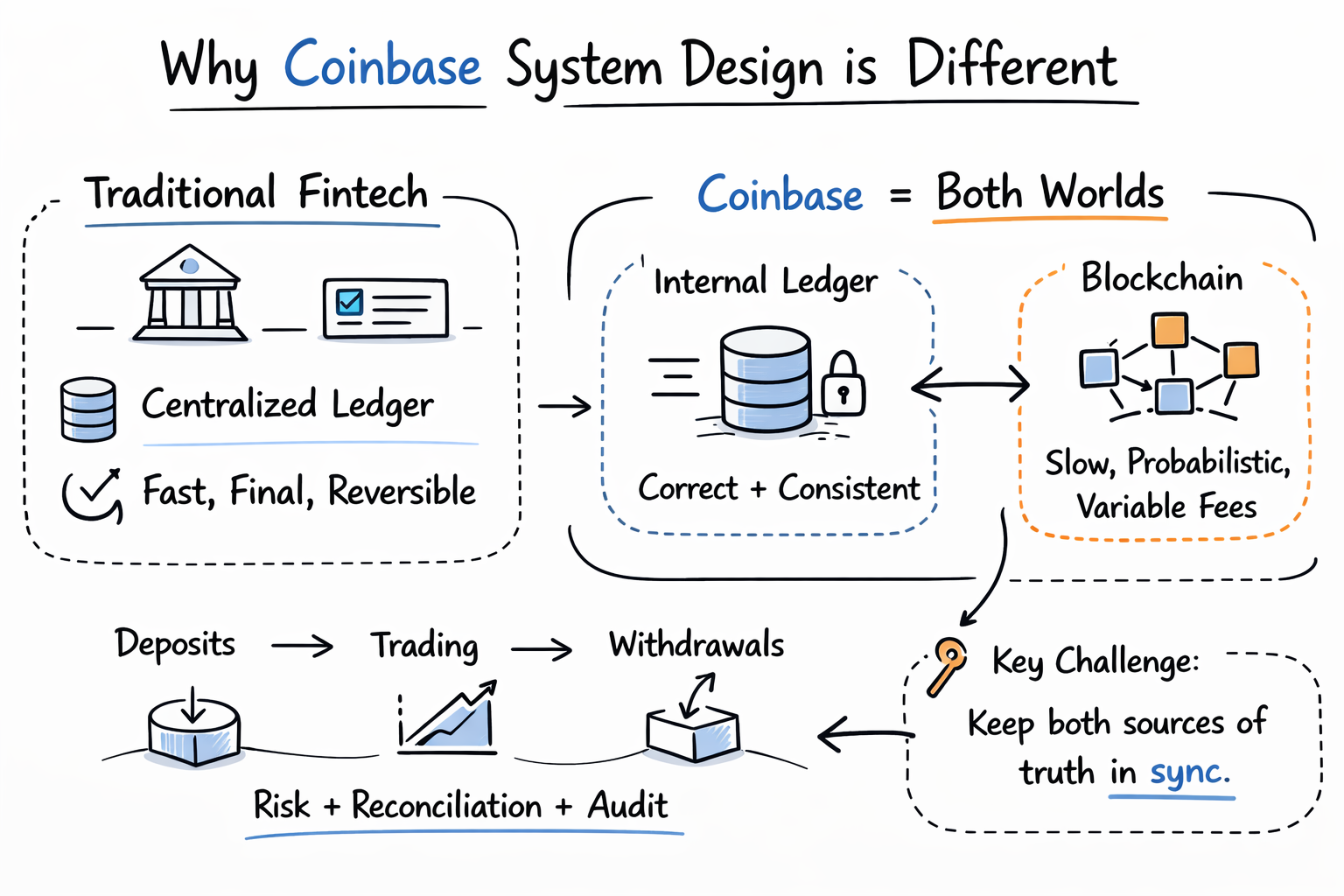
Traditional fintech systems typically rely on centralized ledgers and payment rails where finality is well-defined, and reversals follow established rules. The Coinbase System Design still needs those centralized guarantees for its customers, but it must also interact with blockchain networks where confirmation times vary, fee markets change hourly, and finality is probabilistic until enough blocks are mined. This tension drives most of the interesting engineering decisions in Coinbase-style designs.
The interview rewards candidates who can explain how to reconcile two sources of truth without creating drift. Your internal ledger must be correct and strongly consistent, while the blockchain must be monitored and reconciled continuously because it is not perfectly predictable. When you speak about deposits, withdrawals, and trading, Coinbase expects you to treat them as financial workflows where risk controls and auditability are embedded into the architecture rather than added later.
Scalability & System Design for Developers

As you progress in your career as a developer, you'll be increasingly expected to think about software architecture. Can you design systems and make trade-offs at scale? Developing that skill is a great way to set yourself apart from the pack. In this Skill Path, you'll cover everything you need to know to design scalable systems for enterprise-level software.
What the Coinbase System Design interview evaluates#
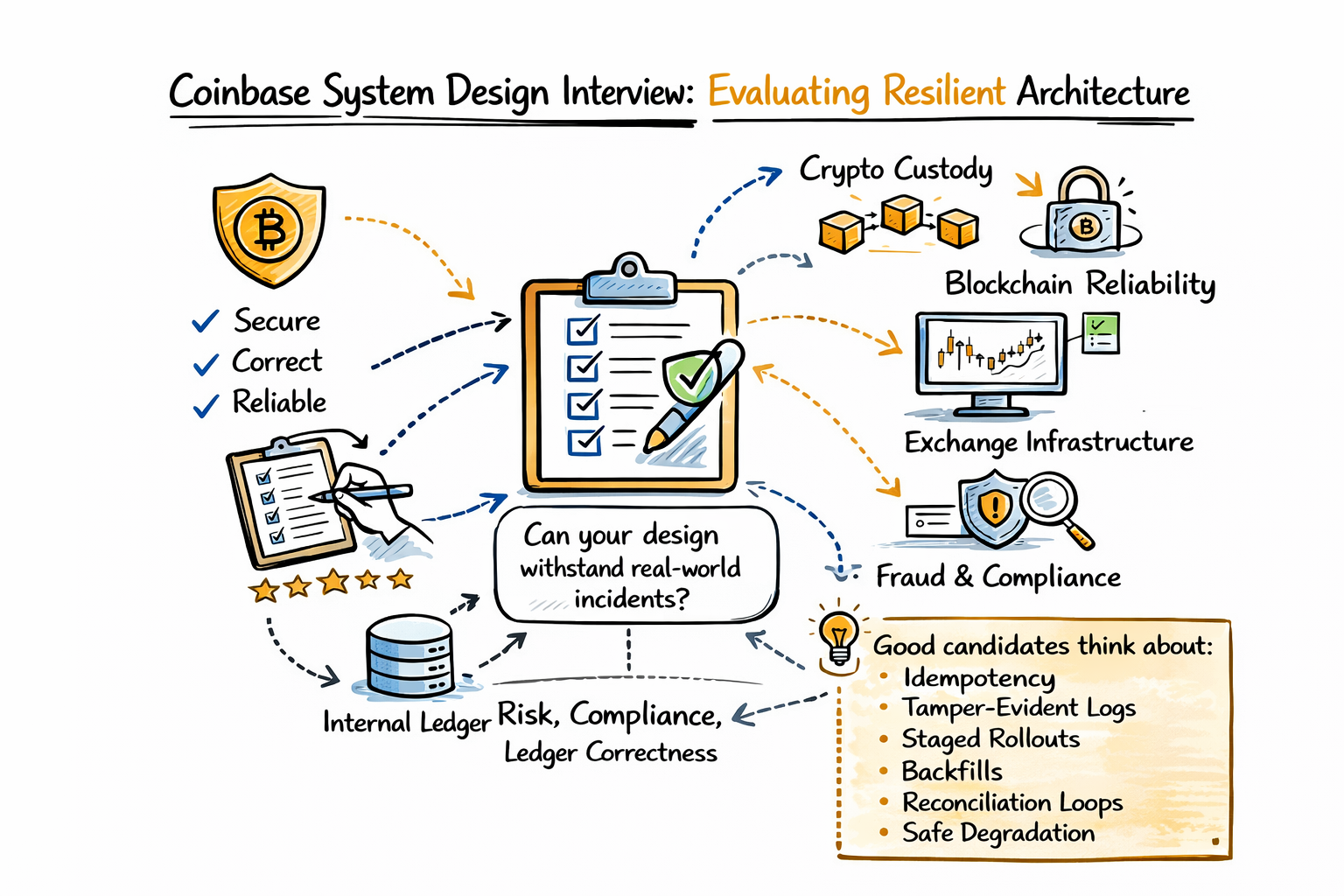
Coinbase engineers build systems where security, correctness, and reliability matter more than shipping new features quickly. In the interview, you are evaluated on how well you can reason about cryptographic custody, blockchain transaction lifecycles, exchange infrastructure, fraud and compliance, internal accounting correctness, and the ability to scale safely during market volatility. Even if the prompt focuses on one area, interviewers often probe adjacent areas because Coinbase systems are tightly coupled through risk, compliance, and ledger correctness.
You will score higher when your design sounds like it could survive real operational incidents. That means you think about idempotency, tamper-evident logs, staged rollouts, backfills, reconciliation loops, and safe degradation during outages. Coinbase does not want hand-wavy answers, and they do not want an architecture that looks elegant but fails when one node is down or a mempool is clogged.
System Design Deep Dive: Real-World Distributed Systems

Modern software systems are expected to operate at a massive scale while meeting strict reliability and latency requirements. Whether it’s a feed refresh, a payment request, or a real-time analytics query, users expect systems to respond instantly and consistently. That expectation has raised the bar for engineers today, understanding that System Design isn’t optional. It’s a core skill for building and evaluating production-grade systems. I built this course from my experience working on large-scale distributed systems at Microsoft (Azure) and Meta (Scuba), and from interviewing hundreds of candidates across both companies. The pattern I kept seeing was this: candidates understood individual components, but struggled to combine them into a coherent system. They knew what a cache or load balancer was, but not when or why to use it. This course is designed to bridge that gap. We start with the foundational building blocks of System Design, including databases, caching layers, load balancing, and messaging systems, and focus on how they interact under real-world constraints. From there, we analyze systems built by companies like Google, Facebook, and Amazon, breaking them down to understand the trade-offs behind each design decision. The goal is not just to learn concepts, but to develop the ability to reason through them in practice. This approach has helped a large number of engineers build stronger intuition for System Design and perform better in interviews. If you want to understand how real systems are designed and be able to design them yourself, this course gives you a clear, practical path forward.
Cryptographic security and wallet architecture#
Coinbase custody starts with one foundational question: how do you protect private keys while still allowing withdrawals and on-chain operations to happen on time? In practice, custody is layered because the platform needs fast hot-wallet liquidity for customer withdrawals while keeping the majority of funds in cold storage, which is deliberately inconvenient to access. Interviewers want you to explain how these layers work together without exposing keys to unnecessary risk.
Hot wallets exist because customers expect withdrawals to complete quickly, but hot wallets are inherently more exposed because they sit closer to online systems. Cold storage exists because the highest-value funds should not be accessible through normal network paths, and the controls around cold operations often involve offline signing, multi-approval workflows, and strict auditing. A strong answer frames wallet architecture as a risk management system, where your design minimizes key access and reduces blast radius.
A table helps here because it clarifies how each custody layer behaves, and it prevents the discussion from turning into vague security talk.
Coinbase-style custody layers and what they optimize for#
Custody layer | Typical purpose | Primary strength | Primary risk | Common control patterns |
Hot wallet | Fast withdrawals and operational liquidity | Low latency and automation | Higher exposure surface | Rate limits, withdrawal batching, monitored signing, and strict limits |
Warm wallet | Buffer between hot and cold | Reduced hot exposure | Still online-adjacent | Time-based approvals, limited signing scope |
Cold storage | Bulk funds custody | Strong protection | Slower operations | Offline signing, multi-approver workflow, strict auditing |
Multisig policy | Shared authorization | Reduced single-key compromise risk | Operational complexity | M-of-N signing, quorum enforcement, key separation |
HSM-backed keys | Secure key storage and signing | Hardware-enforced policies | Integration complexity | Key non-exportability, access control, and audit logs |
This table lets you describe custody architecture in a way that feels concrete and operational, which is exactly the tone Coinbase interviewers respond to.
Blockchain transaction pipelines and the reality of probabilistic finality#
Coinbase interacts with multiple blockchains, and each chain behaves differently in ways that matter for System Design. Confirmation times vary widely, reorg behavior differs by chain, fee markets can become congested, and transaction formats and validation rules vary across networks. Interviewers expect you to describe how you broadcast transactions, monitor them, confirm them, and reconcile them against your internal ledger without creating inconsistencies.
A clean way to think about blockchain interaction is as a pipeline that moves transactions through well-defined states. A withdrawal is not “done” when you broadcast it, because it can sit in the mempool, be replaced, be dropped, or be confirmed and then reorged out. Your pipeline needs state transitions, retry logic, and safe rules around when to credit deposits or finalize withdrawals.
A table improves flow in this section because it gives readers a shared language for transaction states, and it makes your later failure-handling discussion feel inevitable rather than bolted on.
Transaction lifecycle states you should model explicitly#
State | What it means operationally | What your system should do |
Created | Request exists but not signed | Validate, apply risk checks, reserve funds |
Signed | Transaction has a valid signature | Store immutable record, prepare broadcast |
Broadcasted | Sent to network, may be in mempool | Track transaction hash, monitor propagation |
Pending confirmations | Included in a block, but not final enough | Count confirmations, watch for reorg risk |
Finalized | Meets your chain-specific finality threshold | Mark complete, settle ledger, notify user |
Failed or replaced | Dropped, rejected, or superseded | Retry with the updated fee, or reverse the reservation safely |
When you speak in these terms, you show Coinbase that you understand blockchain unpredictability and that you design with explicit state modeling instead of optimism.
Exchange and order book design under load#
Coinbase is also a high-scale exchange, which means it must support order matching, market data distribution, and low-latency flows that are sensitive to sequencing and fairness. You do not need to design a high-frequency trading platform to do well, but you do need to demonstrate you understand order books, matching engines, persistence, and how to stream market data reliably.
A good answer frames the exchange as two major paths that need different design choices. The trading path is latency-sensitive and often built around in-memory structures with deterministic sequencing and a reliable log for durability. The market data path is fan-out heavy and benefits from event streaming, caching, and partitioned distribution so that millions of clients can subscribe without overwhelming the matching core.
This section becomes stronger when you explain that the order book is not just a database table, because correctness depends on strict ordering. You should describe how you ensure determinism, how you handle cancellations, and how you persist events so the system can recover without losing state. If your design includes an append-only event log as the source of truth for orders, you are speaking Coinbase’s language, because auditability and replay matter in financial systems.
Fraud detection and compliance as first-class architecture#
Crypto attracts abuse, and Coinbase is built around the idea that compliance is part of the product, not a feature that can be postponed. Interviewers expect you to integrate KYC, AML, transaction monitoring, and audit trails from the beginning. If you design a withdrawal flow without discussing risk scoring and compliance gates, your architecture will feel incomplete.
A realistic design treats fraud and compliance as both synchronous and asynchronous participants. Some checks must block the flow immediately, such as sanctions screening or identity requirements that prevent certain actions. Other checks can run asynchronously, such as anomaly detection and behavioral models that adjust risk scores over time and trigger account review workflows.
You can strengthen your answer by describing a risk decision service that consumes signals from identity verification, device fingerprints, address reputation, velocity patterns, and historical user behavior. Your goal is not to implement machine learning in the interview; your goal is to show you know where the decisions belong and how they integrate into the transaction pipeline without creating inconsistent ledger state.
Ledger correctness and financial accounting#
The internal ledger is where Coinbase becomes “real finance.” Coinbase cannot treat blockchain balances as the only source of truth because the company must represent user balances, trades, fees, staking rewards, and custody movements in a strongly consistent, auditable system. The internal ledger must never drift, because drift becomes money missing, money duplicated, or money that cannot be reconciled under audit.
A strong answer describes the ledger as an accounting system that uses double-entry principles and enforces invariants. Every movement of value should be represented as balanced entries, and every write should be idempotent so that retries do not create duplicates. This is where event sourcing often fits naturally, because an append-only record of ledger events supports replay, auditing, and reconstruction after incidents.
Coinbase interviewers often probe how you reconcile the ledger against the blockchain state. You should describe reconciliation loops that compare expected on-chain balances against observed balances for custody addresses, then raise alerts and trigger investigation workflows when mismatches appear. If you mention reorg handling and explain how you delay finalization thresholds based on chain risk, you demonstrate domain depth that most candidates miss.
Scaling for market volatility without sacrificing safety#
Coinbase traffic spikes are not theoretical because market events can trigger extreme bursts in signups, logins, withdrawals, trades, and API usage. Systems that behave fine at steady state can collapse during volatility if they do not have backpressure, buffering, and safe degradation. Interviewers want to hear how you scale while preserving correctness and security, especially when user demand is highest.
A mature design uses queue buffering to absorb bursts, autoscaling for stateless services, and caching for read-heavy APIs such as price charts and portfolio screens. It also uses load shedding and circuit breakers to protect critical systems, because not every feature is equally important during an incident. Coinbase will prefer a system that temporarily degrades non-critical features but preserves trading integrity and ledger correctness.
This section benefits from a small table because it helps you communicate safe degradation choices in a way that feels intentional rather than reactive.
Safe degradation strategies during market spikes#
System area | What can degrade safely | What must remain correct | Typical protection mechanism |
Market data | Lower refresh rate, cached snapshots | Price feed integrity for trading | Caching, fan-out throttling |
Withdrawals | Longer processing time, batching | Ledger reservation correctness | Queues, rate limits, risk gating |
Trading | Reduced non-essential features | Matching determinism, sequencing | Partitioning, backpressure, strict ordering |
Notifications | Delayed alerts | Audit logs and user balances | Async queues, retry policies |
Search and analytics | Temporary unavailability | Core custody and exchange services | Load shedding, circuit breakers |
This table keeps the blog readable while reinforcing the key point: scaling is not only about adding servers, it is about deciding what can bend without breaking trust.
Format of the Coinbase System Design interview#
A typical Coinbase System Design interview runs for forty-five to sixty minutes, and interviewers expect a structured answer that shows domain awareness. You start by clarifying requirements, then you identify constraints such as security, compliance, and consistency expectations. You propose a high-level architecture, then you deep dive into one or two critical components, and you close by discussing failures, monitoring, and trade-offs.
Coinbase interviews reward candidates who stay grounded in real-world reasoning. If you talk about theoretical scalability without addressing key custody threats, or if you optimize latency at the expense of ledger correctness, you will appear misaligned with the company’s priorities. A strong interview performance sounds like you have operated production systems and understand how finance-grade infrastructure is built.
Common Coinbase System Design interview topics#
Coinbase prompts are usually drawn from systems the company actually operates, so you will often see wallet design, exchange design, transaction monitoring, compliance systems, and staking or rewards processing. Even when the prompt seems narrow, interviewers will test how you connect it to the internal ledger and risk controls because those linkages are what make Coinbase's infrastructure coherent.
Designing a cryptocurrency wallet system is one of the most common prompts, and you should cover hot and cold custody, key management, transaction signing, blockchain node integration, address allocation, withdrawal batching, and ledger reconciliation. Designing a crypto exchange often focuses on the order book and matching engine, and you should discuss deterministic sequencing, persistence, and the separation between trading paths and market-data distribution.
Designing blockchain transaction monitoring tends to probe how you track mempool behavior, confirmations, and reorg risk, and how you notify users safely without crediting funds prematurely. Designing KYC and AML systems evaluates how you build traceability and auditing, while designing staking and rewards systems often tests event processing, accrual, and accounting integration into the ledger.
How to structure your answer for the Coinbase System Design interview#
You should start by clarifying whether the system operates on a single chain or multiple chains, because multi-chain support changes abstractions, monitoring, and reconciliation strategies. You should ask whether balances require strong consistency at all times and whether the system is primarily wallet-facing or exchange-facing, because those choices influence latency, correctness thresholds, and risk controls. You should also confirm compliance expectations and whether you are optimizing for security-first behavior or user-facing speed.
After you clarify the scope, you should anchor the design around non-functional requirements such as secure key handling, immutable auditing, strong consistency for the ledger, durability of transaction history, and resilience during spikes. You should then estimate scale with realistic assumptions around active users, transaction volume, withdrawal throughput, and market-driven burst behavior. From there, you present a high-level architecture and explain data flow clearly, then you choose a deep dive area such as wallet custody, ledger design, or transaction monitoring.
When deep diving, your goal is to show careful state modeling and operational thinking. You should explain how you make writes idempotent, how you handle retries without double-spending, how you reconcile with blockchain truth, and how you respond to failures like node downtime and reorgs. You close by describing trade-offs, such as batching withdrawals to reduce fees while increasing user waiting time, and you suggest future evolutions like chain abstraction layers and improved fee estimation models.
Example walkthrough: Coinbase-style withdrawal system#
A Coinbase withdrawal system is a great example because it forces you to combine fraud checks, ledger correctness, custody security, and blockchain unpredictability in one flow. The request arrives through an API gateway, and authentication ensures the user is authorized and the session is safe. Risk checks and compliance checks run early, because a suspicious withdrawal should be blocked before the ledger changes or the wallet signs anything.
Once the withdrawal is approved, the ledger service reserves funds and creates a pending entry that represents the intent to withdraw. The wallet service selects a hot wallet with sufficient liquidity and constructs an unsigned transaction, then a signing service backed by an HSM produces the signature without exposing private keys. The node service broadcasts the signed transaction, and a confirmation tracker monitors it until it passes the finality threshold for that chain, after which the ledger marks it complete, and the user is notified.
If confirmations lag, the system should raise alerts and potentially trigger replacement transactions if the chain supports fee bumping. If a reorg occurs, the system should roll the transaction state back to pending confirmations and avoid marking the withdrawal final until the risk window passes. The strength of this design is that the ledger remains correct regardless of blockchain timing, and custody keys are accessed only through controlled signing paths.
Final thoughts#
The Coinbase System Design interview tests whether you can build secure crypto systems that remain correct during market chaos and unpredictable blockchain behavior. Coinbase expects security-first thinking, ledger correctness, compliance awareness, and resilience, and the best answers are the ones that model states explicitly and treat audits and reconciliation as core requirements.
If you structure your answer cleanly, speak in terms of custody layers and transaction lifecycles, and explain trade-offs like a production engineer, you will stand out as someone who can build systems worthy of holding real money.