Data engineering career path: Skills, roles, and opportunities
Curious about becoming a data engineer? Discover the skills, tools, and career progression needed to build scalable data systems. Follow a clear roadmap and start your journey into one of the fastest-growing tech roles today.
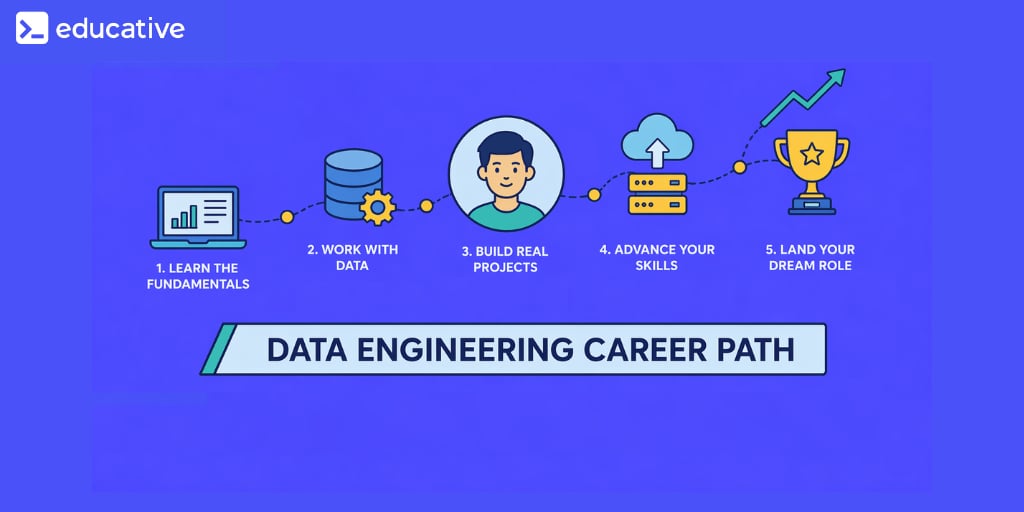
As organizations increasingly rely on data-driven decision-making, the infrastructure required to collect, process, and analyze information has become significantly more complex. Companies now operate large-scale analytics systems that ingest data from applications, sensors, and digital platforms. These systems must be reliable, scalable, and capable of supporting analytics and machine learning workloads. Because of this shift, many professionals exploring technical careers begin researching a data engineering career path to understand how they can work on the infrastructure behind modern data systems.
Data engineers play a central role in building these systems. They design pipelines that move data across platforms, maintain storage systems optimized for analytics, and ensure that datasets are reliable and accessible for analysts, scientists, and product teams. As data infrastructure continues to expand across industries, the need for engineers who understand both software systems and data platforms continues to grow.
Learn Data Engineering

As organizations scale their use of data, the bottleneck is infrastructure. Data engineering has become the backbone of modern data systems, enabling reliable pipelines, scalable storage, and real-time processing. Yet many professionals struggle to learn data engineering beyond isolated tools. This course is designed to give you a systems-level understanding of data engineering, so you can build and reason about data platforms with confidence. I built this course from my experience working with data-intensive systems and teaching how complex architectures evolve under real-world constraints. A consistent pattern I observed was that learners could write queries or use frameworks, but lacked a clear mental model of how data flows through systems end-to-end. This course addresses that gap by focusing on how to learn data engineering as a cohesive discipline, not just a collection of technologies. You’ll start by understanding how data moves across systems and how to work with structured data using SQL and Python. From there, you’ll handle semi-structured and unstructured data with NoSQL systems like MongoDB. The course then moves into designing scalable architectures using data warehouses and lakehouses, followed by working with big data technologies such as Hadoop, Spark, and Kafka, all framed through practical system design patterns. If you want to learn data engineering in a way that prepares you to build reliable, scalable data systems, this course provides a clear and structured path forward.
Understanding how the role works, the skills required, and the typical progression within the field can help aspiring engineers plan their learning journey more effectively.
What does a data engineer do?#
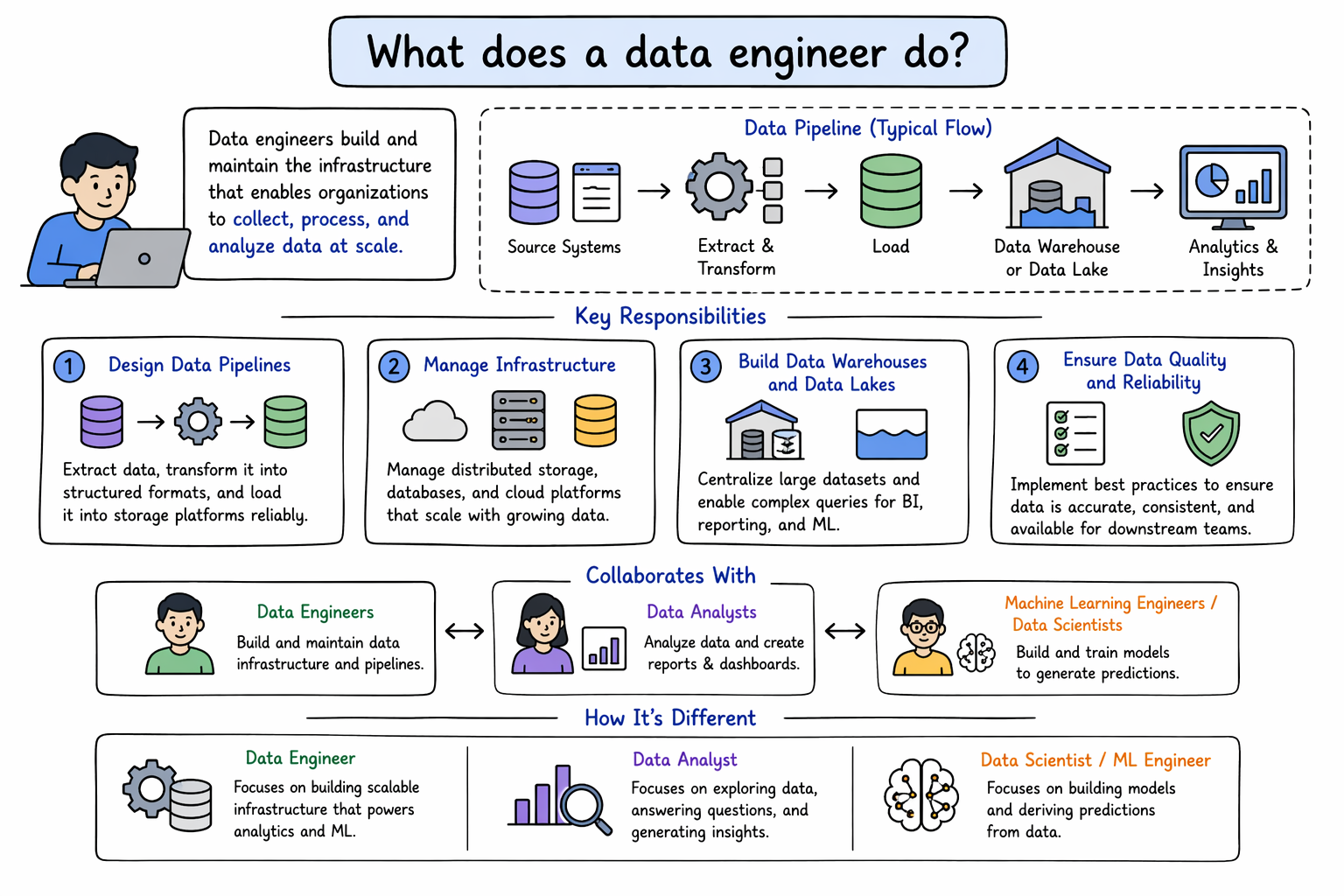
Data engineers focus on building and maintaining the infrastructure that enables organizations to collect, process, and analyze data at scale. Their work often involves designing systems that move large volumes of information from operational applications into analytical platforms.
One major part of the data engineer roadmap involves designing data pipelines. These pipelines extract data from source systems, transform it into structured formats, and load it into storage platforms such as data warehouses or data lakes. Pipelines must operate reliably because analytics teams depend on accurate and up-to-date datasets.
Data engineers also manage the infrastructure used to store and process large datasets. This infrastructure may include distributed storage systems, analytical databases, and cloud-based data platforms. Engineers must ensure that these systems scale effectively as data volumes grow.
Another important responsibility involves building data warehouses and data lakes. These systems allow organizations to centralize large datasets and perform complex queries that support business intelligence dashboards, reporting systems, and machine learning models.
Data engineers frequently collaborate with analytics teams and machine learning engineers. While analysts focus on interpreting data and scientists develop predictive models, data engineers ensure that the underlying datasets are accessible, clean, and structured.
This role differs from that of data analysts and data scientists because it focuses primarily on building the infrastructure that supports analytics rather than performing the analysis itself.
Core skills required for data engineering#
Developing expertise in data engineering requires mastering several technical areas that combine software engineering with data infrastructure knowledge.
Programming with Python, Java, or Scala#
Programming is essential for building automated data pipelines and processing workflows. Python is widely used because it provides powerful libraries for data processing and automation, while languages such as Java and Scala are often used within distributed data processing frameworks. Engineers use programming languages to transform datasets, integrate APIs, and build scalable pipeline systems.
SQL and relational databases#
SQL remains one of the most important skills for data engineers because analytical systems rely heavily on structured queries. Engineers use SQL to retrieve datasets, transform data, and design database schemas that support analytical workloads. Understanding how relational databases operate also helps engineers optimize queries and manage large datasets efficiently.
Data modeling and schema design#
Data modeling involves structuring datasets in ways that support efficient analysis and querying. Engineers design schemas that represent relationships between entities while maintaining performance and scalability. Well-designed schemas make it easier for analytics teams to explore and analyze large datasets.
ETL pipeline architecture#
Extract, transform, and load pipelines form the backbone of most data infrastructure systems. Engineers must design workflows that collect data from source systems, transform it into consistent formats, and load it into analytics platforms. Reliable ETL pipelines ensure that data remains accurate and available.
Distributed systems and big data tools#
Many organizations process datasets that exceed the capacity of a single machine. Distributed systems allow data processing tasks to run across clusters of machines. Understanding how distributed processing works helps engineers design systems capable of handling large-scale workloads.
Cloud data platforms#
Most modern data infrastructure runs in cloud environments such as AWS, Azure, or Google Cloud. These platforms provide storage services, analytics engines, and data processing tools that support scalable pipelines. Engineers must understand how these services integrate into data architecture.
These skills form the technical foundation required for anyone pursuing a data engineering career path.
Data Engineering Foundations in Python

Data engineering is currently one of the most in-demand fields in data and technology. It intersects software engineering, DataOps, data architecture, data management, and security. Data engineers, such as analysts and data scientists, lay the foundation to serve data for consumers. In this course, you will learn the foundation of data engineering, covering different parts of the entire data life cycle: data warehouse, ingestion, transformation, orchestration, etc. You will also gain hands-on experience building data pipelines using different techniques such as Python, Kafka, PySpark, Airflow, dbt, and more. By the end of this course, you will have a holistic understanding of data engineering and be able to build your data pipelines to serve data for various consumers.
Tools and technologies used in data engineering#
Modern data pipelines rely on a combination of distributed processing frameworks, workflow orchestration tools, and cloud-based analytics platforms.
Apache Spark is widely used for distributed data processing. It allows engineers to process large datasets across clusters of machines and supports batch processing as well as real-time analytics.
Apache Kafka is commonly used for streaming data systems. It enables real-time ingestion of event streams generated by applications, sensors, or IoT devices.
Apache Airflow is a workflow orchestration platform that helps engineers schedule and monitor data pipelines. It allows developers to define pipeline workflows programmatically and automate recurring data processing tasks.
Snowflake and BigQuery represent modern cloud-based data warehouses that allow organizations to run analytical queries on massive datasets without managing infrastructure directly.
Cloud providers such as AWS, Azure, and Google Cloud offer a wide range of services that support data storage, processing, and analytics. These services allow engineers to build scalable data pipelines without maintaining physical hardware.
Together, these tools form the technological ecosystem that powers modern data infrastructure systems.
Data engineering career progression#
Data engineers typically progress through several stages as they gain experience and take on more complex responsibilities.
Role | Experience Level | Responsibilities | Skills Focus |
Junior Data Engineer | Entry level | Assist with pipeline development, data cleaning, and database tasks | Programming, SQL, ETL basics |
Data Engineer | Mid level | Build pipelines, manage infrastructure, support analytics teams | Pipeline architecture, data modeling |
Senior Data Engineer | Advanced | Design data platforms, optimize distributed systems, mentor engineers | Distributed systems, system design |
Data Architect | Leadership | Define data infrastructure strategy and architecture | Platform design, architecture planning |
Junior data engineers typically focus on implementing existing pipelines and learning the technologies used within the organization.
Mid-level data engineers design and maintain data pipelines while ensuring that data systems remain reliable and scalable.
Senior data engineers often lead infrastructure initiatives, optimize large-scale processing systems, and mentor junior team members.
Data architects focus on designing the overall data infrastructure strategy for an organization, evaluating new technologies, and ensuring that data systems support long-term business needs.
Learning roadmap for aspiring data engineers#
Developing expertise in data engineering requires following a structured learning process that builds foundational skills before moving into advanced systems.
Learning programming fundamentals: Begin by mastering a programming language such as Python. Focus on writing scripts that manipulate structured data and interact with APIs or databases.
Mastering SQL and databases: Learning SQL and relational database concepts allows engineers to query datasets and design schemas that support analytical workloads.
Understanding ETL pipelines: Study how data moves from source systems into analytics platforms. Practice building simple pipelines that ingest and transform datasets.
Learning distributed data frameworks: Explore frameworks that support large-scale data processing. Understanding distributed systems allows engineers to design scalable pipelines.
Working with cloud data platforms: Gain experience with cloud-based analytics tools and storage systems. Cloud platforms are widely used in modern data infrastructure environments.
Following this progression helps engineers gradually develop the knowledge required to build and maintain large-scale data systems.
FAQ#
How long does it take to become a data engineer?#
The time required depends on prior technical experience. Developers with backgrounds in programming and databases may transition within a year of focused learning, while beginners may require additional time to build foundational skills.
Do data engineers need a computer science degree?#
A computer science degree can provide valuable theoretical knowledge, but many professionals enter the field through self-directed learning, online courses, and practical project experience.
Which programming language should beginners learn first?#
Python is often recommended for beginners because it provides strong libraries for data processing and automation. It also integrates well with many modern data engineering tools.
Is data engineering harder than data science?#
Both fields require strong technical skills, but focus on different areas. Data engineering emphasizes infrastructure and pipeline design, while data science focuses more on statistical analysis and machine learning models.
Conclusion#
The data engineering career path offers opportunities to work on the infrastructure that powers modern analytics platforms, machine learning systems, and large-scale data pipelines. Engineers in this field design systems that collect, process, and store massive volumes of information used across organizations.
By mastering programming, SQL, distributed systems, and cloud data platforms, aspiring engineers can gradually develop the skills required to build a reliable data infrastructure. Continuous learning and hands-on project experience remain essential for progressing through the stages of the data engineering career path and adapting to the evolving technologies that shape modern data systems.