The best end-to-end examples of Machine Learning System Design
Explore real end-to-end examples of machine learning System Design and learn how recommendation engines, fraud detection systems, and forecasting platforms work from data pipelines to deployment and monitoring.

If you have been studying machine learning for a while, you may have noticed an interesting gap between academic learning and real-world implementation. Many courses teach algorithms, optimization techniques, and model evaluation metrics, but they rarely show how those models become part of a production system that millions of users rely on every day.
In practice, machine learning is rarely just about training a model. It is about designing a system that continuously collects data, processes it into meaningful features, trains models, deploys them into production environments, and monitors their performance over time. This process is what engineers refer to as machine learning System Design.
Understanding machine learning System Design becomes easier when you examine real end-to-end examples. By studying how recommendation engines, fraud detection systems, or demand forecasting platforms operate, you begin to see the architecture patterns that make machine learning systems reliable and scalable.
Grokking the Machine Learning System Design Interview
Machine learning is changing what companies expect from senior engineers. Building a model is only one part of the job. Senior engineers are expected to design ML systems that scale in production while accounting for data quality, infrastructure, latency, reliability, cost, and business requirements. ML system design is a core skill for senior AI and machine learning roles. I created this course based on my experience designing large-scale systems at Microsoft and Meta, where I worked on infrastructure and real-time analytics, and interviewed hundreds of candidates. The biggest pattern I saw was that even strong engineers struggled to structure ambiguous ML system design problems and communicate trade-offs clearly. This course introduces the 6-step framework I developed to solve that gap. In this course, you'll master a 6-step ML system design framework that covers everything from problem formulation and requirements gathering to data strategy, model architecture, evaluation, and production deployment. You'll work through real-world case studies spanning recommendation systems, fraud detection, semantic search, content moderation, and LLM-powered applications, tackling the exact challenges faced in interviews. If you're serious about mastering ML system design interviews, this is the best place to start.
In this blog, you will explore several end-to-end examples of machine learning System Design. Each example walks through the key components of the system, including data pipelines, model training processes, deployment strategies, and monitoring mechanisms. By the end, you will have a clearer picture of how machine learning systems operate beyond the notebook and how to crack the machine learning System Design interviews.
What an end-to-end machine learning system actually includes#
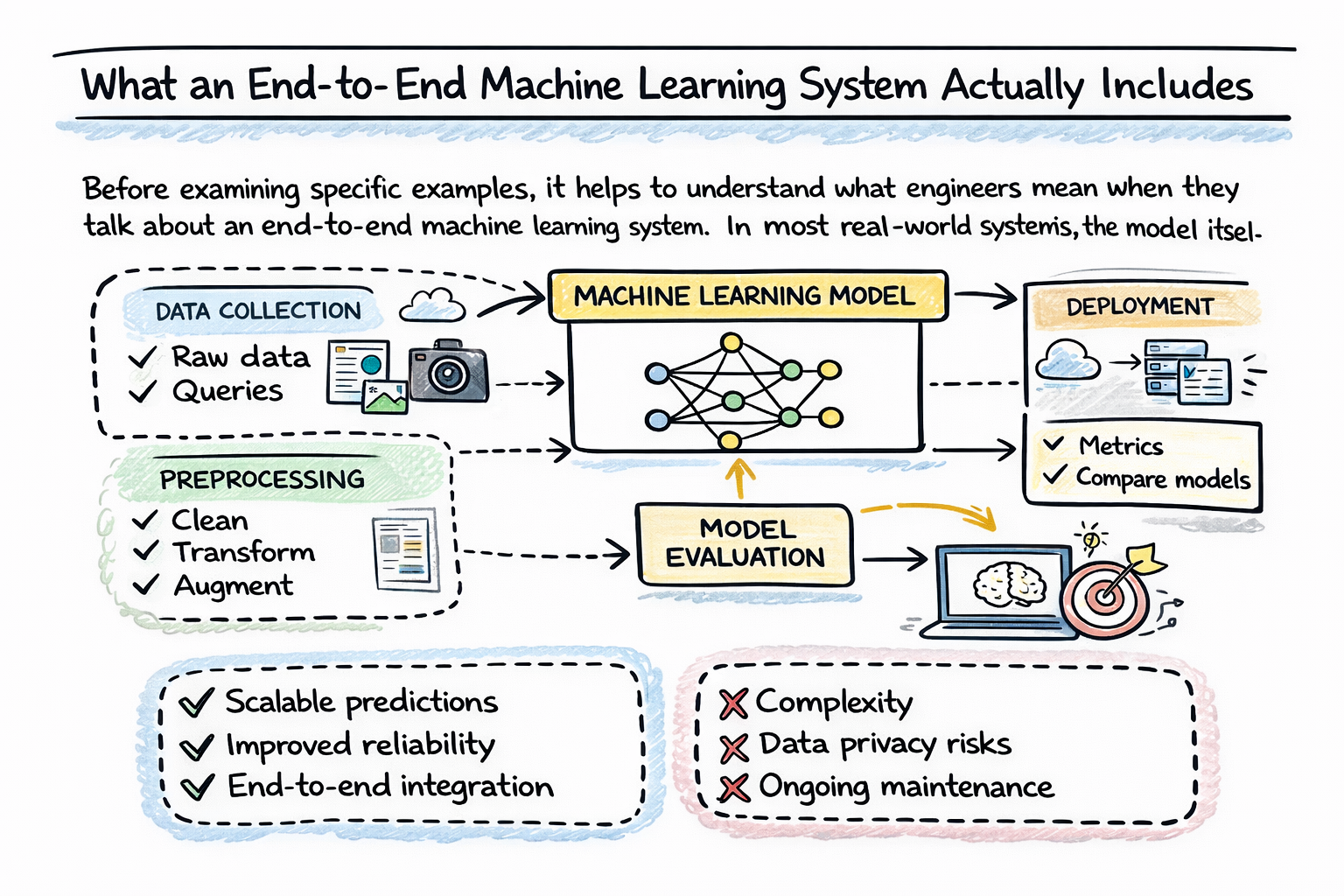
Before examining specific examples, it helps to understand what engineers mean when they talk about an end-to-end machine learning system. In most real-world systems, the model itself is only one part of a much larger architecture.
A complete machine learning system includes several interconnected components that ensure predictions are accurate, reliable, and scalable.
System Component | Role in the System |
Data Collection | Gathering raw data from applications and services |
Data Processing | Cleaning and transforming raw data into features |
Model Training | Training machine learning models using historical data |
Model Deployment | Serving predictions to applications |
Monitoring | Tracking performance and detecting issues |
Retraining Pipeline | Updating models as new data arrives |
Each of these components must work together smoothly. If one part of the system fails, the entire machine learning pipeline can become unreliable.
With that context in mind, you can now explore several real-world examples of machine learning System Design.
Grokking the Machine Learning Interview

Machine learning interviews at top tech companies now focus more on open-ended system design problems. “Design a recommendation system.” “Design a search ranking system.” “Design an ad prediction pipeline.” These questions evaluate your ability to reason about machine learning systems end-to-end. However, most candidates prepare for isolated concepts instead of system-level design. This course focuses specifically on building that System Design muscle. You’ll work through 9 real-world ML System Design problems (the same questions asked at Meta, Google, Amazon, and Microsoft) and learn a repeatable methodology for breaking each one down: defining the problem, choosing metrics, selecting model architectures, designing data pipelines, and evaluating trade-offs. Each system you design builds on practical ML techniques covered earlier in the course: embeddings, transfer learning, online experimentation, model debugging, and performance considerations. By the time you’re designing your third or fourth system, you'll have the technical vocabulary and judgment to explain why your design choices work. This is exactly what interviewers are looking for. The course also includes 6 mock interviews so you can practice articulating your designs under realistic conditions. If you have an ML or System Design interview coming up at any major tech company, this course will help you walk in with a clear framework for tackling whatever they throw at you.
Example 1: Designing a recommendation system#
Recommendation systems are among the most widely used machine learning applications. Platforms such as Netflix, Amazon, and YouTube rely heavily on recommendation engines to personalize content for users.
When you design a recommendation system, the goal is to predict which items a user is most likely to engage with. However, achieving this goal requires more than simply training a model.
Understanding the data pipeline#
The first step in designing a recommendation system involves collecting user interaction data. This data may include clicks, purchases, watch history, and search behavior.
These interactions are stored in data pipelines that process raw logs and convert them into structured datasets. The system then transforms these datasets into features such as user preferences, item popularity, and contextual signals.
Data Source | Example Features |
User interactions | Click frequency, watch history |
Item metadata | Category, genre, popularity |
Contextual data | Time of day, device type |
These features allow the model to learn patterns in user behavior.
Training the recommendation model#
Once the feature pipeline is ready, the system trains a recommendation model using historical interaction data. Many recommendation systems use collaborative filtering or deep learning models that learn relationships between users and items.
The model learns to rank items based on predicted relevance, which allows the system to generate personalized recommendations.
Deploying the recommendation service#
After training, the model must be deployed as a service that can generate predictions in real time. When a user visits the platform, the system queries the model to produce a ranked list of recommended items.
Low latency becomes critical here because recommendations must appear instantly.
Monitoring recommendation performance#
Recommendation systems must continuously monitor metrics such as click-through rate, engagement time, and user retention. These metrics help engineers determine whether the model is improving the user experience.
Over time, the system re-trains models with new interaction data to keep recommendations relevant.
Example 2: Fraud detection System Design#
Fraud detection systems are another common example of machine learning System Design. These systems analyze financial transactions to determine whether they are legitimate or suspicious.
Understanding the problem space#
In a fraud detection system, the machine learning model predicts the probability that a transaction is fraudulent. However, the system must make decisions quickly because transactions often require real-time approval.
This requirement means that both accuracy and latency are critical.
Building the data pipeline#
Fraud detection systems rely on transaction data, user behavior patterns, and historical fraud cases. The system processes these signals to generate features that help identify suspicious behavior.
Data Type | Example Feature |
Transaction data | Transaction amount |
User behavior | Location patterns |
Device signals | Device fingerprint |
These features allow the model to detect anomalies and suspicious activity.
Training fraud detection models#
Fraud detection models are often trained using classification algorithms that distinguish between legitimate and fraudulent transactions. Because fraud cases are relatively rare, engineers must handle class imbalance carefully.
The system may also incorporate anomaly detection techniques to identify unusual transaction patterns.
Real-time inference#
Once deployed, the fraud detection system evaluates each transaction in real time. If the model predicts a high fraud probability, the system may block the transaction or trigger additional verification steps.
Continuous learning and monitoring#
Fraud detection systems require constant updates because fraud patterns evolve rapidly. Monitoring systems track false positives, false negatives, and model drift to ensure the system remains effective.
Example 3: Demand forecasting system#
Demand forecasting systems are widely used in industries such as retail, logistics, and supply chain management. These systems predict future demand for products so companies can manage inventory and optimize production.
Data ingestion and preprocessing#
Demand forecasting systems collect historical sales data along with contextual signals such as seasonality, promotions, and market trends.
Data Source | Example Feature |
Historical sales | Daily sales volume |
Promotions | Discount campaigns |
Seasonal trends | Holiday effects |
These features allow the model to capture patterns that influence demand.
Model training#
Time-series forecasting models are commonly used for demand prediction. These models learn patterns such as seasonal fluctuations and long-term trends.
Modern forecasting systems may use machine learning techniques such as gradient boosting or deep learning models designed for sequential data.
Deployment strategy#
Unlike fraud detection or recommendation systems, demand forecasting often runs as a batch process rather than real-time inference. Predictions may be generated daily or weekly and stored in databases that supply chain systems can access.
Monitoring forecast accuracy#
Forecasting systems track metrics such as mean absolute error and prediction bias. Monitoring ensures that the model remains accurate as market conditions change.
Example 4: Content moderation system#
Content moderation systems are increasingly important for social platforms. These systems analyze text, images, or videos to detect harmful or inappropriate content.
Data collection#
Moderation systems rely on large labeled datasets that identify harmful content categories such as spam, hate speech, or misinformation.
Content Type | Example Feature |
Text | Language patterns |
Images | Visual objects |
Metadata | User history |
Model training#
Deep learning models are commonly used for content moderation tasks. Natural language processing models analyze text, while computer vision models process images and videos.
Deployment pipeline#
Content moderation models often operate in near real time, analyzing posts as they are uploaded. The system flags suspicious content for review or automatically removes it.
Monitoring system behavior#
Monitoring focuses on metrics such as detection accuracy and moderation latency. Engineers also track false positives to avoid incorrectly removing legitimate content.
Common architectural patterns across ML systems#
Despite differences in application domains, many machine learning systems share common architectural patterns.
Architectural Layer | Function |
Data pipeline | Collects and processes raw data |
Feature store | Stores reusable features |
Training pipeline | Automates model training |
Model serving | Delivers predictions |
Monitoring system | Tracks performance |
Recognizing these patterns helps engineers design systems more efficiently because many challenges recur across different applications.
Final thoughts#
End-to-end examples of machine learning System Design reveal an important truth about machine learning engineering. The model itself is rarely the most complex part of the system. Instead, the surrounding infrastructure that supports data pipelines, training workflows, deployment services, and monitoring systems determines whether a machine learning application succeeds.
By studying real-world examples such as recommendation engines, fraud detection systems, demand forecasting platforms, and content moderation tools, you begin to recognize the architectural patterns that power modern machine learning systems.
Once you understand these patterns, designing your own machine learning systems becomes far more intuitive. You move beyond training models in isolation and begin building systems that operate reliably in production environments.