How does JS Express work?
Want to understand how modern web servers work in Node.js? Learn how JS Express processes requests, manages middleware, and powers REST APIs so you can build scalable backend applications with confidence.
Modern web applications require efficient backend frameworks that can process requests, manage routes, and communicate with databases reliably. JavaScript developers commonly rely on Express, a lightweight framework built on top of Node.js, to create scalable server-side applications.
Many developers learning backend JavaScript eventually ask how does JS Express work because it forms the foundation of countless web applications and APIs. Express simplifies server development by providing structured tools that manage routing, middleware, and request handling.
Understanding how Express works helps developers design efficient server architectures and build REST APIs that support modern web and mobile applications. This guide explains the internal architecture of Express, how requests are processed, and how developers build web services using the framework.
Learn Express.js

Express.js is a popular Node.js framework, especially useful for building APIs and server-side apps. It’s lightweight, unopinionated, and flexible, giving you full control over how your app is structured. Whether new to backend development or ready to build production-grade services using JavaScript, Express is a great place to start. This customizable roadmap begins with a quick review of Node.js and asynchronous JavaScript. Then, you’ll cover Express.js essentials like routing, middleware, and modular app structure. You’ll learn to build RESTful APIs, connect your app to a database, and implement JSON web tokens (JWT) authentication. You’ll also explore validation and sanitization for added security. Finally, you’ll understand templating engines, real-time features using Socket.IO, and structured logging using Winston. By following this roadmap you’ll have a solid grasp of Express.js and the confidence to build secure, scalable, production-ready backend applications tailored to your own learning goals.
Understanding The Role Of Express In Node.js#
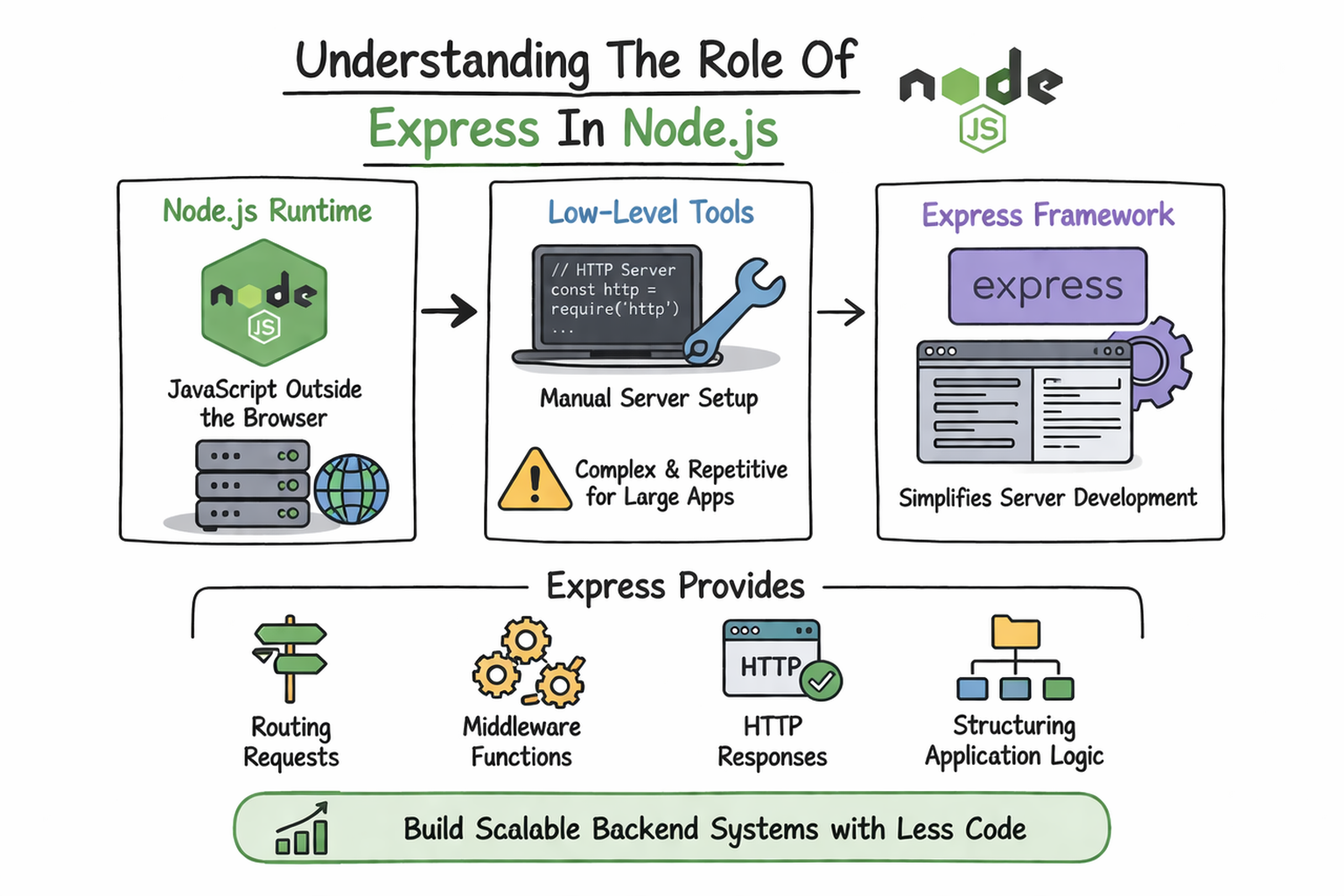
Before exploring how JS Express works, it is helpful to understand how Express fits within the Node.js ecosystem. Node.js itself is a runtime environment that allows JavaScript code to run outside the browser, enabling server-side development.
Node.js provides low-level tools for creating web servers, but writing large applications using only built-in modules can become complex and repetitive. Express solves this problem by offering a structured framework that simplifies common server tasks.
Express provides utilities for routing requests, handling middleware functions, managing HTTP responses, and structuring application logic. These features allow developers to build scalable backend systems with significantly less code.
Beginning Node.js, Express & MongoDB Development
In this course, you’ll learn how to build a full-stack application using the MERN stack and deploy it to the internet. The MERN stack is a popular stack of technologies that build modern Single Page Applications (SPAs). You’ll begin with the basics of MongoDB and the process of setting it up. Next, you will go over work with the Atlas cloud database. Then, you’ll learn how to set up the backend using Node and express. Also, you’ll be creating a fully functional movie review application. After creating the controller and data access objects, you’ll learn to create routes. Next, you’ll test the created API. Finally, you’ll learn how to create the frontend using the React components and deploy the application on Heroku. By the end of this course, you’ll learn how to connect both the backend and the frontend to create a full-stack MERN application, as well as how to deploy it.
Core Components Of An Express Application#
An Express application consists of several components that work together to process HTTP requests and generate responses. These components create the internal architecture that powers Express-based servers.
The following table outlines the primary components of an Express application and their responsibilities.
Component | Purpose | Role In Application |
Server Instance | Initializes Express application | Handles incoming requests |
Routing System | Maps URLs to functions | Directs requests to handlers |
Middleware | Processes requests before response | Handles logic and transformations |
Request Object | Contains client request data | Access request parameters |
Response Object | Sends data back to client | Returns results to user |
These components interact within a request-response cycle that defines how Express processes incoming web requests.
The Express Request And Response Cycle#
The request-response cycle represents the core mechanism that explains how JS Express works in a web server environment. Every time a client sends a request to the server, Express processes that request through a structured pipeline.
The cycle begins when a user accesses a URL or an application sends an API request. Express receives the request and determines which route and middleware functions should handle the request.
After processing the request, Express generates a response that is returned to the client. This response may include data, HTML pages, or JSON objects, depending on the application's functionality.
Understanding Routing In Express#
Routing plays a critical role in how Express applications organize backend logic. Routing allows developers to define how the server should respond to specific URLs and HTTP methods.
When developers study how does JS Express work, routing becomes one of the first concepts they encounter. Express allows developers to define routes that correspond to specific endpoints within an application.
For example, a route might respond to requests for user information, product data, or authentication services. Each route is connected to a function that processes the request and generates a response.
The table below shows common HTTP methods used in Express routing.
HTTP Method | Purpose | Example Use Case |
GET | Retrieve data | Fetch user information |
POST | Send new data | Create new user account |
PUT | Update existing data | Update profile details |
DELETE | Remove data | Delete user record |
By combining routes and HTTP methods, Express allows developers to design structured APIs that follow RESTful architecture principles.
Middleware And Its Role In Express#
Middleware is one of the most powerful features that explains how JS Express works in modern web applications. Middleware functions process requests before the final response is sent to the client.
These functions operate between the incoming request and the route handler that produces the final output. Middleware can modify requests, perform validation, handle authentication, or log application activity.
Middleware allows developers to build modular applications where different components manage different aspects of the request lifecycle. This modular design improves code organization and maintainability.
Types Of Middleware In Express#
Express supports several types of middleware that serve different purposes within the application architecture. Understanding these middleware categories helps developers design scalable backend systems.
The following table outlines common middleware types used in Express applications.
Middleware Type | Function | Example Purpose |
Application Middleware | Runs for every request | Logging and request parsing |
Router Middleware | Runs for specific routes | Authentication checks |
Error Handling Middleware | Processes application errors | Error responses |
Built-In Middleware | Provided by Express | JSON parsing |
Each middleware function receives the request object, response object, and a function that passes control to the next middleware in the pipeline.
Handling Requests In Express#
Requests represent incoming data sent from clients to the server. These requests often contain information such as URL parameters, query strings, and request bodies.
Understanding how JS Express works requires understanding how the framework extracts and processes this information. Express automatically parses request data so developers can access it through structured objects.
The request object contains information about the HTTP method, headers, query parameters, and body content. Developers use this information to determine how the application should respond.
Sending Responses From Express Servers#
After processing a request, Express must generate a response that is returned to the client. Responses may contain HTML pages, JSON data, or status messages depending on the application.
The response object provides several methods for sending output. These methods allow developers to send data, set HTTP status codes, and control response headers.
Express simplifies response handling by offering intuitive functions that manage common tasks such as sending JSON responses or rendering templates.
Building REST APIs With Express#
One of the most common uses of Express is building REST APIs that allow applications to communicate with servers. These APIs power modern web applications, mobile apps, and third-party integrations.
Developers learning how JS Express works often build REST APIs as their first backend projects. Express provides a clean structure for organizing API endpoints and managing data requests.
A REST API typically consists of routes that correspond to resources such as users, products, or messages. Each route performs operations such as retrieving data, updating records, or deleting information.
Connecting Express To Databases#
Most real-world applications require persistent data storage. Express applications commonly connect to databases in order to store and retrieve application data.
Developers often use databases such as MongoDB, PostgreSQL, or MySQL with Express servers. These databases allow applications to manage structured data efficiently.
Database integration typically occurs within route handlers or service layers. Express processes incoming requests, retrieves data from the database, and returns the results to the client.
Structuring Large Express Applications#
As applications grow larger, organizing Express code becomes increasingly important. Developers often divide their applications into modules that separate routing, middleware, and business logic.
Understanding how does JS Express work also involves understanding application architecture patterns. Modular structures allow teams to maintain large codebases more efficiently.
Many Express applications follow layered architecture models that include routes, controllers, services, and database layers. This structure improves maintainability and scalability.
Performance And Scalability In Express#
Express is designed to be lightweight and efficient, which allows it to handle large numbers of concurrent requests. Because it runs on Node.js, Express benefits from Node's non-blocking event-driven architecture.
Non-blocking operations allow servers to process multiple requests simultaneously without waiting for long-running tasks to finish. This design helps Express applications scale effectively in production environments.
Developers can further improve scalability by using load balancing, caching systems, and distributed architectures.
Advantages Of Using Express#
Express has become one of the most widely used backend frameworks in the JavaScript ecosystem. Its simplicity, flexibility, and large community make it an attractive choice for developers.
Understanding how JS Express works reveals why the framework remains popular for both small projects and enterprise applications. Express allows developers to build applications quickly while maintaining full control over server architecture.
Another advantage involves its compatibility with numerous libraries and middleware tools. This ecosystem allows developers to extend Express applications with authentication systems, logging tools, and security modules.
Challenges Developers Face With Express#
Although Express is powerful, developers may encounter challenges when building complex applications. Because the framework is flexible, it does not enforce strict architectural patterns.
Developers must design the application structure carefully in order to avoid disorganized codebases. Without proper planning, large Express applications may become difficult to maintain.
However, with good architectural practices and modular organization, Express can support extremely large and scalable backend systems.
The Future Of Express In Web Development#
Despite the emergence of newer frameworks, Express remains one of the most widely used backend tools in JavaScript development. Its stability and simplicity continue to attract developers building APIs and server applications.
Modern frameworks often build on similar concepts such as middleware pipelines and routing systems. Understanding how JS Express work therefore, provides a strong foundation for learning other backend frameworks.
Developers who master Express often transition easily into frameworks such as NestJS or Fastify because many of the core backend principles remain similar.
Conclusion#
Understanding how JS Express works is an essential step for developers who want to build backend applications using JavaScript. Express simplifies server development by providing structured tools for routing, middleware management, and request handling.
By learning how Express processes requests, manages middleware, and communicates with databases, developers gain the ability to build scalable web applications and REST APIs. These skills form a critical foundation for modern backend development.
As web technologies continue evolving, Express remains an important framework within the Node.js ecosystem. Developers who understand its architecture can build reliable backend systems that power modern digital platforms.
