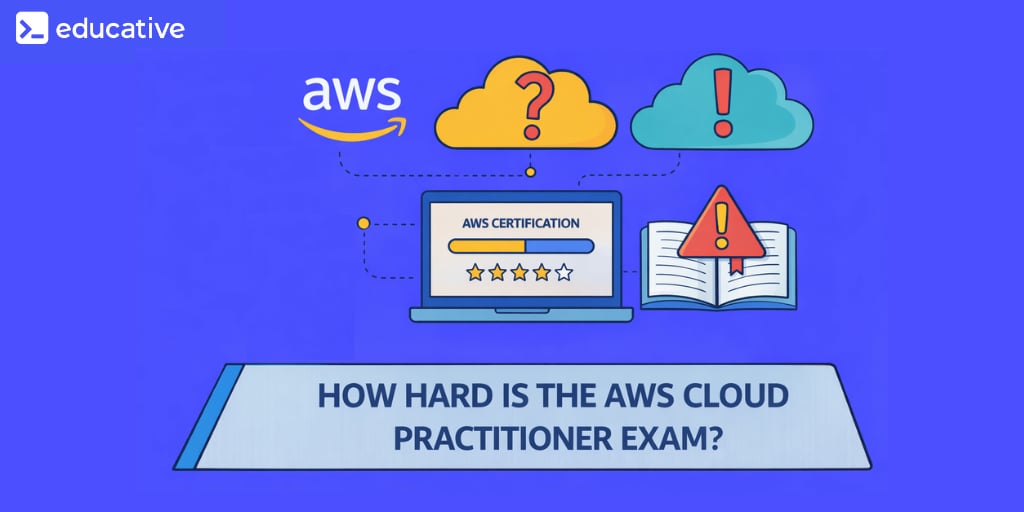
How Hard Is the AWS Cloud Practitioner Exam?
Wondering how hard the AWS Cloud Practitioner exam really is? This in-depth blog breaks down difficulty, question style, common mistakes, and what actually makes the exam easy, or surprisingly tricky, so you can prepare with confidence.
If you’re asking how hard the AWS Cloud Practitioner exam is, you’re already thinking about the right thing. Difficulty isn’t just about how complex the questions are. It’s about how well the exam aligns with what you expect going in.
Some people walk out saying it was easier than they thought. Others leave surprised, even frustrated, wondering how an “entry-level” certification felt trickier than expected. Both reactions are valid, and both usually come down to one thing: misunderstanding what the exam is actually testing.
The AWS Cloud Practitioner exam isn’t hard in the traditional technical sense. You won’t be debugging code or designing architectures. But it is precise. It tests how well you understand cloud concepts, how AWS frames responsibility and pricing, and how you reason through scenarios.
Master AWS Certified Cloud Practitioner CLF-C02 Exam
Cloud computing has become the foundation of modern software, and AWS continues to lead that shift. For many engineers and aspiring technologists, the AWS Certified Cloud Practitioner certification is the first step toward understanding how cloud systems are designed, managed, and scaled. The challenge is building a clear mental model of how everything fits together. I built this course around a common pattern I’ve seen: learners often approach AWS as a collection of tools rather than a system. When preparing for the AWS Certified Cloud Practitioner exam, they can recall services but struggle to explain how they work together in real scenarios. This course is designed to make those connections clear from the start. We begin with the fundamentals of cloud computing, then move into core AWS services across compute, storage, networking, and databases. From there, we explore analytics, machine learning, pricing, and billing, tying each concept back to real-world usage. You’ll also work through monitoring, security, and compliance practices, with hands-on Cloud Labs to reinforce your understanding. If you’re starting your journey as a cloud practitioner, this course gives you a structured path to pass the exam and build a strong foundation in AWS.
This blog breaks down the real difficulty of the AWS Cloud Practitioner exam, what makes it feel hard or easy, and how to judge honestly whether it will be challenging for you.
What “difficulty” really means for this exam#

When people ask how hard an exam is, they often mean one of three things. They want to know how technical it is, how tricky the questions are, or how much preparation is realistically required.
The AWS Cloud Practitioner exam scores low on technical depth but higher on conceptual clarity. That combination is what throws many candidates off.
You’re not tested on how to configure AWS services. You’re tested on whether you understand why those services exist, when they’re appropriate, and who is responsible for what. That kind of reasoning can feel harder than memorization, especially if you’re used to exams with clear right-and-wrong rules.
In other words, the exam is not hard because it’s complex. It’s hard when your expectations don’t match its intent. Your preparation can also improve if you have a timeline for how long you should prepare for the Cloud Practitioner exam.
Learn the A to Z of Amazon Web Services (AWS)

Learn about the core AWS's services like compute, storage, networking services and how they work with other services like Identity, Mobile, Routing, and Security. This course provides you with a good grasp an all you need to know of AWS services. This course has been designed by three AWS Solution Certified Architects who have a combined industry experience of 17 years. We aim to provide you with just the right depth of knowledge you need to have.
Why the Cloud Practitioner exam feels easier than expected for some people#
For certain candidates, the AWS Cloud Practitioner exam feels surprisingly approachable.
If you already understand basic IT concepts like servers, networking, security, and pricing models, the exam often feels like a structured review. Many of the ideas will be familiar, just expressed through AWS terminology.
If you’ve worked around cloud systems, even indirectly, you’ve probably absorbed more than you realize. Concepts like scalability, redundancy, and access control start to feel intuitive rather than abstract.
For these candidates, the exam isn’t hard because it validates the understanding they already have. The challenge is alignment, not learning from scratch.
Why the same exam feels harder than expected for others#
For other candidates, especially those new to cloud computing, the exam can feel deceptively tricky.
The difficulty here doesn’t come from complexity. It comes from unfamiliar framing. Questions often describe scenarios rather than definitions, and if you don’t recognize what problem the scenario is highlighting, the answer options can feel confusingly similar.
Another source of difficulty is the shared responsibility model. Many people assume the cloud provider handles security entirely, which leads to incorrect answers even when the question seems simple.
Pricing questions also catch people off guard. The math isn’t hard, but the logic requires understanding how AWS thinks about cost optimization.
For beginners, the exam is hard, not because it’s advanced, but because it expects a way of thinking they haven’t practiced yet.
How technical is the AWS Cloud Practitioner exam, really?#
This is one of the most common concerns, especially for non-technical candidates.
The AWS Cloud Practitioner exam is low on technical implementation and high on conceptual understanding. You are not expected to write code, configure networks, or manage infrastructure.
You are expected to understand what compute, storage, and networking services do at a high level. You need to know the difference between object storage and block storage, but not how to configure them.
This makes the exam accessible to a wide audience, but it also means guessing doesn’t work. You need to understand concepts, not just recognize terms.
The role of question wording in perceived difficulty#
One reason the exam feels harder than expected is the way questions are worded.
AWS questions are rarely direct. Instead of asking “What is Amazon S3?” they describe a scenario where a company needs durable, scalable storage and ask which service fits best.
This means the exam is testing comprehension, not recall. If you skim questions or rush, it’s easy to miss the key detail that determines the correct answer.
Candidates who slow down and identify what the question is really testing often find the exam much easier than those who rush.
Understanding the exam domains and their difficulty#
The Cloud Practitioner exam is divided into four main domains. Each contributes differently to the overall difficulty.
Exam domain | Weight | Perceived difficulty |
Cloud concepts | ~26% | Easy to moderate |
Security and compliance | ~25% | Moderate |
Cloud technology and services | ~33% | Moderate |
Billing, pricing, and support | ~16% | Surprisingly tricky |
Cloud concepts are usually the easiest if you’ve studied properly. Security becomes tricky when you misunderstand responsibility boundaries. Services feel manageable if you focus on purpose rather than detail. Pricing feels hard if you haven’t spent time understanding AWS’s cost philosophy.
None of these domains is individually difficult, but together they reward balanced preparation.
Why pricing questions make the exam feel harder than it is#
Many candidates underestimate billing and pricing questions because they assume the exam is mostly about services.
In reality, pricing questions require you to understand how AWS expects customers to think about cost. You need to recognize when on-demand pricing is appropriate and when long-term commitments make more sense.
The difficulty comes from scenario interpretation, not calculations. Once you understand the logic, these questions become some of the easiest points on the exam.
The shared responsibility model#
If there is one concept that disproportionately affects exam difficulty, it’s the shared responsibility model.
Questions about security often hinge on whether AWS or the customer is responsible for a specific task. If you haven’t internalized this model, many questions will feel confusing or unfair.
Once you truly understand the boundary, these questions become predictable. Difficulty here is not inherent. It’s conceptual.
Is the AWS Cloud Practitioner exam harder than other entry-level certifications?#
Compared to other entry-level IT certifications, the Cloud Practitioner exam is conceptually more demanding but technically lighter.
You are asked to reason about systems rather than recall commands or configurations. This makes it feel harder for candidates who prefer memorization and easier for those who think in terms of systems and trade-offs.
The exam rewards understanding over rote learning, which is why preparation style matters so much.
How preparation time affects perceived difficulty#
Preparation time has a direct impact on how hard the exam feels.
Candidates who spend time understanding concepts typically describe the exam as fair or even easy. Candidates who rush through material or rely on memorization often describe it as tricky or misleading.
Most people who prepare consistently for four to six weeks find the difficulty manageable. Those who cram often find it unexpectedly challenging.
Common mistakes that make the exam feel harder than it is#
One common mistake is over-studying advanced topics that never appear on the exam. This creates fatigue without improving scores.
Another mistake is under-studying pricing and support plans, assuming they’re minor topics. They aren’t.
A third mistake is taking practice exams too late, which leaves little time to fix conceptual gaps.
These mistakes don’t make the exam harder. They make preparation less effective.
How practice exams change the difficulty equation#
Practice exams dramatically reduce perceived difficulty when used correctly.
They help you recognize question patterns, identify weak areas, and get comfortable with AWS’s wording style. Over time, questions stop feeling tricky and start feeling familiar.
The exam feels hard when it feels unpredictable. Practice removes that unpredictability.
Is the AWS Cloud Practitioner exam hard for non-technical candidates?#
For non-technical candidates, the exam is approachable but not effortless.
You don’t need prior IT experience, but you do need to invest time in understanding concepts. If you approach the exam as something you can “wing,” it will feel hard. If you approach it as a learning experience, it becomes manageable.
Many non-technical candidates pass comfortably by focusing on fundamentals rather than details.
Is the exam harder than people say online?#
Online opinions are skewed. People who find the exam trivial often have prior experience. People who struggle often underestimate it.
The truth sits in the middle. The AWS Cloud Practitioner exam is not difficult, but it is not careless either.
It rewards preparation that builds understanding rather than shortcuts.
How you can accurately judge how hard it will be for you#
The best way to judge difficulty is not by reading opinions, but by testing yourself.
If practice questions feel confusing and unpredictable, the exam will feel hard unless you adjust your preparation. If questions feel logical and familiar, the exam will feel fair.
Difficulty is relative to understanding, not intelligence.
Final verdict#
The AWS Cloud Practitioner exam is moderately challenging in concept but easy in execution.
It does not test great technical skills. It tests whether you understand how cloud computing works, how AWS frames responsibility, and how to reason through common scenarios.
If you prepare thoughtfully, the exam feels fair. If you rush or rely on memorization, it feels tricky.
The difficulty is not the exam itself. The difficulty is matching your preparation to what the exam actually tests.