A complete AWS solutions architect exam guide
Stop memorizing AWS services and start thinking like an architect. This guide helps you understand real System Design concepts, tackle scenario-based questions, and build the skills you need to pass the exam and succeed in real-world cloud design.
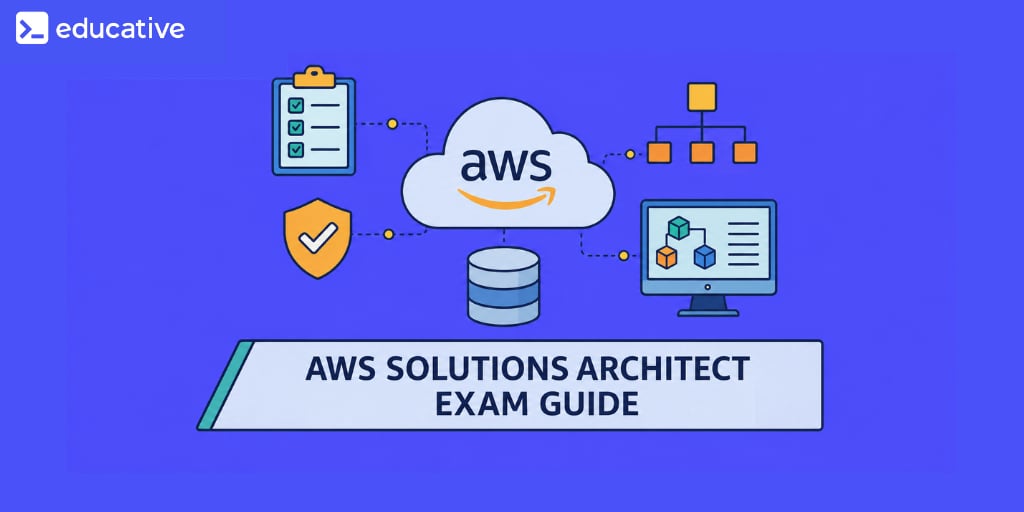
If you’ve started preparing for the AWS Solutions Architect Associate exam, you’ve likely felt the weight of how much there is to cover. You open a course or a guide, and suddenly you’re looking at dozens of services, architectural patterns, and best practices. It can feel overwhelming, especially when everything seems equally important, and there’s no clear starting point.
Many learners respond to this pressure by focusing on memorization. They try to remember which service does what, which combination appears in common questions, and which answers are “usually correct.” While this approach might help in the short term, it often leads to confusion when faced with unfamiliar scenarios. You know the pieces, but you don’t know how they fit together.
This is where a different kind of AWS solutions architect exam guide becomes valuable. Instead of treating the exam as a set of facts to memorize, you approach it as an opportunity to understand how real cloud systems are designed. As your draft suggests, the goal is not just to pass the exam, but to build the kind of architectural thinking that applies beyond it.
Master AWS Certified Solutions Architect Associate SAA-C03 Exam
Cloud architecture has become a core skill for modern engineers. Whether you're building backend systems, deploying microservices, or scaling global applications, understanding how to design on AWS is no longer optional. The challenge is that AWS is an ecosystem. Without a clear structure, it’s easy to get lost in services without understanding how to use them together to build secure, reliable systems. I built this course from my experience working on Azure’s Fabric Controller and Remote Desktop services for Windows Server. In those environments, we dealt with real-world problems around availability, fault tolerance, and large-scale system management. The pattern I’ve seen with learners is similar: they can learn individual services, but struggle to connect them into a complete architecture. This course is designed to help you think in systems, not just services. We focus on the core pillars of AWS architecture, security, reliability, performance, and cost optimization, and show how they come together in practical designs. You’ll learn how to secure accounts and resources, design for high availability using load balancing and replication, and choose the right storage and analytics services for performance. The course also includes hands-on Cloud Labs so you can deploy and interact with real AWS resources, along with practice exams aligned to the SAA-C03 certification. This approach has helped many learners build confidence in AWS and successfully prepare for certification. If you’re aiming to become an AWS Certified Solutions Architect Associate and design systems the right way, this course gives you a clear and structured path.
What the exam is really testing#

When preparing for the AWS Solutions Architect Associate exam, you need to understand that it is not testing your ability to recall isolated facts. It is testing how well you understand cloud architecture as a system. This includes how systems scale, how they remain reliable under failure, how they manage costs, and how they ensure security in distributed environments.
The exam is structured around scenarios that resemble real-world problems. You might be asked how to design a system that handles unpredictable traffic, how to ensure high availability across regions, or how to optimize storage for both performance and cost. These questions require you to evaluate options and choose the most appropriate solution based on constraints.
This is an important shift in perspective. Instead of asking “Which service does this?”, you need to ask “What is the system trying to achieve?” and “Which approach best satisfies those requirements?” The exam rewards reasoning and understanding, not just familiarity with services.
Learn the A to Z of Amazon Web Services (AWS)

Learn about the core AWS's services like compute, storage, networking services and how they work with other services like Identity, Mobile, Routing, and Security. This course provides you with a good grasp an all you need to know of AWS services. This course has been designed by three AWS Solution Certified Architects who have a combined industry experience of 17 years. We aim to provide you with just the right depth of knowledge you need to have.
Why memorization is not enough#
Memorization can give you a sense of progress, but it often leads to shallow understanding. You might remember that a particular service is used for scaling or storage, but you don’t fully understand why it works or when it might not be the best choice. This becomes a problem when the exam presents scenarios that are slightly different from what you’ve studied.
Consider a question that involves designing a system for high availability. If you rely on memorization, you might recall a common pattern and select it without fully analyzing the situation. However, the question may include constraints that make that pattern less suitable. Without a deeper understanding, it becomes difficult to adapt your thinking.
Conceptual understanding changes this entirely. When you understand the principles behind scalability, fault tolerance, and cost optimization, you can reason through unfamiliar scenarios. You are no longer dependent on memorized answers; you can evaluate each option and choose the one that best fits the problem.
How to think about this AWS Solutions Architect exam #
To get the most out of your preparation, you need to treat this AWS solutions architect exam guide as a framework for building mental models. Instead of organizing your learning around individual services, you organize it around concepts. You focus on understanding how systems behave and how different components interact.
This means shifting your attention from “what” to “why.” Instead of asking what a service does, you ask why it exists and what problem it solves. You explore how it behaves under load, how it integrates with other services, and what trade-offs it introduces. This deeper level of understanding allows you to apply your knowledge more flexibly.
The rest of your preparation should follow this approach. Every topic you study should connect back to system behavior. Every service you learn should be understood in the context of a larger architecture. This is what transforms exam preparation into meaningful learning.
Understanding core architecture concepts#
The foundation of the exam lies in core architectural concepts such as high availability, fault tolerance, and elasticity. These ideas define how systems behave under different conditions and are central to both the exam and real-world architecture. Without a clear understanding of these concepts, it becomes difficult to reason about solutions.
High availability, for example, is about ensuring that a system remains accessible even when parts of it fail. This might involve distributing resources across multiple availability zones or implementing redundancy. Fault tolerance goes a step further, ensuring that the system continues to operate correctly despite failures. Elasticity focuses on the ability to scale resources up or down based on demand.
Imagine designing an application that experiences sudden traffic spikes. You need to ensure that the system can handle increased load without degrading performance. This involves combining concepts like load balancing, auto-scaling, and distributed storage. By understanding these principles, you can design systems that are both efficient and resilient.
Connecting AWS services to real-world systems#
AWS services are tools, but their value lies in how they are used within systems. Instead of memorizing features, you should focus on understanding the role each service plays in an architecture. This helps you see how different components come together to solve real-world problems.
For example, a storage service is not just a place to store data—it is part of a larger system that includes data access patterns, performance requirements, and cost considerations. Similarly, a compute service is not just about running code—it is about how that code scales, how it handles failures, and how it integrates with other components.
By connecting services to real-world use cases, you develop a more intuitive understanding. You begin to see patterns and recognize how different architectures are constructed. This makes it easier to apply your knowledge during the exam and in practical scenarios.
Comparison of study approaches#
Study approach | Retention | Depth of understanding | Exam performance |
Memorization-based preparation | Low to moderate | Shallow | Inconsistent, scenario-dependent |
Concept-driven learning | High | Strong | Consistent, adaptable |
Project-based learning | Very high | Deep, experiential | Strong, with real-world alignment |
Each approach has its place, but their effectiveness varies significantly. Memorization-based preparation can help you cover material quickly, but it often leads to gaps in understanding. You may perform well on familiar questions but struggle with new scenarios.
Concept-driven learning provides a stronger foundation. By focusing on principles and patterns, you develop the ability to reason through problems. This leads to more consistent performance and a deeper understanding of the material.
Project-based learning takes this a step further by allowing you to apply concepts in real systems. It reinforces your understanding and helps you develop intuition. While it requires more effort, it provides the most comprehensive preparation.
The role of System Design in exam preparation#
System Design is the bridge between theoretical knowledge and practical application. It allows you to think about systems as a whole, considering how different components interact and how they behave under various conditions. This perspective is essential for both the exam and real-world architecture.
When you approach questions with a System Design mindset, you focus on the overall system rather than individual services. You consider factors such as scalability, reliability, and cost, and evaluate how different options affect these dimensions. This aligns closely with how exam questions are structured.
By incorporating System Design into your preparation, you improve your ability to analyze scenarios and make informed decisions. This not only helps you perform better on the exam but also prepares you for real-world challenges.
Common mistakes during preparation#
One common mistake is over-reliance on practice exams. While practice questions are useful, they can create a false sense of confidence if used in isolation. You may become familiar with certain patterns without fully understanding the underlying concepts.
Another mistake is ignoring foundational concepts. It can be tempting to focus on advanced topics, but without a strong foundation, your understanding remains incomplete. Core concepts like scalability and fault tolerance are essential for both the exam and real-world systems.
Focusing only on passing the exam is another issue. When your goal is limited to achieving a score, you may prioritize short-term strategies over long-term learning. This can leave you unprepared for real-world challenges, even if you pass the exam.
Building a sustainable study strategy#
A sustainable study strategy balances theory, practice, and hands-on experience. You start by building a strong conceptual foundation, ensuring that you understand key architectural principles. This provides a framework for everything else you learn.
From there, you incorporate practice questions and scenarios. These help you apply your knowledge and identify gaps in your understanding. However, they should complement your learning, not replace it.
Hands-on experience is the final piece. By working with AWS services directly, you gain practical insights into how systems behave. This reinforces your understanding and helps you develop intuition, making your preparation more effective and meaningful.
From exam preparation to real-world application#
The knowledge you gain during exam preparation should extend beyond the exam itself. The concepts you learn—scalability, reliability, cost optimization—are directly applicable to real-world systems. This is what makes the certification valuable.
As you move into practical scenarios, you will encounter challenges that go beyond what the exam covers. Systems will behave unpredictably, requirements will change, and new constraints will emerge. This is where your conceptual understanding becomes critical.
By focusing on understanding rather than memorization, you prepare yourself for these challenges. You develop the ability to adapt, reason, and design systems that work in real-world conditions.
Conclusion#
A meaningful AWS solutions architect exam guide is not about shortcuts or quick wins. It is about building a deep understanding of cloud architecture and developing the ability to think in terms of systems. This approach not only helps you pass the exam but also prepares you for real-world challenges.
As you continue your preparation, focus on concepts, reasoning, and practical application. Treat the exam as a milestone, not the final goal. By doing so, you ensure that your learning has lasting value.
Happy learning!