Study Tips for Passing the AWS Cloud Practitioner Certification
Passing the AWS Cloud Practitioner certification is not about memorizing services. Learn the study strategies that help candidates understand AWS concepts, interpret exam questions confidently, and prepare efficiently so the Cloud Practitioner exam feels easy.
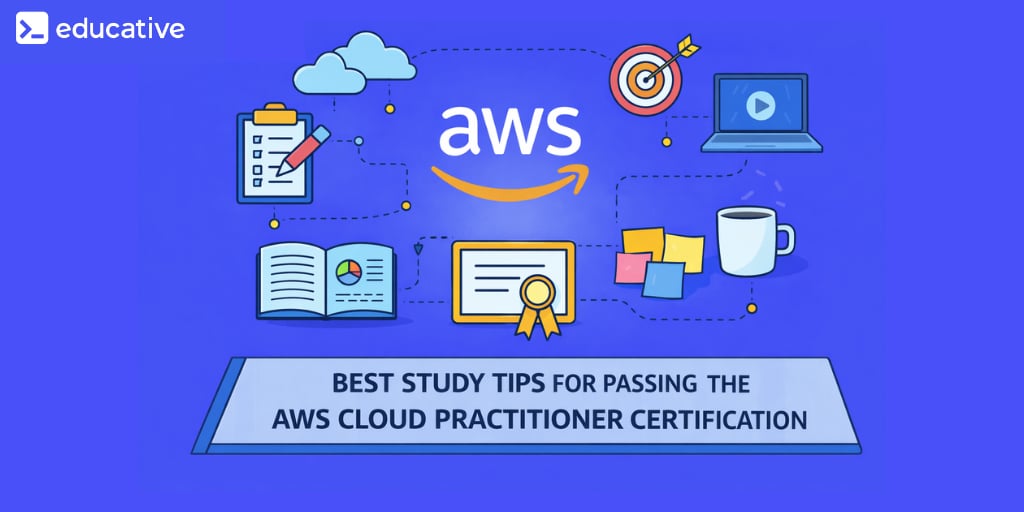
Preparing for the AWS Cloud Practitioner certification often feels deceptively simple at first.
It’s the “foundational” AWS exam. No coding. No system design. No deep infrastructure work. Many people assume it’s just a matter of reading a few definitions and memorizing service names.
Then reality sets in.
You open the exam guide and see cloud concepts, global infrastructure, security responsibilities, pricing models, support plans, and dozens of AWS services that all sound important. Nothing feels impossible, but everything feels easy to mix up.
That’s when most candidates start asking the same question.
What are the best study tips for actually passing the AWS Cloud Practitioner certification, not just studying for it?
The difference matters. Plenty of people study a lot and still feel unsure on exam day. Others study less but prepare more effectively and walk in confidence.
Master AWS Certified Cloud Practitioner CLF-C02 Exam
Cloud computing has become the foundation of modern software, and AWS continues to lead that shift. For many engineers and aspiring technologists, the AWS Certified Cloud Practitioner certification is the first step toward understanding how cloud systems are designed, managed, and scaled. The challenge is building a clear mental model of how everything fits together. I built this course around a common pattern I’ve seen: learners often approach AWS as a collection of tools rather than a system. When preparing for the AWS Certified Cloud Practitioner exam, they can recall services but struggle to explain how they work together in real scenarios. This course is designed to make those connections clear from the start. We begin with the fundamentals of cloud computing, then move into core AWS services across compute, storage, networking, and databases. From there, we explore analytics, machine learning, pricing, and billing, tying each concept back to real-world usage. You’ll also work through monitoring, security, and compliance practices, with hands-on Cloud Labs to reinforce your understanding. If you’re starting your journey as a cloud practitioner, this course gives you a structured path to pass the exam and build a strong foundation in AWS.
This blog focuses on how to study smart, not just hard. It explains what consistently works for Cloud Practitioner candidates, what usually wastes time, and how to structure your preparation so the exam feels fair instead of intimidating.
Why studying for the Cloud Practitioner is different from other certifications#

The Cloud Practitioner exam is not difficult in a technical sense. You are not solving problems or configuring systems.
What makes it tricky is interpretation.
AWS questions often present multiple answers that sound reasonable. The exam is testing whether you understand how AWS thinks about cloud computing, not whether you can recall isolated facts.
This means traditional “cram and memorize” approaches are less effective. The best study strategies focus on clarity, context, and repetition, not volume.
Once you understand this, your entire approach to studying changes.
Cloud Computing Fundamentals

We are surrounded by the technology that we utilize daily. Most of it makes use of cloud computing. Cloud is not a nuance anymore; it’s the norm. As software practitioners, it’s imperative to have a good understanding of cloud computing concepts. In this course, you will learn the fundamental concepts of cloud computing. Next, you’ll familiarize yourself with cloud’s standard services. You’ll also learn about various service models available in cloud computing. You’ll learn the concepts of clustering and its relevance in cloud computing. You’ll explore storage and deployment concepts in the cloud. You’ll wrap up with a hands-on experience of how to pick a cloud platform and start your cloud journey. In the end, you’ll have plenty of resources to continue your cloud learning journey. By the end of this course, you’ll have a deeper understanding of the basic concepts of cloud computing and the services and products that cloud platforms offer.
Start by understanding the exam’s intent, not just the syllabus#
One of the most effective study tips is also the most overlooked.
Before diving into resources, you should understand what AWS is actually trying to test.
The Cloud Practitioner certification validates foundational understanding of cloud computing and AWS. It is designed for beginners, non-technical roles, students, and career switchers. You are being tested on concepts, responsibilities, and service roles, not on implementation.
When you keep this intent in mind, it becomes easier to filter what matters and what doesn’t.
If a topic feels deeply technical, it is probably outside the scope of this exam.
Build a mental model instead of memorizing definitions#
Many candidates approach AWS study by trying to memorize definitions.
This usually backfires.
The Cloud Practitioner exam rewards understanding relationships. How cloud benefits connect to pricing. How security responsibilities connect to service models. How global infrastructure connects to availability.
When you study with the goal of building a mental model of how AWS fits together, questions start to feel predictable.
A good test of this is whether you can explain a concept out loud in your own words. If you can, you understand it. If you can’t, memorization is masking confusion.
Use a structured course as your foundation#
For most people, a structured course is the best place to start.
A good Cloud Practitioner course introduces concepts gradually, explains AWS terminology in plain language, and connects ideas instead of listing services. It gives you a narrative.
Courses are especially important if you are new to cloud computing. They prevent early frustration and help everything else make sense.
However, watching a course alone is rarely enough. Courses build understanding, but retention fades without reinforcement. The key is how you use the course.
Treat it as your foundation, not your entire study plan.
Reinforce learning immediately after studying#
One of the most effective study tips is timing.
After you learn a concept, you should reinforce it quickly. This might mean reviewing flashcards, summarizing the idea in your own words, or answering a few related questions.
Immediate reinforcement strengthens memory and reveals misunderstandings early.
If you wait too long, concepts blur together. If you reinforce immediately, clarity builds faster and lasts longer.
This habit alone dramatically improves study efficiency.
Practice questions early, but not blindly#
Many people delay practice questions until the very end of their preparation. This is a mistake.
Practice questions are not just for testing readiness. They are one of the best learning tools available.
Early practice questions help you understand how AWS frames scenarios and what details matter. They also reveal which topics you misunderstood or overlooked.
The key is how you use them.
You should not judge yourself by early scores. Instead, focus on explanations. Understanding why an answer is wrong is often more valuable than getting one right.
Learn how AWS writes questions#
Another powerful study tip is to study the exam’s language, not just its content.
AWS questions are carefully worded. Certain phrases signal specific ideas, such as cost optimization, fault tolerance, or shared responsibility.
As you review practice questions, pay attention to wording patterns. Over time, you start recognizing what AWS is really asking.
This skill reduces hesitation on exam day and makes answer elimination much easier.
Master the shared responsibility model early#
If there is one concept that deserves extra attention, it is the shared responsibility model.
AWS repeatedly tests whether you understand what AWS is responsible for and what the customer is responsible for. Many wrong answers sound tempting because they assume AWS handles something it doesn’t, or vice versa.
Once this model is clear, a surprising number of questions become straightforward.
This is one of the highest-return study areas for beginners.
Don’t fear billing and pricing#
Billing and pricing often cause unnecessary anxiety.
The Cloud Practitioner exam does not require math. You are not calculating bills or estimating usage costs.
Instead, AWS tests whether you understand pricing models conceptually. Pay-as-you-go, usage-based pricing, and long-term commitments appear frequently.
You should also understand that AWS provides tools to monitor and manage costs.
Once you stop expecting calculations, this section becomes much easier to study.
Use flashcards for reinforcement, not learning#
Flashcards are extremely effective for this exam, but only when used correctly.
Flashcards are best for reinforcing terminology and distinctions after you understand the concepts. They help prevent hesitation during questions.
They are not a replacement for learning.
If you rely on flashcards alone, you risk recognizing terms without understanding them. Used alongside courses and practice questions, flashcards become a powerful confidence booster.
Take short, focused notes instead of long summaries#
Note-taking is often misunderstood.
Copying slides or rewriting documentation rarely helps. Effective notes clarify thinking.
For the Cloud Practitioner exam, notes should focus on comparisons, responsibilities, and “why” explanations. Short summaries written in your own words are far more useful than long transcripts.
Notes are most valuable when they are informed by practice questions. If a topic keeps tripping you up, that’s where notes earn their place.
Space your study sessions instead of cramming#
One of the most evidence-backed study tips is spacing.
Studying a little each day over multiple weeks is far more effective than cramming everything into a few long sessions.
Spacing allows concepts to settle and connections to form. It also reduces anxiety and burnout.
For most candidates, two to four weeks of consistent study is ideal for the Cloud Practitioner exam.
Simulate exam conditions at least once#
Before exam day, you should experience what the full exam feels like.
This means taking at least one full-length practice exam under timed conditions. This is not about scoring perfectly. It’s about comfort.
Simulating the exam helps you understand pacing, mental fatigue, and focus. It also reduces uncertainty, which is a major source of anxiety.
Candidates who do this almost always feel calmer on exam day.
Review mistakes systematically, not emotionally#
When reviewing practice exams, avoid emotional reactions to scores.
Instead, look for patterns. Are you missing questions about security? Pricing? Infrastructure?
Targeted review is far more effective than general re-studying. It turns practice exams into feedback loops instead of judgment events.
This approach accelerates improvement and builds confidence.
Avoid common study traps that waste time#
Many candidates fall into predictable traps.
One is over-studying technical depth. The Cloud Practitioner exam does not require deep dives into service internals, APIs, or configurations.
Another is collecting too many resources. Jumping between platforms creates friction instead of clarity.
A third is delaying practice questions until the last minute.
Avoiding these traps is just as important as following good study tips.
How to know you’re ready for the exam#
Readiness is not about feeling perfect. It’s about feeling familiar.
When questions feel recognizable, when you can eliminate wrong answers confidently, and when practice exams feel manageable, you are likely ready.
Confidence comes from clarity, not memorization.
If you understand why answers are correct, not just which ones are correct, you are in good shape.
A practical comparison of study tools and their roles#
The table below summarizes how common study tools support Cloud Practitioner preparation.
Study tool | Best contribution | Common misuse |
Courses | Build understanding | Passive watching |
Practice exams | Teach exam thinking | Score obsession |
Flashcards | Reinforce recall | Using too early |
Notes | Clarify confusion | Overwriting content |
AWS docs | Accurate reference | Reading end-to-end |
Seeing tools this way helps you use each one intentionally.
Final thoughts on passing the AWS Cloud Practitioner certification#
So, what are the best study tips for passing the AWS Cloud Practitioner certification?
Focus on understanding, not memorization. Study relationships, not isolated facts. Practice interpreting AWS questions, not just answering them.
Use a small number of high-quality resources consistently. Reinforce learning regularly. Review mistakes thoughtfully.
When you prepare this way, the Cloud Practitioner exam stops feeling intimidating and starts feeling fair.