Why do models hallucinate? Understanding the limits of GenAI
Models hallucinate because they predict plausible text—not truth—so without grounding or validation, they can generate confident but incorrect answers.
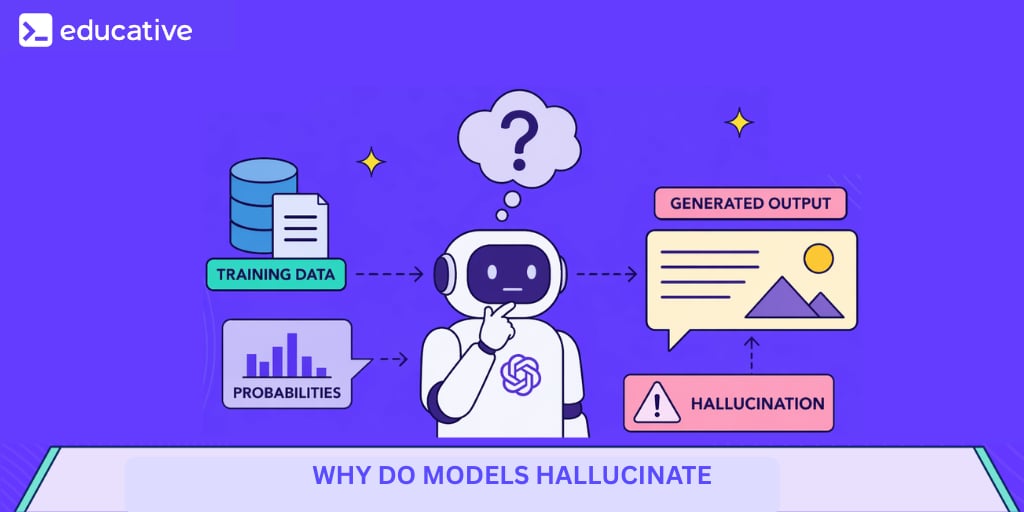
Generative AI systems have rapidly become central to many modern applications, including chatbots, coding assistants, research assistants, and intelligent search tools. Modern large language models can produce fluent text, generate code, summarize complex documents, and answer technical questions across a wide range of domains. Their ability to synthesize information in natural language has made them powerful tools for developers, researchers, and organizations building AI-driven products.
Despite these impressive capabilities, developers frequently encounter situations where generative models produce responses that are incorrect, fabricated, or unsupported by reliable information. These outputs often appear confident and well-structured, making them difficult to detect without careful verification. A model may cite nonexistent research papers, describe software libraries that do not exist, or provide technical explanations that sound plausible but contain subtle inaccuracies.
This behavior raises an important technical question for developers and researchers: why do models hallucinate, even when they appear to understand the question being asked.
Hallucinations are not random glitches or software bugs. Instead, they arise naturally from the way generative models are trained and how they produce outputs during inference. Understanding the mechanisms behind these errors is essential for building reliable AI systems and designing applications that account for the limitations of modern generative models.

Generative AI is rapidly reshaping how software is built, how decisions are made, and how humans interact with machines. From large language models to multimodal systems, understanding generative AI is becoming a foundational skill. This course focuses on generative AI essentials, giving you the conceptual clarity and practical perspective needed to navigate this fast-moving space with confidence. I built this course from my work in adaptive AI systems, intelligent tutoring platforms, and teaching complex machine learning concepts at scale. A recurring challenge I observed was that learners could use generative AI tools, but lacked a clear mental model of how these systems actually work. This course addresses that gap by breaking generative AI down into its core principles and connecting them to real-world applications. You’ll begin with the fundamentals of generative AI, including its evolution, key architectures, and language representations. From there, you’ll explore foundation models, pretraining, fine-tuning, and optimization strategies that power modern systems. The course also covers large language models, multimodal AI (vision and audio), and how context is constructed within neural systems. Throughout, you’ll develop the ability to interpret, guide, and effectively interact with AI systems. If you want to master generative AI essentials and build a strong foundation for working with modern AI systems, this course provides a clear, structured path to get there.
How generative models produce outputs#
Large language models and other generative systems are trained using deep neural networks and extremely large datasets that contain books, articles, code repositories, websites, and many other forms of digital text. During training, the model learns statistical relationships between tokens, phrases, and broader semantic structures. These patterns allow the system to recognize how language is typically used across different contexts.
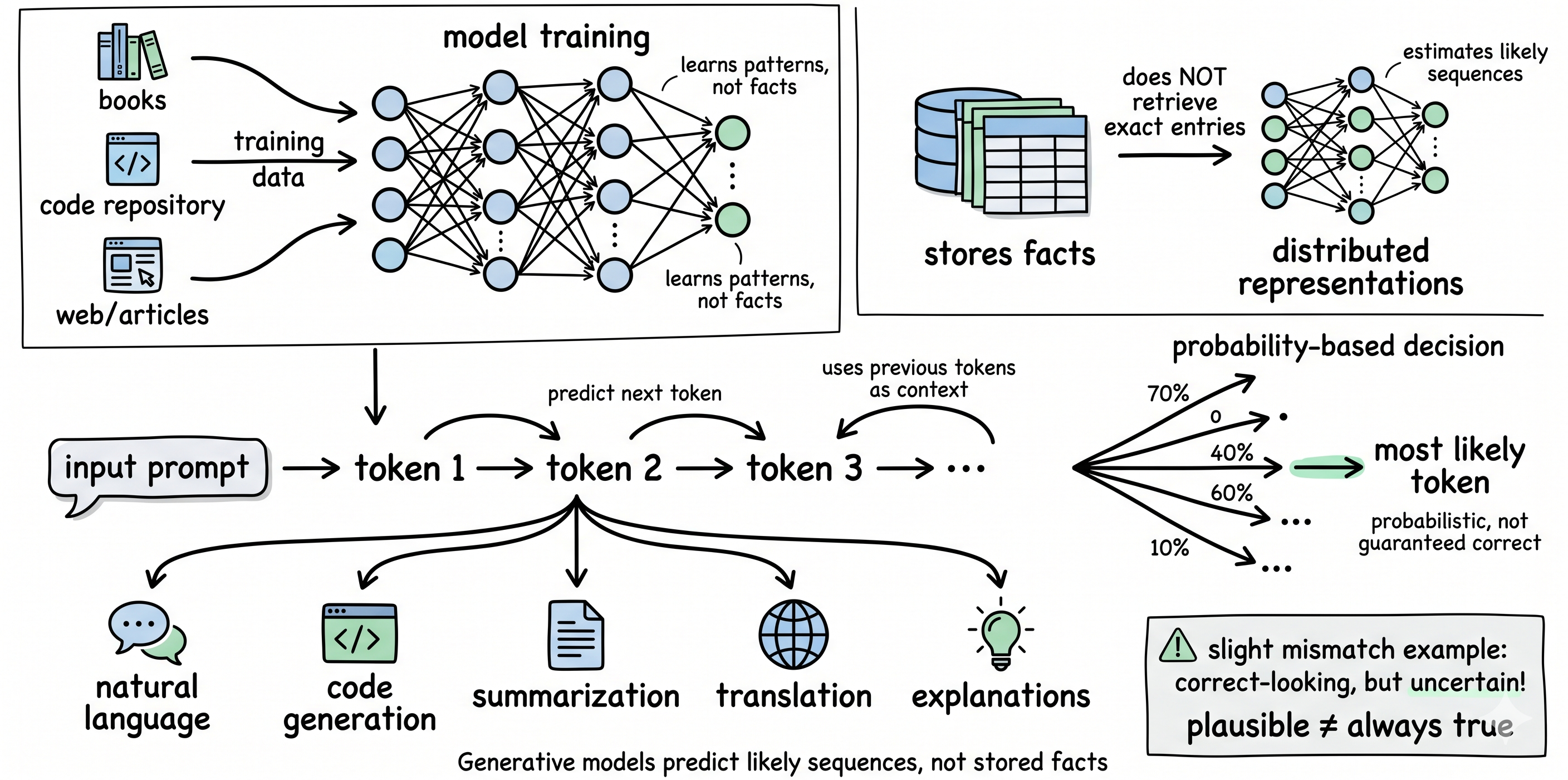
Unlike a traditional database or knowledge base, a generative model does not store facts as discrete entries that can be retrieved on demand. Instead, it learns a distributed representation of language patterns. These representations allow the model to estimate what sequence of tokens is most likely to appear given a particular input.
When a user submits a prompt, the model begins generating a response by predicting the most likely next token based on the input context and its learned patterns. This process repeats iteratively, producing a sequence of tokens that forms the final output. Each token prediction depends on the previously generated tokens and the statistical relationships encoded within the model.
This prediction process enables generative models to perform a wide range of tasks, including:
Producing natural language responses to user queries
Generating code snippets and programming explanations
Summarizing long documents or research papers
Translating between languages
Explaining technical concepts in detail
However, it is important to recognize that this generative process is probabilistic rather than deterministic. The model selects tokens based on likelihood rather than factual certainty. Because of this design, the model is optimized to produce responses that are linguistically plausible and contextually coherent, not necessarily responses that are guaranteed to be correct.
This probabilistic foundation is one of the key reasons developers investigate why do models hallucinate when working with generative AI systems.
What hallucinations mean in generative AI#
In the context of generative AI, hallucinations refer to outputs that contain fabricated, incorrect, or unsupported information. The model produces a response that appears coherent and authoritative, yet the information within that response does not correspond to verified facts.
Hallucinations can appear in many forms across different types of generative models. Common examples include:
Invented academic references or research papers
Incorrect explanations of technical or scientific concepts
Fabricated statistics or numerical data
Descriptions of programming libraries or APIs that do not exist

These outputs often emerge when the model encounters a prompt for which it lacks reliable or specific information. Instead of acknowledging uncertainty, the model attempts to generate a response that resembles the patterns it learned during training. Because the model is optimized to produce fluent language, it may generate detailed explanations that appear convincing even when the underlying information is incorrect.
Understanding hallucinations requires recognizing that generative models prioritize coherence and probability over verification. The model’s objective is to produce text that fits the expected structure of language rather than confirm whether the information is factually accurate.
This behavior helps clarify why do models hallucinate when faced with unfamiliar questions or incomplete context.
Root causes of hallucinations#
Hallucinations arise from several structural characteristics of modern generative AI systems. These characteristics are inherent to how the models are trained and how they generate outputs during inference.
Probabilistic text generation#
Generative models produce responses by predicting the most likely next token in a sequence rather than verifying factual accuracy. When the model lacks sufficient information to answer a question with confidence, it still attempts to generate a plausible continuation of the text. This mechanism can produce responses that sound correct even when they contain incorrect details.
Training data limitations#
Although large language models are trained on massive datasets, those datasets inevitably contain gaps, inconsistencies, outdated information, and noise. The model learns patterns from this imperfect data. As a result, when it encounters prompts involving niche topics, recent developments, or specialized technical domains, it may rely on incomplete or ambiguous signals from its training data.
Lack of external verification#
Most generative models operate without built-in fact-checking systems. During inference, they typically do not consult external knowledge bases, databases, or authoritative sources unless additional retrieval mechanisms are integrated into the system architecture. Without access to external verification, the model relies entirely on the statistical knowledge encoded during training.
Ambiguous prompts#
The structure of the input prompt also plays a significant role in hallucination behavior. If a prompt is vague, incomplete, or ambiguous, the model must infer missing context. These assumptions can lead to fabricated explanations, invented details, or incorrect interpretations of the user’s request.
Together, these structural factors explain why do models hallucinate in many real-world AI applications.
Comparing different hallucination causes#
Cause | Description | Impact on Model Output |
Probabilistic generation | Model predicts likely tokens | May produce plausible but incorrect text |
Training data gaps | Missing or outdated information | Leads to inaccurate answers |
Lack of grounding | No external knowledge retrieval | Increased hallucination risk |
Prompt ambiguity | Incomplete instructions | Model guesses missing details |
In practice, hallucinations rarely arise from a single factor. Instead, they often emerge from the interaction of several causes at once. A prompt may be ambiguous, the relevant knowledge may be missing from the training data, and the model may generate text based on probabilistic patterns that resemble previously seen explanations. These combined effects increase the likelihood that the model produces convincing but incorrect responses.
Example of hallucination in practice#
Consider a developer interacting with an AI assistant while building a new application. The developer asks the model for documentation about a hypothetical software library named StreamGraphJS. In reality, this library does not exist.
Rather than responding that it cannot find information about the library, the model may generate a detailed description explaining how StreamGraphJS works. The response might include invented APIs, example code snippets, configuration instructions, and even explanations of advanced features. The output may appear highly technical and structured in a way that resembles authentic documentation.
This occurs because the model recognizes patterns associated with documentation writing. It has seen many examples of programming library documentation during training, so it generates a response that fits the expected format of those documents. However, the underlying entity is fictional, and therefore the generated explanation is entirely fabricated.
This scenario illustrates another situation where developers encounter the question why models hallucinate when interacting with generative AI tools.
Engineering techniques to reduce hallucinations#
Although hallucinations cannot be completely eliminated, developers can significantly reduce their frequency through careful system design and engineering practices.
Retrieval-Augmented Generation (RAG)#
Retrieval-Augmented Generation integrates external information retrieval systems into the model’s response generation process. When a user submits a query, the system first retrieves relevant documents from a knowledge base, database, or search engine. These documents are then provided as additional context to the model during generation.
By grounding responses in real documents, RAG systems help reduce hallucinations and improve factual accuracy.

Retrieval-augmented generation (RAG) is rapidly becoming the standard for building reliable, production-ready LLM applications. As generative models face limitations around hallucination and stale knowledge, RAG provides a structured way to ground outputs in real data, making it essential for any system that requires accuracy, context, and trust. I built this course from my work in intelligent systems and adaptive AI, where combining retrieval with generation is critical for building systems that reason over dynamic information. A recurring pattern I observed was that developers could build LLM demos, but struggled to make them dependable in real-world scenarios. The missing piece was almost always retrieval. This course is designed to make RAG practical and approachable. You’ll learn RAG fundamentals through its architecture and workflows, then implement end-to-end pipelines using LangChain. You’ll build a working RAG application and extend it with a Streamlit frontend, focusing on how to structure data, queries, and responses effectively. Developers are already using RAG to power search, assistants, and enterprise AI systems. If you want to build LLM applications that are accurate and production-ready, this is where you start.
Structured prompting#
Clear and well-structured prompts reduce ambiguity and guide the model toward more reliable responses. Developers can specify constraints, request citations, or instruct the model to acknowledge uncertainty when information is unavailable.
Structured prompting helps narrow the range of possible interpretations and reduces the likelihood that the model will invent missing details.
Output validation systems#
Some AI applications use secondary validation mechanisms to verify generated outputs. These systems may include rule-based validators, fact-checking models, or programmatic checks that compare outputs against known data sources.
Validation layers act as a safeguard that detects potentially incorrect or fabricated responses before they reach end users.
Tool integration#
Allowing generative models to interact with external tools such as APIs, databases, or search engines reduces the need for the model to rely solely on its internal knowledge. When the model can query a database or call a search service, it can retrieve accurate information instead of attempting to infer or fabricate details.
Combining these strategies significantly improves the reliability of generative AI systems and reduces hallucination risk in production environments.
Designing trustworthy AI systems#
Reducing hallucinations requires more than selecting a powerful model. Building trustworthy AI systems involves thoughtful engineering decisions across the entire application stack.
Developers should monitor model outputs continuously in production environments to identify patterns of incorrect responses. Logging and evaluation pipelines can help teams detect hallucination trends and improve system prompts or retrieval mechanisms over time.
Providing citations and sources for generated answers can also improve transparency. When users can see where information originates, they can evaluate its reliability more effectively.
Another practical strategy is to limit the tasks assigned to generative models. Tasks that require precise factual accuracy, such as medical guidance, financial analysis, or legal interpretation, may require additional safeguards or human oversight.
Human review remains an important component of trustworthy AI systems. For critical workflows, incorporating expert validation ensures that incorrect model outputs do not propagate into decision-making processes.
Final words#
Generative AI systems have dramatically expanded the capabilities of modern software, enabling applications that can generate text, explain technical topics, and assist with complex workflows. However, these systems also introduce new reliability challenges that developers must understand and manage.
Exploring why models hallucinate reveals that hallucinations are a natural consequence of how generative models operate. Because language models generate outputs through probabilistic token prediction rather than explicit fact retrieval, they can produce responses that are coherent but incorrect.
These behaviors are further influenced by limitations in training data, the absence of built-in verification mechanisms, and ambiguity in user prompts. By integrating retrieval systems, designing structured prompts, implementing validation layers, and carefully monitoring production systems, developers can significantly reduce hallucination risk.
Understanding why models hallucinate is essential for building reliable generative AI applications and for designing systems that balance the creative power of AI with the safeguards needed for trustworthy deployment.
Happy learning!
