How to prepare for the AWS Solutions Architect certification
Struggling with AWS prep? Learn how to prepare for the AWS Solutions Architect certification by thinking like an architect, mastering system design, and understanding trade-offs. Build real-world cloud skills and pass with confidence.
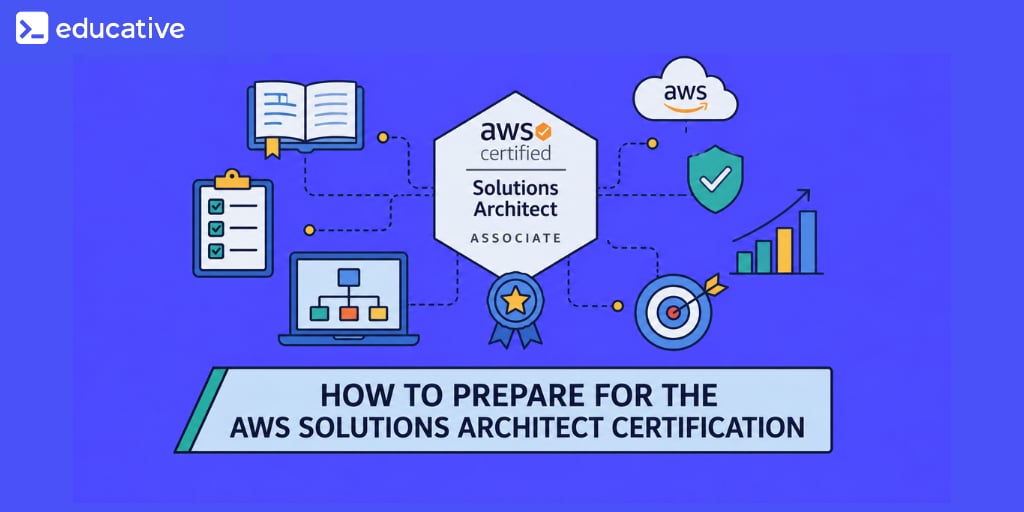
If you’ve started preparing for the AWS Solutions Architect exam, you’ve probably felt the initial overwhelm. There are dozens of services, countless features, and an endless stream of practice questions that all seem equally important. At first, it feels like the only way forward is to memorize everything and hope it sticks.
This is where many learners get stuck. They treat the exam as a test of recall rather than a test of understanding. You might find yourself asking, How can I prepare for the AWS Solutions Architect certification exam? and expecting a list of topics or resources. But the real answer is less about what to study and more about how you think while studying.
The exam is not designed to test whether you can remember service limits or feature lists. It’s designed to evaluate whether you can design systems on AWS, systems that are scalable, reliable, and cost-effective. To prepare effectively, you need to shift your focus from memorization to understanding how real systems are built and why certain decisions are made.
Master AWS Certified Solutions Architect Associate SAA-C03 Exam
Cloud architecture has become a core skill for modern engineers. Whether you're building backend systems, deploying microservices, or scaling global applications, understanding how to design on AWS is no longer optional. The challenge is that AWS is an ecosystem. Without a clear structure, it’s easy to get lost in services without understanding how to use them together to build secure, reliable systems. I built this course from my experience working on Azure’s Fabric Controller and Remote Desktop services for Windows Server. In those environments, we dealt with real-world problems around availability, fault tolerance, and large-scale system management. The pattern I’ve seen with learners is similar: they can learn individual services, but struggle to connect them into a complete architecture. This course is designed to help you think in systems, not just services. We focus on the core pillars of AWS architecture, security, reliability, performance, and cost optimization, and show how they come together in practical designs. You’ll learn how to secure accounts and resources, design for high availability using load balancing and replication, and choose the right storage and analytics services for performance. The course also includes hands-on Cloud Labs so you can deploy and interact with real AWS resources, along with practice exams aligned to the SAA-C03 certification. This approach has helped many learners build confidence in AWS and successfully prepare for certification. If you’re aiming to become an AWS Certified Solutions Architect Associate and design systems the right way, this course gives you a clear and structured path.
Why exam preparation is often misunderstood#

A common mistake in exam preparation to become a Solutions Architect is relying heavily on memorization and repetition. Many learners go through video courses, read documentation, and complete practice questions repeatedly, hoping that exposure alone will lead to success. While this approach can help you recognize patterns, it often fails when the exam presents slightly different scenarios.
The issue is that memorization does not build the kind of understanding required for architectural decisions. You might know what a service does, but not when to use it or why it is the best choice in a given situation. This gap becomes apparent when questions involve trade-offs or require you to evaluate multiple options.
Consider someone who has completed hundreds of practice questions but still struggles during the exam. The problem is not a lack of effort; it’s a lack of depth. Without understanding how systems behave and how services interact, it becomes difficult to apply knowledge in new contexts. This is why preparation needs to go beyond repetition.
Understanding how to prepare for the AWS Solutions Architect certification exam in practice#
To answer the question How can you prepare for the AWS Solutions Architect certification exam?, you need to focus on how systems are designed on AWS. The exam is built around scenarios that reflect real-world challenges, where you must choose the best solution based on requirements and constraints.
This means understanding how different services fit together. Instead of studying services in isolation, you should think about how they interact within a system. For example, how does a load balancer work with auto-scaling groups? How does a database choice affect performance and cost? These relationships are what the exam is testing.
The rest of your preparation should revolve around this idea. Every topic you study should connect back to system design. When you learn about a service, ask yourself how it would be used in a real system and what trade-offs it introduces. This approach builds the kind of understanding that the exam requires.
Learn the A to Z of Amazon Web Services (AWS)

Learn about the core AWS's services like compute, storage, networking services and how they work with other services like Identity, Mobile, Routing, and Security. This course provides you with a good grasp an all you need to know of AWS services. This course has been designed by three AWS Solution Certified Architects who have a combined industry experience of 17 years. We aim to provide you with just the right depth of knowledge you need to have.
Thinking like an architect instead of a test-taker#
One of the most important shifts you can make is moving from thinking like a test-taker to thinking like an architect. A test-taker looks for keywords and tries to match them to memorized answers. An architect evaluates the entire scenario, considers constraints, and chooses the most appropriate solution.
Exam questions are designed to reflect this mindset. You are often given a scenario with specific requirements, such as high availability, low latency, or cost optimization. The correct answer is not always the most obvious one; it’s the one that best balances these requirements.
Imagine a question about designing a highly available system. You might see options involving multiple availability zones, replication strategies, and failover mechanisms. Instead of looking for the “right” answer, you need to analyze how each option addresses the requirements. This is how architects think, and it’s how you should approach the exam.
Learning AWS services through use cases#
Understanding AWS services is essential, but the way you learn them matters. Instead of memorizing features, focus on use cases. Ask yourself when a service is appropriate and what problem it solves within a system.
For example, rather than memorizing the details of Amazon S3, think about how it is used in real systems. It might serve as a storage layer for static assets, a data lake for analytics, or a backup solution. Each use case highlights different aspects of the service and how it interacts with other components.
This context-driven approach helps you build a mental model of how systems are constructed. When you encounter a question on the exam, you can draw on these models to evaluate options. You are no longer guessing; you are reasoning based on how systems work.
Comparison of preparation approaches#
Approach | Focus | Effectiveness for exam | Long-term value |
Memorization-based preparation | Service features and definitions | Low for scenario-based questions | Minimal |
Practice-question-driven preparation | Pattern recognition and repetition | Moderate for familiar questions | Limited |
Conceptual, system-focused preparation | System design and decision-making | High for all question types | Strong real-world applicability |
This comparison highlights why many learners struggle despite putting in significant effort. Memorization-based preparation might help with simple questions, but it breaks down when scenarios become complex. Practice questions can improve familiarity, but they often reinforce patterns rather than understanding.
Conceptual preparation, on the other hand, builds a deeper understanding of how systems work. It allows you to adapt to new scenarios and make informed decisions. This not only improves your performance on the exam but also prepares you for real-world architecture challenges.
Understanding trade-offs in AWS architectures#
A key aspect of the exam is evaluating trade-offs. Every architectural decision involves balancing factors such as cost, performance, and reliability. The exam often presents multiple valid options, and your task is to choose the one that best fits the scenario.
For example, you might need to decide between a highly scalable solution that increases cost and a more cost-effective solution that introduces some limitations. The correct answer depends on the priorities outlined in the question. Understanding these trade-offs is essential for selecting the best option.
This is where your preparation pays off. By thinking in terms of systems and use cases, you can evaluate how each choice affects the overall architecture. You are not just choosing an answer; you are making a decision based on reasoning.
Connecting exam preparation to real-world systems#
One of the most valuable aspects of preparing for this exam is that it can directly translate into real-world skills. If you approach your preparation with the right mindset, you are not just studying for a test; you are learning how to design systems on AWS.
This means thinking about how services interact, how systems scale, and how failures are handled. These are the same considerations you would face in a production environment. By practicing this kind of thinking, you build skills that go beyond the exam.
When you connect your preparation to real-world scenarios, the material becomes more meaningful. You are no longer memorizing facts; you are understanding how systems work. This makes your learning more effective and more relevant.
Common mistakes during preparation#
One of the most common mistakes is focusing solely on passing the exam. This often leads to shortcuts such as memorizing answers or relying on exam dumps. While this might help in the short term, it does not build the understanding needed for real-world applications.
Another mistake is ignoring system-level thinking. If you study services in isolation, you miss the bigger picture of how they interact. This makes it difficult to answer scenario-based questions, which are a core part of the exam.
There is also a tendency to over-rely on repetition. While practice is important, it must be combined with understanding. Without this, you risk becoming familiar with questions without truly understanding the underlying concepts.
How to build confidence for the exam#
Confidence in the exam comes from understanding, not repetition. When you understand how systems are designed, you can approach questions with clarity and reasoning. You are not guessing; you are evaluating options based on your knowledge.
This also helps you eliminate incorrect answers. Even if you are unsure of the correct choice, you can identify options that do not meet the requirements. This increases your chances of selecting the best answer.
Over time, this approach builds confidence. You start to recognize patterns, understand trade-offs, and make decisions more effectively. This is the kind of confidence that comes from real understanding, not just practice.
Conclusion#
So, How can you prepare for the AWS Solutions Architect certification exam? The answer lies in shifting your focus from memorization to understanding. Instead of trying to learn everything, focus on how systems are built, how services interact, and how decisions are made.
This approach not only improves your chances of passing the exam but also prepares you for real-world architecture challenges. By thinking like an architect, you develop skills that extend far beyond the test itself.
In the end, the exam is not just a certification; it’s an opportunity to build a deeper understanding of cloud architecture. Approach it with that mindset, and you’ll gain far more than just a passing score.
Happy learning!
