How to study for the AWS Data Engineer certification
Learn how to study for AWS Data Engineer certification with a structured plan, real-world practice, and deep understanding of data pipelines. Build in-demand cloud skills, boost your career, and confidently pass the certification exam.
If you are planning to build a career in data engineering or cloud-based data systems, understanding how to study for AWS Data Engineer certification is one of the smartest moves you can make. This certification validates not only your knowledge of AWS services but also your ability to design, build, and optimize data pipelines in real-world scenarios.
The biggest mistake is approaching the exam as a memorization exercise rather than a systems-thinking problem. Once you shift your mindset and understand how to study for AWS Data Engineer certification strategically, the preparation process becomes far more effective and aligned with real-world data engineering skills.
Learn the A to Z of Amazon Web Services (AWS) Cover

Learn about the core AWS's services like compute, storage, networking services and how they work with other services like Identity, Mobile, Routing, and Security. This course provides you with a good grasp an all you need to know of AWS services. This course has been designed by three AWS Solution Certified Architects who have a combined industry experience of 17 years. We aim to provide you with just the right depth of knowledge you need to have.
Understanding The AWS Data Engineer Certification#
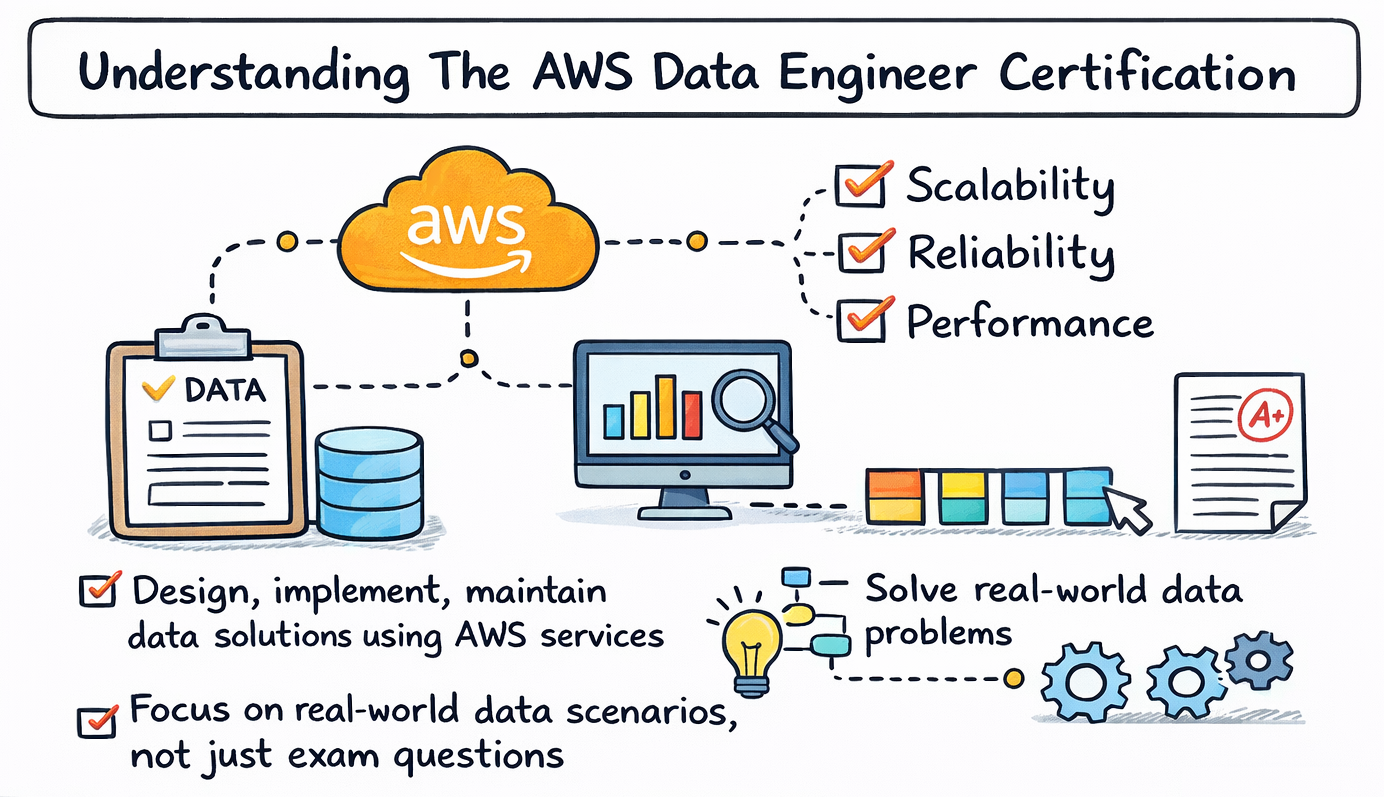
Before diving into preparation strategies, it is important to understand what the certification actually evaluates. The AWS Data Engineer certification focuses on your ability to design, implement, and maintain data solutions using AWS services, with an emphasis on scalability, reliability, and performance.
When you think about how to study for AWS Data Engineer certification, you should treat it as preparation for solving real-world data problems rather than simply passing an exam. The questions are designed to test your understanding of architecture decisions, trade-offs, and service integrations.
Data Analytics on AWS: An Architectural Guide

Due to the widespread adoption of the internet and the prevalence of connected devices, a large amount of data is generated every second. This abundance of data allows businesses to gather valuable insights and reinvent their businesses. Amazon Web Services (AWS) offers a range of solutions to help address these challenges. This course provides an overview of the data management and analytics services provided by AWS. You’ll begin with understanding different databases and how to migrate data between them. Then, you’ll learn about Amazon Simple Storage Service (S3) and set up data lakes. Next, you’ll learn about AWS data security features, including S3 encryption, Lake Formation access controls, and audit logging. You’ll also set up and run Extract, Transform, and Load (ETL) workflows on AWS Glue. You’ll finish with in-depth purpose-built analytics tools in AWS. By the end of this course, you’ll have mastered the data analytics and management tools that AWS offers.
Domain | Focus Area Description |
Data Ingestion | Collecting and importing data from various sources |
Data Transformation | Processing and transforming data pipelines |
Data Storage | Choosing appropriate storage solutions |
Data Analysis | Querying and analyzing datasets |
Security And Governance | Managing access, encryption, and compliance |
Understanding these domains is critical because they form the backbone of both the exam and real-world data engineering workflows.
Building The Right Mindset For Preparation#
One of the most overlooked aspects of how to study for AWS Data Engineer certification is mindset. Many candidates focus heavily on documentation and practice questions but fail to develop an intuition for system design and data flow.
In my experience, the candidates who perform best are those who approach preparation as if they are designing production systems. This means thinking about scalability, cost, latency, and fault tolerance rather than just memorizing service features.
Key AWS Services You Must Master#
To succeed in the certification, you need a strong understanding of specific AWS services that are central to data engineering workflows. These services often appear in exam questions and real-world scenarios.
Core AWS Services For Data Engineering#
Category | Key Services | Purpose |
Ingestion | Kinesis, Data Pipeline | Real-time and batch data ingestion |
Storage | S3, Redshift | Data storage and warehousing |
Processing | Glue, EMR | Data transformation and processing |
Querying | Athena | Serverless data querying |
Orchestration | Step Functions | Workflow management |
When preparing, focus on how these services interact rather than studying them in isolation.
Creating A Structured Study Plan#
A structured study plan is essential when figuring out how to study for AWS Data Engineer certification effectively. Without a plan, it is easy to get overwhelmed by the number of services and topics involved.
In my experience, a phased approach works best, where you start with foundational concepts and gradually move toward advanced topics. This ensures that you build a strong base before tackling complex scenarios.
Suggested Study Phases#
Phase | Focus Area Description |
Foundation | AWS basics, core services, and cloud concepts |
Intermediate | Data pipelines, storage strategies, and processing tools |
Advanced | Optimization, security, and system design scenarios |
This progression helps you connect concepts naturally and avoid confusion.
Learning Data Ingestion And Streaming#
Data ingestion is a critical part of the certification, as it involves collecting data from various sources and preparing it for processing. AWS provides services like Kinesis for real-time streaming and Data Pipeline for batch processing.
Understanding how to study for AWS Data Engineer certification requires you to focus on when to use streaming versus batch processing. This decision often depends on latency requirements and data volume, which are common considerations in exam questions.
Mastering Data Storage Solutions#
Storage is another core area that requires careful attention during preparation. AWS offers multiple storage options, each suited for different use cases, such as S3 for object storage and Redshift for data warehousing.
In real-world systems, choosing the right storage solution impacts performance, cost, and scalability. This is why exam questions often test your ability to select the appropriate storage service based on specific requirements.
Understanding Data Transformation And Processing#
Data transformation involves cleaning, aggregating, and preparing data for analysis. AWS services like Glue and EMR play a key role in this process by enabling large-scale data processing.
When learning how to study for AWS Data Engineer certification, focus on understanding how these services handle distributed processing and how they integrate with other AWS components.
Querying And Analyzing Data#
Once data is stored and processed, it needs to be analyzed to extract insights. AWS provides services like Athena, which allows you to query data directly from S3 using SQL.
Understanding how these tools work and when to use them is essential for both the certification and real-world applications. This knowledge helps you design efficient data pipelines and optimize performance.
Security And Governance Concepts#
Security is a critical aspect of data engineering, especially when dealing with sensitive information. AWS provides tools for encryption, access control, and compliance, which are all tested in the certification.
In my experience, candidates often overlook this area, but it plays a significant role in both exam questions and real-world systems. Understanding how to secure data pipelines is essential for building reliable solutions.
Practice With Real-World Scenarios#
One of the most effective ways to prepare is to practice with real-world scenarios. Instead of focusing only on theoretical knowledge, try designing data pipelines and solving practical problems.
This approach helps you internalize concepts and improves your ability to answer scenario-based questions, which are common in the certification exam.
Common Challenges And How To Overcome Them#
Preparing for the AWS Data Engineer certification can be challenging due to the breadth of topics and the complexity of services. Many candidates struggle with connecting concepts and applying them in practical scenarios.
In my experience, the best way to overcome these challenges is to focus on understanding workflows rather than individual services. This helps you see the bigger picture and improves your problem-solving skills.
AWS Data Engineer Certification Vs Other Certifications#
It is also helpful to understand how this certification compares to others in the AWS ecosystem.
Certification Comparison#
Certification Type | Focus Area |
Solutions Architect | System design and architecture |
Developer | Application development on AWS |
Data Engineer | Data pipelines and analytics systems |
This comparison highlights the specialized nature of the data engineer certification.
Time Commitment And Preparation Strategy#
The time required to prepare depends on your background and experience with AWS. Beginners may need several months to build a strong foundation, while experienced engineers can prepare more quickly.
When thinking about how to study for AWS Data Engineer certification, consistency is more important than intensity. Regular study sessions and hands-on practice lead to better retention and understanding.
Real-World Perspective On Certification Value#
From a career perspective, the AWS Data Engineer certification demonstrates your ability to work with modern data systems and cloud technologies. It is highly valued by employers and can open doors to new opportunities.
In my own experience, certifications are most valuable when combined with practical skills. This is why focusing on hands-on learning is essential during preparation.
Final Thoughts On How To Study For AWS Data Engineer Certification#
Understanding how to study for AWS Data Engineer certification is about more than passing an exam. It is about building a deep understanding of data engineering principles and cloud-based systems.
As you continue your preparation, focus on connecting concepts, practicing real-world scenarios, and developing a strong foundation. This approach will not only help you succeed in the certification but also prepare you for real-world challenges.