A developer’s guide to the solutions architect career path
This blog shows how to navigate the solutions architect career path by moving from coding to system design, gaining architectural thinking, and expanding into cloud, scalability, and communication skills.
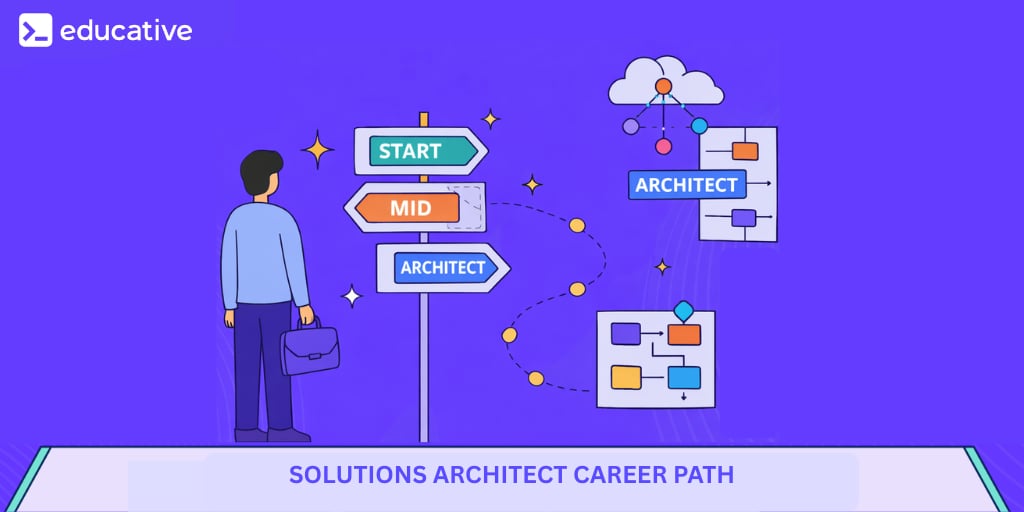
At some point in your career, you start thinking beyond writing code. You’ve spent years building features, debugging systems, and improving performance, but you begin to wonder what comes next. You might hear about architecture roles, see colleagues transition into them, or come across job postings that describe responsibilities at a system level. That’s usually when the idea of a solutions architect career path first enters your thinking.
At first, the role feels distant and abstract. It sounds like something that requires years of experience, deep knowledge, and a completely different skill set. You might assume that architects spend most of their time drawing diagrams or making high-level decisions that are disconnected from implementation. This perception makes the transition feel unclear and, in some cases, intimidating.
The reality is that the solutions architect career path is not a fixed route you follow step by step. It is a progression in how you think about systems, responsibilities, and decision-making. Understanding this shift is what makes the journey feel more grounded and achievable, rather than something reserved for a select few.
Cloud architecture has become a core skill for modern engineers. Whether you're building backend systems, deploying microservices, or scaling global applications, understanding how to design on AWS is no longer optional. The challenge is that AWS is an ecosystem. Without a clear structure, it’s easy to get lost in services without understanding how to use them together to build secure, reliable systems. I built this course from my experience working on Azure’s Fabric Controller and Remote Desktop services for Windows Server. In those environments, we dealt with real-world problems around availability, fault tolerance, and large-scale system management. The pattern I’ve seen with learners is similar: they can learn individual services, but struggle to connect them into a complete architecture. This course is designed to help you think in systems, not just services. We focus on the core pillars of AWS architecture, security, reliability, performance, and cost optimization, and show how they come together in practical designs. You’ll learn how to secure accounts and resources, design for high availability using load balancing and replication, and choose the right storage and analytics services for performance. The course also includes hands-on Cloud Labs so you can deploy and interact with real AWS resources, along with practice exams aligned to the SAA-C03 certification. This approach has helped many learners build confidence in AWS and successfully prepare for certification. If you’re aiming to become an AWS Certified Solutions Architect Associate and design systems the right way, this course gives you a clear and structured path.
What makes the solutions architect role different#
The most significant difference between a developer and a solutions architect lies in the scope of thinking. As a developer, your focus is on building features and solving specific problems within a defined context. You are concerned with correctness, efficiency, and maintainability at the code level. These are critical skills, but they operate within a relatively narrow boundary.

As an architect, that boundary expands dramatically. You are no longer just thinking about how a feature works, but how the entire system behaves. You consider how services interact, how data flows, and how the system responds under load or failure conditions. This shift from component-level thinking to system-level thinking is what defines the role.
For example, imagine implementing a payment feature as a developer. Your focus might be on validating inputs and ensuring transactions are processed correctly. As an architect, you would think about how that feature integrates with other services, how it scales during peak usage, and how failures are handled. This broader perspective is what makes the role fundamentally different.
The early stage: building strong engineering foundations#
Most architects begin their journey as developers or engineers. This stage is essential because it provides the technical foundation needed to understand how systems are built. Writing code, debugging issues, and working with real applications give you insights into how systems behave in practice.
During this phase, you develop an understanding of how different components interact. You learn how to troubleshoot problems, optimize performance, and maintain systems over time. These experiences are not just about solving immediate issues—they help you build intuition about how systems work.
This foundation becomes critical later in your career. Without it, it is difficult to make informed architectural decisions. You need to understand the implications of your choices at the implementation level, even if you are no longer writing code daily. This is why strong engineering experience is a cornerstone of the solutions architect career path.
The transition phase: moving toward system-level thinking#
The transition from developer to architect does not happen overnight. It begins gradually, as you start thinking beyond individual components. You become more aware of how different parts of the system interact and how changes in one area affect others.
This phase often involves exposure to challenges like scalability and performance. You might work on systems that need to handle increased traffic or deal with complex data flows. These experiences push you to think about architecture, even if it is not your primary role.
For instance, you might notice that a system struggles under heavy load. As a developer, you might optimize specific queries or improve caching. As you transition toward architecture, you begin to think about redesigning the system to handle load more effectively. This shift in perspective is a key part of the journey.
The solutions architect career path in practice#
The solutions architect career path is not linear, and it rarely follows a predefined sequence. Different individuals reach this role through different experiences, depending on the projects they work on and the opportunities they encounter. Some may transition gradually within their current role, while others may take on new responsibilities in different organizations.
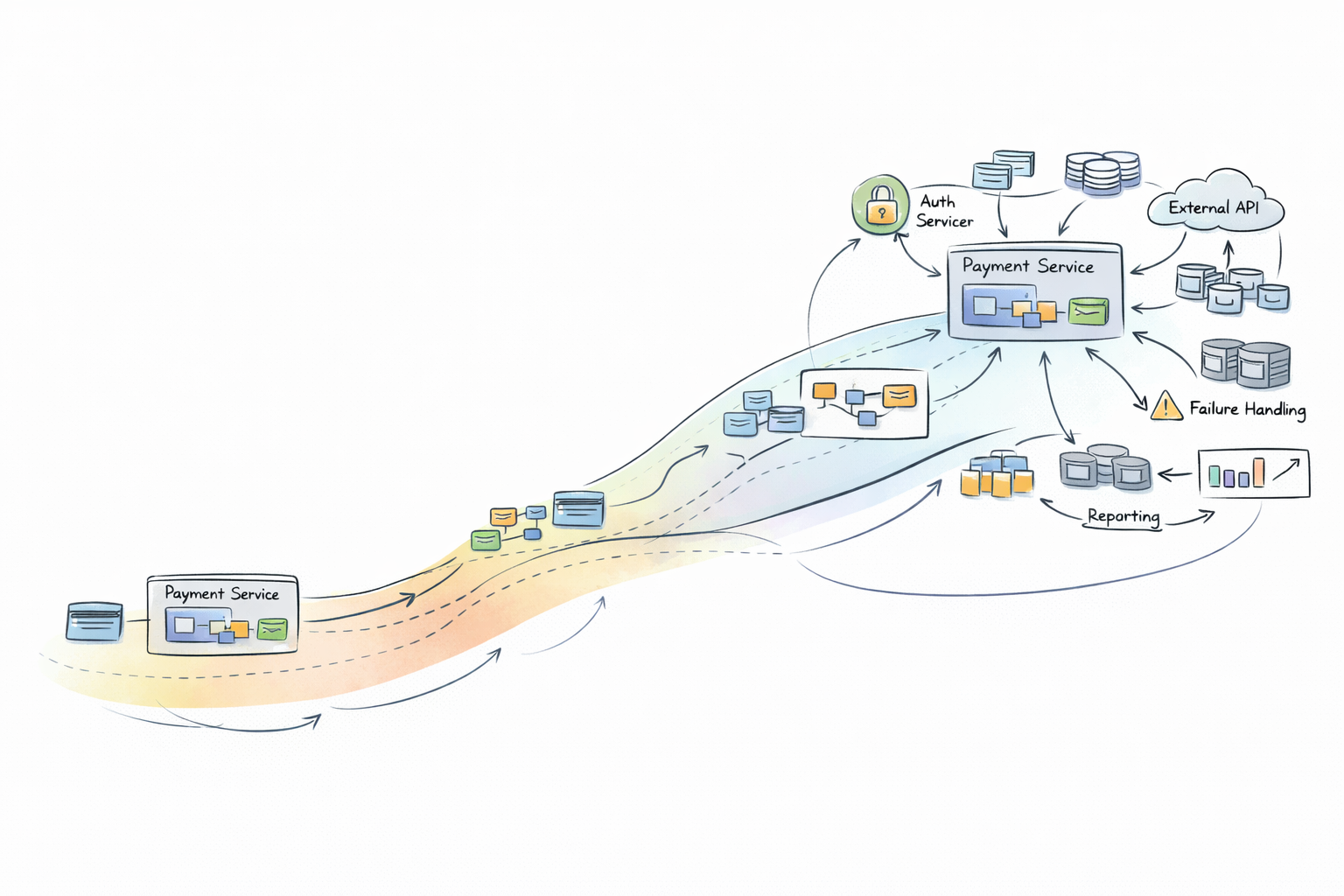
What remains consistent, however, is the progression in thinking. As you gain experience, your responsibilities expand. You move from solving specific problems to designing systems that address broader challenges. This evolution is shaped by the complexity of the systems you work on and the decisions you are required to make.
It is helpful to think of this path as a continuum rather than a ladder. You are constantly building on your previous experience, refining your understanding, and adapting to new challenges. This perspective makes the journey feel more organic and less constrained by rigid expectations.
Comparison of career stages#
Stage | Primary focus | Scope of decisions | Typical responsibilities |
Developer | Feature implementation | Code-level, localized | Writing and maintaining application logic |
Senior engineer | System improvements and scalability | Component-level, expanding | Optimizing performance, designing modules |
Solutions architect | System design and alignment | Cross-system, strategic | Designing architectures, guiding teams |
This progression highlights how responsibilities evolve over time. As a developer, your focus is on building features and ensuring they work correctly. As a senior engineer, you begin to think about improving systems and addressing performance challenges.
As a solutions architect, your role shifts toward designing systems and guiding teams. You are responsible for ensuring that different components work together effectively and that the system meets both technical and business requirements. This progression is not about replacing previous skills, but about building on them.
Developing system design expertise#
System Design becomes increasingly important as you move along this path. It is where you learn to think about systems in terms of scalability, reliability, and performance. These concepts are not theoretical—they directly influence how systems behave in real-world environments.
Developing this expertise requires practice and experience. You need to work on systems that handle real challenges, such as traffic spikes or distributed data processing. Over time, you begin to understand how different design choices affect outcomes.
This process is gradual. You start by applying basic concepts, then refine your understanding as you encounter more complex scenarios. Eventually, System Design becomes a natural way of thinking, rather than something you consciously apply.

For a decade, when developers talked about how to prepare for System Design Interviews, the answer was always Grokking System Design. This is that course — updated for the current tech landscape. As AI handles more of the routine work, engineers at every level are expected to operate with the architectural fluency that used to belong to Staff engineers. That's why System Design Interviews still determine starting level and compensation, and the bar keeps rising. I built this course from my experience building global-scale distributed systems at Microsoft and Meta — and from interviewing hundreds of candidates at both companies. The failure pattern I kept seeing wasn't a lack of technical knowledge. Even strong coders would hit a wall, because System Design Interviews don't test what you can build; they test whether you can reason through an ambiguous problem, communicate ideas clearly, and defend trade-offs in real time (all skills that matter more than ever now in the AI era). RESHADED is the framework I developed to fix that: a repeatable 45-minute roadmap through any open-ended System Design problem. The course covers the distributed systems fundamentals that appear in every interview – databases, caches, load balancers, CDNs, messaging queues, and more – then applies them across 13+ real-world case studies: YouTube, WhatsApp, Uber, Twitter, Google Maps, and modern systems like ChatGPT and AI/ML infrastructure. Then put your knowledge to the test with AI Mock Interviews designed to simulate the real interview experience. Hundreds of thousands of candidates have already used this course to land SWE, TPM, and EM roles at top companies. If you're serious about acing your next System Design Interview, this is the best place to start.
Expanding into cloud and distributed systems#
Modern architecture relies heavily on cloud platforms and distributed systems. As you progress in your career, you need to gain experience in these areas. This involves understanding how systems are deployed, scaled, and managed in cloud environments.
Working with cloud platforms exposes you to new challenges, such as managing resources efficiently and ensuring high availability. You also learn how distributed systems operate, including how data is replicated and how services communicate.
This knowledge is not just theoretical. It comes from working with real systems and understanding how they behave under different conditions. This practical exposure is what allows you to design systems that are both scalable and reliable.

This course is about establishing the basic principles of distributed systems. It explains the scope of their functionality by discussing what they can and cannot achieve. It also covers the basic algorithms and protocols of distributed systems through easy-to-follow examples and diagrams that illustrate the thinking behind some design decisions and expand on how they can be practiced. This course also discusses some of the issues that might arise when doing so, eliminates confusion around some terms (e.g., consistency), and fosters thinking about trade-offs when designing distributed systems. Moreover, it provides plenty of additional resources for those who want to invest more time in gaining a deeper understanding of the theoretical aspects of distributed systems.
The importance of communication and business alignment#
As you move into architecture roles, your interactions extend beyond technical teams. You begin working with product managers, business stakeholders, and other non-technical roles. This requires you to translate technical concepts into language that others can understand.
Communication becomes a key skill. You need to explain why certain decisions are made and how they impact the system. At the same time, you must ensure that technical solutions align with business goals.
For example, you might design a system that optimizes performance but increases cost. You need to explain this trade-off to stakeholders and ensure that it aligns with business priorities. This ability to bridge technical and business perspectives is essential for success.
Common misconceptions about the career path#
One common misconception is that there is a fixed path to becoming an architect. In reality, the journey varies widely depending on individual experiences and opportunities. There is no single route that guarantees success.
Another misunderstanding is that certifications alone define the transition. While certifications can provide structure, they do not replace real-world experience. The ability to design systems comes from working on complex applications and understanding how they behave.
There is also a belief that the role requires no coding background. This is not true. A strong technical foundation is essential for making informed decisions. Even if you are not coding daily, you need to understand how systems are implemented.
How to navigate your own journey#
Navigating your journey requires self-awareness and continuous learning. You need to assess your current skills and identify areas for growth. This might involve working on more complex systems or taking on responsibilities that expose you to architectural challenges.
You can start by focusing on areas that align with architecture, such as system design and scalability. Working on real projects helps you apply these concepts and build practical experience. Over time, this experience shapes your understanding and prepares you for more advanced roles.
Rather than following a rigid plan, think of your journey as an evolving process:
Seek opportunities to work on systems that require architectural thinking
Analyze how real-world systems are designed and understand their trade-offs
Gradually take on responsibilities that involve decision-making at a system level
This approach allows you to grow naturally, building skills and confidence along the way.
Final words#
The solutions architect career path is not defined by a series of steps, but by a progression in how you think about systems. It involves moving from implementation to design, from solving problems to shaping solutions, and from focusing on components to understanding entire systems.
As you gain experience, your responsibilities expand, and your perspective evolves. You begin to see how different parts of a system interact and how decisions impact outcomes. This shift is what defines the journey toward becoming an architect.
By focusing on building systems, understanding trade-offs, and developing your skills over time, you can navigate this path effectively. It is not about reaching a destination quickly, but about growing into a role that requires both depth and perspective.
Happy learning!
