How to get started with Express.js for web development
Ready to move into backend development? Learn how to get started with Express.js the right way, master middleware, understand request flow, and build scalable, maintainable APIs with a structured learning path.
If you already know JavaScript and want to move into backend development, you’ve probably asked yourself: How do I get started with Express.js for web development? The internet makes it look straightforward: install a package, define a few routes, and you have an API.
That part is easy.
The harder part is understanding how to build something maintainable, testable, and predictable. Express is minimal by design. It gives you power without guardrails. To use it well, you need to understand what it is, what it is not, and how backend systems actually behave under real usage.
Learn Express.js

Express.js is a popular Node.js framework, especially useful for building APIs and server-side apps. It’s lightweight, unopinionated, and flexible, giving you full control over how your app is structured. Whether new to backend development or ready to build production-grade services using JavaScript, Express is a great place to start. This customizable roadmap begins with a quick review of Node.js and asynchronous JavaScript. Then, you’ll cover Express.js essentials like routing, middleware, and modular app structure. You’ll learn to build RESTful APIs, connect your app to a database, and implement JSON web tokens (JWT) authentication. You’ll also explore validation and sanitization for added security. Finally, you’ll understand templating engines, real-time features using Socket.IO, and structured logging using Winston. By following this roadmap you’ll have a solid grasp of Express.js and the confidence to build secure, scalable, production-ready backend applications tailored to your own learning goals.
This guide focuses on architecture, mental models, and structured learning, not quick wins.
Why Express.js is popular for web development#
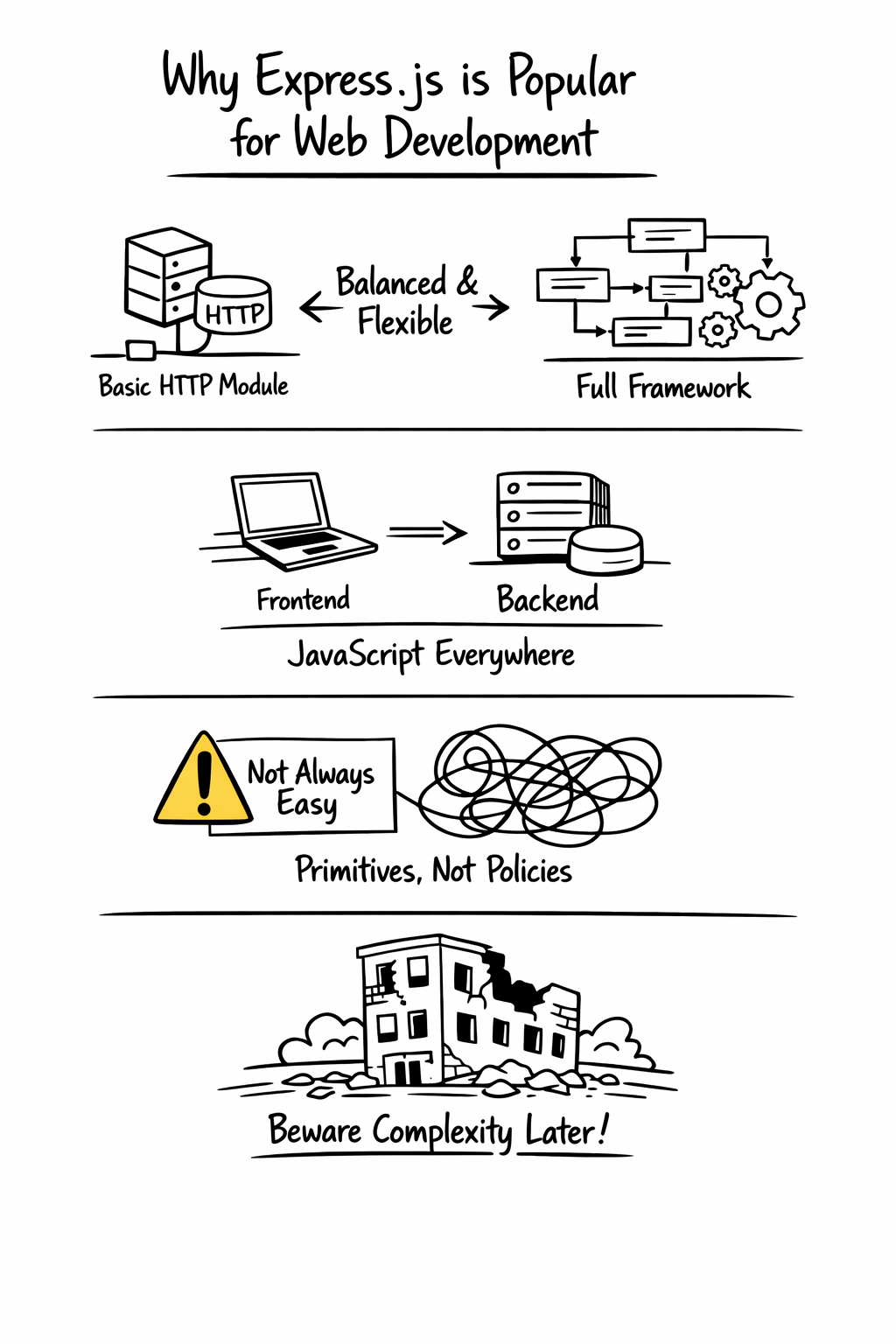
Before learning Express.js, it is important to know that it became popular because it sits in a useful middle ground.
It is more structured than using Node’s built-in http module directly, but far less opinionated than frameworks like Django or Rails. It gives you routing, middleware support, and a simple abstraction over HTTP without dictating how your application must be organized.
For JavaScript developers, it also offers continuity. You stay in the same language across the frontend and backend. That reduces context switching and makes it easier to move between layers of your stack.
But popularity does not mean simplicity in the long term.
Express is often described as “minimal.” That word is misleading. Minimal does not mean basic. It means it provides primitives, not policies.
If you misunderstand those primitives, your application will work at first and then slowly degrade into something difficult to maintain.
Express is not:
A full-stack framework
An ORM
An authentication solution
A deployment platform
It is a thin, flexible layer for handling HTTP requests in Node.js.
Once you understand that, you stop expecting it to solve problems it was never designed to address.
Beginning Node.js, Express & MongoDB Development
In this course, you’ll learn how to build a full-stack application using the MERN stack and deploy it to the internet. The MERN stack is a popular stack of technologies that build modern Single Page Applications (SPAs). You’ll begin with the basics of MongoDB and the process of setting it up. Next, you will go over work with the Atlas cloud database. Then, you’ll learn how to set up the backend using Node and express. Also, you’ll be creating a fully functional movie review application. After creating the controller and data access objects, you’ll learn to create routes. Next, you’ll test the created API. Finally, you’ll learn how to create the frontend using the React components and deploy the application on Heroku. By the end of this course, you’ll learn how to connect both the backend and the frontend to create a full-stack MERN application, as well as how to deploy it.
What happens when a request hits an Express server#
The most important concept when understanding how Express works is not routing. It is flow.
Every request travels through a chain of middleware functions. Understanding that chain is the difference between writing demos and building systems.
Here is the lifecycle in practical terms:
The HTTP request arrives at your server.
Express matches it against registered middleware in the order they were added.
Each middleware function receives (req, res, next).
Middleware can modify the request, send a response, or pass control forward.
If an error occurs, error-handling middleware (with four parameters) takes over.
Everything is linear and ordered.
Order matters.
If you register JSON parsing middleware after defining your routes, req.body will be undefined in those routes. If you place authentication middleware below protected routes, those routes will not be protected.
These are not edge cases. They are structural realities of the framework.
A strong Express developer can explain the exact order in which middleware executes and how errors propagate through that chain.
Consider asynchronous code. If an async route throws an error, how does Express catch it? Do you need to wrap handlers? Should you use a helper? How do you ensure centralized error formatting?
These questions move you from “I can define endpoints” to “I can design APIs.”
In Express, architecture is expressed through middleware order and separation of concerns.
If you internalize that sentence, you will approach learning differently.
Recommended learning resources#
When someone asks, How do I get started with Express.js for web development?, the best answer depends on what stage they are in.
If you are transitioning from frontend JavaScript, you need structure first. Not deployment pipelines. Not microservices. Structure.
Educative – Learn Express.js#
Educative’s course is effective because it emphasizes interactive learning and structured progression.
Instead of passively watching someone else build an API, you write and execute code directly in the browser. That interaction matters. Express concepts—especially middleware execution and request flow—become clearer when you run code yourself and see what happens.
The course progresses logically. It introduces routing, then middleware, then more advanced concepts in sequence. That sequencing is helpful for developers who already know JavaScript syntax but need backend mental models.
Who is it best for?
Developers who:
Know JavaScript fundamentals
Are new to backend frameworks
Want guided progression rather than scattered blog posts
Prefer interactive coding to video-only content
It is not a deployment deep dive. It is not a distributed systems course. It is a structured backend foundation.
After you build that foundation, the official Express documentation becomes much more valuable. The docs are precise and technically clear, but they assume some familiarity.
Video tutorials from creators like The Net Ninja or Traversy Media are also widely respected. They are useful for seeing complete examples in context, especially when integrating databases or authentication libraries.
However, video tutorials often encourage passive consumption. Unless you pause, retype, and modify examples, understanding remains shallow.
The difference between these resources is not quality. It is learning mode.
Structured interactive courses build muscle memory.Documentation builds precision.Video tutorials build exposure.
The key is sequencing them deliberately.
Comparison table of resources#
Resource | Focus | Depth | Strengths | Limitations |
Educative – Learn Express.js | Structured backend fundamentals | Moderate, progressive | Interactive coding, logical sequencing | Limited infrastructure coverage |
Official Express Docs | Technical reference | Deep API clarity | Authoritative explanations | Not beginner-narrative driven |
The Net Ninja | Guided practical apps | Moderate | Visual walkthroughs | Risk of passive learning |
Traversy Media | Full-stack integration demos | Moderate | Real-world examples | Less architectural emphasis |
Notice that none of these resources promise production readiness. That comes from building independently.
A realistic learning progression#
Learning Express should follow a deliberate path.
Understand routing and how URL parameters work.
Experiment with middleware order and observe behavior.
Implement centralized error handling.
Separate routes, controllers, and business logic.
Build a small API independently without referencing a tutorial.
Each step builds a different layer of competence.
Routing teaches you mechanics.
Middleware experimentation teaches you flow.
Error handling teaches you resilience.
Separation of concerns teaches you maintainability.
Independent building teaches you confidence.
If you skip the final step, you remain tutorial-dependent.
A narrative walkthrough: from beginner to production-ready thinking#
Imagine you start with only JavaScript experience.
You begin with a structured course like Educative. You create a basic server. You define GET and POST routes. You parse JSON bodies.
Then you build a small project—perhaps a simple blog API.
Initially, everything is in one file.
As features grow, you notice duplication. You extract routes into a separate module. Then you realize business logic should not live inside route definitions, so you create a service layer.
You add centralized error handling middleware to avoid repeating res.status(500) everywhere.
You introduce authentication middleware and notice how middleware order affects access control.
You refactor again.
Now your folder structure reflects intent. Routes are thin. Controllers orchestrate logic. Services encapsulate domain rules.
At this stage, you read the official documentation differently. It is no longer abstract. It maps to real problems you’ve encountered.
This iterative restructuring is how backend understanding develops.
How to know you're ready to build production APIs#
Production readiness is not about advanced optimization techniques. It is about clarity and predictability.
You are likely ready when:
You understand the full request lifecycle from entry to response.
You use centralized error-handling middleware consistently.
You separate routing from business logic.
You handle asynchronous code safely and deliberately.
You can add cross-cutting concerns (logging, authentication, validation) without restructuring your entire app.
Production systems introduce additional concerns: environment configuration, security hardening, performance, monitoring. But those build on architectural clarity.
If your structure is unstable, scaling only magnifies the instability.
Conclusion#
Express is powerful precisely because it is minimal.
If you are asking How do I get started with Express.js for web development?, focus first on understanding the request–response lifecycle and middleware flow. Use structured, interactive resources like Educative to build strong foundations. Reinforce your understanding with official documentation and practical examples.
Then stop consuming and start building.
Backend development is not about memorizing route definitions. It is about designing predictable systems. Express gives you the tools. Your job is to learn how to assemble them responsibly.
