How to learn Express.js from scratch
Want to build powerful backend applications with Node.js? Understand how to learn Express.js step by step and discover how routing, middleware, and APIs work together to power modern web development.
Modern web applications depend heavily on reliable backend systems that process requests, manage data, and deliver responses efficiently. Express.js has become one of the most widely used backend frameworks in the JavaScript ecosystem, making it an essential technology for developers interested in server-side development.
Many aspiring backend developers eventually ask how to learn Express.js because it forms the foundation of countless web APIs and server applications. Express simplifies Node.js server development by providing tools that handle routing, middleware, and request processing with minimal configuration.
Understanding how to learn Express.js effectively requires more than simply reading documentation. Developers must combine theoretical learning with practical projects that demonstrate how Express powers real-world web services and application backends.
Learn Express.js

Express.js is a popular Node.js framework, especially useful for building APIs and server-side apps. It’s lightweight, unopinionated, and flexible, giving you full control over how your app is structured. Whether new to backend development or ready to build production-grade services using JavaScript, Express is a great place to start. This customizable roadmap begins with a quick review of Node.js and asynchronous JavaScript. Then, you’ll cover Express.js essentials like routing, middleware, and modular app structure. You’ll learn to build RESTful APIs, connect your app to a database, and implement JSON web tokens (JWT) authentication. You’ll also explore validation and sanitization for added security. Finally, you’ll understand templating engines, real-time features using Socket.IO, and structured logging using Winston. By following this roadmap you’ll have a solid grasp of Express.js and the confidence to build secure, scalable, production-ready backend applications tailored to your own learning goals.
Understanding What Express.js Is#
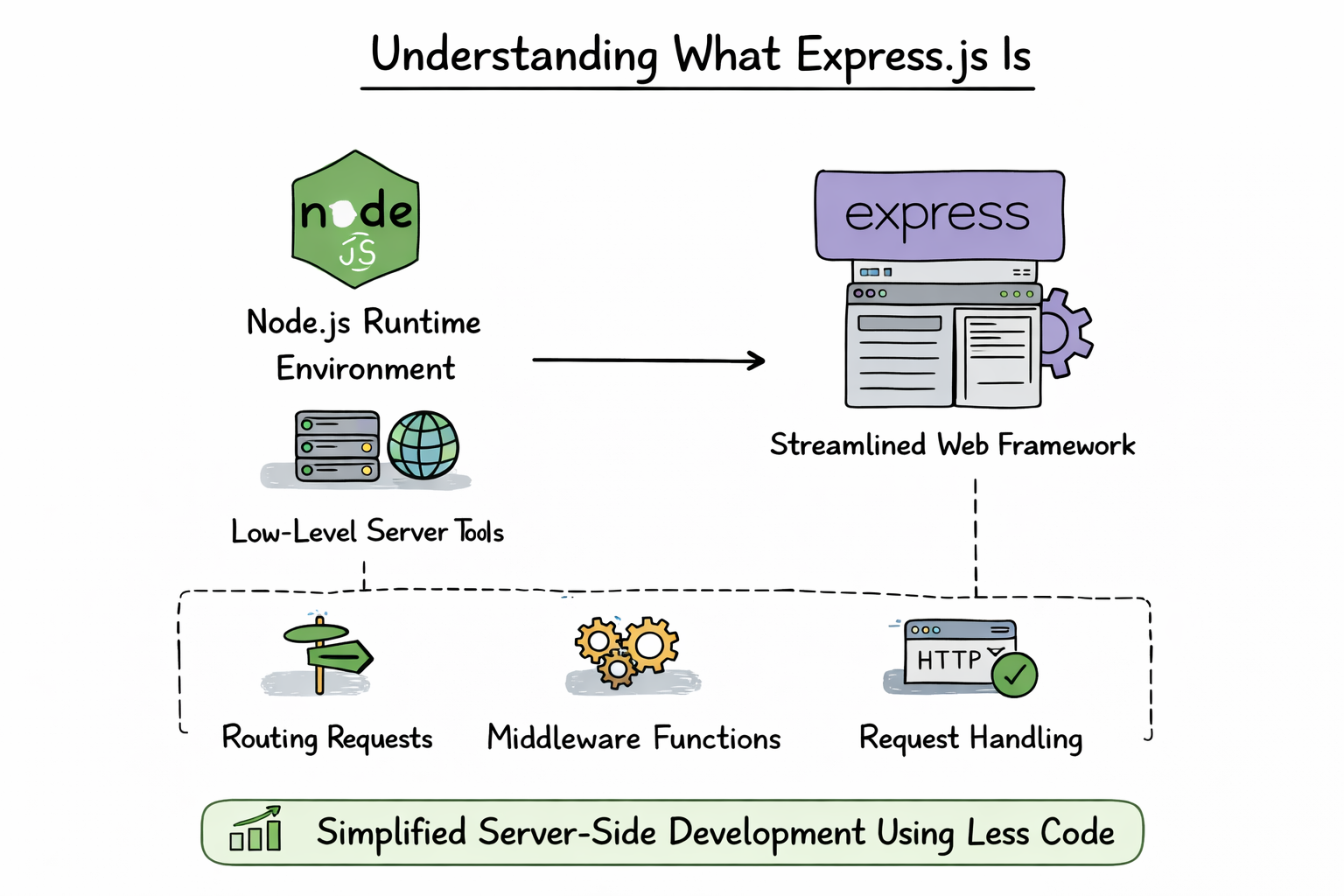
Before understanding how to learn Express.js, it is important to understand the purpose of the framework and the role it plays in web development. Express.js is a lightweight web framework built on top of Node.js that helps developers build server-side applications and APIs.
Node.js itself provides the runtime environment that allows JavaScript to run outside the browser. However, building full applications directly using Node.js can require writing complex server logic from scratch.
Express.js simplifies this process by offering structured tools that manage routing, middleware, and request handling. These tools allow developers to build scalable web servers using significantly less code.
Beginning Node.js, Express & MongoDB Development
In this course, you’ll learn how to build a full-stack application using the MERN stack and deploy it to the internet. The MERN stack is a popular stack of technologies that build modern Single Page Applications (SPAs). You’ll begin with the basics of MongoDB and the process of setting it up. Next, you will go over work with the Atlas cloud database. Then, you’ll learn how to set up the backend using Node and express. Also, you’ll be creating a fully functional movie review application. After creating the controller and data access objects, you’ll learn to create routes. Next, you’ll test the created API. Finally, you’ll learn how to create the frontend using the React components and deploy the application on Heroku. By the end of this course, you’ll learn how to connect both the backend and the frontend to create a full-stack MERN application, as well as how to deploy it.
Why Developers Should Learn Express.js#
Express.js has remained one of the most popular backend technologies for JavaScript developers for many years. Its simplicity and flexibility make it suitable for both small projects and large production systems.
Understanding how to learn Express.js allows developers to build REST APIs that power web applications, mobile apps, and cloud services. Many modern full-stack frameworks also rely on Express concepts such as routing and middleware.
Another reason developers choose to learn Express involves its massive community support. Thousands of tutorials, libraries, and open-source projects make it easier to learn and solve development challenges.
Prerequisites For Learning Express.js#
Before starting the journey of learning Express.js, developers should first understand several fundamental technologies. Express operates within the Node.js ecosystem, which means basic knowledge of JavaScript and server-side programming is essential.
The table below outlines the core prerequisites developers should learn before beginning Express development.
Skill | Why It Matters | Example Application |
JavaScript Fundamentals | Express uses JavaScript syntax | Variables, functions, callbacks |
Node.js Basics | Express runs on Node.js | Creating simple servers |
HTTP Protocol | Express processes HTTP requests | Understanding GET and POST |
Command Line Usage | Installing packages and running servers | Using npm commands |
These foundational skills help developers understand how Express interacts with Node.js and web technologies.
Understanding The Architecture Of Express Applications#
A key part of knowing how to learn Express.js involves understanding the architecture of Express applications. Express organizes backend code into components that process requests and generate responses.
Every Express application begins with a server instance that listens for incoming HTTP requests. These requests pass through routing systems and middleware before a response is sent back to the client.
The following table illustrates the core architectural components of an Express application.
Component | Purpose | Role In Application |
Express Application Instance | Initializes server | Handles incoming traffic |
Routing System | Maps URLs to handlers | Directs request processing |
Middleware | Processes requests | Handles authentication and validation |
Request Object | Contains request data | Access query parameters and body |
Response Object | Sends responses to client | Returns JSON or HTML output |
Understanding these components allows developers to visualize how Express processes requests.
Setting Up An Express Development Environment#
Setting up a development environment is one of the first steps when understanding how to learn Express.js. Developers typically begin by installing Node.js and using the Node package manager to install Express.
The development environment usually includes a code editor, Node.js runtime, and a project directory containing configuration files and dependencies. This setup provides the tools needed to build and run Express applications.
Once Express is installed, developers can create a simple server that listens for requests and returns responses. This initial step helps learners understand how Express applications operate.
Understanding Routing In Express#
Routing is one of the most fundamental concepts in Express development. When developers study how to learn Express.js, they quickly discover that routing controls how servers respond to different URLs.
Routes define which function should handle a particular request. For example, a route may return user information, process login requests, or update database records.
The table below illustrates common HTTP methods used in Express routing.
HTTP Method | Purpose | Example Endpoint |
GET | Retrieve data | /users |
POST | Create new resource | /users/create |
PUT | Update existing resource | /users/update |
DELETE | Remove resource | /users/delete |
These routes allow developers to organize backend logic and build RESTful APIs.
Learning Middleware In Express#
Middleware represents one of the most powerful features of Express. When starting with Express.js, developers must understand how middleware functions process requests within the application pipeline.
Middleware functions execute before the final route handler sends a response. These functions can perform tasks such as authentication checks, logging activity, or validating input data.
Middleware creates a modular architecture where different components handle different aspects of request processing. This design allows developers to build scalable backend systems.
Types Of Middleware Used In Express#
Express applications typically use several categories of middleware that perform specialized functions. Understanding these categories helps developers design well-structured server architectures.
The following table highlights common middleware types used in Express development.
Middleware Type | Function | Example Use |
Application Middleware | Runs for all requests | Logging and request parsing |
Router Middleware | Runs for specific routes | Authentication checks |
Error Handling Middleware | Handles application errors | Sending error responses |
Built-In Middleware | Provided by Express | JSON parsing |
Each middleware function contributes to processing requests before the response is generated.
Building REST APIs With Express#
One of the most practical ways to learn how to learn Express.js is by building REST APIs. APIs allow applications to communicate with backend servers to retrieve and update data.
REST APIs typically consist of endpoints that represent resources such as users, products, or orders. Each endpoint responds to specific HTTP methods that define the operation being performed.
Developers commonly build APIs for mobile applications, web platforms, and cloud services using Express. This makes Express one of the most widely used backend frameworks for API development.
Connecting Express Applications To Databases#
Most real-world applications require persistent data storage. Developers learning Express.js eventually integrate databases into their applications.
Databases such as MongoDB, PostgreSQL, and MySQL allow Express servers to store and retrieve structured information. Express route handlers often communicate with databases to process requests and return results.
Database integration allows developers to build applications that manage users, store content, and track transactions. This capability transforms simple Express servers into fully functional backend systems.
Structuring Large Express Projects#
As Express applications grow in complexity, organizing code becomes increasingly important. Developers often divide applications into modules that separate routing, business logic, and database interactions.
This structure helps maintain readability and scalability in large codebases. Many teams adopt architectural patterns such as MVC to organize Express applications.
Understanding application structure is an important step in mastering how to learn Express.js effectively. Good organization helps developers collaborate and maintain large backend systems.
Building Real Projects To Practice Express#
Projects play a major role in reinforcing Express knowledge. While tutorials explain individual concepts, projects require developers to combine routing, middleware, and database integration into working applications.
The following table highlights beginner-friendly projects that help developers practice Express development.
Project Type | Skills Learned | Example Outcome |
REST API For Blog | Routing and middleware | Content management API |
Authentication System | User login and security | Login service |
Task Management API | CRUD operations | Project tracker |
File Upload Service | Handling request data | Image upload API |
Working on projects helps developers gain confidence and understand how Express operates in real applications.
Debugging And Troubleshooting Express Applications#
Debugging is an essential skill when learning Express.js. Developers frequently encounter errors related to routing logic, middleware configuration, or asynchronous code.
Understanding error messages and analyzing server logs helps identify the root cause of issues. Express provides tools that allow developers to implement error-handling middleware to manage application failures.
Over time, debugging experience strengthens a developer's ability to diagnose and resolve complex backend issues.
Improving Performance In Express Applications#
Performance optimization becomes important as Express applications handle increasing traffic. Developers often use techniques such as caching, load balancing, and efficient database queries to improve performance.
Node.js and Express benefit from asynchronous programming, which allows servers to handle many requests simultaneously. This architecture improves scalability for high-traffic applications.
Developers who learn performance optimization techniques can build backend systems that support large user bases without performance degradation.
Learning Resources For Express Development#
Understanding how to learn Express.js effectively often involves combining several educational resources. Official documentation provides detailed explanations of framework features and configuration options.
Online courses and tutorials offer structured learning paths that guide developers through building applications step by step. Open-source projects also provide valuable insights into how experienced developers structure Express applications.
Exploring real-world codebases helps learners understand practical development patterns and architectural decisions.
Conclusion#
Understanding how to learn Express.js is an important step for developers interested in backend JavaScript development. Express provides the tools necessary to build web servers, APIs, and scalable backend applications.
By learning routing, middleware, database integration, and project structure, developers gain the skills required to create modern backend systems. These concepts form the foundation for many advanced web development technologies.
Developers who master Express can build powerful server applications that support web platforms, mobile apps, and cloud services.
