How to prepare for a React interview
Preparing for a React interview requires more than memorizing concepts. Learn how to build strong React fundamentals, practice real coding problems, and confidently explain your projects so you can stand out in competitive developer interviews.
Preparing for a React interview requires more than simply memorizing framework syntax or reviewing documentation. Modern React interviews evaluate how well developers understand JavaScript fundamentals, component architecture, state management, and real-world application design.
Many candidates focus only on React APIs while overlooking the broader skills that interviewers actually assess. Successful candidates demonstrate a deep understanding of how React works internally, how to structure scalable applications, and how to solve problems using component-based design.
Learn React 19: The Complete Guide to Modern Web Apps

React remains one of the most widely used libraries for building modern web applications. This course focuses on modern React (React 18+ and emerging React 19 capabilities), covering improvements in rendering, concurrency, and application architecture that help developers build faster and more scalable user interfaces. This course takes you beyond the fundamentals and focuses on building production-ready React applications. You'll learn how to structure large React codebases using feature-based architecture, state ownership principles, context segmentation, reducer patterns, and headless or compound components. You'll also explore React’s rendering internals, including the Fiber architecture, render and commit phases, and modern concurrent rendering patterns using transitions and Suspense, along with performance optimization strategies such as memoization and component profiling. The course then moves into modern async UI patterns, teaching you how to build responsive interfaces using Suspense, server-side and streaming rendering concepts, lazy loading, and error boundaries, along with an introduction to React Server Components (RSC). You'll learn how to manage server data effectively using TanStack Query (formerly React Query), including caching, dependent queries, optimistic updates, and query invalidation. The course also introduces real-time-inspired and offline-first UI strategies, background synchronization, and performance techniques such as using Web Workers for off-main-thread computation. Beyond architecture and data management, you'll learn how to build complex forms, scalable workflows, and accessible user interfaces, along with practical testing strategies using React Testing Library. The course concludes with production-focused topics including accessibility architecture, internationalization (i18n), design systems, security considerations, and deployment practices. You'll be able to design, optimize, and deploy scalable React applications using modern architectural and performance patterns. Throughout the course, you'll apply what you learn through two hands-on projects: Task Manager Dashboard: Build a complete React dashboard that manages tasks, routing, state, and API interactions. Product Launch Readiness Board: Build a modern collaboration tool featuring optimistic updates, offline-capable editing, simulated real-time collaboration (UI-level), Suspense-based lazy loading, and a themeable, internationalized UI.
Learning how to prepare for a React interview involves developing a balanced strategy that combines technical knowledge, practical coding ability, and experience explaining architectural decisions.
Understanding What React Interviews Actually Test#
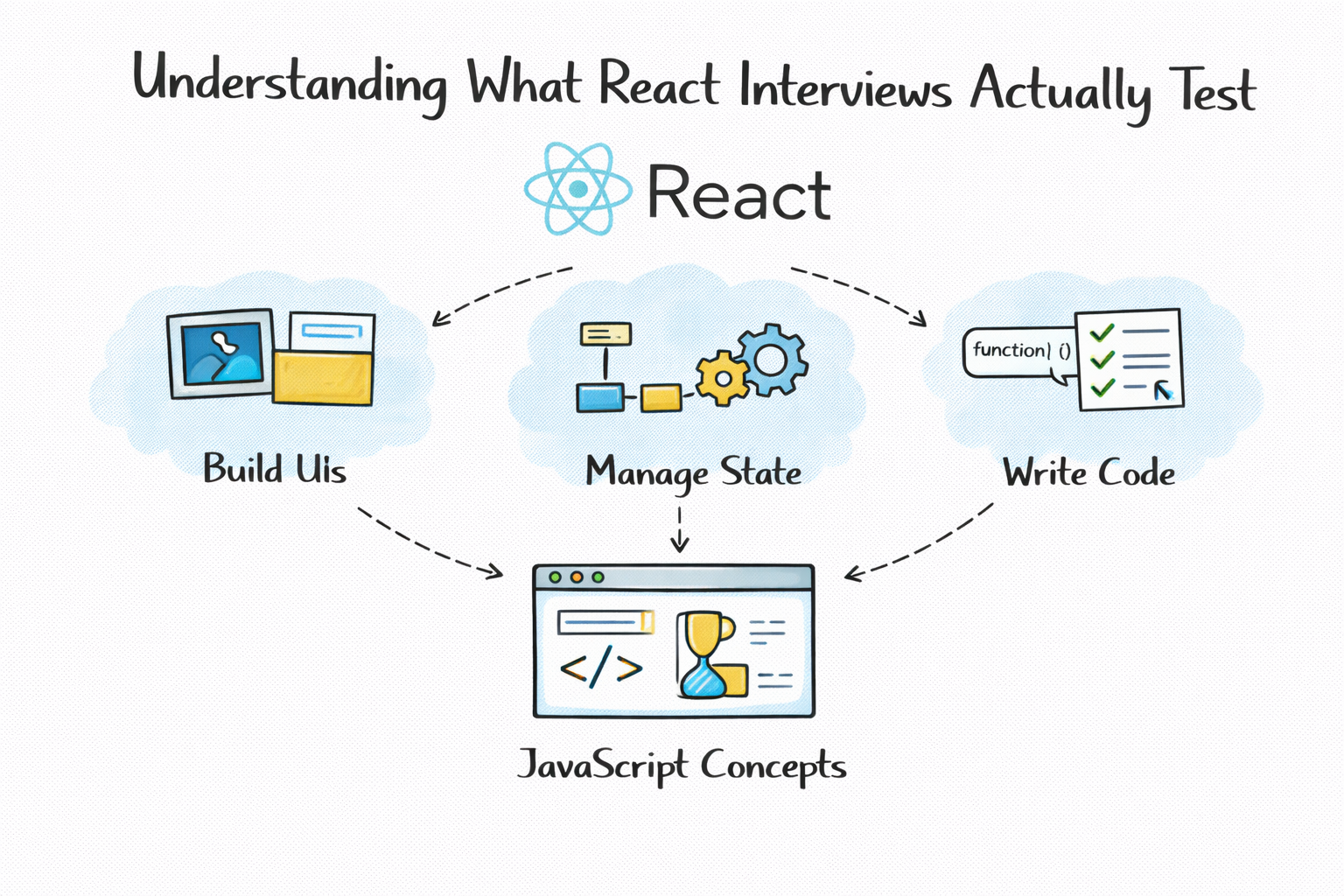
React interviews often evaluate several different skill areas rather than focusing on a single framework feature. Interviewers want to understand how well candidates can build user interfaces, manage state, and write maintainable code within a modern front-end environment.
Companies also expect React developers to have strong JavaScript knowledge because React itself is built entirely on top of JavaScript concepts. Many interview questions, therefore, explore closures, asynchronous programming, array methods, and functional programming patterns.
The table below shows the primary areas that React interviews typically evaluate.
Skill Area | What Interviewers Evaluate |
JavaScript Fundamentals | Closures, promises, array methods |
React Core Concepts | Components, props, state, hooks |
Application Architecture | Component structure and data flow |
Performance Optimization | Memoization and rendering behavior |
Problem Solving | Ability to build real features |
Candidates who understand these areas thoroughly usually perform much better during technical discussions and coding exercises.
Zero to Hero in Front-end Development with React

Front-end development is a critical part of web applications. Many of the in-demand tech jobs today are for front-end developers. This Skill Path is designed for individuals who are interested in becoming front-end developers but don't have a background in programming. You’ll learn how to design and build efficient and scalable user interfaces using HTML, CSS, JavaScript, and the React framework. By the end of this Skill Path, you’ll have a strong understanding of front-end development concepts and the ability to build your own web applications.
React Fundamentals Every Candidate Must Know#
One of the most important steps in learning how to prepare for a React interview involves mastering the core concepts of the library. Interviewers frequently begin by evaluating whether candidates truly understand how React applications work internally.
Developers should be able to explain how components render, how props pass data between components, and how state controls dynamic behavior. Understanding the virtual DOM and how React efficiently updates the user interface also demonstrates deeper conceptual knowledge.
React Concept | What Candidates Should Understand |
Components | Building reusable UI elements |
Props | Passing information between components |
State | Managing dynamic data |
Virtual DOM | Efficient UI updates |
Rendering | How React updates the interface |
Interviewers often ask candidates to explain these concepts verbally before moving into coding exercises.
Understanding React Hooks In Depth#
Modern React development relies heavily on hooks, which means most React interviews include questions about them. Hooks allow functional components to manage state and lifecycle behavior without using class-based components.
The most frequently discussed React hooks include useState, useEffect, and useContext, which form the foundation of most React applications. Developers preparing for interviews should understand not only how these hooks work but also when to use them effectively.
Hooks often appear in practical coding tasks where candidates must fetch API data, update component state, or handle user input dynamically.
Hook | Interview Focus |
useState | Managing component data |
useEffect | Handling side effects and lifecycle behavior |
useContext | Sharing state across components |
useRef | Referencing DOM elements |
useMemo | Preventing unnecessary re-renders |
Understanding how hooks influence component re-renders often becomes a key discussion topic during technical interviews.
Learn React Hooks for Frontend Development

Web development has changed significantly in recent years. A web developer should not only know the basics of HTML, CSS, and JavaScript but also be proficient in frameworks such as Angular, React, and Vue. These frameworks make web development easier, enabling developers to focus on the application logic. This course is designed for newcomers to React and experienced React developers alike. You’ll start by learning the most fundamental concept in React—components. Specifically, you’ll learn about function components. You’ll then learn how to manage application state and side effects. You’ll then learn about the useMemo hook to boost an application’s performance. You’ll learn about the useContext hook which enables us to perform area updates in our application. Finally, you’ll learn how to create custom hooks in React. After completing this course, you can develop frontend applications with React. You’ll be able to develop complex web applications faster because React makes the process much easier.
Practicing Real React Coding Problems#
One of the most effective strategies for learning how to prepare for a React interview involves practicing real coding problems rather than focusing only on theoretical knowledge. Many interviews include live coding exercises where candidates must implement small UI features.
Examples of these tasks may include building a search filter, creating a dynamic form, or implementing a list with interactive behavior. These exercises help interviewers evaluate whether candidates can apply React concepts in realistic development scenarios.
Candidates who practice building small components and interactive features often develop stronger confidence during technical interviews.
Practice Task | Skill Demonstrated |
Dynamic list filtering | State management |
Form validation | Event handling |
API data rendering | useEffect usage |
Component communication | Props and state flow |
Pagination UI | Component architecture |
Hands-on practice helps candidates understand how different React concepts interact during real application development.
Understanding Component Architecture#
React interviews often involve discussions about application architecture and how developers structure large projects. Writing working code is important, but structuring that code in a scalable way demonstrates professional-level expertise.
Developers should understand how to divide interfaces into smaller components that remain reusable and maintainable. Interviewers often ask candidates to describe how they would structure a large application, such as a dashboard or e-commerce platform.
Component hierarchy and data flow frequently appear in system-style discussions during React interviews. Candidates who can explain why certain components manage state while others remain presentational show strong architectural thinking.
Preparing For State Management Questions#
As React applications grow larger, managing application state becomes increasingly complex. Interviewers often explore how candidates approach state management across multiple components.
Developers should understand the difference between local component state and global application state. Understanding when to use tools such as Redux, Zustand, or React Context often becomes part of the conversation.
State Type | Description |
Local State | Managed within a single component |
Shared State | Passed between components via props |
Global State | Managed using tools such as Redux |
Server State | Data fetched from APIs |
Understanding these distinctions helps developers explain how data flows through a React application.
Performance Optimization In React Applications#
Performance optimization frequently appears in advanced React interview discussions. Large applications can experience performance issues if developers do not understand how React re-renders components.
Interviewers may ask candidates how to reduce unnecessary re-renders or optimize expensive computations. Developers who understand memoization techniques often perform better in these discussions.
React provides several tools to improve performance, including useMemo and React.memo, which help prevent unnecessary updates when component data has not changed.
Optimization Technique | Purpose |
React.memo | Prevents unnecessary component re-renders |
useMemo | Caches expensive calculations |
useCallback | Prevents unnecessary function recreation |
Code Splitting | Improves application loading speed |
Understanding when and why to use these tools demonstrates advanced React knowledge.
Preparing React Projects For Interviews#
Interviewers frequently ask candidates to discuss past projects because real experience often reveals more about a developer’s ability than theoretical knowledge alone. Candidates should be prepared to explain the architecture, challenges, and technical decisions involved in their React projects.
Developers should describe how components communicate, how state is managed, and how performance considerations influenced design decisions. Being able to explain why specific tools or libraries were chosen demonstrates maturity and thoughtful development practices.
Projects that involve API integration, routing, and dynamic user interfaces tend to create stronger talking points during interviews.
How To Practice Explaining React Concepts#
Technical interviews often include conversational questions that evaluate communication skills alongside technical expertise. Candidates who can clearly explain complex ideas often stand out from equally skilled developers who struggle to articulate their thinking.
Practicing explanations of concepts such as hooks, component rendering, and state updates helps developers become more comfortable discussing technical ideas. Teaching concepts aloud or writing technical notes can significantly improve clarity during interviews.
Interviewers appreciate candidates who can break down complex topics into simple explanations that demonstrate genuine understanding.
A Realistic Preparation Timeline#
Preparing for a React interview requires a structured approach that gradually builds both knowledge and practical skills. Candidates who follow a consistent preparation plan usually develop confidence more quickly.
Preparation Phase | Focus |
Week 1–2 | Review JavaScript and React fundamentals |
Week 3–4 | Practice hooks and component architecture |
Week 5–6 | Build small React projects |
Week 7–8 | Practice coding exercises and mock interviews |
This timeline provides a balanced approach that reinforces both conceptual understanding and practical coding experience.
Final Thoughts#
Learning how to prepare for a React interview requires more than reviewing documentation or memorizing framework features. Successful candidates develop a deep understanding of JavaScript fundamentals, React architecture, and real-world development practices.
React interviews focus on practical knowledge, problem-solving ability, and communication skills rather than memorized definitions. Developers who combine conceptual understanding with hands-on project experience often perform far better during technical discussions.
With consistent practice, thoughtful project work, and a clear understanding of React’s core principles, preparing for a React interview becomes a manageable and rewarding process.