How to prepare for low-level design questions in tech interviews
Master low-level design interviews with a structured roadmap, real problem practice, and proven strategies. Strengthen your OOP skills, apply design patterns confidently, and walk into tech interviews prepared to design clean, extensible systems.
You can solve LeetCode problems efficiently and still struggle in a low-level design interview. You can talk confidently about distributed systems and scalability, yet hesitate when asked to design a parking lot or an elevator system from scratch. That gap is more common than you think.
Low-level design questions in tech interviews are not about writing syntactically correct code. They test how you think about structure, responsibilities, abstractions, extensibility, and maintainability. In other words, they test whether you can design software that survives real-world change.
If you have been wondering, “How can I prepare for low-level design questions in tech interviews?” This blog will give you a structured, practical, and realistic roadmap. You will learn what interviewers actually evaluate, which skills matter most, how to practice effectively, and how to turn preparation into genuine design intuition rather than memorized solutions.
Grokking the Low Level Design Interview Using OOD Principles
Low-level design interviews test something most engineers don't practice enough: taking a vague, open-ended prompt as "design a parking lot" or "design Stack Overflow" and turning it into a structured, implementable system with clearly defined classes, relationships, and behaviors. Knowing what inheritance is won't get you through. You need to demonstrate that you can use it to model a real system under time pressure. This course teaches that skill through repetition across 20+ real-world design problems. Each one follows the same structured approach: define requirements, identify key objects and relationships, model the system with UML diagrams (class, use case, sequence, activity), and then implement working code. By the time you've designed your fifth or sixth system, the process becomes second nature, which is exactly the point. We start with the foundations: OOP concepts, SOLID principles, and the most commonly tested design patterns. Then we move into the problems themselves: parking lots, elevator systems, Amazon's online shopping platform, chess, LinkedIn, and more. Each problem comes with a full walkthrough and a mock interview so you can test yourself under realistic conditions. Whether you're preparing for your first low-level design round or you've been avoiding this part of the loop, this course gives you a repeatable framework for breaking down any OOD problem systematically.
By the end of this article, you will not just know what to study. You will know how to study in a way that actually moves the needle.
Understanding What Low-Level Design Interviews Really Test#
Before you prepare, you need clarity about the target. Many candidates prepare incorrectly because they confuse low-level design with high-level system design.
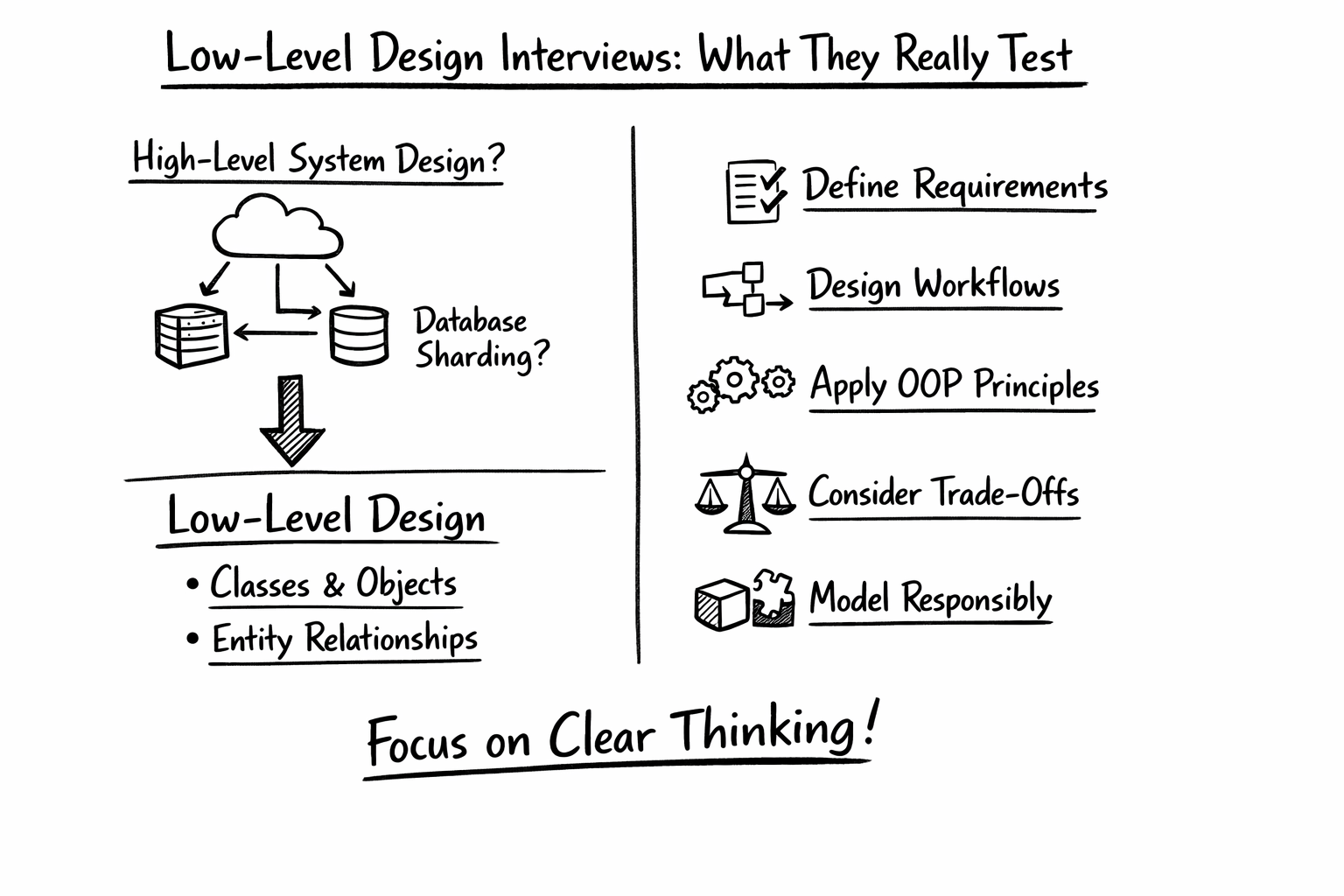
Low-level design questions focus on designing the internal structure of a system at the class and object level. Instead of discussing load balancers and database sharding, you define entities, relationships, workflows, interfaces, and responsibility boundaries. You translate requirements into clean abstractions.
Interviewers typically evaluate your ability to break down requirements, model entities correctly, apply object-oriented principles, design for extensibility, and reason about tradeoffs. They are less concerned with syntax and more concerned with clarity of thought.
The difference becomes clearer when you compare high-level and low-level design side by side.
Dimension | High-Level System Design | Low-Level Design |
Scope | Distributed systems | Single module or service |
Focus | Scalability and availability | Class structure and relationships |
Artifacts | Architecture diagrams | Class diagrams and code |
Evaluation | System-wide tradeoffs | OOP principles and maintainability |
Depth | Networking, databases | Abstraction, patterns, clean design |
When you understand this distinction clearly, your preparation becomes focused rather than scattered.
The Core Skills You Must Build#
If you want to prepare for low-level design patterns for questions in tech interviews effectively, you must strengthen a specific set of skills. These skills go beyond memorizing common problems.
Object-Oriented Thinking#
Low-level design interviews heavily rely on object-oriented principles. You must understand abstraction, encapsulation, inheritance, and polymorphism deeply enough to apply them naturally rather than mechanically.
For example, when designing a parking lot system, you should instinctively recognize that different vehicle types share common behavior but also require specialized rules. That instinct comes from understanding inheritance and composition tradeoffs, not from memorizing a template solution.
Object-oriented thinking allows you to assign responsibilities cleanly. Without it, your design becomes a collection of unrelated classes.
Modeling Real-World Systems#
Low-level design is about modeling. You take a real-world system, such as an ATM or a library, and convert it into software constructs.
Strong modeling requires you to identify entities, define their relationships, and decide which behaviors belong to which classes. You must also consider how future requirements might affect your design.
If you practice modeling with evolving constraints, your confidence grows significantly.
Understanding Design Patterns#
Design patterns are not interview trivia. They are reusable solutions to common structural problems.
Patterns such as Strategy, Factory, Observer, Decorator, and Singleton often appear in low-level design scenarios. When you understand their intent, you can apply them naturally to improve extensibility and reduce coupling.
The goal is not to force patterns into your design. The goal is to recognize when a recurring structural problem needs a well-known solution.
Writing Clean and Maintainable Code#
Even if the interviewer does not ask you to implement the full solution, your code structure matters. You should demonstrate clean method boundaries, meaningful naming, and clear separation of concerns.
Clean code reinforces clean design. When your methods are small and responsibilities are clear, your overall architecture becomes easier to explain and defend.
A Step-by-Step Roadmap to Prepare for Low-Level Design Questions#
Preparation becomes effective when it follows a logical progression. If you jump directly into solving complex LLD problems without strengthening fundamentals, your progress will feel inconsistent.
Step One: Rebuild Your Foundations#
Start by revisiting object-oriented programming fundamentals. Make sure you can clearly explain abstraction, encapsulation, inheritance, composition, and polymorphism.
Implement small systems from scratch, such as a basic booking system or inventory manager. Focus on clarity of responsibilities rather than speed.
This step builds confidence and prevents fragile understanding later.
Step Two: Study Core Design Patterns#
Once your OOP foundation is strong, study essential design patterns. Focus on understanding the problem each pattern solves.
When you practice applying patterns to small examples, you begin recognizing them naturally in larger design problems. This recognition becomes powerful during interviews.
Step Three: Solve Classic Low-Level Design Problems#
Now you move into structured practice. Choose common interview problems such as parking lot design, elevator system design, ATM system design, and food delivery platforms.
For each problem, follow a structured approach. Start with requirement clarification. Identify entities. Define relationships. Draw class diagrams. Then implement the core components in code.
Implementation is critical because it exposes design flaws quickly. What looks clean on paper may feel messy in code.
Step Four: Introduce Changing Requirements#
Once you have a working design, introduce new constraints. What happens if the parking lot adds electric charging stations? What if the ATM supports multiple currencies?
Strong low-level design preparation includes practicing adaptability. Interviews often introduce requirement changes mid-discussion to test flexibility.
How to Structure Your Answer During the Interview#
Preparation is incomplete without learning how to communicate your design clearly.
Clarify Requirements First#
Never start designing immediately. Ask clarifying questions about scope, constraints, and expected features.
This demonstrates structured thinking and ensures that you are solving the correct problem.
Identify Core Entities#
After clarifying requirements, identify the main entities in the system. Discuss their responsibilities before diving into implementation details.
This shows that you think in terms of abstraction rather than code fragments.
Define Relationships and Responsibilities#
Explain how entities interact and why responsibilities are distributed in a certain way.
Interviewers value reasoning. When you explain your thought process, you differentiate yourself from candidates who simply draw diagrams.
Discuss Tradeoffs#
Strong candidates articulate tradeoffs. You should explain why you chose composition over inheritance or why you introduced an interface for extensibility.
Tradeoff discussions signal maturity and practical experience.
Common Low-Level Design Problems in Interviews#
Understanding frequently asked problems helps you practice strategically.
Problem Type | Skills Tested | Common Focus Areas |
Parking Lot | OOP, abstraction | Vehicle hierarchy, slot allocation |
Elevator System | Scheduling logic | Request handling, optimization |
ATM System | State management | Transaction flow, extensibility |
Library System | Entity modeling | User roles, inventory handling |
Food Delivery | Workflow design | Order lifecycle, payment strategies |
Each problem emphasizes slightly different aspects of design. Practicing a variety ensures balanced preparation.
Resources That Can Help You Prepare#
While practice is central, structured resources can accelerate your learning.
Online platforms such as Educative and Design Gurus offer interview-focused, low-level design walkthroughs. These courses simulate real interview scenarios and guide you step by step through requirement analysis and modeling.
Books such as Clean Code, Head First Design Patterns, and Refactoring deepen your design instincts. They strengthen the foundations that interview questions build upon.
University-backed courses on Coursera provide conceptual clarity around architecture and modeling, which reinforces your practical preparation.
Combining one structured course with foundational books and consistent practice creates a powerful preparation strategy.
Mistakes That Hurt Candidates in LLD Interviews#
Many candidates prepare but still underperform because of common pitfalls.
One mistake is memorizing solutions. Interviewers frequently modify requirements to test adaptability. Memorized answers collapse under variation.
Another mistake is ignoring implementation. Designing without writing code gives a false sense of clarity.
A third mistake is skipping fundamentals. Weak OOP foundations lead to fragile abstractions.
If you avoid these mistakes, your preparation becomes far more effective.
How Long Should You Prepare?#
The timeline depends on your experience level. If you already have production experience, strengthening your LLD skills may take two to three months of focused effort.
If you are early in your career, the process may take longer because you are simultaneously building programming maturity.
Consistency matters more than duration. Solving one well-structured LLD problem per week with full implementation and reflection can significantly improve your design ability within a few months.
How to Know You Are Ready#
You know you are ready for low-level design questions in tech interviews when you can approach new problems confidently without relying on memorized templates.
If you can clarify requirements calmly, model entities logically, discuss tradeoffs clearly, and adapt to changing constraints, you are prepared.
Confidence in LLD comes from repetition and reflection, not from watching more tutorials.
Final Thoughts#
Preparing for low-level design questions in tech interviews requires structure, deliberate practice, and strong fundamentals. You cannot shortcut your way to design maturity.
When you rebuild your OOP foundation, study essential design patterns, practice classic problems, implement them thoroughly, and learn to articulate tradeoffs clearly, you develop genuine design intuition.
Low-level design interviews are not traps. They are opportunities to demonstrate how you think about building software that lasts. When you prepare thoughtfully, you do not just improve your interview performance. You improve how you design systems in real-world engineering work.
Approach your preparation with intention, consistency, and curiosity, and you will see measurable growth.
