The System Design interview has become one of the most important evaluation stages for software engineering roles, and in 2026, the expectations are even higher.
You’re not simply being tested on your knowledge of components — you’re being assessed on how well you think, communicate, and solve real-world engineering problems at scale. Companies want engineers who can design systems that handle millions of users, unpredictable traffic, and real-time data, all while staying cost-efficient and reliable.
Grokking Modern System Design Interview
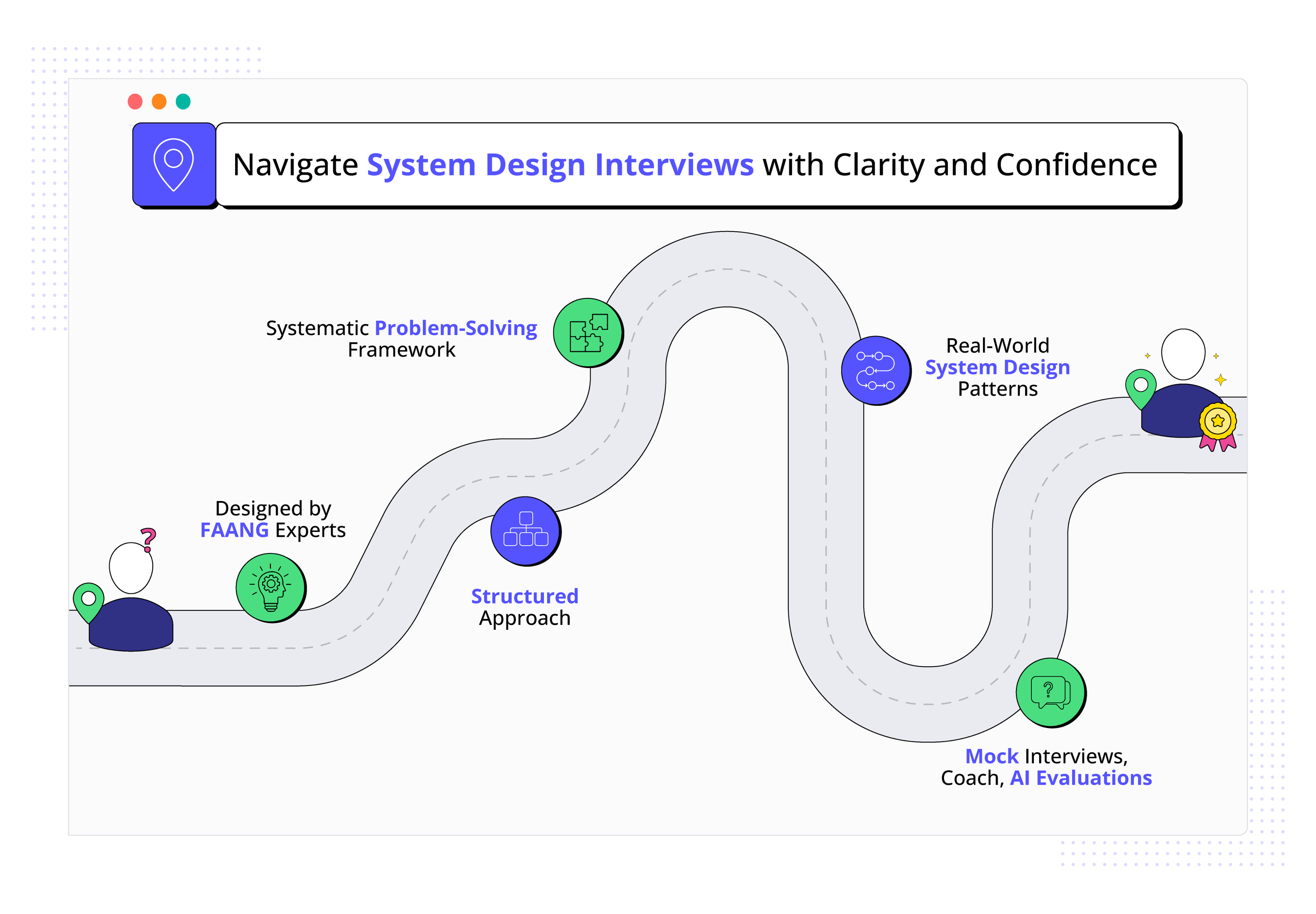
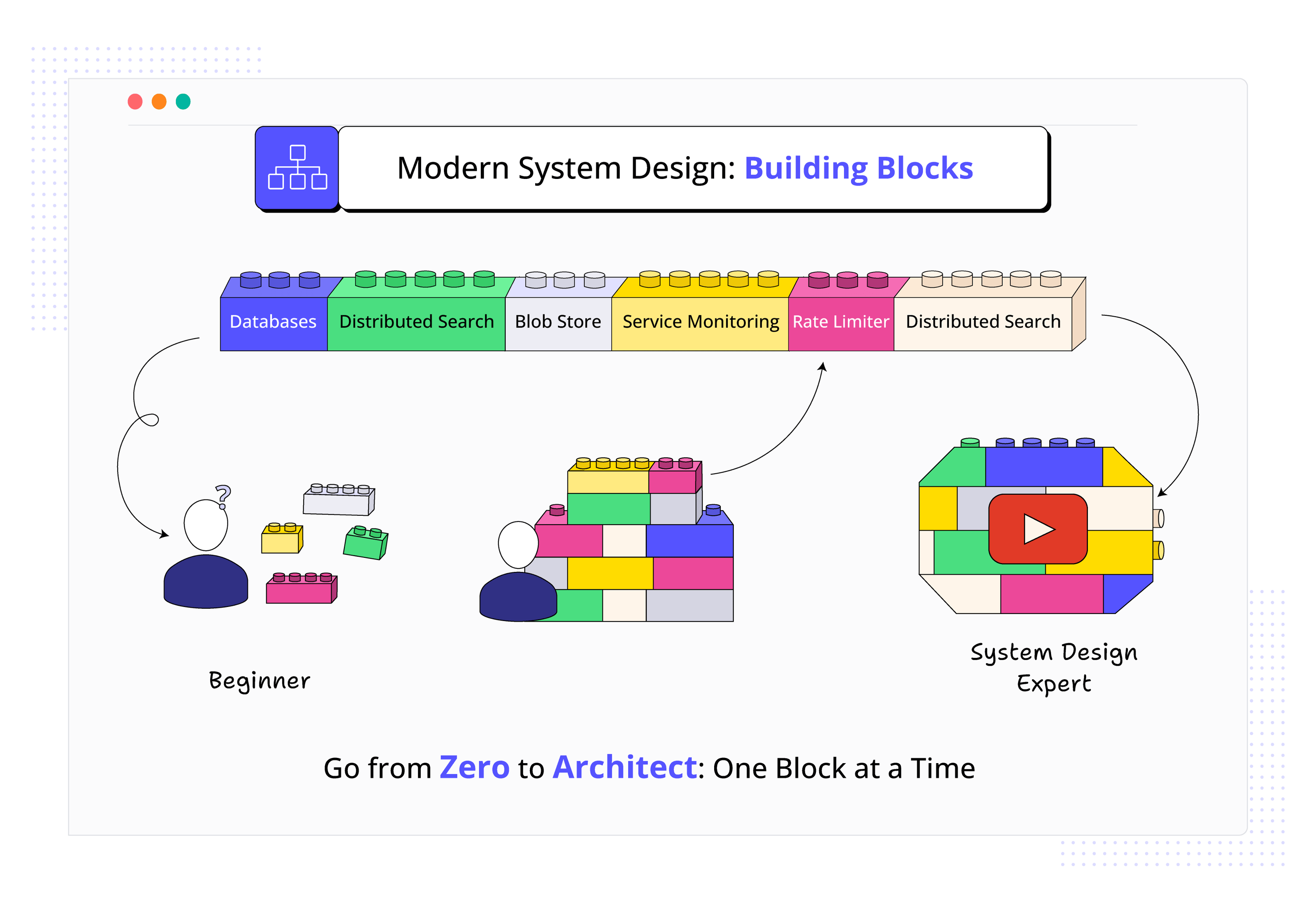
System Design Interviews decide your level and compensation at top tech companies. To succeed, you must design scalable systems, justify trade-offs, and explain decisions under time pressure. Most candidates struggle because they lack a repeatable method. Built by FAANG engineers, this is the definitive System Design Interview course. You will master distributed systems building blocks: databases, caches, load balancers, messaging, microservices, sharding, replication, and consistency, and learn the patterns behind web-scale architectures. Using the RESHADED framework, you will translate open-ended system design problems into precise requirements, explicit constraints, and success metrics, then design modular, reliable solutions. Full Mock Interview practice builds fluency and timing. By the end, you will discuss architectures with Staff-level clarity, tackle unseen questions with confidence, and stand out in System Design Interviews at leading companies.
In this guide, you’ll learn exactly how to prepare for the System Design interview in 2026 with a step-by-step plan, modern examples, and practical strategies for success.
Many candidates focus more on whether the System Design interviews are more open-ended or more structured, but in reality, interviewers care about something more important: your ability to think like an engineer. They want to see whether you can take a vague problem, break it down, and design something practical, scalable, and cost-efficient.
Here’s what interviewers evaluate most:
Interviewers want to see whether you can divide a large-scale system into manageable components. That means clearly identifying:
Core user flows
Throughput and latency expectations
Data storage needs
External integrations
Constraints and assumptions
They want to hear your reasoning, not just a diagram.
The heart of the System Design interview is trade-off thinking. You will be expected to discuss choices like:
SQL vs NoSQL
Monolith vs microservices
Push vs pull communication
Caching strategies
Leader-based vs leaderless replication
Event-driven vs request-driven flows
Interviewers want to know whether you can justify each decision based on use cases, failure scenarios, and scalability demands.
A strong System Design interview is less about drawing the perfect diagram and more about explaining your thought process. Interviewers evaluate whether you can:
Set clear assumptions
Work backwards from user needs
Explain design decisions in simple terms
Present the system in layers
Adapt your design when requirements change
Your understanding of production-grade constraints
Modern systems face real-world challenges like:
Latency
Throughput
Availability
Consistency requirements
Cost efficiency
Fault tolerance
Interviewers expect you to think in terms of trade-offs, bottlenecks, and failure modes, not just happy paths. A candidate who can describe how a system behaves under stress instantly stands out.
System Design Interview: Fast-Track in 48 Hours
Need to prep for a system design interview in a hurry? Whether your interview is days away or your schedule is packed, this crash course helps you ramp up fast. Learn the core patterns, apply structured thinking, and solve real-world design problems—all in under 15 minutes per challenge. This is a condensed version of our flagship course, Grokking the Modern System Design Interview for Engineers & Managers, designed to help you build confidence, master fundamentals, and perform under pressure. Perfect for software engineers and managers aiming to ace high-stakes interviews at top tech companies.
Preparing for the System Design interview in 2026 requires more than memorizing architectures; you need a structured roadmap that teaches you how systems work, why they behave the way they do, and how to articulate your decisions clearly. This step-by-step framework helps you build the right mindset, skills, and habits so that you’re truly ready for any question an interviewer throws at you.
Before you design anything complex, you need a solid understanding of the concepts that form the backbone of modern distributed systems. Think of this phase as building your vocabulary and intuition.
Here’s what you should focus on:
You’ll frequently encounter terms like latency, throughput, replication, sharding, eventual consistency, and partition tolerance. These are not just buzzwords; they’re the lenses you use to evaluate every design choice.
Focus on learning:
Latency: the time it takes for a request to complete
Throughput: how many operations per second your system handles
Replication: copying data to increase availability
Sharding: dividing data for scalability
Load balancing: distributing traffic across servers
Caching: reducing load and improving speed
Understanding these terms makes your explanations sound precise and intentional.
Interviewers want to know whether you can think at multiple layers:
Logical architecture shows the conceptual flow and components.
Physical architecture shows servers, databases, partitions, and regions.
You should be comfortable switching between them during the interview.
Resources like System Design Deep Dive: Real-World Distributed Systems are great places to start building this foundation.
System Design Deep Dive: Real-World Distributed Systems
This course deep dives into how large, real-world systems are built and operated to meet strict service-level agreements. You’ll learn the building blocks of a modern system design by picking and combining the right pieces and understanding their trade-offs. You’ll learn about some great systems from hyperscalers such as Google, Facebook, and Amazon. This course has hand-picked seminal work in system design that has stood the test of time and is grounded on strong principles. You will learn all these principles and see them in action in real-world systems. After taking this course, you will be able to solve various system design interview problems. You will have a deeper knowledge of an outage of your favorite app and will be able to understand their event post-mortem reports. This course will set your system design standards so that you can emulate similar success in your endeavors.
Architecture patterns are the building blocks of nearly every System Design interview discussion. You don’t need to memorize every detail; you just need to understand what problem each pattern solves, what constraints it introduces, and when it’s the right fit.
You should be able to explain patterns like:
Monolithic architecture: simple and fast to build, harder to scale
Microservices: flexible, granular scaling, but adds operational overhead
Event-driven architecture: great for real-time systems
Client-server model: foundational to every distributed system
SOA (Service-Oriented Architecture)
CQRS (Command Query Responsibility Segregation)
Publish–subscribe systems
Layered architecture
For each pattern, focus on describing:
Why you would use it
The main benefits
The trade-offs
A real-world example
The biggest challenge candidates face is not understanding a pattern; it’s articulating when and why they would use it. Your communication clarity becomes a signal of your engineering maturity.
If Step 1 teaches you the vocabulary and Step 2 teaches you the grammar, Step 3 teaches you how to form sentences. Real-world systems help you practice applying concepts in a consistent, structured way.
Begin with small systems so you can get used to the interview structure without feeling overwhelmed:
URL shortener
Rate-limiting service
Distributed counter
File storage service
Once you’re comfortable, take on designs that demand more thought:
Messaging queues
Notification systems
E-commerce checkout flows
Log ingestion pipelines
As you gain confidence, tackle designs that mirror the scale of real interview questions:
Real-time chat application
Uber-like ride coordination system
YouTube-like video platform
Real-time analytics dashboard
Global content recommendation engine
Each example teaches you something new about constraints, bottlenecks, and scalability.
The System Design interview is not a test of perfection; it’s a test of clarity. You’re being evaluated on how clearly you explain your thinking.
Here’s how to communicate effectively:
Interviewers won’t give you every detail. You need to state assumptions like:
Expected number of users
Read/write ratio
Latency requirements
Data size
Data consistency expectations
Anyone can say “I’ll use caching.” The stronger answer explains:
Why caching is needed
Which cache type you’d choose
How long items stay cached
What failure modes might arise
Your diagram doesn’t need to be artwork, it needs to be readable. Show components, flows, and bottlenecks.
If your interviewer adds constraints (which they will), show that you can adjust.
Practicing mock interviews helps you convert knowledge into skill.
Whether you’re practicing alone or with peers, follow the same steps:
Clarify
Estimate
Design high-level architecture
Break into components
Discuss scaling
Evaluate trade-offs
Listening back helps you identify:
Gaps in your explanations
Overuse of buzzwords
Missing assumptions
Areas where you rushed
Templates help beginners, but interviewers can spot rehearsed answers. Think flexibly instead.
These seven concepts form the backbone of nearly every System Design interview. If you understand these deeply, you’ll instantly sound more confident and capable.
Each concept below includes a definition, why it matters, and how it shows up during interviews.
Scalability is the ability of a system to handle increasing load by adding more resources. Interviewers expect you to understand:
Vertical vs horizontal scaling
Stateless vs stateful components
Why load distribution matters
How to prevent bottlenecks
When to scale databases, caches, or queues
If you can explain how your system scales from 100 requests per second to 100,000, you’re already ahead of most candidates.
Reliability is the system’s ability to function correctly over time. You should discuss:
Redundancy
Failover strategies
Multi-region backup
Health checks
Monitoring and alerting
A reliable system doesn’t break under stress, and interviewers want to hear how you’d maintain uptime under failures.
Availability measures how often the system is operational. Interviewers expect you to know:
What high availability means
The role of replication
Why multi-AZ or multi-region systems matter
How load balancers improve availability
The ability to reference availability targets (e.g., 99.9%) makes your answers sound production-ready.
Consistency is how up-to-date and aligned data is across the system. You should be able to describe:
Strong consistency
Eventual consistency
Read-after-write consistency
Trade-offs between consistency and performance
Interviewers love asking how you would handle inconsistent data across replicas; this separates strong candidates from average ones.
Partitioning (or sharding) divides data into smaller, manageable segments. Expect to explain:
Key-based partitioning
Range-based partitioning
Hash-based partitioning
How to avoid hotspots
How rebalancing works
Partitioning improves scalability but introduces complexity; interviewers want to know whether you understand both sides.
Caching improves speed and reduces database load. You should understand:
When to cache
Cache invalidation
TTL (time-to-live)
Write-through vs write-back caching
CDN caching
Caching issues cause the majority of production bugs in distributed systems, so speaking confidently about it impresses interviewers.
Load balancing distributes traffic across servers to prevent overload. You should discuss:
L4 vs L7 load balancers
Round-robin, least-connections, and weighted strategies
Health checks
Sticky sessions
Global load balancing
Interviewers expect you to explain how traffic flows through your system and how you prevent single points of failure.
To prepare for the 2026 System Design interview, you need to understand modern tooling, not in terms of commands or configuration, but in terms of architectural purpose and trade-offs. Tools change, but the principles behind them remain stable.
Below are categories that interviewers expect you to know at a conceptual level.
Topics you should understand:
Message brokers for decoupling services
Distributed logs for ordered event processing
Queue vs pub/sub
At-least-once, at-most-once, exactly-once delivery
You don’t need to know implementation details, just when to use each pattern and why.
Modern systems rely heavily on caching to reduce latency and costs. You should understand:
Local vs distributed caches
Cache warming
Cache invalidation strategies
Why TTL matters for performance
You’ll be expected to know:
How CDNs reduce latency
How edge nodes perform computation
Why edge is essential for real-time features
Database choice is a major part of the System Design interview. You should be able to explain:
When to use relational databases
When to choose NoSQL for scaling
The role of indexing
Data replication and partitioning models
Trade-offs related to consistency
Interviewers expect you to describe:
How systems store large files
Why object storage is essential for scalability
How CDNs integrate with object stores
Knowing how systems behave in production is now part of the interview. Focus on:
Metrics, logs, and traces
Health checks
Redundancy
Auto-healing
These concepts help you sound production-ready.
While not required, these skills help you stand out:
Container orchestration
Stream processing
Basic cost optimization strategies
Infrastructure-as-code
API gateway design
Data lifecycle management
To prepare for the System Design interview, you should practice real-world examples that reflect the complexity of modern systems. Below are typical 2026-style questions, along with the strategic thinking you should apply to each.
These examples help you learn the structure and thought process, not the exact answer, so you can adapt to any problem.
What you should think through:
Different notification types (push, SMS, email, in-app)
Message prioritization
Notification queues
Rate limits
Delivery guarantees (at-least-once delivery)
Retry policies
User preference management
Global region routing
Interviewers expect you to discuss queues, pub/sub, caching, and failover systems for high-scale delivery.
Design a real-time chat application
This is a common interview favorite.
Focus on:
WebSockets or long polling
Message delivery guarantees
Read receipts
Typing indicators
User online/offline status
Partitioning by chat room or shard keys
Storing recent messages in cache
Storing history in persistent storage
You’ll be evaluated on how you manage real-time updates and large-scale concurrency.
You might not implement ML models, but you should know the system pipeline:
Collect user events
Process events using streaming pipelines
Generate candidate recommendations
Cache personalized results
Track feedback loops
Provide low-latency retrieval
Your focus should be on data ingestion, processing, and low-latency access, not ML math.
Interviewers expect you to discuss:
Token bucket or leaky bucket algorithms
Global rate limits vs per-user limits
Redis as a fast data store
Slotted counters
Burst handling
Distributed rate limit synchronization
This question tests your understanding of caching, atomicity, and race conditions.
Think through:
Task queues
Worker pools
Heartbeats and retries
Idempotency
Dead-letter queues
Scheduling intervals
Monitoring
Fault-tolerant leadership election
This tests your grasp of reliability, job orchestration, and queue-based systems.
Interviewers will look for your understanding of:
High-frequency location updates
Spatial indexing
Geo-sharding
Hotspot detection
Real-time state synchronization
Efficient data compression
Map-based querying
This question evaluates your ability to design low-latency, large-scale systems with constant updates.
Expect to discuss:
Video upload and chunking
Transcoding pipeline
CDN distribution
Metadata storage
Search indexing
Recommendation integration
Adaptive bitrate streaming
This is a multi-component, multi-service system, great for showcasing your senior-level thinking.
Preparing for the System Design interview doesn’t need to feel chaotic or overwhelming. With the right structure, you can build your System Design fundamentals, learn architecture patterns, and practice real interview scenarios in just four weeks. This 4-week plan is designed to help you stay consistent, make daily progress, and gradually build confidence as you master more complex systems.
Think of this as a practical, tactical plan, something you can follow step-by-step to be interview-ready by the end of the month.
In week one, your goal is to build a strong baseline understanding of the essentials. You’re not designing full systems yet; you’re learning the concepts that will shape those designs.
Focus on:
Understanding fundamentals such as latency, throughput, availability, replication, and failure modes
Reviewing core concepts
Learning about monolithic vs microservices architectures
Practicing basic diagramming
Studying caching, partitioning, and load balancing
Understanding how read and write paths work in distributed systems
Daily habit:
Spend 45 minutes reading foundational content
Spend 15 minutes summarizing concepts in your own words
By the end of week 1, you should feel confident explaining basic system concepts out loud.
Week two helps you learn how real systems are structured. This is where the pieces start coming together.
Focus on:
Studying common System Design patterns
Understanding when to use pub/sub, event-driven architecture, and CQRS
Learning database selection trade-offs
Exploring object storage, CDNs, and distributed caches
Practicing simple problems like URL shorteners, rate limiters, and counters
Daily habit:
Pick one architecture pattern each day and explain when you’d use it
Draw one simple system end-to-end
By the end of week 2, you should be able to approach smaller design problems with confidence.
Week three is where you truly level up. You’ll start working on full-scale designs and refine your ability to structure your answers in a clear, consistent way.
Focus on:
Practicing intermediate systems
Reviewing System Design examples
Walking through the chat application System Design outline
Designing systems like:
Notification service
Analytics pipeline
Media storage service
Task scheduler
Content distribution system
Daily habit:
Complete one full design per day (even if messy)
Use the repeatable framework from Section 7
Spend 10 minutes identifying trade-offs for each design
By the end of week 3, you should have strong design instincts and be comfortable navigating follow-up questions.
The final week is all about sharpening your communication and becoming interview-ready.
Focus on:
Practicing timed interviews
Recording yourself explaining a system
Reviewing weak areas
Doing peer mock sessions
Studying System Design interview practice prompts
Completing advanced, 2026-style problems
Daily habit:
Do one 45-minute mock interview
Review your recording and note improvement areas
By the end of week 4, you should feel confident, structured, and ready for any System Design interview question.
Preparing for the System Design interview in 2026 may seem challenging, but with the right strategy, consistency, and mindset, you can absolutely master it. You already have the tools, frameworks, examples, practice plan, and understanding of what interviewers are really evaluating. Now it comes down to putting everything into action.
Remember: you don’t need to be perfect. You simply need to be thoughtful, structured, and clear in your approach to problems. Focus on fundamentals, practice intentionally, and use the resources available to you. Every interview is simply another opportunity to improve.