Is ChatGPT an LLM? Understanding AI chat systems
Is ChatGPT really an LLM or something else? Discover how ChatGPT works, how it uses large language models, and why understanding this difference is key to mastering modern AI systems.
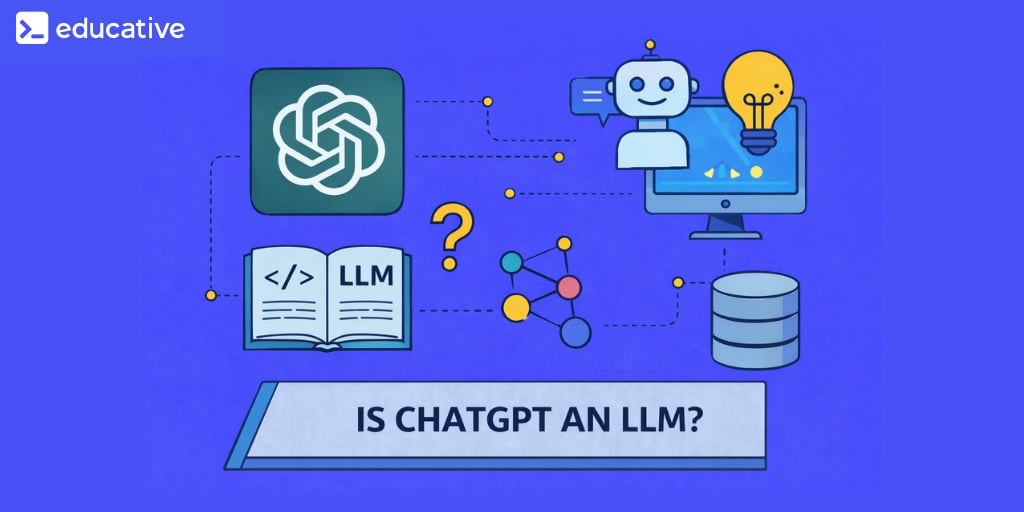
Conversational AI systems have become increasingly common across productivity tools, programming assistants, customer support platforms, and research applications. Millions of users now interact with AI systems through chat interfaces that can answer questions, write code, explain complex topics, and assist with daily tasks. As people explore these tools, a common technical question emerges: is Chat GPT an LLM, or is it something different from the language models powering modern AI systems?
ChatGPT is a conversational interface created by OpenAI that allows users to interact with advanced artificial intelligence through dialogue. The system is designed to feel natural and interactive, responding to questions and prompts in a conversational format.
However, the underlying technology behind ChatGPT is built on large language models. These models perform the core language understanding and generation tasks that make conversational AI possible. Understanding the relationship between ChatGPT and large language models helps clarify how modern AI chat systems operate.
Essentials of Large Language Models: A Beginner’s Journey
Large language models (LLMs) are at the core of today’s AI transformation, powering everything from conversational agents to code generation and enterprise automation. As adoption accelerates, understanding how LLMs actually work, and how to use them effectively in real systems, is no longer optional for developers and data professionals. I built this course from my work in neural networks and intelligent systems, where LLMs represent a shift from traditional modeling to probabilistic reasoning at scale. A recurring pattern I observed was that many practitioners could use APIs but lacked a clear mental model of how LLMs process language, make decisions, and fail in edge cases. This course is designed to bridge that gap with a systems-level perspective. You’ll learn LLM fundamentals from first principles, covering architecture, tokenization, embeddings, attention, and training dynamics, before moving into practical workflows like prompting, retrieval-augmented generation (RAG), and tool integration. Each concept is tied to how LLMs are actually deployed in production systems. Engineers and researchers are already building on these foundations to create real-world AI applications. If you want to go beyond surface-level usage of LLMs, this is where you begin.
What is a large language model?#
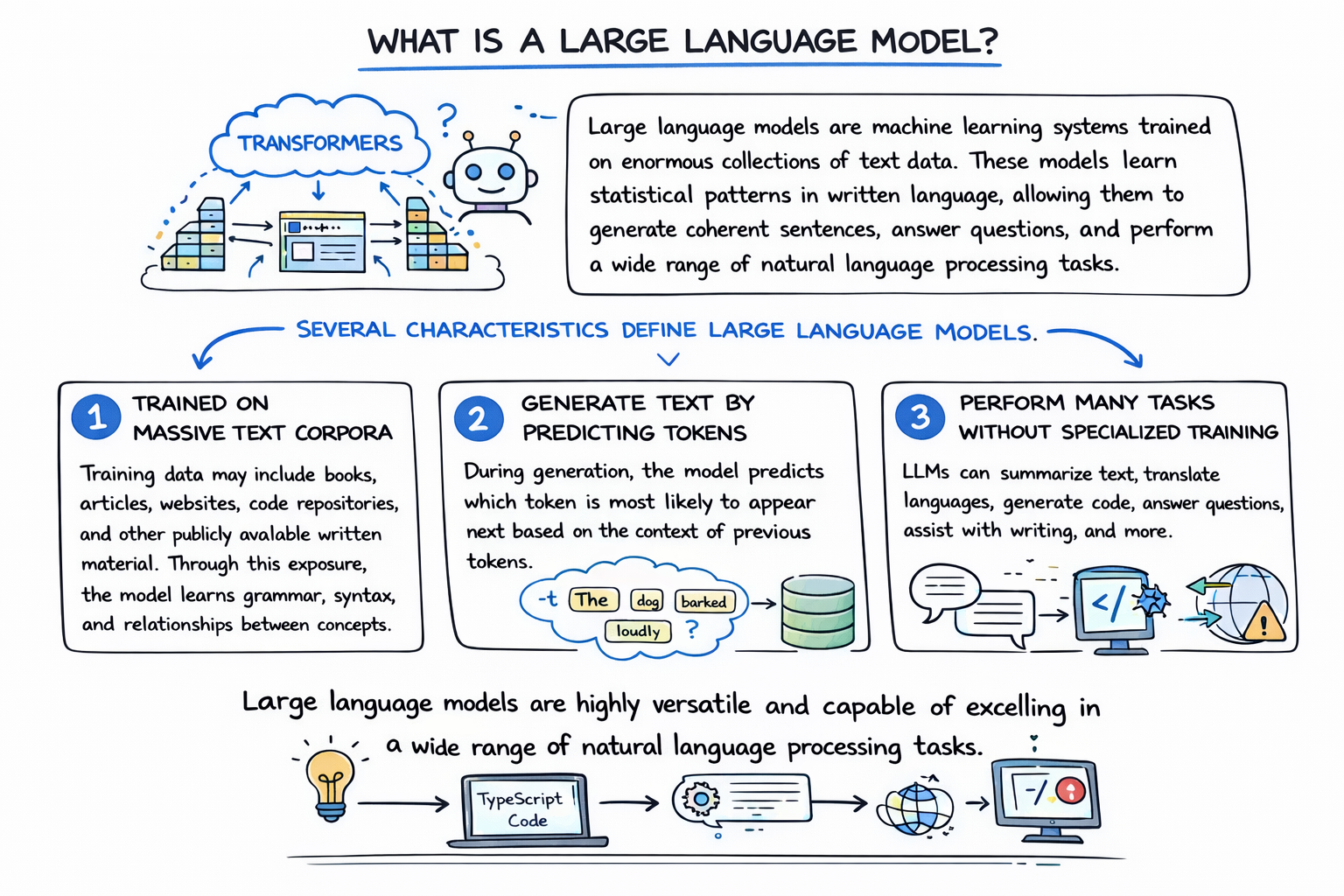
Large language models are machine learning systems trained on enormous collections of text data. These models learn statistical patterns in written language, allowing them to generate coherent sentences, answer questions, and perform a wide range of natural language processing tasks.
The development of modern large language models became possible through advances in neural network architectures known as transformers. Transformer-based architectures allow models to analyze entire sequences of text while learning relationships between words across long contexts.
Several characteristics define large language models.
First, they are trained on massive text corpora. Training data may include books, articles, websites, code repositories, and other publicly available written material. Through this exposure, the model learns grammar, syntax, and relationships between concepts.
Second, LLMs generate text by predicting tokens in sequence. A token may represent a word, part of a word, or a symbol. During generation, the model predicts which token is most likely to appear next based on the context of previous tokens.
Third, large language models are capable of performing many tasks without specialized training for each one. These tasks include summarizing text, translating languages, generating code, answering questions, and assisting with writing.
Because of these capabilities, LLMs form the technological foundation of many modern AI tools.
Become an LLM Engineer
Generative AI is transforming industries, revolutionizing how we interact with technology, automate tasks, and build intelligent systems. With large language models (LLMs) at the core of this transformation, there is a growing demand for engineers who can harness their full potential. This Skill Path will equip you with the knowledge and hands-on experience needed to become an LLM engineer. You’ll start with the generative AI and prompt engineering to communicate with AI models. Then you’ll learn to interact with AI models, store and retrieve information using vector databases, and build AI-powered workflows with LangChain. Next, you’ll learn to enhance AI responses with retrieval-augmented generation (RAG), fine-tune models using LoRA and QLoRA, and develop AI agents with CrewAI to automate complex tasks. By the end, you’ll have the expertise to design, optimize, and deploy LLM-powered solutions, positioning yourself at the forefront of AI innovation.
Understanding how ChatGPT works#
ChatGPT is designed as a conversational AI interface that allows users to interact with large language models through natural dialogue. Instead of accessing a language model directly through an API or programmatic interface, users communicate with ChatGPT through a chat-based environment.
When a user sends a message, the system processes the text and passes it to the underlying large language model. The model then analyzes the prompt and generates a response based on patterns learned during training.
One of the important features of ChatGPT is its ability to maintain conversational context. The system keeps track of previous messages within the conversation, allowing the model to generate responses that remain consistent with earlier interactions.
In addition to the language model itself, ChatGPT incorporates several additional components that improve the user experience:
Conversation memory that preserves context across messages
Instruction tuning that helps the model follow user requests
Safety filters and moderation systems that help prevent harmful outputs
These components work together to create an interactive conversational experience that feels more natural than interacting with a raw language model.
All You Need to Know About Prompt Engineering

As generative AI becomes embedded in everyday workflows, the ability to guide models effectively is emerging as a core skill. Prompt engineering is foundational to how we build reliable, controllable AI systems. Yet most practitioners struggle to learn prompt engineering in a structured way, often relying on trial and error. This course focuses on turning prompt design into a disciplined, repeatable process. I built this course from my work in intelligent systems and adaptive AI, where controlling model behavior has always been as important as building the model itself. A pattern I observed across teams was that even strong engineers treated prompts as ad hoc inputs rather than system components. This led to instability, inconsistency, and hidden failure modes. This course addresses that gap by framing prompt engineering as a structured design problem. You’ll learn how to design prompts with clear objectives, defined roles, and controlled ambiguity to improve output quality. The course covers techniques such as few-shot prompting, schema-based outputs, reasoning strategies, and parameter tuning. You’ll also explore grounding, long-context handling, and defenses against prompt injection. Finally, you’ll integrate evaluation, monitoring, and safety practices to maintain prompt reliability in production systems. If you want to learn prompt engineering in a way that prepares you to build stable, trustworthy AI systems, this course provides a clear and practical foundation.
ChatGPT architecture explanation#
To better understand how ChatGPT operates, it helps to examine the architectural layers involved in modern conversational AI systems.
At the core of the system is a large language model from the GPT family. These models are transformer-based neural networks trained to generate text by predicting token sequences.
Above the model layer is an alignment and instruction-tuning process. OpenAI trains models using techniques such as reinforcement learning from human feedback. This training process helps guide the model toward generating helpful, safe, and contextually appropriate responses.
The application layer sits on top of the language model. This layer manages conversation state, processes user inputs, formats prompts for the model, and returns generated responses to the user.
Finally, additional safety and moderation systems monitor interactions to ensure that outputs remain aligned with usage guidelines.
This layered architecture allows ChatGPT to function as a user-friendly conversational system while relying on large language models as its computational foundation.
Is Chat GPT an LLM?#
When discussing whether is Chat GPT an LLM, it is important to distinguish between the interface users interact with and the underlying model that performs the language generation.
ChatGPT itself is not a single large language model. Instead, it is an application built on top of large language models developed by OpenAI. These models belong to the GPT family and serve as the engine that generates responses.
The role of ChatGPT is to provide a structured conversational environment where users can interact with these models naturally. The system handles conversation context, formatting of prompts, and integration of safety mechanisms.
In other words, large language models perform the actual language processing, while ChatGPT provides the interface that allows humans to communicate with those models effectively.
Understanding this distinction clarifies that ChatGPT is an AI-powered application that uses LLM technology rather than being the model itself.
ChatGPT vs large language models#
Although ChatGPT relies on large language models, the two represent different layers within the overall AI system.
Feature | Large Language Model | ChatGPT |
Core function | Generate language based on training data | Conversational interface built on an LLM |
Architecture | Neural network model | Application using LLM technology |
Interaction style | API or programmatic use | Dialogue-based interaction |
Large language models serve as the computational engines that process language and generate responses. Developers often interact with these models through APIs when building AI-powered applications.
ChatGPT, by contrast, is designed for interactive conversation. It provides a chat-based interface that allows users to communicate with the underlying models using natural dialogue.
This separation between model and interface is common in modern AI systems.
Real-world applications of ChatGPT#
AI systems built on large language models have become useful across a wide range of industries and professional tasks.
One prominent application involves programming assistance. Developers frequently use conversational AI systems to explain code, identify bugs, and generate new code snippets. These capabilities help programmers work more efficiently when developing software.
Content creation and summarization represent another common use case. Writers, analysts, and researchers use conversational AI tools to summarize documents, generate drafts, and explore complex ideas.
Educational applications are also growing rapidly. Students and professionals use AI systems as learning assistants that provide explanations, answer technical questions, and guide problem-solving.
Customer support automation represents another area where conversational AI has gained traction. Organizations can deploy AI-powered chat systems to answer common questions, guide users through troubleshooting processes, and provide assistance at scale.
These use cases demonstrate how conversational interfaces combined with large language models enable practical applications across many fields.
How conversational AI systems are evolving#
The field of conversational AI continues to evolve as researchers improve both the underlying language models and the systems that interact with them.
Advances in model architecture allow language models to process larger contexts and generate more accurate responses. Improvements in training techniques help align model outputs with human expectations for clarity, safety, and usefulness.
At the same time, conversational interfaces are becoming more sophisticated. Systems now integrate tools for reasoning, external knowledge retrieval, and structured data processing.
Understanding the relationship behind the question is Chat GPT an LLM helps clarify how modern AI systems combine powerful language models with application layers designed for human interaction.
As research progresses, conversational AI systems will likely continue expanding their capabilities across domains such as programming, research, education, and data analysis.
FAQ#
What model powers ChatGPT?#
ChatGPT is powered by large language models from the GPT family developed by OpenAI. These models are transformer-based neural networks trained on large datasets of text. The specific model used can vary depending on the system version and deployment environment.
How are large language models trained?#
Large language models are trained using massive text datasets and deep neural networks. During training, the model learns to predict the next token in a sequence of text. Over time, this process allows the model to learn grammar, relationships between concepts, and patterns in human language.
Can LLMs exist without conversational interfaces?#
Yes, large language models can operate without conversational interfaces. Developers frequently interact with these models through APIs or integrate them into applications that perform tasks such as document analysis, translation, or code generation.
What is the difference between GPT models and ChatGPT?#
GPT models refer to the underlying large language models trained by OpenAI using transformer architectures. ChatGPT is an application that uses these models and presents them through a conversational interface designed for interactive dialogue.
Conclusion#
Conversational AI systems such as ChatGPT represent an important evolution in how humans interact with artificial intelligence. While users communicate with ChatGPT through a chat-based interface, the underlying capabilities come from large language models trained on vast collections of text.
Understanding is Chat GPT an LLM helps clarify how modern AI chat systems operate. Large language models provide the computational engine for language understanding and generation, while applications like ChatGPT create user-friendly environments that enable natural interaction with these models.
As AI research continues to advance, the combination of powerful language models and interactive interfaces will likely play an increasingly important role in software development, education, and digital productivity.
Happy learning!