Low-level design interview questions for System Design roles
Master the most common low-level design interview questions for System Design roles. Learn what interviewers evaluate, how to structure your answers, and how to practice effectively so you can walk into LLD interviews confident and prepared.
When you prepare for System Design roles, most of your attention naturally goes to high-level architecture. You think about scalability, distributed systems, databases, and caching layers. Then you walk into an interview and are asked to design a parking lot or an ATM system at the class level.
That moment can feel disorienting if you have not prepared specifically for low-level design.
Low-level design interview questions for System Design roles test something different. They examine whether you can translate abstract requirements into concrete class structures, define responsibilities clearly, apply design patterns thoughtfully, and design for extensibility. They test how you build systems from the inside out.
Grokking the Low Level Design Interview Using OOD Principles
Low-level design interviews test something most engineers don't practice enough: taking a vague, open-ended prompt as "design a parking lot" or "design Stack Overflow" and turning it into a structured, implementable system with clearly defined classes, relationships, and behaviors. Knowing what inheritance is won't get you through. You need to demonstrate that you can use it to model a real system under time pressure. This course teaches that skill through repetition across 20+ real-world design problems. Each one follows the same structured approach: define requirements, identify key objects and relationships, model the system with UML diagrams (class, use case, sequence, activity), and then implement working code. By the time you've designed your fifth or sixth system, the process becomes second nature, which is exactly the point. We start with the foundations: OOP concepts, SOLID principles, and the most commonly tested design patterns. Then we move into the problems themselves: parking lots, elevator systems, Amazon's online shopping platform, chess, LinkedIn, and more. Each problem comes with a full walkthrough and a mock interview so you can test yourself under realistic conditions. Whether you're preparing for your first low-level design round or you've been avoiding this part of the loop, this course gives you a repeatable framework for breaking down any OOD problem systematically.
If you are wondering, “What are the most common low-level design interview questions for System Design roles?”, this guide will walk you through the questions you are most likely to encounter. More importantly, you will understand what each question evaluates and how to approach it strategically.
This is not just a list. It is a preparation blueprint.
Why Low-Level Design Matters for System Design Roles#
Before diving into specific questions, you need to understand why low-level design is included in interviews for System Design roles.
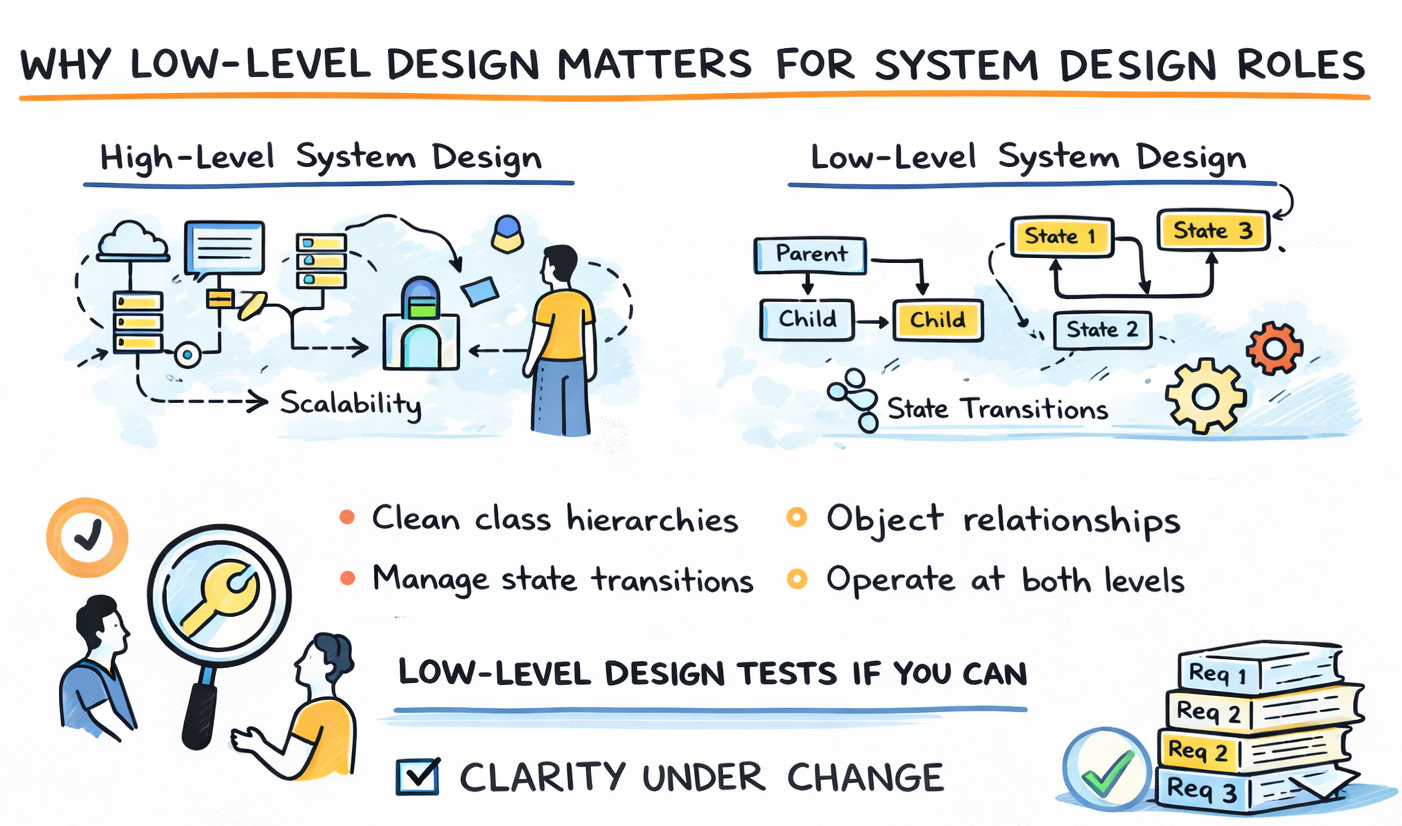
High-level System Design evaluates your ability to think about scalability and architecture. Low-level design evaluates your ability to structure the internal components of a system. If you cannot design clean class hierarchies, manage state transitions, or handle object relationships effectively, your high-level architecture will eventually collapse under complexity.
Hiring managers know this. They want engineers who can operate at both levels.
Low-level design questions also reveal how you think under evolving requirements. They show whether you can maintain clarity when constraints change. For System Design roles, this adaptability is critical.
Grokking Modern System Design Interview

For a decade, when developers talked about how to prepare for System Design Interviews, the answer was always Grokking System Design. This is that course — updated for the current tech landscape. As AI handles more of the routine work, engineers at every level are expected to operate with the architectural fluency that used to belong to Staff engineers. That's why System Design Interviews still determine starting level and compensation, and the bar keeps rising. I built this course from my experience building global-scale distributed systems at Microsoft and Meta — and from interviewing hundreds of candidates at both companies. The failure pattern I kept seeing wasn't a lack of technical knowledge. Even strong coders would hit a wall, because System Design Interviews don't test what you can build; they test whether you can reason through an ambiguous problem, communicate ideas clearly, and defend trade-offs in real time (all skills that matter ore than never now in the AI era). RESHADED is the framework I developed to fix that: a repeatable 45-minute roadmap through any open-ended System Design problem. The course covers the distributed systems fundamentals that appear in every interview – databases, caches, load balancers, CDNs, messaging queues, and more – then applies them across 13+ real-world case studies: YouTube, WhatsApp, Uber, Twitter, Google Maps, and modern systems like ChatGPT and AI/ML infrastructure. Then put your knowledge to the test with AI Mock Interviews designed to simulate the real interview experience. Hundreds of thousands of candidates have already used this course to land SWE, TPM, and EM roles at top companies. If you're serious about acing your next System Design Interview, this is the best place to start.
Categories of Common Low-Level Design Interview Questions#
The most frequently asked Low-level design patterns and questions typically fall into a few recurring categories. Understanding these categories helps you prepare systematically.
Category | Focus Area | Example Problems |
Resource Management Systems | Entity modeling and allocation logic | Parking Lot, Library Management |
Workflow and State Systems | State transitions and lifecycle management | ATM Machine, Order Management |
Scheduling and Coordination Systems | Request handling and prioritization | Elevator System |
Commerce and Payment Systems | Strategy and extensibility | Payment Gateway, Food Delivery |
Notification and Event Systems | Observer pattern and decoupling | Notification Service, Stock Alerts |
Each category tests a different dimension of design maturity. Let us explore the most common questions in detail.
Parking Lot System Design#
The parking lot design question is one of the most frequently asked low-level design interview questions for System Design roles. It appears simple at first glance, which makes it deceptively powerful.
This problem tests your ability to model entities such as vehicles, parking spots, tickets, and floors. It also tests inheritance, abstraction, and allocation logic.
What Interviewers Evaluate#
Interviewers want to see how you define relationships between vehicles and slots. They observe whether you use inheritance appropriately for vehicle types. They evaluate how you design the allocation strategy and whether your system can handle future changes, such as adding electric charging stations.
If you jump straight into coding without clarifying requirements, you weaken your answer. If you build rigid class hierarchies that cannot adapt, you expose design weaknesses.
The strength of your response lies in structured modeling and extensibility.
Library Management System#
The library management system is a classic low-level design problem because it focuses heavily on entity modeling and role-based behavior.
You must model books, users, librarians, transactions, and inventory management. This question emphasizes responsibility distribution and relationship clarity.
What It Tests#
This problem tests whether you can separate user roles cleanly and handle operations such as issuing and returning books. It also examines how you manage state changes and avoid mixing unrelated responsibilities.
Strong candidates clearly separate concerns and design for scalability in terms of features, not infrastructure.
ATM Machine Design#
The ATM machine design question is commonly used to test workflow and state transitions. It introduces multiple operational states such as idle, card inserted, transaction processing, and cash dispensing.
This question is particularly effective for evaluating whether you understand the State design pattern.
What Interviewers Look For#
Interviewers observe how you model state transitions and whether you avoid large conditional blocks. They examine how you separate transaction logic from state management.
They may also introduce variations such as handling multiple currencies or adding new transaction types to see how adaptable your design is.
Your ability to handle state transitions cleanly often distinguishes average answers from strong ones.
Elevator System Design#
The elevator System Design question focuses on scheduling and coordination. It tests how you manage requests, prioritize them, and handle multiple elevators efficiently.
Unlike purely entity-driven problems, this question requires algorithmic thinking combined with clean object modeling.
What It Evaluates#
Interviewers evaluate how you design the request queue, how elevators communicate with a central controller, and how scheduling decisions are made.
They often probe how your system adapts if the number of floors increases or if different scheduling strategies are introduced.
This question reveals whether you can blend behavioral patterns with structured modeling.
Food Delivery System#
Modern System Design interviews frequently include commerce-related problems, such as food delivery platforms.
This problem combines entity modeling, workflow management, and extensibility.
What It Tests#
You must design users, restaurants, orders, delivery agents, and payment strategies. Interviewers observe whether you apply patterns like Strategy for payment methods or Observer for notifications.
They also evaluate how you handle order state transitions and how easily your system accommodates new features.
This question is a comprehensive test of multiple low-level design principles.
Payment Gateway Design#
The payment gateway question focuses heavily on extensibility and clean abstraction.
You must design support for multiple payment methods and potentially integrate third-party services.
What Interviewers Evaluate#
They want to see how you isolate payment logic from business logic. They look for appropriate use of Strategy or Factory patterns.
They may introduce new payment methods mid-discussion to test adaptability.
Your answer should emphasize decoupling and open-closed principle adherence.
Notification System Design#
Notification systems test your understanding of event-driven architecture at a low level.
You must model subjects, observers, and subscription management.
What It Tests#
Interviewers observe whether you apply the Observer pattern appropriately. They evaluate how you manage multiple notification channels, such as email and SMS.
They also assess whether your design prevents tight coupling between the event source and subscribers.
Strong answers emphasize decoupled communication.
Order Management System#
Order management systems test workflow management and state transitions.
You must model order states such as created, confirmed, shipped, delivered, and canceled.
What It Evaluates#
Interviewers observe whether you handle state transitions cleanly and whether your design can accommodate new states without breaking existing logic.
This question often overlaps with the State pattern and demonstrates your ability to manage lifecycle complexity.
Comparing the Most Common Low-Level Design Questions#
The table below summarizes the skills each question primarily evaluates.
Question | Core Skill Evaluated | Key Patterns Often Used |
Parking Lot | Entity modeling | Singleton, Strategy |
Library System | Role separation | Factory |
ATM Machine | State management | State |
Elevator System | Scheduling logic | Strategy |
Food Delivery | Workflow + extensibility | Strategy, Observer |
Payment Gateway | Decoupling | Strategy, Factory |
Notification System | Event-driven design | Observer |
Order Management | Lifecycle handling | State |
Seeing these questions side by side helps you recognize recurring themes.
How to Approach These Questions Strategically#
Preparation is not about memorizing solutions. It is about mastering a structured approach.
Start by clarifying requirements before designing. Identify core entities and assign responsibilities clearly. Avoid mixing unrelated concerns within the same class.
Discuss tradeoffs openly. Explain why you chose composition over inheritance or why you introduced a particular pattern.
When requirements change mid-discussion, treat them as an opportunity to demonstrate flexibility.
Common Mistakes Candidates Make#
One common mistake is over-engineering simple problems. Adding unnecessary abstractions can make your design harder to understand.
Another mistake is jumping into implementation without clarifying assumptions. This often leads to misaligned solutions.
Some candidates also neglect discussing tradeoffs. Every design decision introduces complexity. Acknowledging that complexity shows maturity.
Avoiding these pitfalls significantly improves your performance.
How to Practice Effectively#
The most effective way to prepare for low-level design interview questions for System Design roles is through deliberate practice.
Choose one problem per week and solve it end-to-end. Clarify requirements, design class diagrams, implement core logic, and refactor where necessary.
Introduce variations intentionally. Add new features or constraints to test adaptability.
Over time, patterns will emerge naturally in your thinking.
Final Thoughts#
Low-level design interview questions for System Design roles are not random. They follow recurring themes centered around entity modeling, workflow management, scheduling, and extensibility.
Questions such as parking lot design, ATM machine design, elevator systems, food delivery platforms, and notification systems appear repeatedly because they reveal how you structure software at a fundamental level.
When you prepare thoughtfully and practice consistently, these problems stop feeling intimidating. They become opportunities to demonstrate clarity, adaptability, and engineering maturity.
Approach each question with structure and reasoning, and you will walk into System Design interviews with confidence.
