Meta System Design Interview Questions
Preparing for Meta’s System Design interview? This guide breaks down Meta’s most common design questions and teaches you how to reason about scale, ranking, and real-time systems like a senior Meta engineer, clearly, confidently, and correctly.
Meta's System Design interviews are structured around real production-scale problems, covering feed ranking, real-time messaging, content moderation, and ads analytics across systems that serve billions of users. Success depends on reasoning through trade-offs, constraints, and fan-out strategies rather than reciting memorized architectures.
Core principles
- Fan-out strategy selection: Choosing between fan-out-on-write and fan-out-on-read is a recurring decision that directly affects feed latency, storage cost, and freshness for systems like Newsfeed and Instagram Stories.
- Real-time pipeline design: Features like live comments, chat, and notifications require persistent connections, pub/sub systems, and distributed logs to meet low-latency delivery guarantees at scale.
- Ranking and ML infrastructure: Recommendation and feed systems depend on a clearly separated recall layer and precision layer, with a feature store, candidate generation, and model serving working in concert.
- Dual-pipeline architecture: Ads analytics and other high-throughput systems benefit from combining a real-time streaming pipeline with a batch pipeline to balance query speed, accuracy, and fault recovery.
- Latency-tiered moderation: Content moderation systems are evaluated on their ability to classify content across multiple urgency tiers, from real-time blocking to async review, while accounting for regional policy differences.
If you’re preparing for Meta’s System Design interview, here’s the first thing you should know: the questions are not random. They’re structured, deeply tied to Meta’s real production-scale challenges, and intentionally crafted to see whether you can think like a Meta engineer working on systems that serve billions of users every single day.
In this guide, you’ll walk through the most common Meta System Design interview questions, understand what each one is really testing, and learn how to approach them the way senior Meta engineers do. Whether you’re targeting E4, E5, or even E6, the patterns are the same: clarity, constraints, trade-offs, and the ability to reason about massive-scale architecture.
Grokking Modern System Design Interview

For a decade, when developers talked about how to prepare for System Design Interviews, the answer was always Grokking System Design. This is that course — updated for the current tech landscape. As AI handles more of the routine work, engineers at every level are expected to operate with the architectural fluency that used to belong to Staff engineers. That's why System Design Interviews still determine starting level and compensation, and the bar keeps rising. I built this course from my experience building global-scale distributed systems at Microsoft and Meta — and from interviewing hundreds of candidates at both companies. The failure pattern I kept seeing wasn't a lack of technical knowledge. Even strong coders would hit a wall, because System Design Interviews don't test what you can build; they test whether you can reason through an ambiguous problem, communicate ideas clearly, and defend trade-offs in real time (all skills that matter more than ever now in the AI era). RESHADED is the framework I developed to fix that: a repeatable 45-minute roadmap through any open-ended System Design problem. The course covers the distributed systems fundamentals that appear in every interview – databases, caches, load balancers, CDNs, messaging queues, and more – then applies them across 13+ real-world case studies: YouTube, WhatsApp, Uber, Twitter, Google Maps, and modern systems like ChatGPT and AI/ML infrastructure. Then put your knowledge to the test with AI Mock Interviews designed to simulate the real interview experience. Hundreds of thousands of candidates have already used this course to land SWE, TPM, and EM roles at top companies. If you're serious about acing your next System Design Interview, this is the best place to start.
Why Meta System Design interview questions feel unique#
Before diving into specific questions, it’s important to understand why Meta’s System Design interviews feel fundamentally different from those at other large tech companies. Meta builds products centered on real-time interaction, social graphs, and continuous engagement. Even small architectural decisions can impact user behavior at a massive scale.
Meta optimizes heavily for real-time experiences that span the globe. Features like Messenger typing indicators, live comment streams, and instant reactions demand extremely low latency. Delays of even a few hundred milliseconds can noticeably degrade engagement, which makes latency a first-class design concern.
Another defining characteristic is Meta’s emphasis on read-heavy systems. Newsfeeds, timelines, and recommendation surfaces must serve massive volumes of reads efficiently while ingesting an equally staggering number of writes from posts, reactions, comments, and events. This forces engineers to think carefully about caching layers, fan-out strategies, and read-path optimization.
Finally, Meta’s culture of rapid experimentation shapes its architecture. Systems must evolve quickly, support frequent feature launches, and allow for A/B testing at scale. As a result, Meta System Design interview questions often focus on how systems can change safely over time, not just how they work on day one.
Because of this, Meta System Design interview questions often emphasize fan-out strategies, ranking architectures, caching layers, real-time pipelines, consistency trade-offs, and asynchronous messaging.
How Meta differs from other System Design interviews#
Dimension | Meta | Typical Big Tech |
Primary focus | Real-time social interaction | General scalability |
Traffic pattern | Extremely read-heavy with constant writes | More balanced |
Latency tolerance | Very low (sub-200 ms) | Moderate |
System evolution | Rapid iteration & experimentation | Slower, stable releases |
Core risks | Engagement loss, feed freshness | Performance bottlenecks |
Common primitives | Fan-out, caching, async pipelines | CRUD + services |
System Design Interview: Fast-Track in 48 Hours

I created this System Design interview prep crash course after spending years interviewing engineers at companies like Meta and Microsoft. I kept seeing the same pattern: candidates who were strong in coding would struggle the moment the System Design interview began. It was because they didn’t have a clear way to approach System Design under pressure. That’s exactly why I built this course to help you master System Design in a hurry, without feeling overwhelmed. System Design interviews aren’t about memorizing architectures or listing technologies. They’re about how you think. Can you break down an ambiguous problem? Can you make the right trade-offs? Can you communicate your decisions clearly? The candidates who succeed are the ones with a structured approach they can rely on. In this course, I’ve distilled that approach into a simple, repeatable framework. Instead of scattered topics, you’ll learn System Design step by step, from understanding requirements to designing scalable systems and explaining your choices with confidence. Each lesson builds your intuition and prepares you for real interview scenarios. This is the same mindset I’ve seen successful candidates use to stand out. Whether you’re preparing for your first System Design interview or trying to level up quickly, this course gives you a practical path forward. By the end, you’ll know how to apply System Design concepts effectively, even when time is limited and the pressure is high.
Now, let’s walk through the key questions one by one, each of which frequently appears in Meta interviews.
How would you design Instagram Stories or Instagram’s Newsfeed?#
This is one of the most iconic Meta System Design interview questions because it captures many of the challenges Meta faces simultaneously: scale, ranking, latency, and freshness.
At its core, this question tests whether you understand how to build a feed system that can serve billions of users with personalized content while maintaining low latency. Interviewers want to see how you reason about feed generation, ranking pipelines, and the trade-offs between precomputation and real-time processing.
A strong answer starts by describing the content creation pipeline. When a user posts a photo, video, or story, the content must be written to durable storage immediately. At the same time, the system typically triggers asynchronous processes that update feed edges for followers. This is where fan-out strategies come into play.
Next, you should discuss feed ranking and machine learning scoring. Meta relies heavily on ranking models that incorporate signals such as user behavior, content similarity, engagement likelihood, and recency. Your design should reflect a decoupled ranking service that can evolve independently of the storage layer.
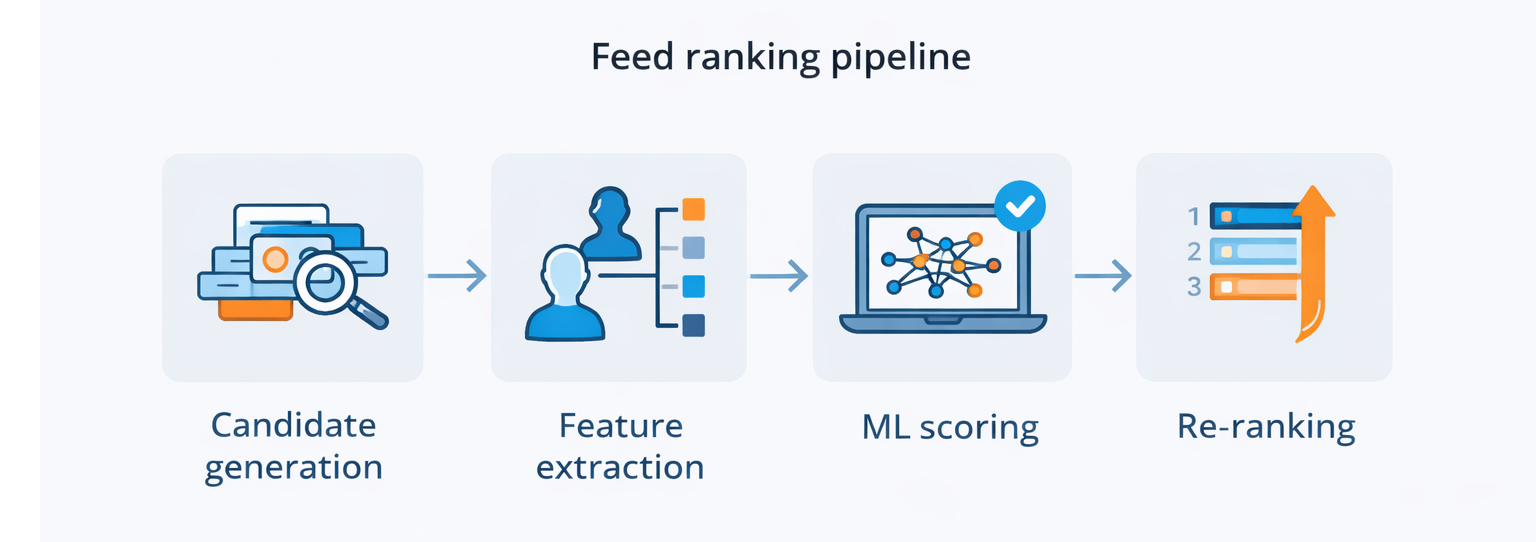
The feed read path is where latency matters most. Successful designs emphasize aggressive caching using in-memory stores and graph databases, with fallbacks to persistent storage when necessary. Stories introduce additional constraints, such as expiration windows and heavy use of CDNs for media delivery.
Throughout your explanation, interviewers expect you to compare fan-out-on-write versus fan-out-on-read approaches, explain how duplicates are avoided, and articulate how freshness is balanced against performance.
Key architectural trade-offs in Meta feed systems#
Design decision | Option A | Option B | Meta-style reasoning |
Feed generation | Fan-out on write | Fan-out on read | Hybrid approach at scale |
Ranking | Precomputed | Real-time | Precompute + lightweight re-ranking |
Caching | Shallow | Multi-layer | Heavy Redis + in-memory |
Freshness | Strong | Eventual | Eventual with freshness bias |
Storage | Monolithic | Sharded | User/edge-based sharding |
What’s the architecture for an API layer to Meta’s Chat?#
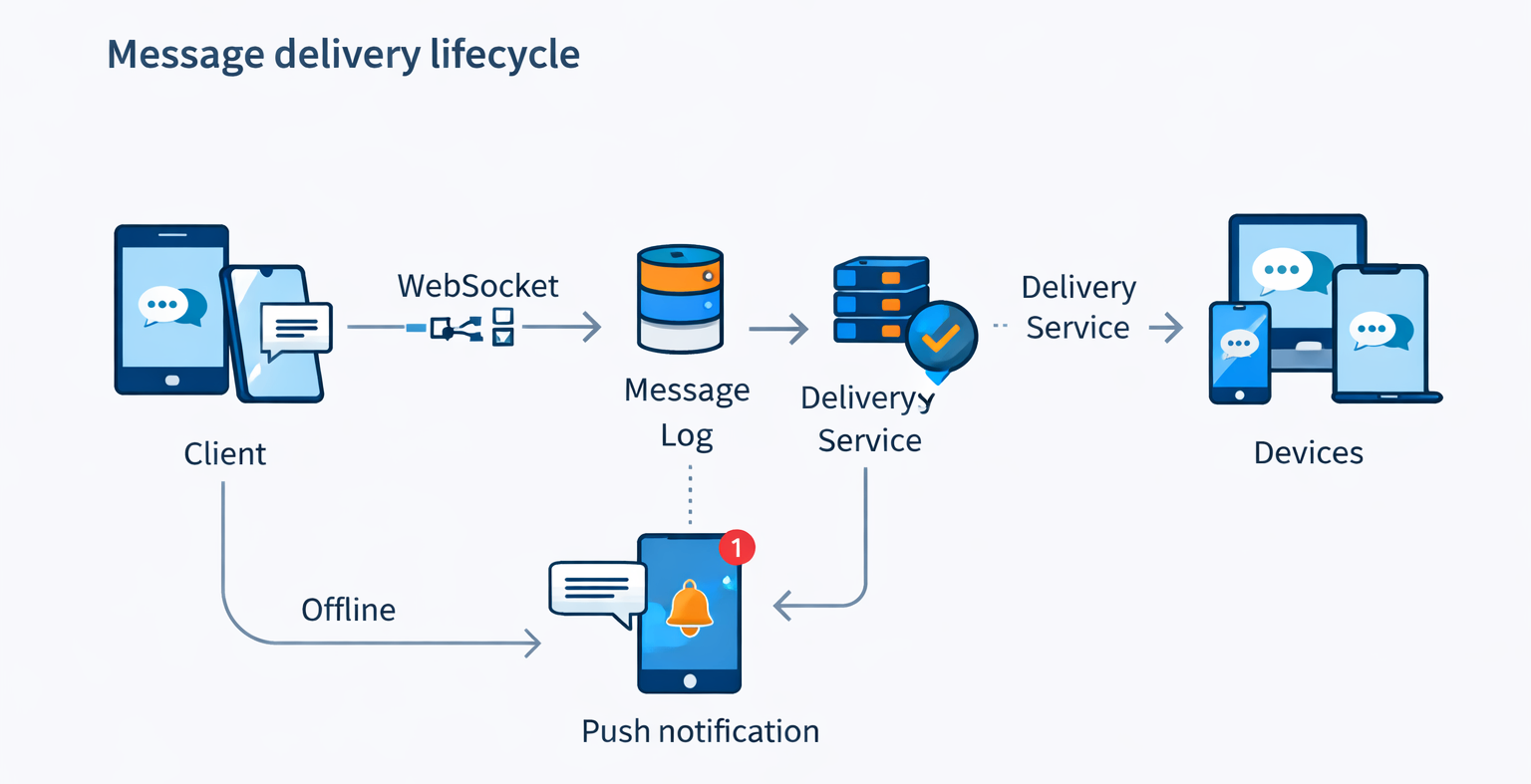
Meta’s chat systems, including Messenger and Instagram DMs, operate at an enormous real-time scale. This question tests your ability to design reliable, low-latency systems that support millions of concurrent connections.
A strong answer begins by explaining how persistent connections are established using technologies like WebSockets or similar protocols. These connections allow bidirectional communication between clients and servers, which is essential for real-time messaging.
Components to highlight#
WebSockets or MQTT for persistent connections
Presence service (online/offline detection)
Message store with write-ahead logs for durability
Delivery service to push messages to online devices
Push notification service for offline users
Load balancers + region failover
Messaging system requirements vs solutions#
Requirement | Design choice |
Real-time delivery | Persistent connections (WebSockets) |
Ordering | Per-conversation sequencing |
Reliability | Write-ahead logs |
Multi-device sync | Device fan-out |
Offline users | Push notifications |
Abuse prevention | Rate limits + spam classifiers |
Global availability | Region-aware routing |
Meta-specific topics worth mentioning#
Meta uses Pulsar-like or Kafka-like systems for logs and streams, so referencing distributed logs is a plus.
Also mention:
Sticky sessions (user tied to a chat server instance)
Multi-device synchronization
Anti-abuse & spam detection layers
The interviewer wants to see if you can handle reliability, ordering guarantees, and large-scale fan-out.
System Design Deep Dive: Real-World Distributed Systems

Modern software systems are expected to operate at a massive scale while meeting strict reliability and latency requirements. Whether it’s a feed refresh, a payment request, or a real-time analytics query, users expect systems to respond instantly and consistently. That expectation has raised the bar for engineers today, understanding that System Design isn’t optional. It’s a core skill for building and evaluating production-grade systems. I built this course from my experience working on large-scale distributed systems at Microsoft (Azure) and Meta (Scuba), and from interviewing hundreds of candidates across both companies. The pattern I kept seeing was this: candidates understood individual components, but struggled to combine them into a coherent system. They knew what a cache or load balancer was, but not when or why to use it. This course is designed to bridge that gap. We start with the foundational building blocks of System Design, including databases, caching layers, load balancing, and messaging systems, and focus on how they interact under real-world constraints. From there, we analyze systems built by companies like Google, Facebook, and Amazon, breaking them down to understand the trade-offs behind each design decision. The goal is not just to learn concepts, but to develop the ability to reason through them in practice. This approach has helped a large number of engineers build stronger intuition for System Design and perform better in interviews. If you want to understand how real systems are designed and be able to design them yourself, this course gives you a clear, practical path forward.
How would you design Meta’s notification system?#
Meta’s notification systems combine real-time signals with delayed, digest-style updates. This makes them an excellent test of event-driven architecture and large-scale fan-out.
A strong answer explains how billions of events flow through an ingestion pipeline built on message queues and stream processors. From there, a notification generation service applies rules, filters, and personalization logic to determine which notifications should be sent.
Notifications must be deduplicated and rate-limited to avoid overwhelming users. They also need to respect user preferences, time zones, and quiet hours. The storage layer must support extremely read-heavy access patterns from mobile clients.
Finally, the delivery layer integrates with platform-specific services such as APNs and FCM, as well as in-app notification APIs. If you discuss idempotency, retry logic, and delivery guarantees, you signal senior-level awareness.
What’s the approach to designing Meta’s recommendation system?#
Recommendation systems at Meta are less about drawing boxes and more about demonstrating an understanding of ranking pipelines and ML infrastructure.
A solid answer describes how user interactions are ingested continuously and transformed into features stored in a feature store. These features feed training pipelines that produce models used for ranking and personalization.
At serving time, the system performs candidate generation to retrieve a broad set of potentially relevant items. These candidates are then ranked and re-ranked using increasingly sophisticated models to optimize engagement and relevance.
Meta interviewers appreciate it when candidates clearly distinguish between the recall layer and the precision layer. Discussing vector similarity search, embedding freshness, and real-time updates further strengthens your answer.
How would you design a real-time analytics system for ads?#
Meta’s advertising systems operate under extremely tight SLAs because delays translate directly into lost revenue. This question tests your ability to design high-throughput streaming systems.
A strong answer begins with event ingestion. Billions of impressions, clicks, and conversions flow into distributed log systems. Stream processors then aggregate these events using windowed operations to compute metrics such as CTR and CPM.
Hot storage systems enable near-real-time queries for dashboards, while cold storage supports long-term analysis and reconciliation. A robust design includes both real-time and batch pipelines to balance speed and accuracy.
Interviewers want to hear about throughput estimation, backpressure handling, and recovery from partial failures. Dual-pipeline designs often stand out as particularly strong.
What’s the architecture for a live video streaming platform?#
Live video systems at Meta require ultra-low latency while serving massive global audiences. This question tests your understanding of media pipelines and content delivery.
A strong answer explains how video is ingested through protocols like RTMP or WebRTC, transcoded into multiple resolutions, and distributed via CDNs. Replay buffers enable features like rewinding live streams.
You should also discuss how comments and reactions are handled in parallel pipelines and how the system balances latency against reliability. Addressing push-based versus pull-based distribution shows architectural maturity.
How would you design Meta Live’s comments feature?#
Live comments are among the most write-heavy features Meta operates. This question tests your ability to design systems optimized for write throughput and low latency.
A strong answer describes a real-time pub/sub system that broadcasts comments to both the broadcaster and viewers. Comments are stored in sharded stores with aggressive in-memory caching for recent activity.
Spam filtering and rate limiting are essential to maintain quality. Ordering guarantees are typically best-effort, relying on timestamps and server ordering. Interviewers look for explicit latency targets and global distribution awareness.
Comment system constraints#
Constraint | How Meta handles it |
Write-heavy traffic | Sharded stores |
Low latency | In-memory pub/sub |
Spam | Rate limiting |
Ordering | Best-effort |
Global viewers | Fan-out optimization |
What’s the design for a content moderation system at scale?#
Content moderation is one of Meta’s most complex systems, touching engineering, ML, compliance, and ethics. Interviewers are especially impressed by thoughtful answers here.
A strong response describes a pipeline that ingests content, performs hashing for deduplication, and applies AI-based classification using NLP, vision, and audio models. Rule-based filters enforce community standards and legal requirements.
Human review tools handle escalations and appeals, while audit logs ensure traceability. Finally, feedback loops feed model retraining. Discussing latency tiers and regional policy differences demonstrates deep understanding.
Interviewer expectations#
Think in terms of latency tiers:
Real-time blocking (e.g., hate speech)
Async reviewing (nudity detection)
Add regional restrictions and policy variations across countries.
This is one of the most impressive Meta System Design interview questions to answer well because it touches engineering, ML, compliance, and ethics.
Final thoughts#
Excelling in Meta’s System Design interview is not about memorizing architectures. It’s about recognizing recurring patterns and applying them thoughtfully. Meta consistently tests candidates on real-time pipelines, fan-out strategies, ranking systems, caching hierarchies, distributed logs, and global reliability.
If you can explain these systems clearly, justify your trade-offs, and tie technical decisions back to user experience and engagement, you won’t just pass the interview. You’ll sound like someone already operating at Meta’s scale.